Abnormal Psychology
 Note
Note Call Kai
 Learn
Learn Practice Test
 Spaced Repetition
 Match
Match Flashcards
 Knowt Play
1/7

There's no tags or description
Looks like no tags are added yet.
Name | Mastery | Learn | Test | Matching | Spaced | Call with Kai | Chat |
|---|
No analytics yet
Send a link to your students to track their progress
8 Terms
what is abnormal behaviour?
statistical infrequency
violation of norms
personal distress
impairment or disability
unexpectedness

impairment vs disability
impairment: describes underlying condition, doesn’t imply limits
disability: alters capacity to meet demands because of the impairment (gap between ability and requirements placed by environment.)
phrenology (franz joseph gall), tenets of system:
brain is the organ of the mind, mind is composed of distinct innate faculties, and since they’re distinct, each must have its own organ in the brain.
the size of an organ is a measure of its power.
the skull’s surface can be read as index of psychological aptitudes and tendencies.
broca’s aphasia: paul broca (1861) and patient “tan”
language disorder: comprehension intact, production affected
all tan would say was “tan” → but understood words, gestures, actions
lesion in BROCA’S AREA (inferior left frontal lobe)
WERNICKE’S APHASIA: Karl Wernicke (1876)
fluid speech production, impaired comprehension (nonsensical speech)
lesion in medial temporal lobe
EXECUTIVE DISORDER: Dr. John Harlow & Phineas Gage
frontal lobe is responsible for e.g. personality and behaviour, also prosocial behaviour and interpersonal behaviour
executive functioning: everything that makes us goal-directed, future-oriented
rod went through the skull, seen by Dr., “Gage was no longer Gage”

the BIRTH of NEUROPSYCHOLOGY: Norman Geshwind
neurologist, brought back to biological understanding of abnormality
kept logs of WWII victims → where they had head physical trauma, did puzzles to test cognition
clock drawing → visual neglect: nothing wrong with your eyes, contralateral issue with reception of visuals
something amiss in PARIETAL lobe
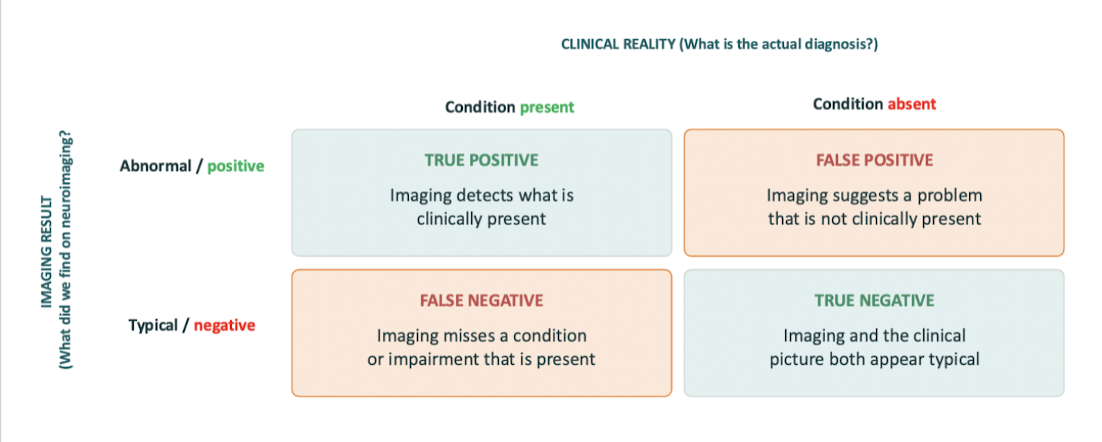
signal detection theory
false positives & false negatives in imaging results