CBT 4
 Call Kai
 Learn
 Practice Test
 Spaced Repetition
 Match
 Flashcards
 Knowt Play
1/23

There's no tags or description
Looks like no tags are added yet.
24 Terms
true
After listening to the patient’s problem, the therapist uses the CBT triangle to identify negative thoughts, emotions, and behaviors and helps the patient distinguish between them. ✅❌
automatic interpretations, beliefs, and assumptions that arise in response to internal or external events.
They are often habitual, rapid, and shaped by prior learning and life experiences.
They help us make sense of situations and can be
verbal (words, sentences, and explicit ideas)
non-verbal (mental images).
They are the running commentary we hear in our minds throughout life.
In CBT, what are thoughts, and what forms can they take?
often focus on identifying automatic thoughts and examining their
accuracy,
flexibility,
functional impact.
What do CBT interventions focus on when examining automatic thoughts?
the physiological changes that occur as a result of emotion.
Examples include:
facial flushing with anger
a pounding heart or tense muscles with anxiety.
Feelings are described as the hard-wired physical manifestation of emotion.
In the lecture’s CBT framework, what are feelings, and what are examples of their physiological manifestations?
true
Emotional responses depend on how situations are interpreted rather than on the events themselves; therefore, similar circumstances may produce different emotional reactions depending on the meaning assigned to them. ✅❌
true
Feelings are described as the hard-wired physical manifestation of emotion. ✅❌
Behaviors are actions taken or avoided in response to thoughts and emotions.
Common responses to emotional distress include:
avoidance, withdrawal,
reassurance-seeking,
compensatory overactivity.
CBT behavioral strategies aim to introduce alternative responses that support adaptive coping and psychological flexibility.
In CBT, what are behaviors, what are common responses to emotional distress, and what do behavioral strategies aim to achieve?
true
In CBT, a situation leads to thoughts that generate feelings, which influence behaviors that can affect the situation positively or negatively. This cyclical process demonstrates the interconnectedness of thoughts, feelings, behaviors, and situations. ✅❌

How can the cognitive triangle help change negative thoughts, feelings, and behaviors (example)?
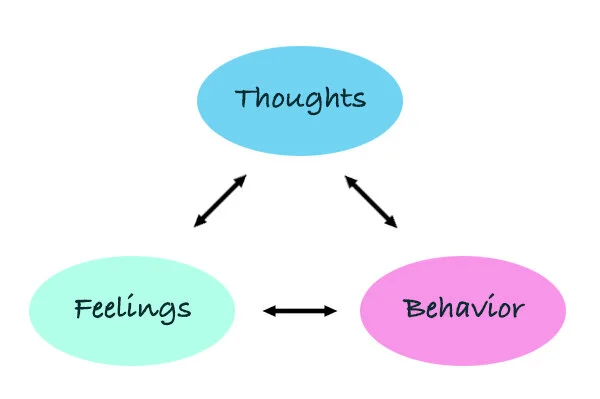
Thoughts influence feelings, which affect behaviors.
What are the three components of the CBT triangle
true
thoughts, feelings and behaviors are interconnected, and each can influence the others. Negative or unhelpful thoughts may contribute to harmful feelings and maladaptive behaviors. ✅❌

How can the CBT triangle be applied to change an unhelpful response? Give the job example.
HOW THOUGHTS IMPACT FEELINGS AND BEHAVIORS
Terry expected the networking event to be useless and believed no one would consider her for a job. She felt depressed, heavy, and exhausted, then decided not to attend. Later, she thought she had wasted the day and would never find a job. Which CBT component initially influenced the others?
HOW BEHAVIORS IMPACT THOUGHTS AND FEELINGS
Albie experiences panic symptoms in class, escapes to the bathroom or returns home, and misses lectures. Falling behind increases his panic, and he fears losing control during an attack. Which CBT component initially influenced the others?
Feelings. Joni’s sadness affected how she viewed her job and relationship, contributing to negative thoughts and withdrawal behaviors.
Joni feels sad after learning that her close friend has a debilitating disease. She then develops negative thoughts about her job and relationship, withdraws from work activities, and becomes distant from her partner. Which CBT component initially influenced the others?
Automatic thoughts are interpretations, predictions, or beliefs about a situation,
whereas emotions are the emotional responses associated with it.
For example, “I’m going to fail” is a thought, while anxiety is an emotion.
How do automatic thoughts differ from emotions in CBT?
Therapists can gently ask, “If that feeling could speak, what might it be saying?”
They can also explore what the client feared, expected, pictured, or believed the situation meant.
How can therapists help clients identify automatic thoughts when they report only an emotion?
use it to identify automatic thoughts,
explore emotional reactions in context,
examine behaviors that maintain distress,
introduce individualized cognitive and behavioral strategies.
Intervention can begin with thoughts, feelings, or behaviors because changing one component can influence the others.
How is the CBT triangle used in therapy, and where can intervention begin?

HOW TO USE THE CBT TRIANGLE WITH CLIENTS?
Reassurance and rehearsing provide short-term relief, but the belief that private meetings signal danger continues.
A manager asks an employee to speak privately. The employee thinks, “I’m in trouble,” feels anxious, and repeatedly rehearses explanations and seeks reassurance. What maintains the employee’s belief that private meetings signal danger?
Avoiding the task reduces progress and creates more apparent evidence supporting the negative thought.
A person fails to complete a planned task, thinks, “I never follow through,” feels shame and low energy, and avoids the task for the rest of the day. How does this behavior reinforce the automatic thought?
Becoming distant reduces the sense of connection in the relationship, reinforcing the interpretation that the friend does not want to talk.
A friend gives a brief reply. A person thinks, “They don’t want to talk to me,” feels hurt, and becomes distant. How can this behavior reinforce the original interpretation?
true
The CBT triangle is important because it explains how psychological distress can become self-reinforcing when thoughts, feelings, and behaviors repeatedly influence one another, allowing distress to persist even when circumstances change. ✅❌
true
The CBT triangles important because it helps clinicians understand mental health challenges by identifying interactional patterns and targeting factors that maintain distress rather than addressing symptoms in isolation. ✅❌