General Immunology
 Call Kai
 Learn
 Practice Test
 Spaced Repetition
 Match
 Flashcards
 Knowt Play
1/14

There's no tags or description
Looks like no tags are added yet.
15 Terms
Mechanism of acquired immunity

Super antigen

Antibody formation

IgG
It is a monomer with the following functions:
Most abundant immunoglobulin in serum (~75%).
Fixes complement
Crosses the placenta and gives immunity to baby
Types IgG 1,2,3,4

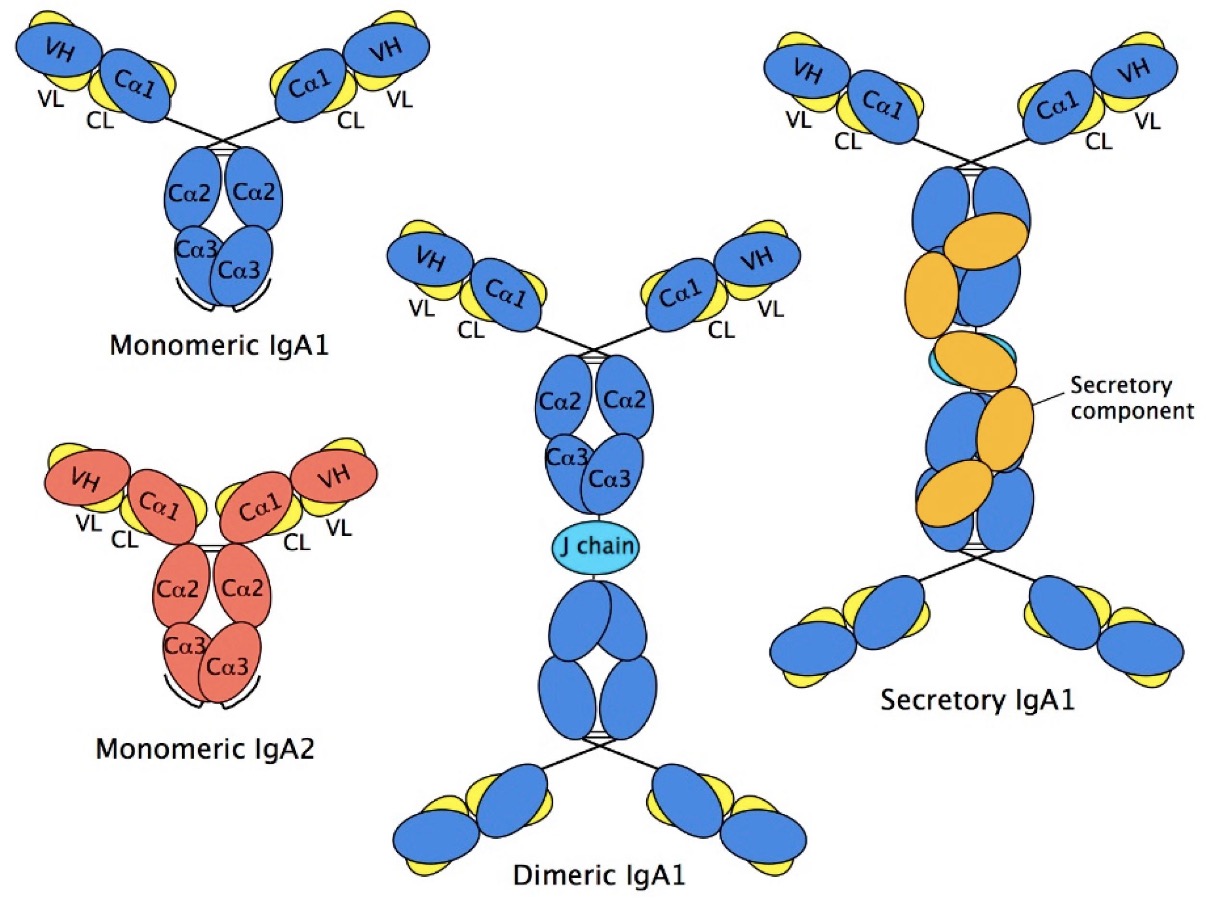
IgA
Serum IgA and Secretory IgA
Found in secretions.
Present in saliva, tears, breast milk and mucus.
Provides mucosal immunity.
Usually a dimer in secretions.
IgE
Monomer
Responsible for type I hypersensitivity.
Involved in allergic reactions.
Important in defence against helminths.
Binds to mast cells and basophils.

IgD
Present on the surface of naïve B lymphocytes.
Acts as a B-cell antigen receptor.
Involved in B-cell activation.

IgM
Pentameter
First antibody produced in primary immune response.
Pentamer in serum.
Best activator of complement.
Does not cross placenta.

What is Type I hypersensitivity? Give examples.
Allergic / IgE-mediated. Allergic rhinitis, allergic bronchitis, ABPA, anaphylaxis.
What is Type II hypersensitivity? Give examples.
Cytotoxic. Blood transfusion reaction, AIHA, Goodpasture syndrome.
What is Type III hypersensitivity? Give examples.
Immune complex-mediated. Glomerulonephritis, rheumatoid arthritis, Arthus reaction, serum sickness.
What is Type IV hypersensitivity? Give examples.
Delayed / cell-mediated. Mantoux test, lepromin test, Type I lepra reaction, contact dermatitis.
What are the types of immune response in graft rejection?
Hyperacute – Type II; Acute – Type IV; Chronic – Type IV.
What is the immune mechanism of GVHD?
Cell-mediated immunity (Type IV).
In which transplants is GVHD commonly seen?
Bone marrow allograft and thymus allograft.