Biology Chemistry: Bonds, Water, Biomolecules, and Proteins
 Call Kai
 Learn
Learn Practice Test
 Spaced Repetition
 Match
Match Flashcards
 Knowt Play
1/51

There's no tags or description
Looks like no tags are added yet.
Name | Mastery | Learn | Test | Matching | Spaced | Call with Kai | Chat |
|---|
No analytics yet
Send a link to your students to track their progress
52 Terms
Covalent bond
A chemical bond formed when two atoms share one or more pairs of electrons (e.g., the bonds within H2O or CO2).
Electron
A negatively charged subatomic particle found outside the nucleus; electrons in the outer shell (valence electrons) determine how an atom bonds.
Electronegativity
A measure of how strongly an atom attracts shared electrons in a bond. Unequal sharing (e.g., O vs. H) creates polar covalent bonds.
Element
A pure substance made of only one type of atom that can't be broken down chemically; defined by its number of protons.
Ion
An atom or molecule with a net electrical charge because it has gained or lost electrons.
Ionic bond
An attraction between oppositely charged ions, formed when one atom transfers electrons to another (e.g., Na+ and Cl- in NaCl).
Molecule
Two or more atoms held together by covalent bonds.
Neutron
An uncharged (neutral) subatomic particle in the nucleus with a mass of about 1 amu; different numbers of neutrons make isotopes.
Proton
A positively charged subatomic particle in the nucleus with a mass of about 1 amu; the number of protons determines the element.
Adhesion
The attraction between water molecules and molecules of a different substance (e.g., water sticking to xylem walls).
Cohesion
The attraction between molecules of the same substance; water molecules stick together because of hydrogen bonding.
Hydrogen bond
A weak attraction between a partially positive hydrogen (covalently bonded to O, N, or F) and a partially negative atom on another molecule or part of a molecule.
Polar
Describes a molecule or bond with an uneven distribution of charge, giving partially positive and partially negative ends (e.g., water).
Hydrophilic
'Water-loving'; polar or charged substances that are attracted to and dissolve in water.
Hydrophobic
'Water-fearing'; nonpolar substances that don't mix with or dissolve in water (e.g., oils, fats).
Surface tension
The resistance of a liquid's surface to being broken, caused by cohesion; lets water striders walk on water.
Monomer
A small, single building-block molecule that can bond with others to form a polymer (e.g., amino acid, nucleotide, monosaccharide).
Polymer
A large molecule made of many repeating monomers linked together by covalent bonds.
Polymerization
The process of joining monomers together to form a polymer.
Dehydration synthesis
A reaction that joins two monomers by forming a covalent bond and releasing a molecule of water (builds polymers).
Hydrolysis
A reaction that breaks the covalent bond between monomers by adding a molecule of water (breaks down polymers).

Monosaccharide
A simple sugar and the monomer of carbohydrates (e.g., glucose, fructose, galactose)

Polysaccharide
A large carbohydrate polymer made of many monosaccharides joined by glycosidic bonds (e.g., starch, glycogen, cellulose).

Starch
A polysaccharide of glucose used for energy storage in plants.
Cellulose
A polysaccharide of glucose that forms the structural component of plant cell walls; it is not easily digested by most animals.
Glycerol
A 3-carbon alcohol that forms the backbone of fats and phospholipids.
Fatty acid
A long hydrocarbon chain with a carboxyl group at one end; a building block of fats and phospholipids.
Saturated fatty acid
A fatty acid with no C=C double bonds, so it is 'saturated' with hydrogens; straight chains pack tightly and are usually solid at room temperature.
Unsaturated fatty acid
A fatty acid with one or more C=C double bonds, creating kinks that prevent tight packing; usually liquid at room temperature.
Phospholipid
A lipid made of a glycerol, two fatty acid tails (hydrophobic), and a phosphate group head (hydrophilic); forms the bilayer of cell membranes.
Fat
A lipid (triglyceride) made of one glycerol bonded to three fatty acids; used for long-term energy storage and insulation.
Steroid
A lipid made of four fused carbon rings (e.g., cholesterol, estrogen, testosterone).
Cholesterol
A steroid lipid found in animal cell membranes that helps regulate membrane fluidity; also a precursor for steroid hormones.
DNA
Deoxyribonucleic acid; a double-stranded nucleic acid with deoxyribose sugar that stores genetic information (bases A, T, G, C).
RNA
Ribonucleic acid; a usually single-stranded nucleic acid with ribose sugar that helps carry out gene expression (bases A, U, G, C).
Nucleotide
The monomer of nucleic acids, made of a 5-carbon sugar, a phosphate group, and a nitrogenous base.
Nitrogenous base
The nitrogen-containing part of a nucleotide that carries genetic information; either a purine (A, G) or pyrimidine (C, T, U).
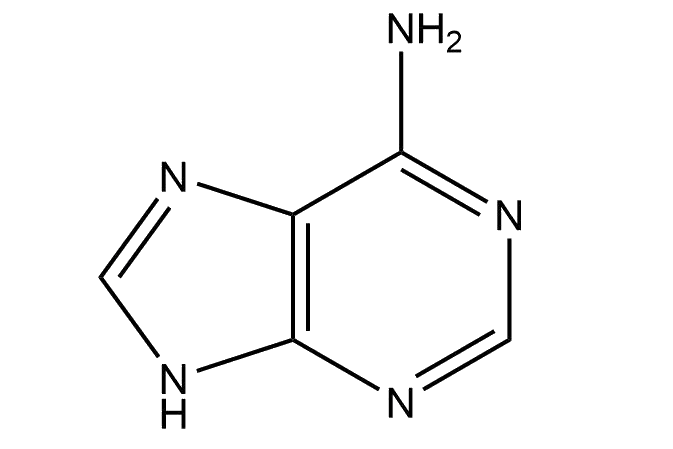
Adenine
A purine base found in DNA and RNA; pairs with thymine in DNA (2 hydrogen bonds) and uracil in RNA.
Guanine
A purine base found in DNA and RNA; pairs with cytosine (3 hydrogen bonds).
Cytosine
A pyrimidine base found in DNA and RNA; pairs with guanine (3 hydrogen bonds).

Thymine
A pyrimidine base found only in DNA; pairs with adenine (2 hydrogen bonds).
Uracil
A pyrimidine base found only in RNA; replaces thymine and pairs with adenine.
5' phosphate end
The end of a nucleic acid strand where the 5' carbon of the sugar has a free phosphate group; new nucleotides are never added here.
3' hydroxyl end
The end of a nucleic acid strand where the 3' carbon of the sugar has a free hydroxyl (-OH) group; new nucleotides are added here during synthesis.
Peptide bond
A covalent bond between the carboxyl group of one amino acid and the amine group of the next, formed by dehydration synthesis.
Carboxyl group
A functional group (-COOH) at the C-terminal end of an amino acid; acts as an acid.
Amine group
A functional group (-NH2) at the N-terminal end of an amino acid; acts as a base.
R group
The variable side chain of an amino acid that gives it unique chemical properties (polar, nonpolar, charged); determines how a protein folds.
Primary structure
The linear sequence of amino acids in a polypeptide chain, held together by peptide bonds.
Secondary structure
Local folding of the polypeptide into alpha helices and beta pleated sheets, stabilized by hydrogen bonds between backbone atoms.
Tertiary structure
The overall 3D shape of a single polypeptide, determined by interactions among R groups (hydrogen bonds, ionic bonds, hydrophobic interactions, disulfide bridges).
Quaternary structure
The arrangement of two or more polypeptide chains into one functional protein (e.g., hemoglobin).