lecture 32 - skeletal muscle physiology - part 2
 Call Kai
 Learn
 Practice Test
 Spaced Repetition
 Match
 Flashcards
 Knowt Play
1/27

There's no tags or description
Looks like no tags are added yet.
28 Terms
motor unit
somatic motor neuron + all the muscle fibres it serves
muscles that are small + control fine motor movements have ____ fibres per motor unit
less (e.g. 10-20 muscle fibres in eye per motor unit)
muscles that are large + control gross motor movements have ____ fibres per motor unit
more (e.g. 2000-3000 in leg per motor unit)
true or false: every somatic motor neuron will ONLY innervate 1 fibre type
true
motor unit summation
signal sent thru 1 motor unit = 1 set of muscle fibres contracting
more force = recruiting more motor units

maximal contraction
all motor units of a muscle recruited
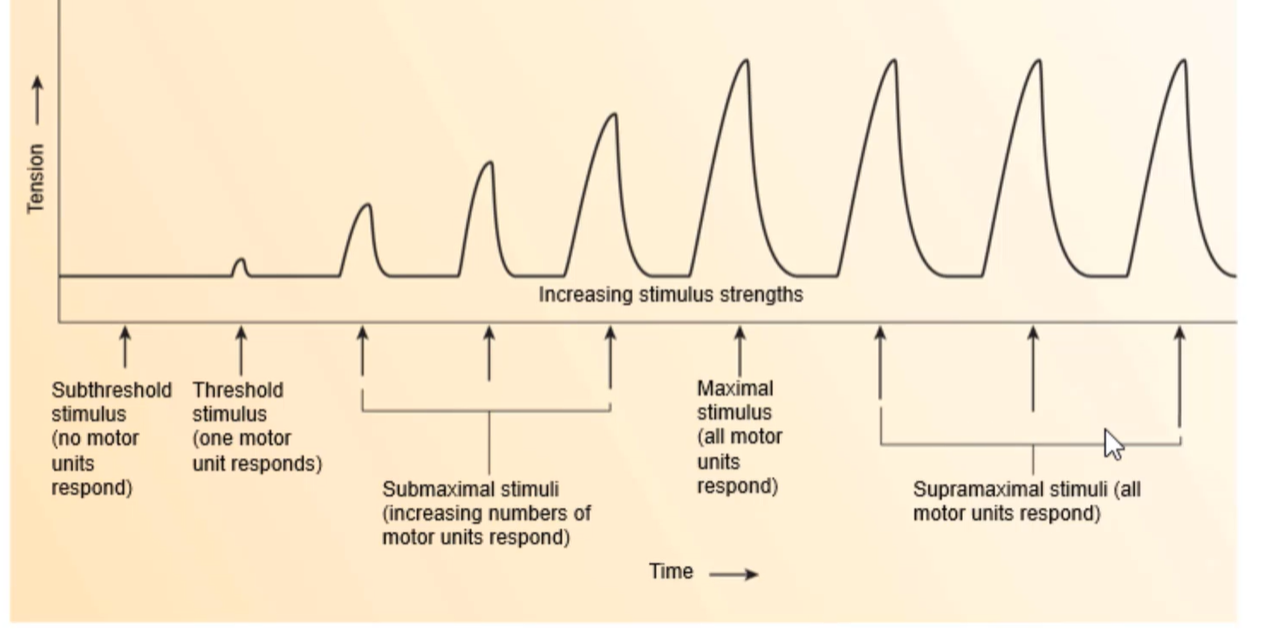
asynchronous recruitment
alternating b/w which motor units are doing work during muscle contraction (to allow some motor units to rest while others take over temporarily)

true or false: we tend to recruit the strongest muscle fibres first before the weaker ones
false: we tend to recruit muscle fibres that are weaker first, then the stronger muscle fibres as tension/stimulus increases

threshold stimulus
produces a weak contraction from single motor unit
a muscle under maximal stimulus can contract for a short/long time
short
true or false: over the course of your lifespan, the # of muscle fibres you have DOES NOT change
true
why are some people able to generate stronger contractions than others?
more myofibrils (actin, myosin) within each muscle fibre = more sarcomeres = more contraction
2 types of contractions
isometric
isotonic
isometric contractions
length of muscle doesn’t change, but tension increases
e.g. pushing against a wall
isotonic contractions
tension produced is constant but length of muscle changes
2 types
2 types of isotonic contractions
concentric contraction
eccentric contraction
concentric contraction
type of isotonic contraction
muscle shortens when tension overcomes resistance
eccentric contraction
type of isotonic contraction
muscle lengthens when resistance overcomes tension
e.g. tug of war where other team is stronger → you get pulled in the opposite direction, even though you’re pulling as hard as you can
3 fibre types
type I
type IIa
type IIx
type I muscle fibres
slow twitch/high oxidative/slow oxidative (SO)
slow ATPase
smaller in diameter
more mitochondria
can make lots of ATP
better blood supply (more capillaries surrounding type I fibres)
fatigue resistant (endurance → can contract for long times but not with much force)
2 isoforms of ATPase
fast ATPase (breaks down ATP fast)
slow ATPase (breaks down ATP slow)
type IIa muscle fibres
fast twitch/low oxidative/fast oxidative-glycolytic (FOG)
fast ATPase
larger in diameter than type I (can make stronger contractions)
less mitochondria than type I
less blood supply than type I
less aerobic capacity (easier to get tired) than type I
type IIx muscle fibres
fast glycolytic (FG)
largest/strongest muscle fibres
fewest mitochondria
least blood supply
lowest aerobic capacity (gets tired quickest)
true or false: within a muscle, you only have one fibre type
false; you will have different fibre types depending on the job of that muscle
in the quadriceps muscle, what % of muscle fibres is type I and II?
50% each
in our postural muscles, do we have a higher % of type I or II fibres?
I
true or false: you can change type I fibres into type II fibres by training
FALSE
true or false: you can change type IIa fibres into type IIx fibres by training
true