FMI CH1
 Call Kai
 Learn
 Practice Test
 Spaced Repetition
 Match
 Flashcards
 Knowt Play
1/15

There's no tags or description
Looks like no tags are added yet.
16 Terms
What are the 4 functions of money ?
Means of exchange: serve as an intermediary good in transactions
Investment: It becomes mean to save
Unit of account: Valuations and relative value between goods are expressed in money
Standard use for future payments: Its use is not limited to exchanges at a given moment in time
Name other factors that make money useful
Value in comparison to its weight (low production cost
Durable
Divisible (without loss of value)
Standardised quality
Easily recognisable
Stable purchasing power
Whats barter trade ?
Trade that is based on exchange of goods and services, not money
What is fiat money ?
A government-issued currency declared as legal tender that is not backed by a physical commodity like gold or silver.
What is fiduciary money ?
Money that derives its value from public trust and confidence in the issuer or payment system rather than from intrinsic commodity value
What are the 3 main forms/shapes of money
1) Paper money and coins = currency
2) Sight deposits (zichtrekeningen)
3) E-money (digital alternative to physical cash that stores monetary value electronically—on a card, a mobile device, or a server—for making cashless payments.)
What are the 3 money concepts ? (M1, M2 & M3)
M1 (money that can be used immediately) = physical cash and funds + deposits held by non banks that can be withdrawn immediately
M2 (“near money) = M1 + deposits w/ maturity <2 years + deposits refundable within notice period <3 months
M3 (“near near money”) = M2 + repurchase agreements + money market fund shares + money market paper + debt securities =< 2 years
Repurchase agreements = Short-term, collateralized loans where a bank sells a security to an investor and agrees to buy it back—often the next day—at a slightly higher price.
Money market fund shares = Shares in investment funds that pool cash to buy very safe, short-term debt (like Treasury bills).
Money market paper = Short-term, tradable IOUs issued by banks and financial institutions
Debt securities =< 2 years = Short-term bonds or notes issued by Monetary Financial Institutions (MFIs) that mature in 2 years or less.
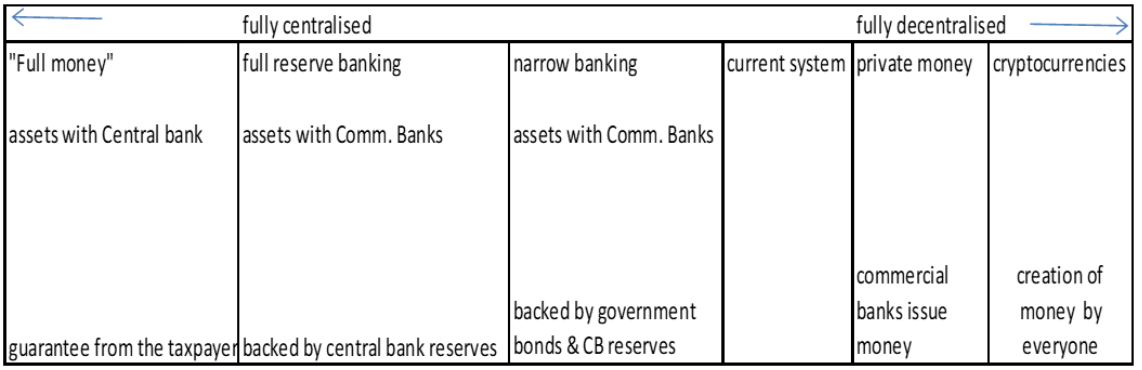
What is a full money system ?
All money people have at banks is 100% backed by reserves at the central bank → makes bank runs impossible
What is full reserve banking ?
All money people have at banks is 100% backed by reserves at a commercial bank → makes bank runs impossible
What is narrow banking ?
Money at the bank is backed by commercial banks and with the government as well. The commercial banks require a reserve ratio
What is fractional reserve banking ?
(= our current system): A banking system where banks keep only a small fraction of customer deposits as liquid reserves (cash in vaults or balances at the central bank) and lend out the rest
Graph of al monetary systems
What’s the formula for total money supply M and for base money B ?
M = m (money multiplier) x B (base money)
B = CP (currency in circulations) + R (bank reserves)
Draw the balance sheet from the ECB (simplified)
International reserves = Foreign-currency assets held by the Eurosystem
Claims = Domestic financial assets representing what euro-area institutions owe the ECB
Currency = physical banknotes
Bank reserves = Electronic balances that commercial banks hold in their accounts at the ECB

What’s reserve ratio rr ?
The percentage of customer deposits that a commercial bank holds as reserves—either as physical cash in its vaults or as electronic balances at the central bank—rather than lending out

What is the money multiplier m ?
It’s the ratio that measures how much the broader money supply (M) expands for every €1 of base money (B)
