Term 4 - 2.3 Biogeochemical Cycles
 Call Kai
 Learn
 Practice Test
 Spaced Repetition
 Match
 Flashcards
 Knowt Play
1/49

There's no tags or description
Looks like no tags are added yet.
50 Terms
2.3.1 Introduction (4)
2.3.1 Introduction:
Biogeochemical cycles are closed systems
Biogeochemical cycles insure the natural processes that recycle nutrients in various chemical forms from the environment to organisms and then back to the environment
Biogeochemical cycles ensure chemical elements continue to be available to living organisms
Elements move through biotic (living) and abiotic (non-living) components of ecosystems via flows that involve transfers and transformations
2.3.6 Stores, Sinks, and Sources of Carbon (3)
2.3.6 Stores, Sinks, and Sources of Carbon:
Ecosystems play a crucial role in the global carbon cycle by acting as stores, sinks, or sources of carbon
The balance between carbon inputs (such as photosynthesis) and outputs (such as respiration) determines whether an ecosystem accumulates or releases carbon
Understanding these dynamics helps in managing ecosystems to mitigate climate change
2.3.6 Tree Growth and Forest Ecosystems (1 + 2, 1 + 2, 1 + 3)
2.3.6 Tree Growth and Forest Ecosystems:
Photosynthesis:
Trees and other vegetation absorb CO₂ from the atmosphere during photosynthesis
CO₂ is converted into organic compounds, such as glucose, which are used to build plant tissues
Biomass Storage:
The carbon absorbed by trees is stored in their biomass, including trunks, branches, leaves, and roots
Forests act as significant carbon sinks, sequestering large amounts of CO₂ over their lifetimes
Soil Carbon:
Soils contain about 2,500 Gt of carbon, which is about three times the amount of carbon in the atmosphere
Dead plant material, such as leaves and branches, decomposes and contributes to soil organic matter
Soil stores carbon as organic matter, which can remain in the soil for long periods
2.3.2 Stores, Sinks, and Sources (4)
2.3.2 Stores, Sinks, and Sources:
Biogeochemical cycles have stores, sinks and sources
Stores (storages) remain in equilibrium with the environment
Sinks indicate net accumulation of the element
Sources indicate net release of the element
2.3.2 Stores (Storages)
2.3.2 Stores (Storages):
Stores are components of biogeochemical cycles where elements are held or stored for varying lengths of time
Forms of Stores:
Reservoirs like the ocean, soil, atmosphere, or living organisms
Examples:
Carbon stored in fossil fuels
Nitrogen in the soil
Phosphorus in sediments
Equilibrium:
When in equilibrium, stores maintain a balance with their surroundings
The rate at which elements enter and leave the store is roughly equal
2.3.2 Sinks
2.3.2 Sinks:
Sinks are parts of the cycle where there is a net accumulation of elements, meaning more of the element is absorbed or stored than released
Examples:
Forests acting as carbon sinks by absorbing more CO₂ during photosynthesis than they release through respiration
Oceans absorbing excess atmospheric CO₂
Importance:
Sinks play a crucial role in regulating the concentration of elements in the environment
They help mitigate potential imbalances
2.3.2 Sources
2.3.2 Sources:
Sources are parts of the cycle where there is a net release of elements into the environment, meaning more of the element is released from the store than absorbed or stored
Examples:
Fossil fuel combustion, which releases stored carbon into the atmosphere as CO₂
Agricultural activities that release nitrogen from the soil into the air as nitrous oxide (N₂O)
Importance:
Sources contribute to the availability of elements in different forms and locations
They can have both positive and negative impacts on ecosystems
2.3.2 Matter Flows - Transfers (1)
2.3.2 Matter Flows - Transfers:
Transfers: Transfers involve the movement of matter without changing its form. For example, the movement of water through the water cycle from precipitation to runoff and infiltration
2.3.2 Matter Flows - Transformations (1)
2.3.2 Matter Flows - Transformations:
Transformations: Transformations involve a change in the chemical nature of matter. For instance, nitrogen fixation converts atmospheric nitrogen (N₂) into ammonia (NH₃) by bacteria, making nitrogen available for plants
2.3.2 Global Carbon Cycle 1 (4)
2.3.2 Global Carbon Cycle:
Carbon is constantly moved between different stores through life processes
The carbon cycle is a natural process where carbon moves between stores and flows
The carbon cycle is maintained in dynamic equilibrium
The amount of carbon absorbed into stores is balanced by the amount of carbon released
Dead organic matter in cold forests are locked up
Cold --> less enzyme activity
Soil particles contain carbon - soils can store more carbon than gas reserves - when we dig up soil we release carbona and disturb where trees and plants grow
Largest carbon sink - the ocean
Residence time (sinks) - keeping carbon locked up
Residence time is the average period that a carbon atom remains in a store
Fossil fuels have a very long residence time - we're depleting the storage - take million years to form, but we've taken it out for 100 years
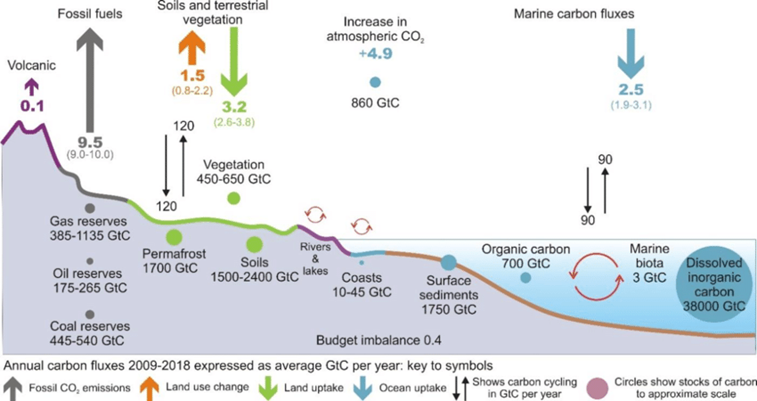
2.3.2 Global Carbon Cycle 2 (6)
Organisms: Living organisms, including plants, animals, and microorganisms, store carbon in organic molecules such as carbohydrates, lipids, proteins, and nucleic acids. These organisms take in carbon during processes like photosynthesis and release it through respiration and decomposition
Crude Oil and Natural Gas: These fossil fuels are ancient organic carbon stores formed from the remains of plants and animals that lived millions of years ago. They contain carbon in the form of hydrocarbons, which release carbon dioxide (CO₂) when burned
Soil Organic Matter: Dead plant and animal material decomposes into organic matter in soils, storing carbon for varying lengths of time depending on environmental conditions and decomposition rates
Atmosphere: Carbon dioxide (CO₂) is the primary inorganic form of carbon in the atmosphere. It is a key greenhouse gas, influencing Earth's climate by trapping heat
Soils: Inorganic carbon can be found in soils in the form of carbonates, such as calcium carbonate (CaCO₃). These compounds are formed through weathering processes and can be stable for long periods
Oceans: The oceans store large amounts of inorganic carbon in the form of dissolved CO₂, bicarbonate (HCO₃⁻), and carbonate ions (CO₃²⁻). The ocean acts as a major carbon sink, absorbing CO₂ from the atmosphere. Oceans contain around 38,000 Gt of dissolved carbon. Oceans absorb about 20% of the carbon dioxide (CO₂) released into the atmosphere each year
2.3.3 Carbon Stores
2.3.3 Carbon Stores:
Warm - more photosynthesis - there is water and sunlight - trees store large amount of carbon
Warm --> more carbon in biomass, less soil (tropical wet/moist)
Cold --> less carbon in biomass, more in soil (boreal forest)

2.3.5 Carbon Sequencing (3)
2.3.5 Carbon Sequencing:
Life processes continually move carbon between different stores in what is known as the global carbon cycle
A carbon store, or storage, is an area where carbon accumulates over time through carbon sequestration. Carbon sequestration is the process of capturing gaseous and atmospheric carbon dioxide and storing it in a solid or liquid form, thereby reducing the amount of greenhouse gases in the atmosphere
Natural processes, such as the growth of trees and the formation of fossil fuels, play a significant role in carbon sequestration
2.3.5 Importance of Carbon Sequencing (1 + 2, 1 + 2)
2.3.5 Importance of Carbon Sequencing:
Climate Regulation:
Natural carbon sequestration helps regulate the global climate by reducing atmospheric CO₂ levels
Forests and other ecosystems play a vital role in balancing the carbon cycle and mitigating the effects of climate change
Biodiversity and Ecosystem Health:
Healthy, carbon-sequestering ecosystems support diverse plant and animal species
Maintaining and restoring these ecosystems contributes to overall ecological health and resilience
2.3.7 Formation of Fossil Fuels
2.3.7 Formation of Fossil Fuels:
Organic Matter Burial:
Over millions of years, dead plants and microorganisms accumulate in sediment layers
These organic materials are buried under sediments, where they are subjected to high pressure and temperature
Fossilization:
The buried organic matter gradually transforms into fossil fuels, such as coal, oil, and natural gas
This process effectively locks away carbon in a stable, long-term form
Residence Time:
The residence time of carbon in fossil fuels is virtually unlimited, spanning hundreds of millions of years
This prolonged storage period is due to the deep burial and geological processes that preserve these carbon-rich deposits
Unlike the relatively short residence times of carbon in living organisms or the atmosphere, fossil fuels serve as long-term carbon reservoirs
2.3.3 Equilibrium and Residence Time (4)
2.3.3 Equilibrium and Residence Time:
Equilibrium: the rate of carbon absorption (input) is balanced by the rate of carbon release (output). This balance is crucial for maintaining stable levels of carbon in different reservoirs and for overall climate stability
Residence Time: the average period that a carbon atom remains in a particular store before moving to another. It is an important concept for understanding the dynamics of the carbon cycle
Short Residence Times: Carbon in the atmosphere, plants, and soils typically has short residence times, ranging from days to years. For example, carbon dioxide in the atmosphere can be taken up by plants during photosynthesis and released back through respiration relatively quickly
Long Residence Times: Carbon in fossil fuels like crude oil and natural gas has very long residence times, measured in hundreds of millions of years. These carbon stores remain stable over geological timescales unless disturbed by human activities such as mining and combustion
2.3.6 Carbon Cycle Sinks (6)
2.3.6 Carbon Cycle Sinks:
Carbon is a fundamental element for all living things
All living organisms are made of carbon
The majority of our energy needs are met through the combustion of fossil fuels (oil, coal, and natural gas)
Combustion of these fuels releases carbon dioxide (CO₂) into the environment
Places where carbon is stored are called Carbon Sinks
Oceans are the largest carbon sinks
2.3.4 Carbon Flow 1 (2)
2.3.4 Carbon Flow:
Carbon flows refer to the transfers and transformations of carbon as it moves through the carbon cycle in ecosystems
Carbon flows between stores in ecosystems by photosynthesis, feeding, defecation, cellular respiration, death and decomposition
2.3.4 Carbon Flow 2 (6)
Photosynthesis: Photosynthetic organisms absorb carbon dioxide (CO₂) from the atmosphere and convert it into organic compounds using the energy from sunlight. This process stores carbon in plant biomass and forms the basis of the food web
Cellular Respiration: Both plants and animals release CO₂ back into the atmosphere through cellular respiration, a process that breaks down organic compounds to produce energy. This is a key transformation in the carbon cycle
Defecation: Not all consumed carbon is assimilated; some is excreted as waste. This process returns carbon to the soil, where it can be used by decomposers or contribute to soil organic matter
Feeding: When animals consume plants or other organisms, they transfer the stored carbon into their own bodies. This carbon is then used for growth, energy, and reproduction, moving through the food chain
Sedimentation From aquatic environments to coal deposits, oil deposits, and natural gas deposits Organic matter settles to the floor forming sediment. Under pressure this transforms into coal deposits, oil deposits, and natural gas deposits
Death and Decomposition: When organisms die, their bodies are broken down by decomposers, such as bacteria and fungi. This decomposition process converts organic carbon back into inorganic forms, releasing CO₂ and other compounds into the soil and atmosphere
2.3.8 Human Impact on Carbon Stores (2)
2.3.8 Human Impact on Carbon Stores:
Human activities have significantly altered the natural equilibrium of carbon stores. One of the main sources of these carbon dioxide emissions is the extraction and combustion of fossil fuels
Burning Fossil Fuels: The combustion of crude oil, natural gas, and coal releases large amounts of CO₂ into the atmosphere, rapidly depleting ancient carbon stores and increasing atmospheric CO₂ levels, contributing to global warming
2.3.8 Agricultural Systems (7)
2.3.8 Agricultural Systems:
Agriculture is a human activity that disturbs the carbon cycle Agricultural systems can be carbon stores, sources, or sinks depending on farming techniques
Agriculture enhance soil’s capacity to sequester carbon
Maintain a balance between carbon inputs (plant residues, organic fertilizers) and outputs (CO₂ emissions from soil respiration)
Absorb more CO₂ from the atmosphere than they release
Achieved through practices that increase soil organic matter and enhance plant growth
Can lead to increased carbon emissions. Agriculture releases more carbon into the atmosphere than it stores in the soil
Use of fossil fuel-burning machinery contributes to emissions
2.3.8 Agricultural As a Carbon Source
2.3.8 Agricultural As a Carbon Source:
Heavy Tillage
Removes nutrients and disrupts saprotrophs
Degrades soil structure and quality
Increases soil erosion by wind and water
Monocultures:
Deplete soil of the same nutrients repeatedly
Inhibit carbon return to the soil
Draining Wetlands:
Releases stored carbon dioxide
Reduces carbon storage capacity
Wetlands support extensive plant life and decaying organic matter
Carbon Sink:
Agriculture can absorb more carbon into the soil than it releases
Regenerative agriculture restores soils as carbon sinks while producing food and materials
Crop Rotation:
Plant different crops after each harvest
Reduces soil nutrient depletion
Increases healthy soil bacteria
Reduces oxidation of organic material
Zero Tillage:
Leave organic matter in the soil to decompose
Returns nutrients to the soil
Cover Cropping:
Plant cover crops (green manure) like peas, beans, and clover
Adds nutrients and nitrogen to the soil
Improves soil fertility during fallow periods
Composting:
Mimic natural leaf decomposition
Layer carbon-rich (straw, wood chips) and nitrogen-rich (grass cuttings, waste food, manure) materials
Produces nutrient-rich loam to enhance soil quality
2.3.9 Oceans as Carbon Sink (5)
2.3.9 Oceans as Carbon Sink:
CO2 is absorbed into the oceans by dissolving and released as a gas when it comes out of solution
Oceans play a crucial role in the global carbon cycle, regulating atmospheric CO2 levels
The oceans are the largest source of liquid water on Earth, containing around 38,000 Gt of dissolved carbon
Factors such as temperature and pressure influence the release of CO2 from ocean water back into the atmosphere
This process helps maintain atmospheric CO2 balance, influences global climate, and supports marine life through photosynthesis
2.3.11 Mitigating Human Impact
2.3.11 Mitigating Human Impact:
Low-Carbon Technologies:
Transitioning to renewable energy sources such as solar, wind, hydro, and geothermal power can significantly reduce CO₂ emissions
These technologies generate electricity without burning fossil fuels, thus lowering greenhouse gas emissions and reducing dependence on non-renewable resources
Example: Solar panels convert sunlight directly into electricity, while wind turbines harness wind energy to generate power
Energy Efficiency:
Implementing energy-efficient technologies and practices in industries, transportation, and buildings reduces overall energy consumption and CO₂ emissions
Energy efficiency minimizes the demand for energy from fossil fuels, cutting down emissions and lowering energy costs
Example: LED lighting, high-efficiency appliances, and improved insulation in buildings contribute to significant energy savings
Fossil Fuel Reduction:
Reducing the burning of fossil fuels for energy production and transportation is crucial for decreasing CO₂ emissions
Lowering fossil fuel use reduces the release of greenhouse gases and mitigates climate change
Example: Promoting electric vehicles and public transportation reduces reliance on gasoline and diesel engines
Deforestation Reduction:
Preventing deforestation and promoting sustainable forest management are essential for maintaining carbon stores in forests
Forests act as significant carbon sinks, and protecting them helps preserve their carbon sequestration capacity.
Example: Implementing policies to curb illegal logging and promoting sustainable forestry practices ensure that forests continue to absorb CO₂
Reforestation:
Reforestation involves planting trees on degraded or deforested lands to restore forest cover and enhance carbon sequestration
Trees absorb CO₂ from the atmosphere and store carbon in their biomass, contributing to long-term carbon sequestration and ecosystem restoration
Example: The Bonn Challenge aims to restore 350 million hectares of deforested and degraded landscapes by 2030, enhancing global carbon sequestration efforts
Artificial Carbon Sequestration:
Artificial carbon sequestration technologies capture CO₂ emissions from industrial sources and store them underground in geological formations
This process prevents CO₂ from entering the atmosphere and contributes to reducing greenhouse gas concentrations
Example: Carbon capture and storage (CCS) involves capturing CO₂ from power plants and industrial facilities and injecting it into
2.3.12 The Lithosphere (4)
2.3.12 The Lithosphere:
The lithosphere is the outermost layer of Earth, crucial in the global carbon cycle. It involves the continuous movement of carbon between the atmosphere, biosphere, hydrosphere, and lithosphere
Fossil Fuels: Carbon is stored in fossil fuels like coal, oil, and natural gas
Rocks: Carbon is stored in rocks such as limestone
Limestone contains calcium carbonate (CaCO₃)
2.3.12 Carbon Stores in the Lithosphere
2.3.12 Carbon Stores in the Lithosphere:
Fossil Fuels:
Types: Includes coal, oil, and natural gas
Formation: Formed from the remains of ancient plants and microorganisms that were buried and subjected to heat and pressure over millions of years
Carbon Content: Fossil fuels are rich in carbon, which is released as CO₂ when they are burned for energy
Residence Time: The carbon in fossil fuels has been stored for hundreds of millions of years, locked away from the carbon cycle until extracted and combusted by humans
Carbonate Rocks:
Limestone and Dolomite: These rocks contain significant amounts of calcium carbonate (CaCO₃)
Formation: Formed from the accumulation of shell, coral, algal, and fecal debris in marine environments, or by direct precipitation from seawater
Carbon Storage: Carbonate rocks are one of the largest carbon reservoirs on Earth, storing carbon in a stable form
Residence Time: Carbon stored in carbonate rocks also has a residence time of hundreds of millions of years, making it a long-term carbon sink
2.3.14 Fossil Fuels (1)
2.3.14 Fossil Fuels:
In past geological eras, organic matter from partially decomposed plants became fossilised in coal, and partially decomposed marine organisms became fossilised in oil and natural gas held in porous rocks
2.3.14 Coal Formation
2.3.14 Coal Formation:
Source Material: Partially decomposed plant matter, primarily from ancient forests and swamps
Process:
Over millions of years, layers of plant debris accumulated in wetlands
Burial under sediments caused the organic material to undergo physical and chemical changes, transforming it into peat
Further burial and increased pressure and temperature converted peat into lignite (brown coal), then into bituminous coal (soft coal), and finally into anthracite (hard coal)
Geological Eras:
Major coal-forming periods include the Carboniferous Period (about 359 to 299 million years ago) and the Permian Period (about 299 to 252 million years ago)
2.3.14 Oil and Natural Gas Formation
2.3.14 Oil and Natural Gas Formation:
Source Material: Partially decomposed marine organisms, including plankton and algae
Process:
Organic matter from marine organisms settled on the ocean floor and mixed with sediments, forming organic-rich mud
Over millions of years, this mud was buried under additional sediments, increasing pressure and temperature
The organic material underwent chemical changes, transforming into kerogen (a waxy substance) and then into liquid oil and gaseous hydrocarbons (natural gas)
Oil and natural gas migrated through porous rocks until trapped by impermeable rock layers, forming reservoirs
Geological Eras: Significant oil and gas formation occurred during the Mesozoic Era (about 252 to 66 million years ago), particularly the Jurassic and Cretaceous periods, and the Cenozoic Era (about 66 million years ago to present)
2.3.13 Reef-Building Corals (4)
2.3.13 Reef-Building Corals:
Limestone is the biggest carbon reservoir within Earth's systems. It can be created through biological processes and non-biological processes
Both methods use a carbon form known as carbonate, which forms when carbon dioxide dissolves in the ocean and interacts with water molecules
Reef-building corals and shellfish create calcium carbonate skeletons, which can be preserved over long periods and eventually turn into limestone
Limestone serves as a significant carbon reservoir in Earth's systems. Although limestone formation frequently involves the fossilization of animal remains, it can also occur through non-biological processes, such as the precipitation of calcium carbonate from seawater
2.3.15 Methane Formation (4)
2.3.15 Methane Formation:
Methane is a powerful greenhouse gas (GHG)
Methane makes up only 0.00017% of atmospheric gases
Methane traps heat 28 times better than carbon dioxide
Methane remains in the atmosphere for 10 years until it is oxidised to carbon dioxide and water
2.3.15 Methanogenesis (3)
2.3.15 Methanogenesis:
Production of methane (CH4) from organic matter by methanogenic bacteria
Occurs in anaerobic (oxygen-free) environments like swamps, rice paddies, and the stomachs of cattle
Converts dead organic matter into methane gas
2.3.16 Environmental Impact Methane (4)
2.3.16 Environmental Impact Methane:
Methane is a potent greenhouse gas with a residence time of about 10 years in the atmosphere and is eventually oxidized to carbon dioxide
Contributes to climate change but also serves as a valuable energy source
Produced in the stomachs of ruminants (e.g., cows and sheep) during digestion. Increased demand for food and materials from ruminants leads to higher methane emissions
Rice paddies also contribute to methane emissions. Farmers grow rice in water-flooded fields to remove weeds and pests, increasing methanogen populations and methane production
2.3.17 The Nitrogen Cycle (3)
2.3.21 Nitrogen Stores:
Nitrogen stores are often classified as inorganic or organic
Inorganic:
The largest inorganic nitrogen store is in the atmosphere as N2 gas, comprising 78% of atmospheric gases
Soil also holds nitrogen in gas form
In this form, nitrogen cannot be directly used by plants or animals
Decomposing waste releases ammonia in soils, converted into nitrates (NO3-) and nitrites (NO2-)
In oceans, decomposing matter is converted into ammonia, then nitrates, and nitrites
The nitrogen cycle transforms unusable nitrogen into usable forms for biological processes
Organic:
Organic nitrogen stores are found in plants and animals
Stored in proteins and nucleic acids, essential for all living things
Nitrogen is transferred from producers to consumers through food chains
Consumers digest proteins and nucleic acids into amino acids and nucleotides
These are used to create new tissues and cells
Decomposers and nitrogen-fixing bacteria break down nitrogen from dead organisms, returning it to the soil for recycling through the food chain
2.3.18 Nitrogen Transfers
2.3.18 Nitrogen Transfers:
Transfers:
Nitrogen moves through the atmosphere, soil, and living organisms
Assimilation: Uptake of nitrogen compounds by plant roots
Movement through soil via water and organisms
2.3.18 Nitrogen Transfers Transformations (3)
2.3.18 Nitrogen Transfers Transformations:
Transformations:
Nitrogen Fixation: Conversion of nitrogen gas (N2) to ammonia (NH3)
Nitrogen-fixing bacteria in soil perform this process
Ammonia mixed with water becomes ammonium (NH4+), taken up by plants
2.3.20 Nitrogen Fixing Bacteria (3)
2.3.20 Nitrogen Fixing Bacteria:
Mostly free-living
Some form mutualistic relationships with legume root nodules - plants provide glucose, bacteria fix nitrogen
Rhizobium Bacteria: Grow in nodules on legume roots. Fixed nitrogen gives these plants an advantage in nitrogen-limited environments
2.3.21 Flows (1 + 3 ×4)
2.3.21 Flows:
Mineral Uptake by Producers:
Plants absorb nitrogen compounds from the soil through their roots
Essential for plant growth and development
Nitrogen is a key component of chlorophyll, amino acids, and nucleic acids
Photosynthesis:
Plants convert sunlight into energy
Nitrogen is vital for forming chlorophyll, which captures light energy
Chlorophyll converts carbon dioxide and water into glucose
Consumption and Excretion:
Animals consume plants, transferring nitrogen through the food chain
Nitrogen in proteins and nucleic acids is digested and utilized
Excretion releases nitrogenous waste back into the environment
Death, Decomposition, and Ammonification:
Dead plants and animals decompose, returning nitrogen to the soil
Decomposers break down organic matter, releasing ammonium (NH4+)
Ammonification converts organic nitrogen into inorganic ammonium
2.3.19 Denitrification (3)
2.3.19 Denitrification:
Denitrification only happens in anaerobic conditions, such as waterlogged soils
In these soils, plant growth is reduced or stopped due to lack of oxygen
Denitrification and leaching occur, impacting soil nitrogen levels
2.3.19 Insectivorous Plants (2)
2.3.19 Insectivorous Plants:
In waterlogged, anaerobic soils, some plants adapt by capturing insects
Examples: Pitcher plants and sundews. These plants digest insects and use them as a nitrogen source
2.3.23 The Haber Process (4)
2.3.23 The Haber Process:
The Haber process is an industrial process that produces ammonia from nitrogen and hydrogen
Ammonia is then used to make fertilisers, which are essential for increasing crop yields
The Haber process has increased food production by creating ammonia-rich fertilisers
The processes involves using nitrogen from the atmosphere and hydrogen found in methane (from natural gas), and reacting it at high temperatures to create ammonia
2.3.22 Human Activities on the Nitrogen Cycle - Deforestation (3)
2.3.22 Human Activities on the Nitrogen Cycle - Deforestation:
Timber harvesting disrupts nutrient cycling in tropical rainforests
Rapid decomposition leads to nutrient-rich leaf litter breakdown
Removal of trees causes canopy loss, leading to soil erosion
2.3.22 Human Activities on the Nitrogen Cycle - Aquaculture (2)
2.3.22 Human Activities on the Nitrogen Cycle - Aquaculture:
Fish farms use fertilisers and antibiotics
Pollutes surrounding water bodies, affecting the nitrogen cycle
2.3.22 Human Activities on the Nitrogen Cycle - Urbanisation (5)
2.3.22 Human Activities on the Nitrogen Cycle - Urbanisation:
Draining wetlands for urban expansion reduces denitrification
Less nitrogen enters the atmosphere due to decreased wetland areas
Urban enhancement nitrogen retention
Urban runoff enhances eutrophication
Oxides from automobiles react with other compounds in the atmosphere to form smog and acid rain
2.3.22 Human Activities on the Nitrogen Cycle - Agriculture (4)
2.3.22 Human Activities on the Nitrogen Cycle - Agriculture:
Extensive cultivation doubles annual nitrogen transfer to biologically available forms
Nitrogen fertilizers increase denitrification and nitrate leaching into groundwater
Groundwater nitrogen flows into aquatic systems, causing eutrophication
Fossil fuel combustion and forest burning increase atmospheric nitrogen deposition
2.3.22 Human Activities on the Nitrogen Cycle - Livestock Ranching (2)
2.3.22 Human Activities on the Nitrogen Cycle - Livestock Ranching:
Livestock waste releases large amounts of ammonia
Ammonia enters soil and water systems through leaching, groundwater flow, and runoff
2.3.23 The Haber Process - Advantages (1 + 2 ×3)
2.3.23 The Haber Process - Advantages:
Advantages:
Increased crop yields
Provides a consistent and reliable source of nitrogen, boosting agricultural productivity
Enhances food production to meet the demands of a growing global population
Economic growth
Supports the economy by creating jobs in the fertiliser industry and related sectors
Economic stability and growth in agricultural regions
Food security
Contributes to global food security, reducing the risk of famine and malnutrition
Improve quality of life and health outcomes in many parts of the world
2.3.23 The Haber Process - Disadvantages (1 +2 ×3)
2.3.23 The Haber Process - Disadvantages:
Disadvantages:
Environmental impact
Production of hydrogen from natural gas releases significant amounts of CO2, contributing to climate change
Excessive use of fertilisers can lead to nutrient runoff, causing eutrophication and dead zones in water bodies
Energy consumptions
The process is energy-intensive, requiring high temperature and pressures
Reliance of fossil fuels raises questions about sustainability
Soil health
Improves soil fertility in the short term
Over-reliance can reduce soil biodiversity and disrupt the balance of soil microorganisms
2.3.24 Biogeochemical Flows and Planetary Boundary
2.3.24 Biogeochemical Flows and Planetary Boundary:
Human activities have crossed the nitrogen cycle boundary. Potentially irreversible changes in Earth's ecosystems
Key indicators:
Increased nitrate levels
Eutrophication
Decreased biodiversity
Primary cause:
Global dependence on inorganic fertilisers
Inorganic fertilisers primarily produced using the Haber-Bosch process
Increased Nitrate Levels:
The concentration of nitrates in rivers, lakes, and groundwater has been steadily rising
Widespread use of fertilisers, manure, and other sources of nitrogen pollution contribute to this increase
Elevated nitrate levels can lead to water pollution, making it unsafe for drinking and harming aquatic life
Eutrophication:
Eutrophication is the excessive growth of algae and other aquatic plants due to an abundance of nutrients, primarily nitrogen and phosphorus
This process leads to oxygen depletion, habitat destruction, and fish deaths in affect water bodies
Many rivers, lakes, and coastal areas worldwide have experienced severe eutrophication, resulting in dead zones where aquatic life cannot survive
2.3.25 Mitigating Human Impact on the Nitrogen Cycle
2.3.25 Mitigating Human Impact on the Nitrogen Cycle:
Global collaboration is needed to address the uncontrolled use of nitrogen in industrial and agricultural processes and bring the nitrogen cycle back within planetary boundaries
Efficient Fertiliser Use:
Enhance application techniques
Minimise runoff to reduce pollution
Promoting Sustainable Agriculture:
Implement practices like cover cropping and crop rotation
Improve soil health and reduce fertiliser dependency
Reducing Nitrogen Emissions:
Lower emissions from industrial activities, such as power plants
Mitigate overall nitrogen input
Alternative Nitrogen Sources:
Encourage biological nitrogen fixation by legumes
Reduce reliance on inorganic fertilisers
Preventing Nitrogen Loss:
Use cover cropping, windbreaks, and terracing
Restore floodplains to accelerate denitrification
Preventing Nitrogen Depletion:
Practice mixed cropping, crop rotation, and zero-till farming
Replacing Nitrogen:
Use composting and cover cropping to add nitrogen to the soil
Preventing Nitrogen Pollution:
Regulate factory emissions and reduce fossil fuel processing
Global Collaboration:
Move away from synthetic fertilisers
Promote regenerative agriculture and land-use practices
Support changes through financial incentives, legislation, and consumer choices