Real Econ
 Call Kai
 Learn
Learn Practice Test
 Spaced Repetition
 Match
Match Flashcards
 Knowt Play
1/102

There's no tags or description
Looks like no tags are added yet.
Name | Mastery | Learn | Test | Matching | Spaced | Call with Kai | Chat |
|---|
No analytics yet
Send a link to your students to track their progress
103 Terms
희소성
Scarcity
경제학
사회가 희소자원(scarce resources)을 어떻게 관리하는지를 연구하는 학문
기회비용
Opportunity Cost. 경제학에서 어떤 하나를 선택했을 때, 그 선택으로 인해 포기해야 하는 다른 대안들 중 가장 가치가 큰 것.
Opportunity cost of good A: (quantity of good B given up)/(quantity of good A gained)
상퉁관계
Trade-off. 어느 한쪽을 좋게 하거나 얻으려면, 다른 쪽은 나쁘게 되거나 포기해야 하는 관계
효율성
Efficiency. 희소자원으로 최대의 효과를 얻는 것. (ex. size of pie, making the pie as big as possible)
형평성
Equality.희소자원을 사회 구성원에세 균등하게 분배. (ex. cutting the pie into equal pieces)
기본원리:
모든 선택에는 대가가 있다.
선택의 대가는 그것을 얻기 위해 포기한 그 무엇이다
합리적 판단은 한계적으로 이루어진다(Rational people think at the margin).
사람들은 경제적 유인에 반응한다.
자유 거래는 모두에게 이익이 된다 (Free trade benefits everyone.)
일반적으로 시장이 경제활동을 조직하는 좋은 수단이다.
경우에 따라 정부가 시장 성과를 개선할 수 있다. (In some cases, the government can improve market performance.)
한 나라의 생활수준은 그 나라의 생산 능력에 달려있다.
통화량(money supply)이 지나치게 증가하면 물가는 상승한다.
단기적으로는 인플레이션과 실업 사이에 상충관계가 있다. (Society faces a short-run trade-off between inflation and unemployment.)
합리적인 사람
Rational people. 자신에게 주어진 기회를 계획적이고 체계적으로 활용해 자신들의 목적을 달성하기 위해 최선을 다하는 사람들이다. (They are people who make the most of the opportunities given to them in a planned and systematic way to do their best to achieve their goals.)
한계적 변화
Marginal changes. 사람들이 현재의 행동에 대한 계획을 조금씩 바꾸어 조정하는 것
합리적 판단은 한계적으로 이루어진다 (Rational Thinking at the Margin)
Rational decision-makers compare Marginal Benefit (MB) vs. Marginal Cost (MC)—NEVER Average Cost.
If MB>MC → Do it/Increase activity
If MB<MC → decrease activity
한계편익
Marginal Benefit (MB)
한계비용
Marginal Cost (MC)
평균비용
Average Cost (AC)
매몰비용
Sunk Cost
Water-Diamond Paradox (물과 다이아몬드의 역설)
Price reflects Marginal Benefit (MB), not Total Utility (TU).
Water: Abundant → Low MB → Low Price
Diamond: Rare → High MB → High Price
경제적 유인
Incentive. 처벌의 가능성이나 보상의 기회처럼 사람이 행동하도록 만드는 무언가(비용이나 편익의 변화) Any reward or punishment that changes the costs or benefits of an action, thereby motivating someone to alter their behavior.
특화
Specialization. Allocating resources to produce only goods with the lowest opportunity cost. Countries/individuals benefit from trade when they specialize according to Comparative Advantage (비교우위), expanding their overall consumption possibilities beyond their production possibilities frontier (PPF).
시장경제
Market Economy. An economy where resource allocation is decentralized, driven by self-interested interactions between households (consumers) and firms (producers). Prices reflect consumer valuation (demand) and producer cost (supply), guiding resources without central oversight.
계획경제
Command Economy. A central government authority controls all major aspects of the economy. Land, factories, natural resources, and capital equipment are owned by the state rather than private individuals or corporations. Fails due to the information problem (lack of price signals) and incentive problem (lack of profit motives).
보이지 않는 손: 애덤 스미스
Unintended social benefits resulting from individual self-interested actions in a free market. Prices signal relative scarcity and consumer preference, directing resource allocation automatically.
Self-Interest Drive: The baker does not sell bread out of charity; they sell it to make a profit to support themselves.
Consumer Choice: Consumers buy bread because it yields utility and fulfills a need.
Price Signals (가격 기구): If demand for bread increases, prices rise. This signals bakers to produce more bread and invites new firms into the market.
Market Equilibrium: Through the interaction of Supply and Demand, resources (flour, labor, ovens) are automatically allocated where society values them most—without needing a central planning government agency.
재산권
Property rights. The ability of an individual to own and exercise control over scarce resources.
Ex. A farmer won't grow crops if they expect them to be stolen.
Ex. A restaurant serves food because it trusts customers are legally bound to pay.
재산권 정부 개입 주요 목적
효율성 제고: Enlarging the total economic pie. (ex. 독점 규제 (monopoly regulation as monopolies → market failure))
형평성 제고: Changing how the economic pie is divided up. (Promote Equity) (ex. 누진세 (progressive tax).
시장실패
Market failure. A situation in which a market left on its own fails to allocate resources efficiently.
외부효과
Externality. The impact of an action on a third party's well-being (e.g., pollution). Government role is to stop efficiency failures.
시장지배력
Market power.
No 시장지배력: There are 50 water wells in a small town owned by 50 different people. If Well Owner #1 tries to charge $50 a gallon, everyone buys from the other 49 well owners for $1. Owner #1 has zero market power.
High 시장지배력 (독점력): There is only 1 water well in the entire town owned by a single person. Because consumers have no alternative seller, the owner can restrict the water supply and charge $50 a gallon.
독점력
Monopoly. Monopolists are not exposed to competition—the invisible hand's tool to check self-interest. They restrict supply to raise prices, reducing total economic efficiency.
형평성 제고
Promoting equity. Even if a market achieves maximum efficiency, it can still result in severe inequality in economic well-being. A market economy rewards people based on their ability to produce things that others are willing to pay for.
사회보장제도
Welfare systems. Way gov. promotes equity.
정부실패
Government Failure.
Causes:
Public policies are created through imperfect political processes, often favoring the politically powerful.
Leaders may have good intentions but lack complete or accurate information.
생산성
Productivity. The amount of goods and services produced by each unit of labor input.
High productivity → High real income → High living standard
통화량
Money supply.
인플레이션
Inflation. Ex. Germany post WWI: too much money → inflation
화폐가치
Value of Money. 정부가 통화량을 크게 늘리면 화폐가치가 떨어질 수밖에 없다.
인플레이션과 실업의 단기 상충관계
3 step short-run mechanism:
수요 (demand) 증가: money supply ↑ → economy-wide spending ↑ → overall demand ↑
생산 (production)및 고용 (employment)확대: high demand → firms raise prices → increase output/hire more workers
실업률 하락 (drop in unemployment)
단기 상충관계
Short-run Trade-off
수요
demand
생산
Production
고용
employment
실업률
Unemployment
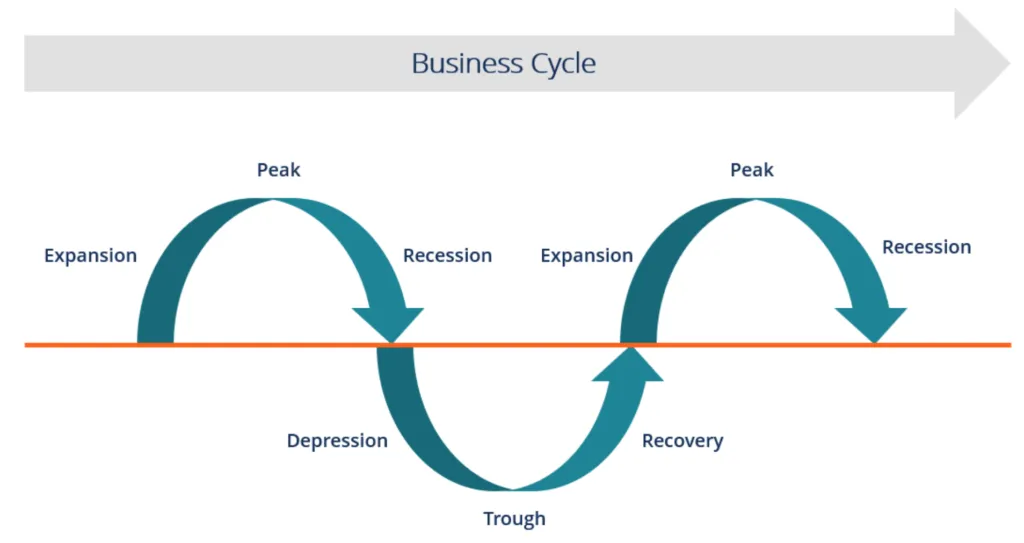
경기순환
Business cycle. Irregular and largely unpredictable fluctuations in economic activity, measured by employment or production of goods and services.
재정정책
Fiscal policy. Controlling Government Spending (정부지출) and Taxes (조세).
통화정책
Monetary policy. Controlling Money Supply (통화량) and interest rates.
이윤
Profit.
노동조합
Labor unions
임금
wages
경제순환모형도 (draw!)
Circular-Flow Diagram. Simplifies the economy by showing how money, goods, services, and factors of production flow through markets between economic actors.
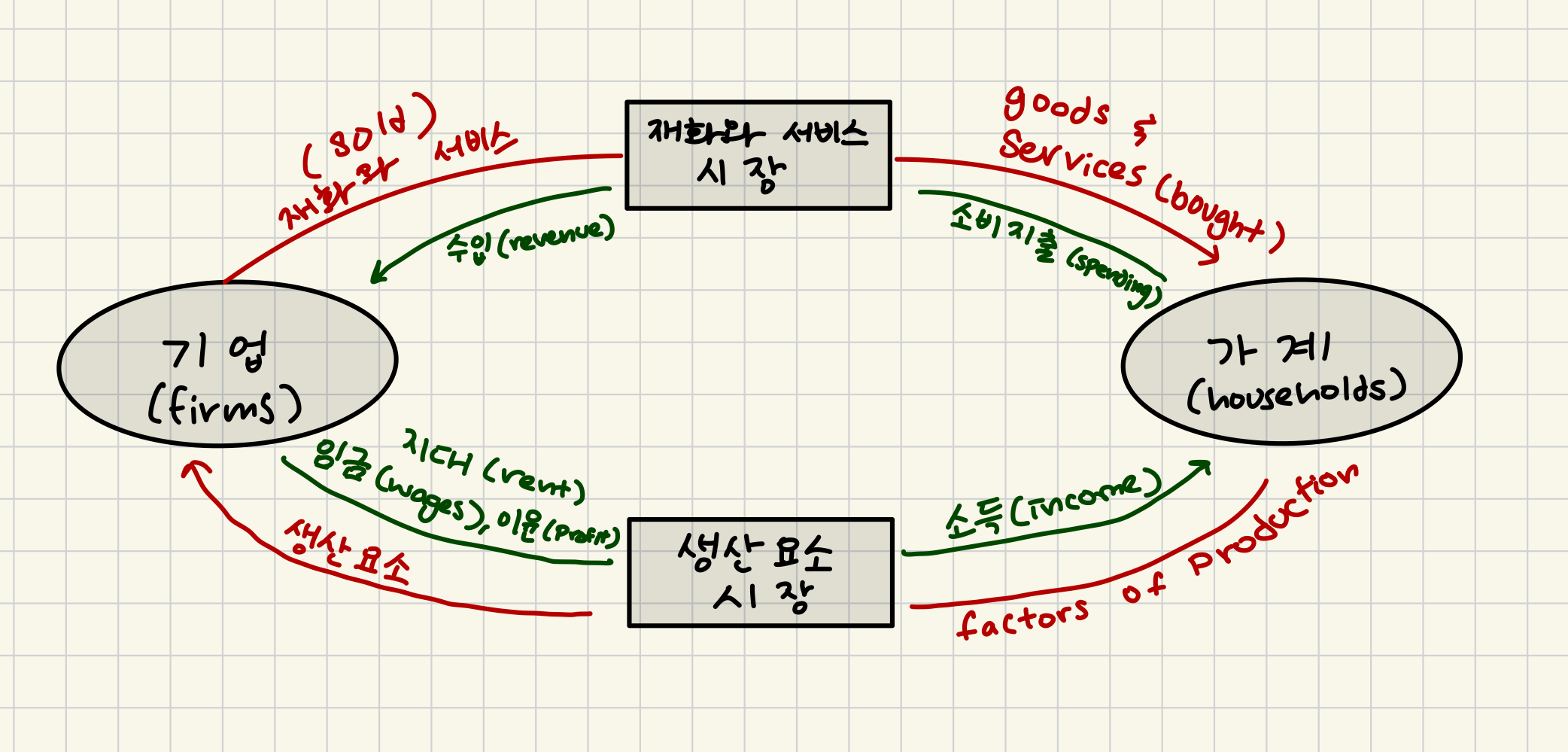
두 가지 의사결정자 (경제순환모형도)
가계(households): Own the Factors of Production (생산요소), consume all goods and services produced by firms.
기업 (firms): Produce goods and services using 생산요소.
생산요소
Factors of production. (CELL)
자본 - 건물, 생산 설비 등 (CAPITAL)
Entrepreneurship
노동 (LABOR)
토지 (LAND)
두 가지 시장 (경제순환모형도)
재화와 서비스 시장 (Markets for Goods and Services): Households buy output produced by firms.
생산요소시장 (Markets for the Factors of Production): Households supply 생산요소 to firms to produce goods and services.
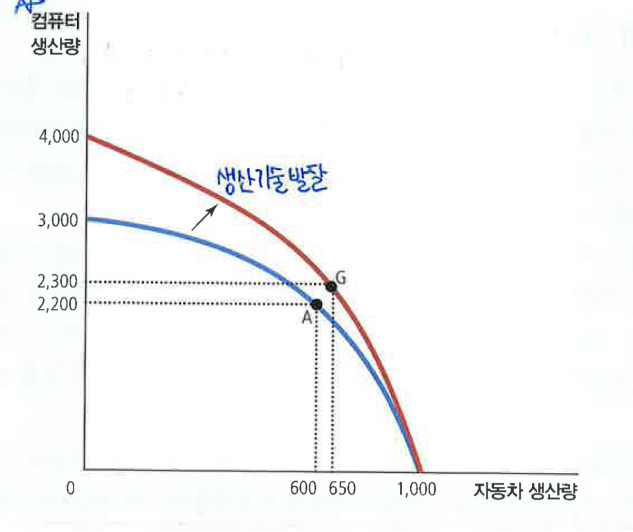
생산가는곡선
Production possibilities frontier (PPF). Shows the various combinations of output (e.g., cars vs. computers) that an economy can possibly produce given its available factors of production (생산요소) and production technology (생산기술).
생산가능곡선의 이동: 기술 발전: 바깥쪽으로의 팽창 (expansion)
생산가능곡선의 기울기
Slope of PPF = 기회 비용.
가파른 기울기 (steep slope): Very high opportunity cost
완만한 기울기 (flatter slope): Low opportunity cost
미시경제학
Microeconomics. 가계와 기업이 어떻게 의사결정을 내리며, 이들이 각각의 시장에서 어떻게 상호작용하는지 연구하는 분야
거시경제학
Macroeconomics. 나라 경제 전체에 관한 경제 현상을 연구하는 분야
실증적 주장 (or 진술)
Positive Statements. Scientist (Describes how the world is). Can be tested/confirmed using data and facts.
Ex. "최저임금제는 실업을 유발한다” (Minimum wage causes unemployment.")
규범적 주장 (or 진술)
Normative Statements. 정책조언자(policy advisor) prescribes how the world should be.
Cannot be tested with data alone (involves ethics, judgement, etc).
Ex. 정부는 최저임금을 인상해야 한다 (raise minimum wage)
연방준비제도
Federal Reserve. Analyzes monetary policy and macroeconomic conditions.
의회예산처
Congressional Budget Office. Provides independent policy and budget evaluations for Congress.
경제자문위원회
Council of Economic Advisers. Advises the U.S. President and publishes the annual Economic Report of the President.
경제학자의 조언이 항상 수용되지 않는 이유
Real-world policy-making must account for PR (홍보), Media reactions (언론), Congressional approval (의회), and Political interest groups (정치적 이해관계)
특화
Specialization. Concentrating production on the good with lower opportunity cost.
소비 기회
Consumption Opportunities. Expanded beyond individual production limits through trade.
자급자족
Autarky. Production equals consumption (Points A and B).
절대우위
Absolute advantage. Ability to produce a good or service using fewer inputs (fewer resources, less time, or less labor) than another producer.
비교우위
Comparative advantage. Ability to produce a good or service at a lower opportunity cost than another producer.
수입품
Imports. 외국에세 생산되어 국내에서 소비되는 물건
수출품
Exports. 국재에서 생산되어 외국에서 소비되는 물건
무역
Trade
시장
Market. 특정한 재화나 서비스를 사고파는 사람들의 모임.
경쟁시장
Competitive market. 소비자와 판매자가 매우 많아서 개별 소비자나 판매자가 시장가경에 거의 영향을 미티지 못하는 시장. (A market in which there are many buyers and many sellers so that each has a negligible impact on the market price.) 특정한 판매자가 가격을 마음대로 결정할 수 없다.
완전경쟁적
Perfectly competitive. (ex. wheat). 100% identical products, zero transaction costs, perfect information, and zero barriers to entry
가격수용자
Price Taker. Individual buyer or seller who has no power to influence market prices and must accept the prevailing market price as given.
수요량
Quantity demanded. 소비자들이 값을 치르고 구입할 의사와 능력이 있는 재화의 양
"The amount of a good that buyers are willing and able to purchase"
수요의 법칙
Law of demand. If other things being equal (ceteris paribus), as the price of a good increases, the quantity demanded of that good decreases
수요표
Demand schedule. Table showing the relationship between the price of a good and the quantity demanded, holding everything else constant
수요곡선
Demand curve.
수요의 증가
Increase in demand. 가격과 무관하게 수요를 증가시키는 변화는 오른쪽으로 이동
수요의 감소
Decrease in demand. 각겨과 무관하게 수요를 감소시키는 변화는 왠쪽으로 이동.
정상재
Normal good. Demand increases when consumer income increases. (vice versa)
(ex. luxury goods, necessities)
열등재
Inferior good. Demand decreases when consumer income increases (ex. instant noodles/bus rides to steak/taxis).
대테재
Substitutes. Pairs of goods that can be used in place of one another to satisfy the same consumer want or need. (ex. Coke/Pepsi)
보완재
Complements. Pairs of goods that are consumed together to satisfy a single want or need. (ex. cars/gasoline, coffee/milk)
수요자에게 영향을 미치는 변수들
가격
소득 (income)
여관재의 가격 (prices of related goods)
취향
미래에 대한 기대
구입자의 수
공급량
Quantity supplied. Amount of a good or service that sellers are willing and able to sell at a specific price point.
공금의 법칙
Law of supply. Positive relationship between price and quantity supplied.
공금곡선/공급표
Supply curve/supply schedule
공급자에게 영향을 미치는 변수들
가격
요소가격 (input prices)
기술
미래에 대한 기대
판매자의 수
균형
Equilibrium. 시장 수요곡선과 시장 공급곡선이 만나는 점
균형가격
Equilbirum price.
균형거래량
Equilibrium quantity.
시장청산가격
Market-clearing price. Price at which the quantity demanded equals the quantity supplied.
초과공급/공급과잉
Excess supply/surplus. Market price is higher than the market-clearing price (시장청산가격)
초과수요/물량부족
Excess demand/shortage. Quantity Demanded > Quantity Supplied
경기침체
Economic recession.