370 NUCLEIC ACIDS (2.5)
 Call Kai
 Learn
Learn Practice Test
 Spaced Repetition
 Match
Match Flashcards
 Knowt Play
1/15

There's no tags or description
Looks like no tags are added yet.
Name | Mastery | Learn | Test | Matching | Spaced | Call with Kai | Chat |
|---|
No analytics yet
Send a link to your students to track their progress
16 Terms
Nucleic acids
—DNA and RNA
—Polymers of nucleotides
Nucleotides
—5 carbon sugars made up of:
→Nitrogenous base: C1
→Phosphate groupe: C5
—Accept/transfer phosphate group to change their activity or create/release bonds
—RNA: ribose (contains OH group)
—DNA: deoxyribose (just a H)

Nitrogenous bases
—Planar, aromatic molecules, derivatives of purine or pyrimidine
—Purines: two aromatic rings
→Adenine (A) and Guanine (G), both in DNA and RNA
—Pyrimidines: single aromatic ring
→Cytosine (C), Thymine (T), Uracil (U)
→DNA+RNA, DNA ONLY, RNA ONLY
Overall conformation
—Nucleotides in long polymer chains → DNA/RNA
—DNA: 2 strands
—RNA: 1 stand
—Nitrogen bases inside the helix (hydrophobic), phosphate sugar backbone on the outside (charged, hydrophilic)

Backbone bond
—Phosphodiester bonds
—Link the two phosphates of the two sugars

Base bond
—The bases from two strands face each other, forms hydrogen bond
—ALWAYS 1 purine and 1 pyrimidine base having the interactions (Watson-Crick base pairing)
→ A-T: forms 2 hydrogen bonds
→ C-G: forms 3 hydrogen bonds
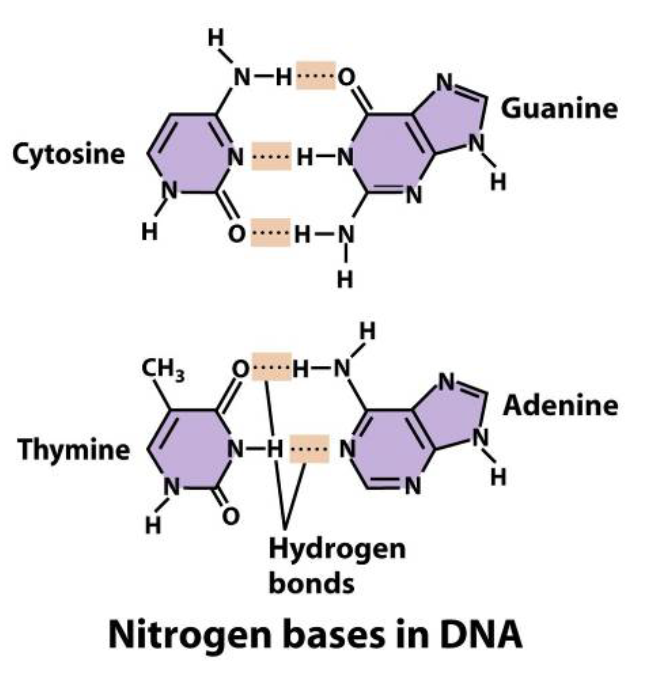
Two strands bonding
—Annealing: binding of two nucleic acid strands
—Aromatic rings of the bases lie ‘on top’ of one another
→Helix held together by the pi stacking interactions (base stacking) and hydrogen bonding
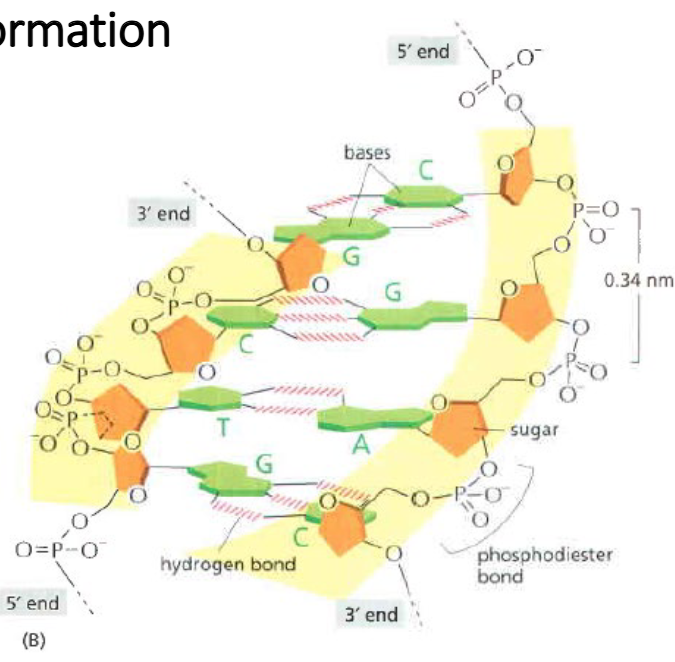
DNA RNA notation
—provided in 5’ to 3’ direction (refers to the carbons)
—Coding DNA strand provides template strand, which is used to form RNA
NOTE: in RNA, T is replaced by U

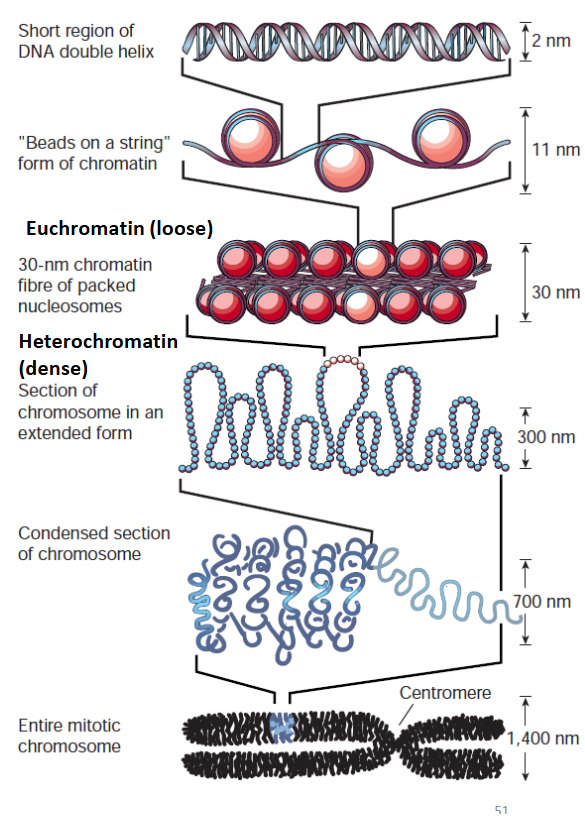
Eukaryotic DNA packaging
—Chromosomes → two copies per cell → diploid
1. DNA wrapped around histone proteins to make chromatin fibres
2. Chromatin fibres packed in a solenoid arrangement into denser chromatin fibres
3. Fibres further condensed into chromosomes
Coiled → if reading needed → uncoil → coil again
Interactions that stabilize DNA
Hydrogen bond between base pairs
Hydrophobic effect
Base stacking (pi interactions between aromatics of the bases)
Ionic interactions between phosphate backbone and ions in solution
Solubility
—DNA/RNA are soluble in water due to hydrophilic phosphate and sugar on the backbone
—Water + (-) phosphate = polar interactions and hydration cell
—Drop pH below pKa and nucleic acid to precipitate them
Salting in
—Low salt concentrations, add salt, increase solubility of nucleic acids
—At low concentrations, cations shield negative phosphate charges, increases the solubility
Salting out
—At high salt concentrations, salt fights with nucleic acid for water
—Nucleic acids stick together and precipitate
DNA melting
—Above a given Tm, DNA strands separate
—Also called DNA denaturation
—Cooling can reattach Watson-Crick base pairs (annealing)
—Can be monitored by measuring absorbance
→Absorption increases at various wavelengths after denaturation

DNA melting curve
—Plot relative absorbance (A at T/A at 25C) against temperature
—Temp where slope is steepest → Tm

Tm depends on:
Higher G-C content (more hydrogen bonds)
Longer DNA molecules
Increased salt concentration
Very low or high pH values changes protonation of bases, decreasing hydrogen bonding, decreasing Tm