Neuro vocab weeks 6-9
 Call Kai
 Learn
 Practice Test
 Spaced Repetition
 Match
 Flashcards
 Knowt Play
1/97

There's no tags or description
Looks like no tags are added yet.
Name | Mastery | Learn | Test | Matching | Spaced | Call with Kai | Chat |
|---|
No analytics yet
Send a link to your students to track their progress
98 Terms
What are the 3 opioid receptor subtypes
mu, kappa, delta
Periaqueductal gray
brainstem structure that is a key area for opioids’ pain relieving (analgesic) effects
mu receptors
receptor in ventral tegmental area (VTA), play a role in opioid addiction
located on GABA interneurons in VTA
open receptor, stopes GABA so dopamine neuron goes..
Key component of Marijuana/CBD
THC (delta-9-tetrahydrocannabinol)
Endocannabinoids, anandamide, and 2-AG
Released postsynaptically by activated synapses and then bind to receptors on presynaptic side (retrograde signals)
Cannabinoid receptors CB1 (brain) and CB2 (immune system)
Both GPCRs, activation slows the release of neurotransmitter from the presynaptic side
effects on memory, cognition
Cannabidiol (CBD)
Found in marijuana, effects are less understood
may have antagonist effects
FDA approved for treating epilepsies
may blunt the psychoactive effects of THC
Stimulants
Have an excitatory effect on the nervous system
Nicotine
Causes rewarding effects dur to nACh-Rs in ventral tegmental area (VTA)
highly addictive
peripheral effects are mediated by actions on nACh-Rs at nerve-muscle junctions
Cocaine
made from purified coca plant leaves
blocks biogenic amine transporters, DAT but also sometimes NET and SERT
blocks reuptake
effects depend on action potential stimulated release of DA
highly addictive
Amphetamine stimulants
Amphetamine, methampetamine, methylphenidate (Ritalin), adderall
amphetamines reverse DAT activity, so not dependent on action potential stimulated release of DA like cocaine, but they dump DA into the synapse
Hallucinogens
LSD, psilocybin, mescaline
(sometimes PCP and ketamine as well)
Effects of hallucinogens
Occur via activation of the 5-HT-2A receptor, in visual cortical areas or in the occipital lobe
Effects of PCP and ketamine
sometimes classified with hallucinogens, very different mechanism
produce a dissociative state from NMDA-R (GluR)
small doses can be used as an anesthetic or to relieve depressive illness
Metabolic tolerance
body’s metabolism and organs (liver especially) become increasingly better at clearing the drug
Functional tolerance
Brain shows less sensitivity to drug over time
Down regulation
decrease in receptor number and/or sensitivity in the case of metabotropic receptors
may occur in response to repeated agonist administration
Up-regulation
increase in receptor number and/or sensitivity
may occur in response to repeated antagonist administration
Cross tolerance
tolerance that generalizes to other drugs in the same chemical class
(ex heroin has cross tolerance with other opioids)
Opponent-process model
(models for studying addiction)
Drug addiction is a result of pairing physiological/emotional pleasure and the physiological/emotional symptoms associated with withdrawal
Over time, pleasure decreases, and withdrawal symptoms become more prominent
Evolution
Gradual changing of one species into another
indifferent process regardless if helpful or harmful
4 observations of evolution
Reproduction increases population size unless factors limit it
Individuals in a species are not identical
Some variation among individuals is due to inheritance
Not all offspring survive to reproduce
Natural Selection
process where traits become more or less common based upon differential reproduction over time
Adaptations
traits which increase the probability of survival of the organism/species
Fitness
Refers to how well a species or member of the species ‘fits’ into its niche
Homology
Features based on common ancestry
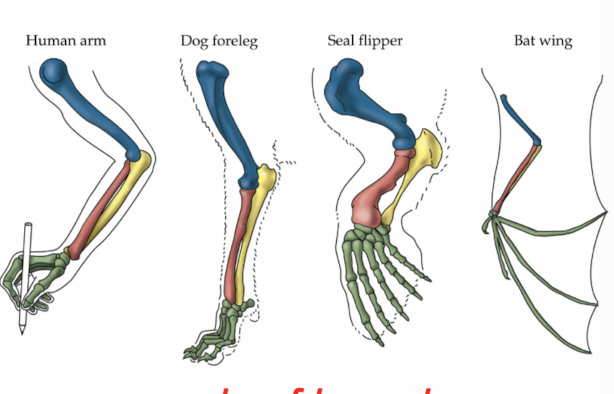
Homoplasy
Similar features that evolved separately

Analogy
biological traits or structures that perform the same function in different species but evolved independently without a shared ancestral origin
via convergent evolution

How many chromosome pairs do genes/DNA have
23 pairs
Taxonomy
Describing, identifying, naming, and classifying organisms into structured hierarchical groups
Phylogeny
The study of the evolutionary history and relationships among groups of organisms
Basic similarities in nervous systems across ALL vertabrates
development from a hollow dorsal tube
bilateral symmetry
segmentation
hierarchical control
separate systems
localization of functions
—brain structures are basically all the same in vertebrates, except for the cortex
—humans have small olfactory bulb and large cortex
Encephalization quotent (EQ)
Takes into account each class’s deviation from the slope of the ratio of brain weight to body weight for all species

How many layers are in the neocortex
six
How many layers are in the allocortex
four
Australopithecus
first appeared 4 million years ago
bipedal (upright) hominin
made stone tools
tool making ability reduced selective pressure for large jaws and teeth
prominent for social harmony in society, weapons caused threat
Homo species (general)
Appeared in the last 2 million years
brain volume reached plateau at this time
comes after Australopithecus
Homo habilis
had cerebral volume of 600-700 cm3
first of homo species
Homo erectus
had cerebral volume of 700-1400 cm3
(expanded over a 1.5 million year period)
2nd of homo species
used fire, tools, killed large animals
spread over asia, africa, europe
lived 40 thousand years ago
Homo sapiens
Emerged 150,000 years ago
Cerebral volume of 1400 cm3
Social Brain Hypothesis
Humans evolved large brains to navigate complex social relationships and group dynamics, rather than to solve purely ecological problems
Sexual selection hypothesis
Traits evolve because they increase an individual's success in getting mates, even if those traits reduce individual survival
By Charles Darwin
other possibilities: tool use, social learning, etc
Genotype
An organism's complete set of genetic material or the specific genetic makeup (DNA sequence) inherited from its parents
contained within an individual
Phenotype
An organism's observable characteristics and traits:
height, eye color, hair color, blood type, behavior, and disease presence
Ectoderm
outer layer of zygote that is formed during gastrulation
part of it becomes the nervous system, the rest of it becomes skin
Gastrulation
Formation of the germ layers: single layered blastula into a multi-layer embryo
ectoderm
mesoderm
endoderm
Transcription factors
Proteins that bind DNA and switch genes on or off
Act in cascades; they establish the body plan (segmentation) and then the specific cell types and tissues within it.
ancient machinery that is shared across many species
Ex: Homeotic (Hox) genes


Neural tube
Precursor of the ventricular system
Result of the dorsal surface thickening; surrounds a fluid-filled cavity
Anterior end enlarges and differentiates into the hindbrain, midbrain, and forebrain
The rest of the neural tube becomes the spinal cord

6 stages of neural development
neurogenesis
cell migration
differentiation
synaptogenesis
neuronal cell death
synaptic rearrangement
stages can overlap across and within regions
Neurogenesis
New, functional neurons are generated from neural stem and progenitor cells
cells on inner side (VZ) of neural tube undergo cell division
cells in VZ provide source where all neurons and glial cells are derived
increase in brain size is due to cell growth, myelenation, glial cell production, etc
continues to occue in a very limited capacity in some brain regions through adulthood
the extent this goes in humans is actively debated

Ventricular zone (VZ)
Temporary embryonic layer of tissue that lines the neural tube in developing embryos
Olfactory bulb
Located on the bottom side of the forebrain, resting just above the nasal cavity and roughly between the eyes
very prominent in rodents, not so much in humans
processing smells
Granule neurons
Small, densely packed neurons found primarily in the cerebellum and the dentate gyrus of the hippocampus
continue to undergo replacement through adulthood
Dentate gyrus
Narrow strip of gray matter in the temporal lobe that forms part of the hippocampal formation
Cell migration
Movement of newly formed neurons and glia to their eventual locations, there are 2 types:
radial migration
tangential migration
Complete before birth, except some interneurons may keep migrating in the frontal cortex for a few months
When this fails: “smooth brain” occurs; neurons never reach their layers, causing severe intellectual delays
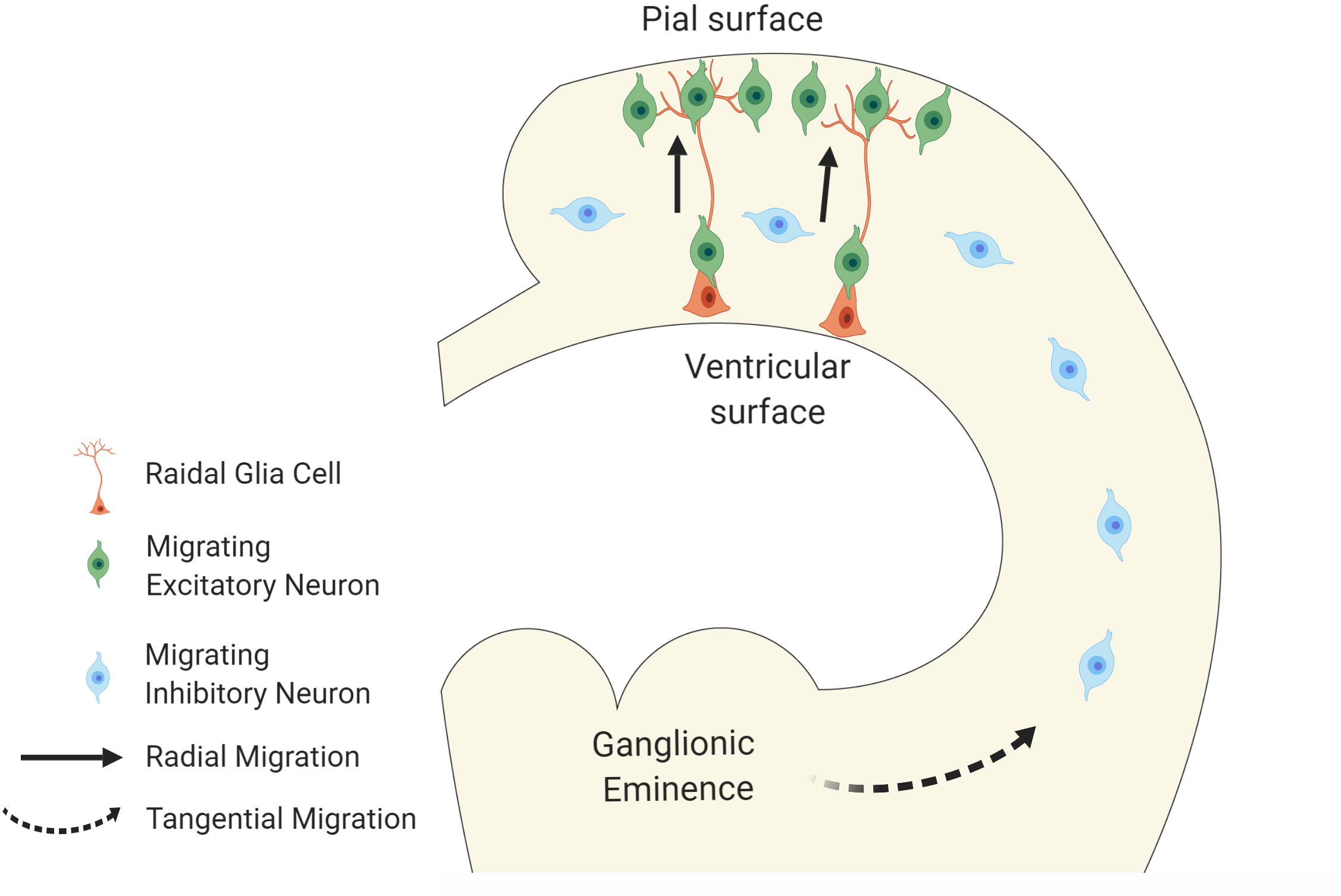
Radial migration
Neurons move outward from the inner ventricular zone (VZ) toward the outer surface of the developing neural tube or cerebral cortex.
occurs on “scaffolding cells”
radial glia from the VZ toward the out surface
ex: pyramidal neurons
vertical
Tangential migration
Involves the movement parallel to the brain’s surface, along the axis of the nervous system
allows neurons to travel horizontally over long distances to their final destinations

Radial glia
Long cells that allow neurons to migrate along them like a highway
Cell differentiation
Unspecialized cells (like stem cells) develop into specialized cells with distinct structures and functions
before migration
This allows multicellular organisms to form complex tissues, organs, and systems, as well as repair and replace damaged cells in adults
Neural cell adhesion molecules (NCAMs)
Proteins on the outer surface of cells that guide cells growing axons to their targets
Just one example of the many important molecules for guiding neuronal processes to their correct location
Growth cones
tips of growing axons
contain finger-like extensions
filopodia at their tips detect local chemicals in the environment
Filopodia
thin, finger-like membrane extensions that project from the leading edge of a developing axon
chemoattractants and chemorepellents
chemical signals that guide growing neurons to their correct targets by directing the growth cone
Synaptogenesis
the formation of the synaptic connections between neurons during brain development
occurs throughout life as neurons are constantly forming new connections and discarding old ones
but slows over time
Apoptosis
“programmed” cell death
gene expression-dependent
Necrosis
Cell death from injury or damage
trauma or disease
Neurotrophins
provided by postsynaptic targets
necessary for presynaptic cells to survive
if they dont recieve enough, they die
allow for matching between the size of target and the number of neurons with axonal efferents to the target region
Nerve growth factor (NGF)
A neurotrophin secreted into target organs (ex muscles) in the peripheral nervous system
regulates the growth, maintenance, survival, and differentiation of specific sympathetic and sensory neurons
Brain-derived neurotrophic factor (BDNF)
a key neurotrophin secreted by target neurons in the neocortex and the hippocampus
A protein that promotes the survival, growth, and maintenance of neurons (nerve cells) in the brain and spinal cord
Low BDNF levels are often associated with conditions like depression, Alzheimer’s disease, and Parkinson’s disease
Synaptic rearrangement
describes the process where earlier formed synapses may be eliminated, and others added
Gliogenesis
glial cells are generated from neural stem cells and progenitor cells
occurs throughout prenatal development concurrent with neurogenesis
increases after birth for many animals, and continues through life
Myelineation
Myelin sheath forms around the axon
occurs primarily after birth
very important for increasing AP velocity (good for cognitive functioning)
Behavioral teratology
Study of how maternal environment influences the nervous system in the fetus
ex: pre or postnatal exposure to toxins, drugs, or other environmental disturbances
Teratogen
Any substance, agent, or environmental factor that can disrupt normal fetal development and cause permanent birth defects
e.g., Accutane, alcohol
Transgenic model
An animal (usually a mouse) with the artificial introduction or removal of a gene
knockout, knock-in, over-expression mutant
Knockout (KO)
A specific gene is inactivated or removed in an animal model
Overexpression mutant
increase expression of an existing gene by inserting extra copies of it into the DNA
Conditional knockout
Expression may be targeted into certain cell types in the body, or its KO is present in the DNA but it is not active until a desired time during a certain time during development
Epigenetics
The study of how your behaviors, lifestyle, and environment can cause changes that affect how your genes work, without altering your underlying DNA sequence
ex: during early life (pre/postnatally), experience can change the expression pattern of genes; this can have long-lasting effects
DNA methylation
Chemical modification of parts of the genome usually prevents gene expression at that site
A natural cellular process where tiny chemical tags called methyl groups attach directly to a DNA molecule without changing the underlying genetic code
Methyl groups act as light switches, turning genes on and off
Histone modification
Alteration of histone proteins
Proteins act as a “spool” for chromosomal DNA, and control how tightly or loosely the DNA is packed
Autism spectrum disorder (ASD)
a class of disorders of neural development characterized by impaired social interaction/communication and restricted interests and repetitive behavior
Signs usually evident by 3 years old, diagnosis often later
Causes are not understood, but clear genetic component
Abnormal development of interneurons in the cerebral cortex
Attention deficit/hyperactivity disorder (ADHD)
symptoms present before age 12
complex genetic and environmental causes that are not yet well understood
some differences noted in the prefrontal cortex
diagnosis rates have risen over time
Law of specific nerve energies
Specific receptors and neural channels for each sense are independent
each can only produce one specific sensation
they all encode information in terms of firing APs to the brain
Adequate stimulus
The specific type of energy that a sensory organ/receptor is most sensitive to
ex: photon of light for an eye, soundwave for the ear, chemical for taste/smell
Transduction
Conversion of physical energy by a receptor into an electrochemical pattern in neurons
Generator potentials
very similar to EPSPs
When large enough threshold, these trigger an AP in the sensory neuron
Topography
Neighboring points on a sensory or motor surface correspond to neighboring neurons in the brain or spinal cord
Coding in sensory systems
Neural activity patterns that simplify and represent information for efficient transmission
Rate coding
How many APs per second
encodes stimulus intensity
more APs = stronger stimulus
Labeled line coding
Neurological model where each individual sensory receptor or nerve fiber is specialized to respond to one specific type of stimulus
Information about each quality travels to the CNS on its own afferent pathway
Somatosensation
Sense of touch
detection of body sensations (touch and pain)
stimulus location is determined from the position of the activated receptors, the somatosensory inputs map onto a representation of the body’s surface in the cerebral cortex
Pacinian corpuscle
Exemplar touch receptor
detects sudden displacement or high-frequency vibrations on the skin
onion-like outer structure
vibrations increase the flow of Na+ to trigger an AP
Adaptation
the progressive loss of a response to a maintained stimulus
key for representing changes in one’s environment, with no adaptation we are constantly bombarded with meaningless info
Tonic receptors
Show slow or no decline in AP frequency
Phasic receptors
display adaptation and decrease frequency of APs
Receptive field
Specific region of the skin, muscle, or internal organ where a stimulus must occur to change the firing rate of a sensory neuron
bullseye pattern
On-center and Off-surround
cat diagram
Primary somatosensory cortex (S1)
Receives touch information from one side (the opposite) of the body