Perio II, Lecture 1 - Introduction and Diagnosis and Treatment Planning (Dr. Chuang)
 Call Kai
 Learn
 Practice Test
 Spaced Repetition
 Match
 Flashcards
 Knowt Play
1/73

There's no tags or description
Looks like no tags are added yet.
74 Terms
Is gingivitis reversible?
Yes
Is periodontitis reversible?
No - irreversible
What are the three types of periodontitis patients?
- Stable case of periodontal health in a successfully treated periodontitis patient
- Gingival inflammation on a reduced periodontium in a successfully treated periodontitis patient
- Unstable case of recurrent periodontits
What could be the diagnosis of a patient who had crown lengthening and gingivitis?
Gingival inflammation on a reduced periodontium in a non-periodontitis patient
What classifies the severity of periodontal disease?
Staging
What classifies the progression of periodontal disease?
Grading
What is the interdental CAL for stage I periodontitis?
1-2mm
What is the interdental CAL for stage II periodontitis?
3-4mm
What is the interdental CAL for stage III and IV periodontitis?
≥5 mm
What is the radiographic bone loss for stage I periodontitis?
Coronal third: <15%
What is the radiographic bone loss for stage II periodontitis?
Coronal third: 15-33%
What is the radiographic bone loss for stage III and IV periodontitis?
Extending to the middle third of root and beyond
What stages of periodontitis have no tooth loss?
Stage I and II
What is the difference between stage III and IV?
- Stage III: ≤4 teeth loss due to periodontitis
- Stage IV: ≥5 teeth loss due to periodontitis
What stage of periodontitis?
- Max. probing depth <4 mm
- Mostly horizontal bone loss
Stage I
What stage of periodontitis?
- Max. probing depth ≤5 mm
- Mostly horizontal bone loss
Stage II
What stage of periodontitis?
In addition to previous stage complexity...
- Probing depths ≥6 mm
- Vertical bone loss ≥3 mm
- Furcation involvement Class Il or III
- Moderate ridge defects
Stage III
What stage of periodontitis?
In addition to previous stage complexity...
Need for complex rehabilitation due to:
- Masticatory dysfunction
- Secondary occlusal trauma (tooth mobility degree ≥2)
- Severe ridge defects
- Bite collapse, drifting, flaring
- < 20 remaining teeth
(10 opposing pairs)
Stage IV
What classifies a diagnosis as generalized versus localized?
Generalized: >30% of teeth invovled
What type of evidence can you use for grading for 120 recare patients?
Direct: radiograph bone loss or CAL over 5 years
What type of evidence can you use for grading for 150 new patients?
Indirect: % bone loss/age
What is the radiograph bone loss or CAL over 5 years for grade A periodontitis?
No loss over 5 years
What is the radiograph bone loss or CAL over 5 years for grade B periodontitis?
<2mm over 5 years
What is the radiograph bone loss or CAL over 5 years for grade C periodontitis?
≥2 mm over 5 years
What is the % bone loss/age for grade A periodontitis?
<0.25
What is the % bone loss/age for grade B periodontitis?
0.25 to 1.0
What is the % bone loss/age for grade C periodontitis?
≥1.0
What grade of periodontits?
Heavy biofilm deposits with low levels of destruction
Grade A
What grade of periodontitis?
Destruction commensurate with biofilm deposits
Grade B
What grade of periodontitis?
Destruction exceeds expectations given biofilm deposits; specific clinical patterns suggestive of periods of rapid progression and/or early onset disease
Grade C
How often does a Grade A periodontitis patient smoke?
Non-smoker
How often does a Grade B periodontitis patient smoke?
<10 cigarettes/day
How often does a Grade C periodontitis patient smoke?
≥10 cigarettes/day
What is the HbA1c of a Grade A periodontitis patient?
Normoglycemic/no diagnosis of diabetes
What is the HbA1c of a Grade B periodontitis patient?
<7.0%
What is the HbA1c of a Grade C periodontitis patient?
≥7.0%
Health or gingivitis?
- Probing attachment loss: None
- Probing pocket depths: ≤3 mm
- Bleeding on probing: <10%
- Radiographic bone loss: None
Health
Health or gingivitis?
- Probing attachment loss: None
- Probing pocket depths: ≤3 mm
- Bleeding on probing: ≥10%
- Radiographic bone loss: None
Gingivitis
Health or gingival inflammation for a successfully treated stable periodontitis patient?
- Probing attachment loss: Yes
- Probing pocket depths: ≤4 mm (no site ≥4mm with BOP)
- Bleeding on probing: <10%
- Radiographic bone loss: Yes
Clinical health on a reduced periodontium
Health or gingival inflammation for a successfully treated stable periodontitis patient?
- Probing attachment loss: Yes
- Probing pocket depths: ≤3 mm
- Bleeding on probing: ≥10%
- Radiographic bone loss: Yes
Gingival inflammation on a reduced periodontium
A successfully treated periodontitis patient in whom sites of gingival bleeding appear remains at high risk of disease recurrence at those sites and of progressive attachment loss. Therefore, gingivitis is defined as bleeding at a shallow site of ≤____ mm, as is the case in gingival heath. Where the probing depth is 4 mm or higher with bleeding, this is no longer a "closed pocket."
≤ 3 mm, (rather than ≤ 4 mm)
What is the diagnosis?
- No interproximal attachment loss on ≥2 teeth
- No BOP
Periodontal health
What is the diagnosis?
- No interproximal attachment loss on ≥2 teeth
- BOP ≥10%
Gingivitis
What is the diagnosis?
- Interproximal attachment loss on ≥2 teeth
- BOP <10%
Clinical health on a reduced periodontium
What is the diagnosis?
- Interproximal attachment loss on ≥2 teeth
- BOP ≥10%
- No PD >5mm
Gingival inflammation on a reduced periodontium
What is the diagnosis?
- Interproximal attachment loss on ≥2 teeth
- Deep PD ≥5mm
Periodontitis (Stage I-IV, Grade A-C)
What is the treatment end goal for a non-periodontitis patient?
Periodontal health
What is the treatment end goal for a patient with
gingival inflammation on a reduced periodontium?
Clinical health on a reduced periodontium
What is the treatment end goal for a periodontitis patient?
Clinical health on a reduced periodontium
"Diagnosis" is based on _________ and _________. But "Treatment Need" is based on _________
- Dx: Attachment Level, BOP
- Tx: Deep Probing Depth
What is the treatment for a patient with periodontal health?
Prophylaxis (D1110)
What is the treatment for a patient with gingivitis?
Prophylaxis (D1110)
What is the treatment for a patient with clinical health on a reduced periodontium?
Prophylaxis (D1110) / Perio Maintenance
What is the treatment for a patient with gingivitis on a reduced periodontium?
Prophylaxis (D1110) / Perio Maintenance
What is the treatment for a patient with periodontitis?
ScRP (Based on teeth number involved with deep PD ≥ 5 mm in each quadrant)
What are the two codes for an ScRP?
- D4342: 1-3 teeth
- D4341: 4+ teeth
What is the treatment for a patient with gingivitis and significant erythema, pseudopockets, or subgingival calculus?
Scaling in the presence of generalized moderate/severe gingivitis (D4346)

Define the following:
The sulcus is deepened because gingival enlargement without destruction of the underlying periodontal tissue (without apical migration of J.E)
Gingival pocket (pseudo pocket)

Define the following:
It is due to apical proliferation of junctional epithelium and destruction of the underlying supporting structures.
Periodontal pocket (true pocket)
What four things should a periodontitis diagnosis include?
- Periodontal diagnosis
- Peri-implant diagnosis (for each implant)
- Diagnoses for mucogingiva (recession / mucogingival defect...)
- Diagnoses tor individual teeth (endo, caries, root tip, tracture...)
According to McGuire & Nunn's Classification, what is the prognosis?
One or more of the following:
- Inadequate attachment to support the tooth
- Grade III or IV furcation involvement
- Miller class III mobility
- Tooth or teeth cannot be maintained by the professional and/or the patient
Hopeless
According to McGuire & Nunn's Classification, what is the prognosis?
One or more of the following:
- Greater than 50% attachment loss
- Grade Il or Ill furcation involvement not accessible for maintenance
- Endodontically involved tooth that must be resolved before periodontal treatment
- Tooth or teeth not easily maintained by professional and/or patient
Questionable
According to McGuire & Nunn's Classification, what is the prognosis?
One or more of the following:
- Up to 50% loss has occurred
- Grade II furcation with difficult access to the depth and position of the furcation
- Greater than Miller class I mobility
- Poor crown-to-root ratio
- Lack of patient compliance
- Presence of systemic factors
Poor
According to McGuire & Nunn's Classification, what is the prognosis?
One or more of the following:
- Up to 25% attachment loss measured clinically and radiographically
- Grade I furcation allows access for maintenance
- Tooth or teeth can be maintained with proper professional and home care
- Limited systemic factors
Fair
According to McGuire & Nunn's Classification, what is the prognosis?
One or more of the following:
- Etiologic factors can be controlled
- Adequate periodontal support
- Tooth or teeth can be adequately maintained by the professional and patient
- Controlled systemic factors
Good
What is included in the periodontal preliminary/ emergency phase?
- Emergency treatment (dental, periapical, periodontal, others)
- Extraction of hopeless teeth
What is included in the periodontal nonsurgical phase (Phase I)?
- Consultation (medical, dental, smoking cessation)
- Plaque control & patient education, Oral hygiene instructions (OHI)
- Correction of contributing factors (caries control, remove ill-fitting restorations, provisional splinting or prosthesis, occlusal adjustment)
- Prophylaxis or ScRP (depending on diagnosis)
What is included in the periodontal surgical phase (Phase II)?
- Periodontal surgeries
- Implant surgeries
- Endodontic therapy
What is included in the periodontal restoration phase (Phase III)?
- Final restorations
- Orthodontic therapy
T/F: Periodontal maintenance (D4910) is NOT recare prophylaxis (D1110.6)
True
Define the following:
Repeated ScRP over remaining deep probing sites under local anesthesia on periodontal patients every 3 months after first round of ScRP
Periodontal maintenance (D4910)
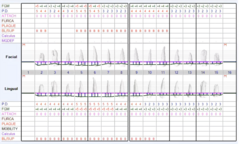
What is the diagnosis?
A) Localized gingivitis
B) Generalized gingivitis
C) Periodontitis stage I grade A
D) Periodontitis stage Ill grade C
B) Generalized gingivitis

What is the recommended treatment?
A) Prophylaxis (D1110)
B) Scaling in the presence of moderate to severe gingivitis (D4346)
C) Scaling and root planing 4+ teeth (D4341)
D) Periodontal maintenance (D4910)
B) Scaling in the presence of moderate to severe gingivitis (D4346)
What is included in the periodontal maintenance phase (Phase VI)?
- Supportive periodontal therapy (every 6 months prophylaxis, every 3 months periodontal maintenance: D4910)
- Occlusal guard