1.2 Gross & microscopic anatomy of muscles
 Call Kai
 Learn
 Practice Test
 Spaced Repetition
 Match
 Flashcards
 Knowt Play
1/23

There's no tags or description
Looks like no tags are added yet.
24 Terms
functions of muscular tissue
stabilize joints and maintain positions
heat generation
body movement
storage and movement of substances within the body
properties of muscular tissue
Electrical excitability –
responds to certain stimuli by producing
action potentials that travel along plasma
membrane. Stimuli:
electrical signals (heart) and
neurotransmitters from neurons.
Contractility – ability to contract
forcefully when stimulated by an action
potential
Extensibility – stretch
without being damaged
Elasticity – return to original
length after contraction or extension
3 types of fascia and what they are
epimysium- outermost layer, encloses entire layer
perimysium- surrounds groups of 10-100 muscle fibers (aka fascicles)
endomysium- innermost, separates individual fibers
What is fascia and hypodermis?
Fascia- sheet of desne irregular connective tissue, holds muscles w similiar functions 2gether
hypodermis- separates muscle from skin
the 2 kinds of hypodermis:
areolar
adipose (fat)

What is a tendon and its functions
An extension of epimysium, perimysium, & endomysium.
A cord of dense regular connective tissue
Attaches muscle to periosteum (bone)
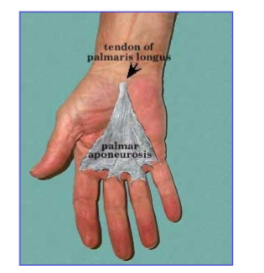
Aponeurosis
flat, broad tendon
what does it mean that a muscle fiber is multinucleated
(result of fusion of tens of myoblasts); do not divide

Sarcolemma
plasma membrane (silver outermost layer)

Transverse (T) tubules
tunnels from sarcolemma to the center of the cell; filled with interstiitial fluid

Sarcoplasm
cytoplasm; contains glycogen and myoglobin (similar to hemoglobin)

Myofibrils
contractile organelles
contain thick and thin filaments (protein molecules)
(in the bottom in the middle-left middle of the image)

Sarcoplasmic reticulum (SR)
endoplasmic reticulum. SR stores and releases Ca 2+ (muscle contraction)

Thick and thin filaments
bordered by the z-line
arranged in compartments called sarcomeres

Z discs (line)
separate sarcomeres

H (A) band
thick filaments

H band = H zone
(only thick filaments) + 2 Zones of Overlap with thin filaments

I band
thin filament

M line
middle of the sarcomere
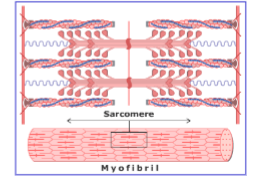
what results in the striation of muscles?
pattern of overlap of thin and thick filaments in a myofibril

What are the three kinds of proteins in myofibrils?
contractile proteins
regulatory proteins
structural proteins
contractile proteins functions and components
generate force in contractions
myosin (motor protein)
actin
regulatory protein functions and components
switch contractions on/off
tropomyosin, troponin (parts of thin filaments that change configuration in response to Ca2
structural protein functions and components
holds filaments in place. Gives elasticity & extensibility
titin- connects Z disc & M line
a-actinin- attaches actin to titin molecules