Microbiology Exam 1
 Call Kai
 Learn
Learn Practice Test
 Spaced Repetition
 Match
Match Flashcards
 Knowt Play
1/85

There's no tags or description
Looks like no tags are added yet.
Name | Mastery | Learn | Test | Matching | Spaced | Call with Kai | Chat |
|---|
No analytics yet
Send a link to your students to track their progress
86 Terms
What is microbio
Study of microorganisms (entities too small to see with eye)
One contribution from Antoni van Leeuwenhoek, Louis Pasteur, and Robert Koch
Leewenhoek: first direct observation of microorganisms (microscope)
Pasteur: Dispelled spontaneous generation, proposed germ theory of disease (swan neck flasks broth without versus with contamination grew organisms)
Pasteurization
Koch: postulates as guidelines to prove microorganism causes specific disease
3 microbial domains
Bacteria
Archaea
Eukarya
Which major groups of microorganisms have prokaryotic cell structure
Bacteria and archaea
Which major groups of microorganisms have a eukaryotic cell structure
Algae, fungi, protozoa, slime molds
Which group of microorganisms lacks a cell structure
Viruses
Why is the ability to streak out microbial cultures for single colonies on sterile agar plates so important for the study of microbiology
Separation of individual cells from mixed population → grow pure colonies → can be studied without interference
List Koch's four postulates
Suspected pathogenic organisms should be present in ALL cases of disease and absent in healthy animals
Should be grown in pure culture
Cells from pure culture should cause disease in healthy animal
Organism should be reisolated and shown to be same as original
Can you think of a microbial pathogen that violates Koch's postulates. If so, how
Viruses: cannot form independent pure cultures, need human specific hosts (ethical constraints)
Compare and contrast prokaryotic and eukaryotic cell architecture (7)
Cell size: small vs large
DNA: 1 molecule (no chromosome) vs many chromosome
Nucleus: absent vs present
Ribosome: 70S vs 80S (target of antibiotics)
Organelles: absent vs mitochondria, chloroplasts, ER, golgi, lysosome, vacuoles, etc
Cell wall: thin (peptidoglycan) vs absent or thick (cellulose)
Movement: flagella (flagellin) vs flagella or cilia (complex fibers + proteins)
What are some common shapes for Bacteria and Archaea? (7) What polymer(s) determines cell shape in these two domains
Bacteria: peptidoglycan, FtsZ, MreB
Archaea: pseudopeptidoglycan

How is the Gram strain performed
Spread culture over slide, air dry, pass through heat to fix
Flood with crystal violet (all stained purple), then with iodine (forms complex)
Decolorize with alcohol (gram pos are purple, negative are colorless)
Safranin counterstain
Why do certain bacterial cells stain Gram positive, while others stain Gram negative
Gram positive: single membrane (thick peptidoglycan layer outside, shrinks and closes pores with decolorizer) → trapped stain stays
Gram negative: 2 membranes (inner and outer w/ periplasm, alcohol dissolves outer and damages peptidoglycan) → stain washes away
Periplasm: aqueous compartment in-between where thin peptidoglycan is
What is peptidoglycan? Which group of microorganisms has it?
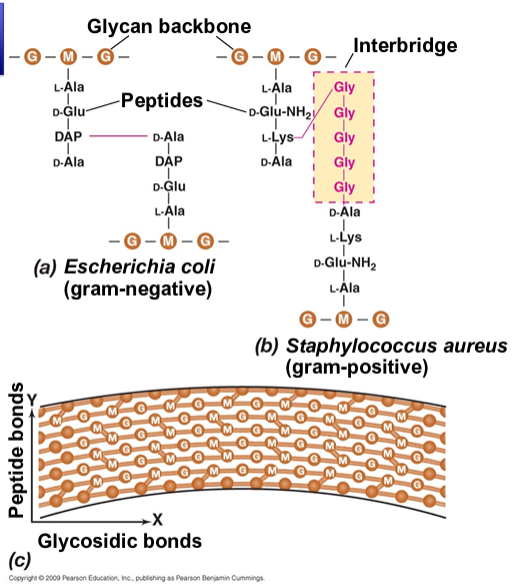
Strong mesh organization of sugars and amino acids supporting cell integrity and structure
Bacteria: gram pos vs gram neg
Archaea and Eukaryotes do not
What is the importance of the transpeptidation reaction for peptidoglycan synthesis?
Creates peptide cross links between adjacent glycan strands → establishing peptidoglycan’s functional structure
Typically links D-ala of one peptide chain to nearby DAP (Gram neg) or inter-bridge (Gram pos)
Glycosidic bond: covalent link one sugar to another (or other molecule), form glycan backbone
Pentapeptide: subunit of peptidoglycan (peptide bond high energy, used to facilitate cross link)
Bactoprenol: sits in membrane, carrier that flips pentapeptide across
Why does penicillin kill growing bacteria?
Penicillin prevents the transpeptidase reaction (mimics D-ala) so transpeptidase enzyme binds permanently creating complex → permanently shut down
What are teichoic acids? Which group of microorganisms possesses them?
Source of antibiotic resistance, anchored in peptidoglycan layer extending outward, gram pos bacteria
What is lipopolysaccharide? Which group of microorganisms possesses them?
Large glycolipid molecule: structural barrier triggering immune response
Lipid A is hydrophobic anchoring molecule in outer mem
Core poly-sac: chain of sugar attached to lipid A
O-poly-sac: repetitive diverse sugar chain extending outward
Strain specific, antigenic (recognized as foreign) - macrophages recognize and systems felt because immune response is activated
Gram neg
What is a serotype?
Subgroup classified together based on specific strain of LPS
Strain specific antisera are produced and useful in serotyping
What is a porin, where is it found, and what is its function?
Transmembrane protein, forms a channel
Outer membrane of gram neg
Allow passive diffusion of hydrophilic substrates less than 100/200 da
What is Braun lipoprotein, where is it found, and what is its function?
Embedded in outer membrane of gram neg and covalently linked to peptidoglycan
Tethers outer mem and peptidoglycan and stabilizes distance of periplasmic space, trigger immune host immune response
What is the bacterial periplasm?
Space between in and outer mem in gram neg
Cell wall includes outer mem and periplasm
What kinds of protein or enzymes are found in the periplasm of Gram negative bacteria?
Peptidoglycan, degradation enzymes, anti-biotic inactivating enzymes (penicillin), protein folding and quality control enzymes, transport proteins + their targets
Compare and contrast Gram positive and Gram negative cell architectures. Use diagrams.
Gram pos: 1 membrane (cytoplasmic), thick peptidoglycan on outside
Gram neg: 2 membranes (cytoplasmic and outer), periplasm in-between with thin peptidoglycan
What kinds of cell walls do Archaea possess?
Repeating protein or glycoprotein cell wall in procrystalline array
How does pseudopeptidoglycan differ from true peptidoglycan?
Different way of making cell walls (no peptidoglycan)
Pseudo-peptidoglycan (w/o muramic acid and B(1,4), B(1,3) instead)
Host’s lysozyme: targets B(1,4) part of peptidoglycan in immune response, B(1,3) is non lysozyme sensitive
Polysaccharide cell walls
What are microbial capsules made of, where are they located on the cell, and what is their function?
Additional layer of carbohydrate or glycoprotein
Outside of cell wall
Pathogenesis (mechanism through which disease develops) and biofilm formation (binding of cells together to resist immune attacks)
What is the function(s) of pili? Of fimbraie? Of flagella?
All surface appendages
Pili: longer, fewer, cell adhesion and conjunction (transfer DNA through pilus to receptor cell)
Fimbraie: short, needle-like, numerous, allow cell adhesion
Flagella: larger, involved in cell motility
Rotary motor driven by membrane electro-chemical gradient (proton re-entry), overlap and antiparallel orientation allows for movement

What is the function of the Type III secretion complex? On what type of bacteria is it found?
Specialized secretion system: secretion needle docks to target host cell mem, signal transduction pathway drives effector → motor protein through needle cripples cell defense and reprograms eukaryotic host cytoplasm to be conductive for pathogen colonization
Gram neg

How do Bacterial and Archaeal phospholipids differ?
Bacteria and Eukarya: ester linked lipids (O=C), standard fatty acid side chains
Archaea: ether linked lipids (O-C), isoprenoid side chains, can posses lipid monolayer (hyper-thermophiles)
more stable, less likely to break apart from heat/stress than bilayer (same thickness)
Thicker membrane is another way to stabilize
Trans vs cis orientation (can’t pack as tight, membrane more fluid)
How do the membranes of Eukarya differ from that of Bacteria and Archaea?
Due to larger cell size, Eukaryotic membranes contain sterols (hydroxyl group at 3 position of carbon ring), fortify membrane structure
Membrane proteins used to move around: need fluidity but not too much
Tm: above will melt, below will freeze, organisms tightly guard (to lower melting point - double bonded unsaturated fatty acids prevent packing, to raise - singled bonded saturated fatty acids, close packing prevents heat degradation), shorter chains lowers Mt
What class of antibiotics targets membrane sterols?
Polyene class of antifungal antibiotics, tartes fungal sterols
Name three classes of membrane transporters that differ in their energetics.
Gradient-dependent (PMF)
Groups translocation (phosphorylate solute)
ABC (ATP)

What is the function of microbial ABC Efflux pumps?
Getting rid of antibiotics, source of antibiotic resistance (and other toxic substances)
What kinds of functions are associated with microbial inclusion bodies?
Metabolic storage inclusion bodies (use liver then muscle stores, electron or energy source)
Ex: sulfur oxidizing bacteria, polyphosphate, etc.)
Magnetosomes: magnetite inclusion for locating sediments (favorable oxygen concentration
Downward magnetic pull close to poles - bacteria
Gas vesicles: buoyancy in photosynthetic microorganisms
want to be close to surface, protein reinforced cells
Why are bacterial endospores so resistant to a large variety of physical and chemical insults?
Detect when life is good (nutrients plentiful vs not)
Spontaneous generation (growing/multiplying in anerobic environment)
Heat, chemical, UV & radiation resistant
This is because highly desiccated (water is enemy - steam/ice crystals denature), Ca ion presence reduces water availability, Small Acid Soluble Proteins (SASPS) complex with DNA for physical and chem protection
What kinds of evidence exist for life ~3.5 billion years ago?
~3.8 bya: sedimentary rocks (liquid water)
~3.5 bya: C and S ratios and stromatolites (sedimentary “microbial mats”)
How can isotopic ratios provide evidence for the presence of life within sedimentary rocks?
C^12/C^13 and S³²/S³4 ratio show preferential incorporation by enzymes

What are stromatolites?
Fossilized (filamentous bacteria trapped in sediments) microbial mass
What were the main constituents found in primitive earth's atmosphere > 3 billion years ago? TEST
Reducing environment
Liquid water, methane, CO2, nitrogen, ammonia
What was the Miller-Urey experiment and why is it important?
Above ingredients & UV light & electric discharge (lightning) → biomolecules
Proved organic molecules (amino acids) could form from inorganic substances
Role of mineral surfaces for catalysis, adherence, organization
What are the important physical and chemical features of oceanic hydrothermal vents that make them an attractive place for the origin of life?
(3rd hypothesis for origin of life)
Favorable conditions for formation of precipitates of FeS (form semi-permeable enclosures)
Fe and Hi ions catalyze formation of biomolecules
Briefly list the essential features of a free living organism
Semi permeable membrane
Metabolism
Genetic storage and self replication: who you are, what you are doing
RNA: coding and functional role
DNA/RNA/protein solution: DNA storage more stable/chemical degradation polymer cleavage less) + proteins betters (lower error rate, less nonfunctional regions)
What is lithotropy?
Metabolic process of organism obtaining energy energy by transferring elections from inorganic substrate (instead of organic carbon compound)
Plentiful lithium, etc., from hydrothermal vents allowed for this primitive metabolism
How is it surmised that Earth acquired an atmosphere plentiful in oxygen? When did this occur?
From cyanobacteria’s oxygenic photosynthesis
Strip O off water, force into ETC
Occurred ~2.5 bya: for much of this, low oxygen levels favored microaerobic microorganisms
For eukaryotic microorganisms needed oxygen detoxification mechanism evolution for normal respiration
What was the importance of Earth acquiring an ozone shield? What important biological event did this coincide with?
~2 bya coincident with first eukaryotes: opening of the vast terrestrial environment for life and aerobic respiration
What is the endosymbiotic theory of plastid origin? What evidence supports this theory?
Eukaryotic cell ancestor invaded by bacterial ancestor → symbiotic relationship of cell containing mitochondria and chloroplast
Evidence
CCC DNA genome found in plastids and bacteria
Plastids and bacteria both contain 70S ribosome
Ribosome specific antibodies
Phylogenetic studies: rRNA sequencing shows mitochondria and chloroplast are of bacterial lineage
Why was the selection of ribosomal RNA a good one to use as a molecular chronometer?
Universally distributed
Functionally homologous (same function)
Conserved enough for unambiguous alignment (not too much going on too fast)
Data agree with previous record (fossils)
What is a "signature sequence" on ribosomal RNA and how is it used?
Specific conserved nucleotide sequence for a particular group of organisms used to classify organisms
Construction of phylogenic trees: Isolate DNA → heat to separate strands, add primers → DNA polymerase to extend → repeat to make many copies → run gel → sequence/alignment to check where conserved
What problems are present in the classical taxonomy consisting of 5 kingdoms? How does the present system of 3 domains address these problems?
Failed to recognized top 4 kingdom had identical cell architecture (Eukaryotic) & single kingdom for archaea and bacteria, not recognizing distinction
Classification unit of domain was created above kingdom: bacteria, archaea, and eukarya
Why is the normal definition of species not appropriate for microorganisms?
Interbreeding population (male and female) does not apply to microorganisms
How is a microbial species defined?
Phenotypic, genotypic, and phylogenetic criteria must be used
What is the binomial classification system for microorganisms?
Gives every microorganism a unique, globally recognized name consisting of genus name (always capitalized) and species name (lowercase)
What is the role of FtsZ protein in prokaryotic cell division?
Critical for division → FtsZ ring determines division plane, recruits other proteins
Zip A attached FtsZ to membrane
FtsA: coordinates septation with peptidoglycan synthesis

What is the role of the MinCDE complex in prokaryotic cell division?
MinCD: inhibitor of FtsZ polymerization is located near poles → localizes the FtsZ ring at mid cell
Oscillation of MinE from one pole to the other drives MinCD oscillation as well → creates time averaged concentration gradient so MinCD is most abundant at poles
How does the MreB protein determine the rod shape in suitably shaped bacteria?
MreB is a cytoskeletal protein, its knock-out leads to coccus shape (default)
Rotating membrane attachment side of MreB determine site of peptidoglycan addition to growing cell wall

Define lag, exponential, and stationary phase growth for microorganisms
Lag: replacements of dead cell
Exponential: all cell components double at same rate as cell division
Stationary: cells runs out of nutrients, toxic products accumulate, “resting” state
Death: some microorganisms, cells die off

If it takes E. coli 40 minutes for the replication fork to complete synthesis of its chromosome, how is the cell able to divide every 25 minutes during rapid growth?
Multiple waves of replication, cell initiates new round of replication at origin while previous round still underway
Describe the operation of the chemostat in achieving an operator-fixed growth rate and cell density
By limiting nutrients and dilution rate
Rate-limiting nutrients: like glucose, nitrogen (as more diluted → growth rate slows)
What determines the maximal growth temperature for a given microorganism? What determines its minimal growth temperature?
Temp is key determinant for growth & cell structure/biochem
Max: protein denature, lipid bilayer becomes fluid and breaking, nucleic acid damage
Min: enzyme slowdown (loss of kinetic energy and molecules colliding), membrane freezes, transport mechanisms/diffusion slow
Protein folding around hydrophobic core, interactions between side chains (ionic bonds, hydrogen bonding, etc), higher GC content
Define Psychrophile, mesophile, and thermophile when it comes to microbial growth.

Define acidophile and alkalinophile when it comes to microbial growth. What mechanism is utilized to grow at the extremes of pH in the environment?
Acidophile: can live at pH <1 (volcanic soils)
Alkaliphile: can live at pH >11 (soda lakes)
Buffer intracellular pH within reasonable limit (4.5-9.5) using proton or hydroxyl ion pumps
Define halophile, osmophile, and xerophile when it comes to microbial growth. What mechanism is utilized to grow under these difficult conditions?
Halophile: need NaCl for growth (no salt - nonhalophile)
Osmophile: thrive in high osmotic pressure, like sugar
Xerophile: can grow in dry environments (lack of water availability)
Use compatible solutes: solute in cell that hold onto or attract water (balance osmotic gradient) that do not interfere with normal metabolism (alcohol, carbs, amino acid derivatives)
Define aerobic, anaerobic, and microaerophilic when it comes to microbial growth.
Aerobic: use oxygen for respiration
Obligate (O required), facultative (O optional), microaerophilic (requires low O)
Anaerobic: cannot use oxygen for respiration
Obligate (O not tolerant), aerotolerant (can detoxify)
What mechanisms do microorganisms utilize in order to prevent damage from toxic oxygen compounds?
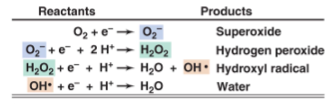
Enzymes converting toxic oxygen intermediate into less harmful substances
Catalase: converts toxic hydrogen peroxide
Peroxidase: hydrogen peroxide (with NADH)
Superoxide dismutase: superoxide (but produces hydrogen peroxide)
Superoxide dismutase with catalase: superoxide
Superoxide reductase: superoxide (but produces hydrogen peroxide)
Regarding sterilization, what is the decimal reduction time? What is the most heat and chemical resistant form of microbial life? How is heat and chemical resistance achieved in this case?
Heat sterilization: exponential decay curve
Exponential because chance of death is independent, heat has an all or nothing effect so history of heat exposure has nothing to do with preset chance → sterility is mathematical prediction
Decimal reduction time: survival fraction passing 10% (changes with temperature and microorganism)
Bacterial endospores are most heat and chem resistant
Core dehydration, Ca presence, SASPs protect DNA
When would sterilization by radiation or filtration be preferable to sterilization by autoclaving?
When material cannot withstand high heat, moisture, pressure
Autoclave: sterilizes liquids at 121 C operating at pressure of 15 lb/in, slow exhaust cycle or will explode, needed to kill endospores/thermophile, different than pasteurization (71 C for 15 sec)
Radiation: generation of free radicals that damage DNA and protein, exponential decay curve
Filtration: multiple types (depth filter contamination can be wide spread, people dead)
When it comes to antimicrobial agents, what is the difference between a bacteriostatic versus bacteriocidal agent?
Bacteriostatic: stop growth but don’t kill microorganism
Bactericidal: stop growth and kill microorganism
Bacteriolytic: stop growth, kill, lyse microorganism
Define the minimum inhibitory concentration (MIC) for a particular antimicrobial agent. Would you expect the MIC of a particular antimicrobial agent to differ in vivo versus in vitro? Explain why.
Lowest concentration needed to inhibit the growth of a test microorganism under defined conditions
Yes, greater in vivo than in vitro due to serum binding, drug half life (hydrophobic nature of drugs → binds to components and lower actual # of free agents)
What is the difference between an antimicrobial agent and substances like disinfectants and antiseptics?
Disinfectants (used on surface) and antiseptics (used topically on the body, less harsh)
Antimicrobial is broader (unique molecular targets of replication inhibition with high affinity)
2 classes: growth factor analogs produced by chemists, antibiotics produced naturally by microorganisms
What is the difference between growth factor analogs and antibiotics? Give an example of each and briefly describe its mechanism of action.
Growth factor analogs: molecular mockery of actual substrate
Sulfa drugs: first major breakthrough, inhibition
Antibiotics: naturally produced by certain microorganisms
Penicillin: finds target enzymes to stop bacteria from cross linking peptidoglycan
What was Paul Ehrlich's contribution to antimicrobial therapy?
1908 nobel prize for co-discovery of anti-toxins (antibodies)
Worked on vital dyes that react strongly with bacteria that wouldn’t bond with mammalian tissue →
Magic bullet theory: lock and key mechanism involving side chain sterochem
First drug was salvarsan used for syphilis (effective but side effects)
What is a photoautotroph? A photoheterotroph? A lithoautotroph? A lithoheterotroph? A chemoheterotroph? (Hint: one or two sentence explanations are sufficient)
Carbon and light source key in nomenclature

Why are no chemoautotrophic organisms present in nature?
Have to process a lot of inorganic molecules to extract tiny amount of usable energy so cannot compete under than specific conditions of unavailable light and chemical energy abundant
What is the difference between fermentation and respiration? In outlining your answer, consider glucose as the starting carbon source.
Fermentation: anaerobic, partial glucose breakdown, yield 2 ATP per glucose, lactic acid product, organic molecule is final electron acceptor (pyruvate), in cytoplasm
Respiration: aerobic, complete glucose breakdown, 32 ATP, CO2 + H2O products, O2 final electron acceptor, in cytoplasm + mitochondria
Why wouldn't pyruvate be an acceptable fermentation end product during the breakdown of glucose?
It cannot regenerate NAD+, which is needed to keep glycolysis running (accepts electrons)
What is the purpose of the Citric Acid (Krebs) cycle? What products are liberated during a single turnover of this pathway?
Energy extraction (complete oxidation of fuel molecules decarboxylation → CO2), electron shuttling/reducing potential (generates reduced coenzymes that donate electrons to ETC to produce ATP), supplies metabolic intermediates
Per turnover (Acetyl-CoA): 2 CO2, 3 NADH, FADH2, GTP,
What is the purpose of membrane-bound electron transport chains in respiration? (Hint: there are two major purposes)
Establish proton gradient: as high energy electron move down from one protein complex to next they loose energy that is used to pump proton across membrane to establish electrochemical gradient/PMF (drives ATP synthase)
Regenerate electron carriers: recycling center, dumping their electrons at starting gate of ETC, NADH and FADH2 are oxidized back into NAD+ and FAD (glycolysis and citric acid cycle require)
What is meant by the term "anaerobic respiration", which sounds like an oxymoron?
Aerobic respiration uses oxygen as final electron catcher, anaerobic respiration uses different molecule, respiration means extraction of energy from fuel
Breaks down nutrients to generate energy without using oxygen (different electron acceptor than fermentation using pyruvate)
What is the major function of ATP synthase in the respiratory pathway of microorganisms?
Small efficient rotary motor using proton reentry to drive ATP synthesis
Why is ATP synthase present in the membranes of anaerobic microorganisms that can only carry out fermentation?
Reverse operation to generate PMF at expense of ATP hydrolysis (pumping protons out of cell) used for active transport of nutrient entry, motility spinning flagella, efflux pumps outing toxins
What is the purpose of accessory pigments in microbial photosynthesis?
Increase light absorption by broadening spectra
Photoprotection: absorb and dissipating excess extra light energy as heat
Bacteria have systems homologous to chloroplast’s thylakoid membranes: goal of focusing light energy at transfer zone to pump protons or drive ATP synthesis when needed
How do anoxygenic and oxygenic microbial photosynthesis differ? Be sure to name external electron donors in each case
Anoxygenic
No oxygen generation
1 photosystem
Cyclic electron flow
Generates PMF & NADPH
Needs external electron donor
Purple bacteria: low infrared light so make ATP using PMF & ATP synthase because reverse electron flow (energy consuming) to make NADPH
Green sulfur and heliobacteria: don’t do former because higher energy can directly synthesize NADPH (NADPH = reducing potential)
Oxygenic (z scheme)
Oxygen generation
2 photosystems
high reducing potential of P680 splits H2O, free electron flows to photosystem I for reduction of NADP (1 can operate independently to generate PMF/ATP when reducing potential not needed

Redox tower and potential
Pairs: something oxidized, something reduced
Strongest reductant on top, oxidant on bottom: greater drop = greater energy availability (going up needs PMF)
What is the purpose of the Calvin cycle? Be sure to explain the first key step in the cycle and name the enzyme that catalyzes it.
Reducing carbon: CO2 → carbohydrate (to biosynthesis) using NADPH & ATP (from light reaction)
RubisCO is key first enzyme (most abundant on Earth - hard/slow reaction rate, not efficient enzyme) breaking apart and fixing carbon
RubisCO regenerated by cycle
Explain how the catabolic strategy of a lithotroph is not so different from an organotroph (i.e. chemoheterotroph) when it comes to energy generation. Hint: generically, what key enzymatic pathways or enzymes are shared?
Used ETC for energy generation (ATP), difference is organic vs inorganic compound as initial electron donor