Database Exam 1
 Call Kai
 Learn
 Practice Test
 Spaced Repetition
 Match
 Flashcards
 Knowt Play
1/87

There's no tags or description
Looks like no tags are added yet.
88 Terms
Analysts who focus on database
database analysts and data modelers
a view of the entities, attributes, and relationships involved in the world being modeled (conceptual schema) as well as a view of tables, fields, and primary and foreign keys
designer view
software used to manage databases
DBMS
in traditional file processing, each application shares data files
false
a view that makes this person involved in the physical schema only
admin view
person who oversees the projects and managers the personnel
project manager
people who use the applications and database
end users
departmental multi tiered client/server databases
intended for several users, department wide
person who analyzes the business situation and establishes requirements who has technical expertise for overall information systems
systems analyst
person, place, object, event, or concept about which an organization wishes to maintain data
entity
traditional methodology used to develop, maintain, and replace information systems
systems developed life cycle
in independent file processing systems, unplanned duplicate data files are
the rule rather than the exception
Personnel responsible for maintains the database
database admin
Advantages to database systems
program-data independence
reduced program maintenance
better data quality
metadata typically describes all of the following
length
data type
allowable values
which sql sublanguage is used to define database structures such as tables
DDL
Which SQL sublanguage includes operations such as SELECT, INSERT, UPDATE, and DELETE
DML
Which SQL sublanguage is primarily concerned with database privileges and access control?
DCL
in a database table, a row is called a
record
primary purpose of sql
communicating with and managing relational databases
in a database table, a column is also called a
field
what is a schema
a database blueprint describing its structure
multi variate attributes in ER notation
{inside flower brackets}
type of relationship: employee may have no or one parking space
optional 1:1
in data definitions, a fact is
an association between two or more terms
entity instance
a single person, place, object, event, or concept
relationship with a min and max of 1
mandatory 1:1
type of relationship: order must contain one product but may contain several products
mandatory many
a relationship involving two different entity types
binary
identifiers in ER notation
text with a single underline
a relationship between entities of the same entity type is of ___ degree
unary
relationship type: a customer may place zero, one, or many orders
optional many (0,N)
relationship involving three entity types
ternary
a required attribute must have
a value for every associated entity or relationship instance
an identifier (key) is
an attribute or combination of attributes that uniquely identifies an entity instance
strong entities
exist independently of other entities and have its own unique identifier
derived attribute
an attribute whose value can be calculated from related attribute values
[derived attribute square brackets]
composite attributes
consist of multiple component attributes where all components are required
have meaningful component parts or sub attributes
ex: employee address broken into street, city, state, and postal code
ER models represent
objects of interest to the user that will be represented or displayed through the system
an attribute is
a property or characteristic of an entity or relationship type
multivalued attributes
may take on one or more than one value for one entity or relationship instance
descending order query
ORDER BY x DESC
check is a value is missing
WHERE value IS NULL
in query execution, which clause is executed first
FROM
in ORDER BY x DESC, y DESC, what is y?
a tiebreaker when x value is the same
find names that do not match ‘A%’
WHERE name NOT LIKE ‘A%’
find records where a specific value is present
WHERE x IS NOT NULL
filter grouped or aggregate results using
HAVING
round to nearest hundred
ROUND(value, -3)
Which query stacks results and removes duplicate rows
UNION
what role can a subquery in the FROM clause serve
acts as a temporary result table that the other query can use
what must be true for two query results to be combined with a set of operations such as union
they must return the same number of columns with compatible data types
what does query-A EXCEPT query-B
rows from query-A that are not in query-b
set operation the preserves duplicate rows
UNION ALL
in JOINs when join on cols have the same name
USING(col name)
joining on two conditions
ON a.col1 = b.col1 AND a.col2 = b.col2
write a query to create a new schema
CREATE SCHEMA ‘schema_name’ ;
Write a query to create a new table with two columns
CREATE TABLE ‘schema’.’table_name’ (
‘col_1’ DATA_TYPE NOT NULL,
‘col_2’ DATA_TYPE NULL
PRIMARY KEY (‘col_1’));
Write a query to select all columns from a table
SELECT * FROM table;
How do you access the ER diagram of your database?
reverse engineering
How do you apply changes from the ER diagram model to the database?
forward engineering
How do you manually add data rows without writing a query?
SELECT * FROM table;
In the query results, you can manually add new rows of data & click APPLY
Many to many relationships require
an intermediary child table from the parent tables defining the relationship
Ex: many students enrolled in many courses requires “enrolled-in” relation between “student” and “course”
How do you add a column to a table?
ALTER TABLE schema.table
ADD col_name datatype;
How do you remove a column from a table?
ALTER TABLE schema.table
DROP COLUMN col_name;
How do you rename a column in a table?
ALTER TABLE schema.table
RENAME COLUMN old_name TO new_name;
How do you change the datatype of a column in a table?
ALTER TABLE schema.table
MODIFY COLUMN col_name datatype;
How do you insert values into a table?
INSERT INTO schema.table(col_1, col_2, col_3, …)
VALUES (col1_val, col2_val,...), (col1_val, …);
How do you change all values in a column?
UPDATE schema.table
SET col_name = value;
Definition Language (DDL)
Defines and modifies the database schema/structure.
CREATE, ALTER, DROP
Which sublanguage is CREATE, ALTER, DROP?
DDL
DML: Data Manipulation Language
Modifies the actual rows/records inside tables.
INSERT, UPDATE, DELETE
Which sublanguage is INSERT, UPDATE, DELETE?
DML
DQL: Data Query Language
Fetches and reads data without changing anything.
SELECT, FROM, WHERE, UNION
Which sublanguage is SELECT, FROM, WHERE, UNION?
DQL
Display Title and Price for books costing more than $30

Display each unique Genre from Book (no duplicates).

Display FirstName, LastName, and Age for customers aged BETWEEN 21 AND 2
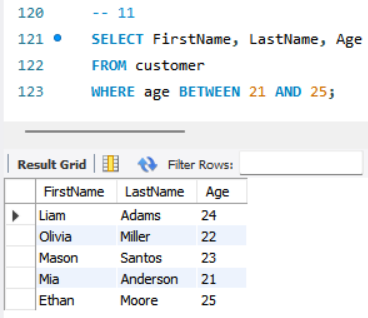
Display FirstName and LastName for customers whose LastName starts with M
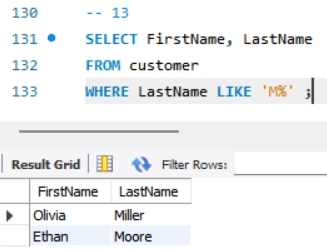
Display FirstName and LastName for customers whose LastName has exactly five letters and ends with “tone”
or just _tone bc _ is exact

Count how many different cities appear in Customer. Label the result UniqueCities.

What order do SQL queries execute in after they’re written?

How do you prevent errors in DDL when tables don’t exist?
DROP TABLE IF EXISTS table_name;
How do you add a foreign key to an existing table?
ALTER TABLE table_name
ADD CONSTRAINT fk_name
FOREIGN KEY (col_name)
REFERENCES ref_table(ref_col);
Dropping tables with relationships
a referenced table cannot be dropped while another table depends on it.
delete the dependent table first
ex: if student references department, drop student first
Insert rows from one table into another
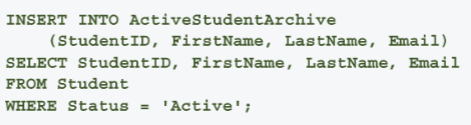
Delete rows from a table
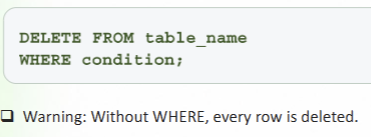
Delete all rows from a table without deleting the table or its structure
TRUNCATE TABLE table_name;