BIO 101- EXAM 3 MATERIAL
 Call Kai
 Learn
 Practice Test
 Spaced Repetition
 Match
 Flashcards
 Knowt Play
1/58

There's no tags or description
Looks like no tags are added yet.
59 Terms
activation energy
energy needed to begin a chemical reaction
gel electrophoresis
a standard laboratory technique used to separate macromolecules such as DNA, RNA, and proteins based on their size and electrical charge As the molecules move through the gel, the porous matrix acts as a molecular sieve. Smaller fragments navigate the pores more quickly and travel farther down the gel, while larger fragments move more slowly and remain closer to the starting wells.
exergonic reaction
spontaneous reaction
reactants had more free energy than the products
The energy released from an exergonic reaction (like ATP hydrolysis) drives the endergonic reaction, allowing the cell to perform necessary work and maintain life.
endergonic reaction
a type of chemical reaction that requires an input of energy to proceed
This results in products that have higher free energy than the reactants: non-spontaneous
active site
where substrate binds to an enzyme
what organelles are involved in catabolic (breaking processes)
lysosomes (break down macromolecules) proteins into amino acids, carbohydrates into sugars, lipids into fatty acids, nucleic acid to nucleotides this process is exergonic
mitochondria (cellular respiration) break down products of glucose (pyruvate) into simple molecules: carbon dioxide and water. this process is exergonic (releases a large amount of energy)
how ribosomes build protein
by linking amino acids together with peptide bonds in an anabolic reaction
catabolic reaction
breaks down complex molecules into simpler ones, releasing energy in the process. spontaneous. (ex: cellular respiration and lysosomal activity)
cellular respiration
The breakdown of glucose in the mitochondria to produce carbon dioxide, water, and large amounts of ATP is the prime example of a catabolic pathway
anabolic reaction
the set of metabolic processes that construct complex molecules from simpler ones. These are the "building" reactions of the cell. assemble macromolecules. endergonic. requires energy in form of ATP (ex: photosynthesis)
protein synthesis
Linking amino acids together via peptide bonds on a ribosome to form a protein chain (polypeptide).
why is molecular cloning used to create pharmaceutical drugs
used for prokaryotes because the genetic code in nearly universal so prokaryotes can transcribe and translate the material easily
most enzymes are
proteins
how glucose create energy
cellular respiration in the mitochondria, breaks down glucose and energy released is ATP, and that is what is used for energy.
how are enzymes a biological catalyst
they lower the amount of activation energy needed for a reaction to start. needed for digestion, DNA replication, and metabolism
what is the transcription bubble
a localized region where the DNA double helix is unwound (separated into two single strands) to allow the process of transcription to occur
what does the transcription bubble contain?
RNA poly, DNA template, growing mRNA
coupled transcription and translation
only in prokaryotes (bacteria and archaea) where the two process occur simultaneously in the same location.
describe the processes of transcription and translation
transcription first, RNA poly transcribes a gene from the DNA template into mRNA (anabolic process, requires energy)
Translation begins before transcription ends, ribosomes bind to the beginning of the mRNA strand and begin synthesizing proteins (anabolic process, requires energy)
silent mutation
a type of gene mutation that causes a change in the DNA sequence but ultimately does not alter the resulting amino acid sequence of the protein produced.
frameshift mutation
a type of gene mutation caused by insertions (adding) or deletions (removing) of nucleotides in a DNA sequence. alters how the ribosome interprets the codons
missense mutation
a type of gene mutation where a single nucleotide change (a point mutation) results in a codon that codes for a different amino acid than the original codon. changes the amino acid at one specific location
nonsense mutation
a type of gene mutation where a single nucleotide change (a point mutation) results in the formation of a premature stop codon
telomers
protect ends of chromosomes from exonucleases, maintain the integrity of the lagging strand
lagging strand
The lagging strand is one of two strands of DNA synthesized during DNA replication. It is synthesized in a discontinuous manner, moving away from the replication fork in short segments called Okazaki fragments.
leading strand
The leading strand is one of the two newly synthesized strands of DNA created during DNA replication. It is synthesized continuously in the same direction that the replication fork is moving
general transcription factors
a set of proteins essential for initiating transcription in eukaryotic cells
how do you decode DNA strands?
transcription: DNA to RNA) specific segment of DNA is copied into a mRNA molecule. A is transcribed into U. T-A, C-G, G-C
translation: (RNA to protein) instructions carried by mRNA are used to assemble a chain of amino acids, forming a protein. ribosome scans for start codon to begin this process.
repair mechanisms in DNA replication
Incorrections are removed, and DNA poly and DNA ligase fill the gap.
describe repair mechanisms: Mismatch Repair
-Mismatch Repair (MMR): This system catches errors (mispaired bases) that DNA polymerase missed during replication, after the proofreading mechanism fails
describe repair mechanisms: Nucleotide Excision Repair
This pathway repairs bulkier damage that distorts the DNA helix, such as the thymine dimers caused by UV radiation. Helicase unwinds the damaged section and removes it. DNA poly and DNA ligase seal the gap
describe repair mechanisms: Base excision repair
his pathway fixes small lesions to a single base, damage is removed, creating a gap. DNA poly and DNA ligase seal the gap
DNA replicates in what kind of manner
semiconservative- each new double-helix molecule produced after replication consists of one original ("parent") strand and one newly synthesized ("daughter") strand
single stranded binding proteins
caps that bind temporarily to single-stranded DNA to keep it from coming back together during replication
central dogma
Replication: The process by which DNA makes copies of itself to pass genetic information to new cells and offspring, ensuring genetic continuity.
Transcription: The process where the genetic information from a DNA gene sequence is copied into an intermediary molecule called messenger RNA (mRNA).
Translation: The process where the sequence of the mRNA is decoded by ribosomes to assemble a specific sequence of amino acids, forming a functional protein.
large ribosomal subunit
the cellular machine responsible for synthesizing proteins (translation). binds to mRNA strand after initiator tRNA has bound to start codon
importance of initiator in translation
initiator codon: AUG signals where the ribosome starts building the protein
What mutations affect activity of substrate binding to enzyme active site?
missense mutations (a single amino acid change), nonsense mutations (creates a premature stop codon), and frameshift mutations (insertions or deletions of nucleotides)
label DNA replication
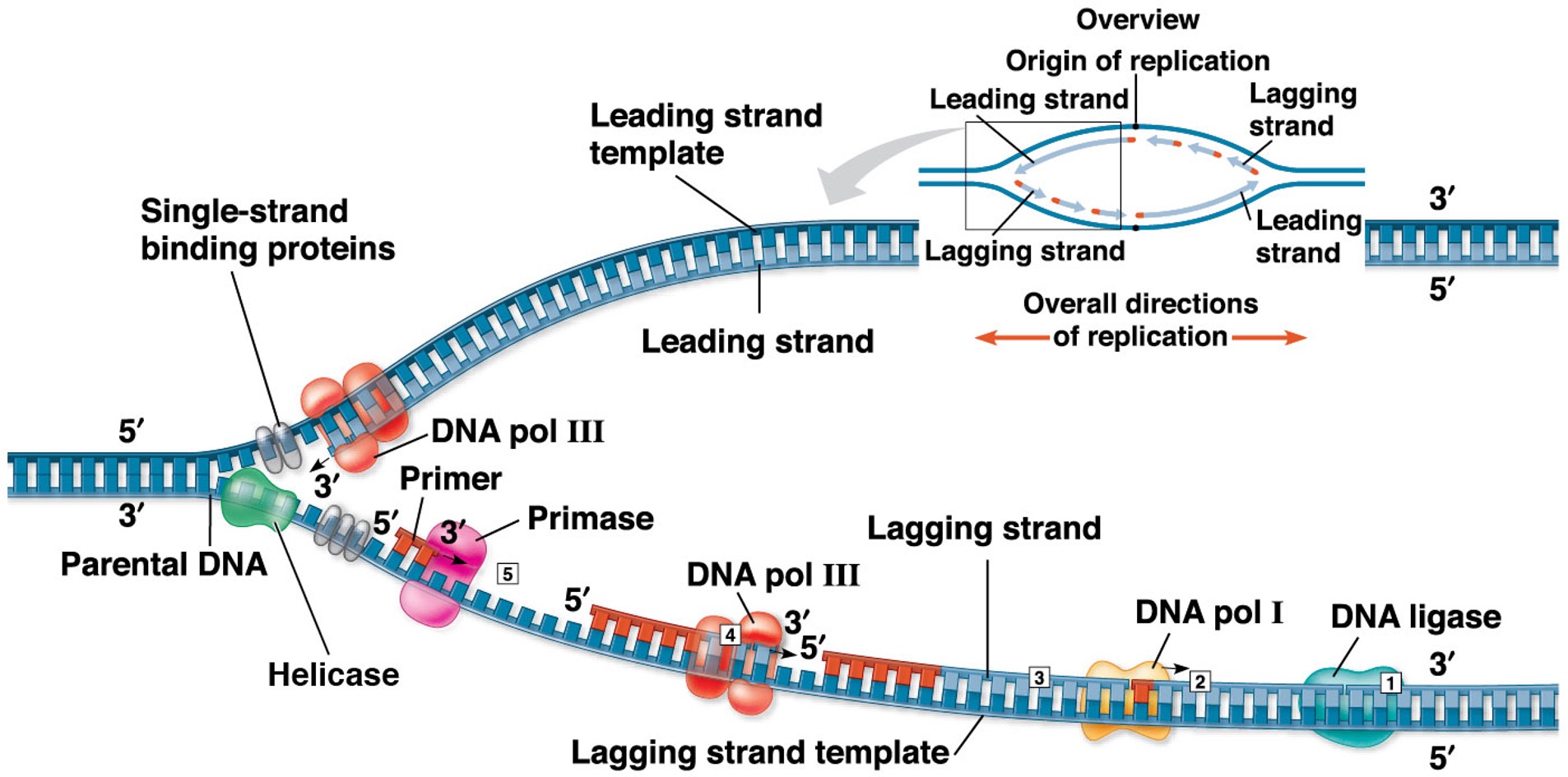
DNA polymerase III
replicates DNA
DNA polymerase I
replaces RNA primer with DNA
primase
creates RNA primer
telomerase
replicates ends of linear chromosomes
ligase
joins okazaki fragmenrs
helicase
separates DNA strands
What processes of replication happen in prokaryotes?
transcription happens in cytoplasm'
multiple genes present in one mRNA transcript
what processes of replication happen in eukaryotes?
introns must be spliced out of the mRNA prior to translation
translation occurs in cytoplasm
5’ cap required for ribosomal attachment
what processes of replication happen in both eukaryotes and prokaryotes?
promoter determines the direction of transcription
RNA poly is used for transcription of mRNA
large ribosomal subunit attaches
A site
incoming tRNA carrying next single amino acid enters the ribosome here
P site
tRNA holding the entire existing protein chain sits here. peptide bond is formed transferring the protein chain to the new amino acid
E site
after peptide bond is formed, now empty tRNA in the P site moves to this site to exit the ribosome to go collect another amino acids
5’ cap
an altered nucleotide added to the 5’ end of a new pre-mRNA molecule in eukaryotes. initiates translation, protects from degradation, ensures introns are spliced out of the pre-mRNA transcript
the 2 ways enzymatic-substrate activity is regulated
competitive inhibitors
noncompetitive inhibitors
competitive inhibitors
bind directly to the active site of an enzyme, inhibiting it by blocking the substrate and separating it from the active site
noncompetitive inhibitors
(allosteric regulation) bind somewhere other than the active site and causes the active site to change form.
how often does transcription, translation, and replication occur?
replication: once during a cell’s life cycle, during s phase
transcription and translation: correlate, happen continuously whenever the cell needs to make a specific protein
horizontal gene transfer
the non-se#ual movement of genetic material between organisms that are not parent and offspring.
how is horizontal gene transfer used in molecular cloning
They trick bacteria into eating DNA: This is called transformation. Scientists mix bacteria with tiny loops of lab-made DNA (plasmids) and use a mild electric shock or chemicals to make the bacteria open their membranes and suck up the DNA.
They use viruses to inject DNA: This is called transduction. They use harmless viruses engineered in the lab to carry the new DNA and inject it into the bacteria.
how can biotech be used for agriculture
maximize nutritional value
prevention from pests
disease resistance