KINS chapter 15 cardiovascular disease risk factors and physical activity
 Call Kai
 Learn
 Practice Test
 Spaced Repetition
 Match
 Flashcards
 Knowt Play
1/88

There's no tags or description
Looks like no tags are added yet.
89 Terms
what fraction of US adults has high blood pressure
about one in two adults, roughly 46.7%
the leading cause of US death every year since 1900, except one
The exception is 1918, the influenza pandemic
941,652 US deaths from cardiovascular disease in 2022, about 29 percent of all US deaths
915,973 in 2023, about one every 34 seconds
How many adults have CVD depends on the definition: 48.9% if hypertension counts, 8.2 percent if it does not
more CVD deaths since 2010, at a lower death rate
US cardiovascular deaths and age adjusted death rates by sex. 1980 to 2024. Deaths rose after 2010 as the population grew and aged; the rate per person rose in 2020 and 2021 and ended lower than in 2010. Men have outnumbered women in deaths since 2013
Dying at an older age

what it costs, and who dies of it
About 415 billion dollars a year in direct and indirect cost, 2021 to 2022
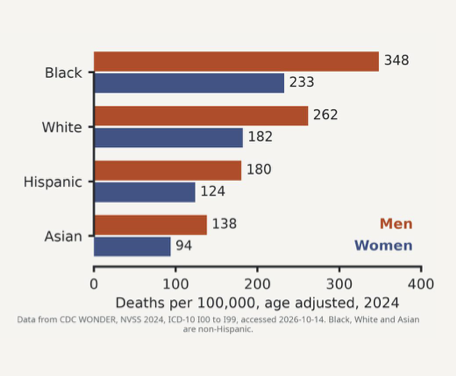
Death rates differ sharply by race and sex. Black men are highest, 348 per 100,000 in 2024
Adjusted for social conditions and risk factors. Black and white adults carry similar risk of fatal coronary disease
Access to resource, fitness spaces
three words that sound alike and mean different things
Arteriosclerosis is the umbrella. Atherosclerosis is the plaque forming kind, Coronary heart disease is what plaque in the coronary arteries does to the heart
arteriosclerosis
thickening and loss of elasticity in artery walls. The stiffening that comes with age is one form of it.
atherosclerosis
the form with plaque: fibrofatty lesions build in the inner wall of medium and large arteries
coronary heart disease
the coronary arteries cannot supply what the heart muscle needs. Also called ischemic heart disease (could happen to ultra endurance runners, cause of muscles)
step 1
the endothelium is injured and LDL-C gets in
Damage to the endothelial lining allows LDL-C to enter the vessel wall

step 2
LDL-C is oxidized and inflammation begins
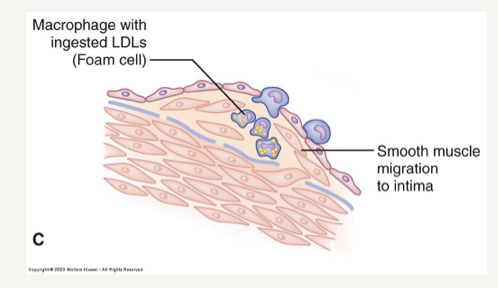
LDL-C in the intimal layer is oxidized, provoking an inflammatory response and drawing macrophages into the arterial wall

step 3
foam cells, smooth muscle migration, plaque
Macrophages ingest the oxidized lipids and signal smooth muscle cells to divide and migrate into the intima, thickening into plaque
put these four in order
Oxidized LDL-C starts an immune cascade
LDL-C levels rise; LDL-C is oxidized in the arterial wall
Macrophages ingest it and plaque adheres to the intima
The endothelium is damaged
The endothelium is damaged (could be high blood pressure, arteriosclerosis)
LDL-C levels rise; LDL-C is oxidized in the arterial wall
Oxidized LDL-C starts an immune cascade
Macrophages ingest it and plaque adheres it to the intima
your textbook defines a risk factor through epidemiological evidence. What kind of claim is that?
an association claim, which may or may not be casual
what is a risk factor and what is not
A behavior, an exposure or an inherited trait that epidemiological evidence associates with a disease worth preventing
That is an association claim. It does not say the factor causes the disease
Some risk factors are causes: lowering LDL-C lowers heart attacks and strokes. Others are markers that predict without causing
No one coined it: the phrase was in insurance by 1895 and in medicine by 1922. Framingham popularized it in 1961 (track large participants risk factors of disease)
three categories of risk factor
the first you count, the second you treat, and the third is where the evidence is still moving
non modifiable, major modifiable, non-traditional
also discussed > Alzheimer’s was it the plaques or associated
non modifiable risk factors
age, sex, family history, race, which is a social variable
major modifiable
lipids, smoking, diabetes, hypertension, obesity, physical inactivity
non traditional risk factors
also called contributing. Inflammation, clotting, stress, apoB, and Lp(a) > an LDL particle with apolipoprotein (a) bound to it
non modifiable: the four you cannot change
You cannot change them, but you can count them, and counting them changes how aggressively you treat everything else
Age and sex > men greater than or equal to 45 years, women great than or equal to 55, per ACSM's current criteria
Family history > myocardial infarction, revascularization or sudden death before 55 in a male first degree relative or before 65 in a female one
Race > a social construct, not a biological predictor. The AHA's PREVENT risk equations leave out
age and sex
men greater than or equal to 45 years, women great than or equal to 55, per ACSM's current criteria
family history
myocardial infarction, revascularization or sudden death before 55 in a male first degree relative or before 65 in a female one
race
a social construct, not a biological predictor. The AHA's PREVENT risk equations leave out
major modifiable: six risk factors you can change
Cholesterol and lipid fractions
Cigarette smoking
Diabetes mellitus
Hypertension
Obesity
Physical inactivity
life’s essential 8: the AHA’s current measure of cardiovascular health
eight metrics in two domains. Sleep is new, and nicotine exposure now counts vaping and secondhand smoke
Health behaviors > diet, physical activity, nicotine exposure, sleep
Health factors > body mass index, non-HDL cholesterol, blood glucose, blood pressure
nice little circle diagram
health behaviors
diet, physical activity, nicotine exposure, sleep
health factors
body mass index, non-HDL cholesterol, blood glucose, blood pressure
and it stopped using categories
The shape changed too: from three boxes per metric to a score that can move a little
2010, Life's Simple 7 > each metric was poor, intermediate or ideal. You were in a box
2022, Essential 8 > each metric scores 0 to 100, and the overall score is the unweighted average of the eight
Reading the score > High is 80 to 100, moderate 50 to 79, low under 50
2010, Life’s simple 7
each metric was poor, intermediate or ideal. You were in a box
2022, essential 8
each metric scores 0 to 100, and the overall score is the unweighted average of the eight
High is 80 to 100, moderate 50 to 79, low under 50
how fat moves around the body
Chylomicrons carry dietary fat from the gut. Very low density lipoprotein (VLDL) carries triglycerides made in the liver
As VLDL gives up its triglycerides it becomes intermediate density lipoprotein (IDL) and then low density lipoprotein (LDL)
LDL carries most of the cholesterol in the blood out to the tissues. High-density lipoprotein (HDL) carries cholesterol back to the liver
HDL's return trip has a name: reverse cholesterol transport
where each lipoprotein goes
Chylomicrons carry dietary fat from the gut. The liver's VLDL becomes IDL, then LDL. HDL brings cholesterol back to the liver
Exercise increases HDL levels

four lipoproteins, and what each one does
Chylomicrons remnants, VLDL, IDL, LDL and Lp (a) all promote atherosclerotic plaque: they are atherogenic. HDL opposes it. The particles share apoproteins because they trade them in the blood

chylomicron
main cargo > triglyceride
main apoproteins > B-48, C,E, A-I, A-II, A-IV
size > 75 to 1200 nm
what it does > dietary fat from the gut to tissue and liver
plaque build up > remnants promote it
VLDL
main cargo > triglyceride
main apoproteins > B-100, E,C
size > 30 to 80 nm
what it does > liver triglycerides out to the tissues
plaque build up > promotes it
LDL
main cargo > cholesterol
main apoproteins > B-100
size > 18 to 25 nm
what it does > most blood cholesterol, out to the tissues
plaque build up > promotes it
HDL
main cargo > cholesterol, phospholipid
main apoproteins > A-I, A-II, C,E
size > 5 to 12 nm
what it does > cholesterol back to the liver
plaque build up > opposes it
LDL-C and Apo-B
Positively related to coronary heart disease
Carries cholesterol outward and leaves it in the wall
This is the one the 2026 guideline still sets a target for
HDL-C and Apo-A1
Inversely related to coronary heart disease
Carries cholesterol back to the liver for excretion
Also anti-inflammatory, antioxidative and vasodilatory
The lipid classification table and the number to read first
Non HDL cholesterol is the total cholesterol minus HDL-C, the cholesterol in every atherogenic particle. ACSM's screening criteria and the 2026 guideline both use it and the guideline's goals run from < 130 down to < 85 mg.dL-1 as risk rises. The table's adult bands dates from NCEP, 2001
Can depend on dietary factors

exercise training changes blood lipids, modestly
Pooled change after exercise training in 148 randomized trials; LDL-C down about 7 mg dL-1, HDL-C about 2. Real consistent, and modest
Bars are confidence intervals (95% confident that it falls in range). Is it significantly significant

what smoking does to the artery
Smoking is not only a lung problem. It attacks the artery by at least separate routes, and it accelerates the plaque process from the start of the hour
Injures the lining > damage the endothelium is step one of atherosclerosis. Smoking supplies it directly
Shifts the lipids > raises circulating total cholesterol and lowers HDL-C
Thickens the clot > platelets adhere, internal clotting speeds up, and the clots are tougher to dissolve
who counts as a smoker, professionally
Current smoker OR quit within the previous six months OR exposed to environmental tobacco smoke. All three count as the positive risk factor
This is the ACSM's current definition in the 12th edition
Six months, not twelve. The ideal-health metric uses twelve. They are different instruments
Exposure counts even if the person has never smoked
The more a person smokes, and the longer, the higher the ris
which person meets the cigarette smoking risk factor as ASCM defines it
someone who gave up smoking four months ago
can exercise help someone stop smoking
Indirectly. Adding exercise to quit support has not been shown to raise quit rates
A short bout of activity does cut cigarette craving, for minutes
Brief isometric or handgrip work during a craving helps in the moment. In two trails it did not raise quit rates
diabetes, and the much larger group just underneath it
Type 2 is 90 to 95 percent of US cases, and the prediabetic group is about four times the size of the diagnosed one
diabetes
40.1 million people in 2023, 12.0 percent of the US population
undiagnosed
27.6 percent of adults with diabetes, 11.0 million adults, do not know they have it
pre diabetes
115.2 million adults. This is the group an exercise physiologist can most change
pre-diabetes already raises cardiovascular risk
Insulin resistance brings dyslipidemia, hypertension, and impaired fibrinolysis
And endothelial dysfunction and inflammation, all before glucose is diagnostic
Across 129 studies, prediabetes carried about 15 percent higher risk of cardiovascular disease than normal glucose
The damage precedes the diagnosis by years. The next slide says how many
insulin resistance starts decades before diabetes
Insulin resistance runs through all 30 years shown. Insulin rises, peaks near year 15 and falls as beta cells fail; diabetes is diagnosed at about year 19

exercise and glucose: what dose, and does weight loss have to happen
No. In type 2 diabetes. Training lowers HbA1c even when body mass does not change, and it raises insulin sensitivity without weight loss
The largest HbA1c drop came at about 1,100 MET minutes a week, roughly 36 minutes a day of brisk walking
Met 1=3.5 oxygen
The worse the control, the bigger the drop: up to about 1 point in severe uncontrolled diabetes, about a quarter to a third of a point in prediabetes
Weight loss is a separate goal, with a separate dose
back to the opening question, and both answers are right
47.7% of US adults at the 130 over 80 definition, 2021 to 2023 at the older 140 over 90 definition. Nobody got sicker in between
Stage 1 hypertension now starts at 130 over 80, stage 2 at 140 over 90
Only about one in five adults with hypertension has it under control
Change the threshold and the prevalence changes. That is what a threshold is
and exercise lowers it, in the people who most need it
Most people with hypertension see blood pressure fall with consistent endurance training, and people at high risk of developing it can lower that risk the same way
Both systolic and diastolic fall, usually without normalization
The effect is larger in people who start higher, which is the useful direction
Isometric training lowers it too; about 6 mmHg systolic in pooled individual data
obesity as a risk factor and as a field measure
About 40 percent of US adults, and the field measures are deliberately crude because they have to work without a laboratory
body mass and waist girth
body mass index
BMI greater than or equal to 30 kg.m-2. Cheap, fast, and blind to where the fast is
waist girth
waist greater than 102 cm in men and greater than 88 cm in women. It is a proxy for visceral fat, which is the part that matters
why both waist girth and body mass index?
BMI misses lean, heavily muscled person and misses a thin person with high visceral fat. Waist catches the second
fat but fit: blunts the risk of a high BMI
CVD mortality by fitness and BMI, pooled from 20 cohorts. Fit people with overweight or obesity showed no significant excess risk; unfit people carried about two to three times the reference risk in every BMI group
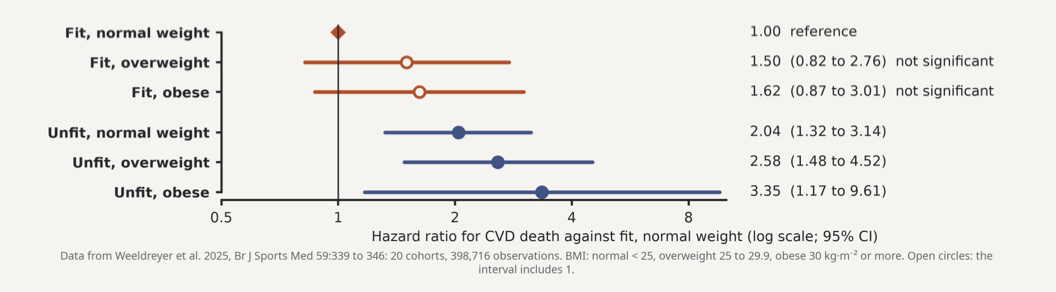
figure 15.8 plots mortality by cardiorespiratory fitness and by percent body fat. Which clam does it support?
Body fat carries risk within each level of fitness
the one risk of exercise itself
During vigorous exertion
Event risk rises transiently, and is the highest in the least habituated
Screening asks about signs or symptoms of cardiovascular, metabolic or renal disease, which can mean medical clearance first
It a real risk, not a theoretical one
Across a life
Habitual activity lowers total cardiovascular risk substantially
The net effect is strongly favorable
The transient risk falls as habituation rises
what does exercise do to lipids
LDL-C and triglycerides fall, HDL-C rises, modestly
what does exercise do to cigarette smoking
indirect only
what does exercise do to hypertension
systolic and diastolic both fall, usually without full normalization
what does exercise do to diabetes
glucose control and insulin sensitivity both improve
what does exercise do to obesity
body fat and visceral abdominal fat both fall
what moved and what to ask next time
Seven metric became eight, and categories became a score
The 2017 blood pressure guideline was retired. Its staging survived
VLDL is atherogenic and Lp(a) is now measured once in every adult
Deaths rose after 2010 while the death rate fell
Of any threshold, ask: whose is it, and when was it set?
health and disease are a continuum, not two states
Disease free, subclinical disease, cardiovascular disease, mild to severe
• In practice it is hard to know the true state of anyone's coronary arteries
• The descriptors depend on what you measured, and on what the measure can see
life’s simple 7, the 2010 construct, now superseded
Four behaviors and three factors, each scored poor, intermediate or ideal. Replaced in 2022 by Life's Essential 8


now read the bottom of that table
Its credit line reads Lloyd-Jones and colleagues, Circulation, 2010
• The definition is sixteen years old, and the AHA retired it in 2022
• A credit line is where the age of a standard is written down
twenty years of ideal cardiovascular health, scored the 2010 way
prevalence of US adults in the ideal category for each of the seven 2010 metrics. 1988 to 2018, the 2010 definition was retired in 2022

whose, and when
Every criteria table is an expert panel's decision, on the evidence it had, on a date
Ask whose, and when, before you ask what the numbers are
When the evidence moves, the table moves
contributing and nontraditional: the third column
Not major, for different reasons, and two of them have since moved up: the 2026 guideline measures Lp(a) in every adult and uses apoB.
inflammation, clotting, and ApoB and Lp(a)
inflammation
C-reactive protein. A marker of systemic inflammation, and
inflammation is central to plaque formation and rupture
clotting
Fibrinogen, which becomes the fibrin threads of a clot, and fibrinolytic activity, which breaks clots down
ApoB and Lp (a)
ApoB counts atherogenic particles, one per particle. Lp(a) is now
measured once in every adult.
is a high HDL still protective? two current answers
ACSM GETP 12e, screening
• HDL-C ≥ 60 mg·dL⁻¹ is a NEGATIVE risk factor
• You subtract one positive risk factor for it
• This is the current edition, not an old one
• 2026 ACC/AHA guideline, treatment
• No HDL goal exists. No total cholesterol goal either
• No total cholesterol to HDL ratio goal
• Also current, also 2026
Source: ACSM GETP 12e; Blumenthal 2026
the dyslipidemia triad
High triglycerides, low HDL-C and small dense LDL-C together carry much higher risk than any one of the three alone.
• It travels with insulin resistance and the metabolic syndrome
• A normal total cholesterol can hide it completely
where the lipid evidence now comes from
A 2025 meta-analysis of 148 randomized training trials, 8,673 participants
• Combined aerobic and resistance training was the most effective mode
• The effects were modest, 3.5 to 11.7 percent, and only about a quarter of trials improved each lipid on its own
adolescent tobacco use as its 2019 peak
Prevalence of tobacco products among US high school students in 2019, by sex and by race or ethnicity

what happened after 2019
High school e-cigarette use was 7.8 percent in 2024, down from 10.0 percent in 2023. The 2019 figure, 27.4 percent, was the peak.
• About a 70 percent relative fall
• Among all students, nicotine pouches are now SECOND at 1.8 percent
• The 2019 survey chart has no pouch category at all
metabolic syndrome is a cluster, not a disease
Visceral obesity and insulin resistance underneath; dyslipidemia, impaired glucose tolerance, hypertension and inflammation on top. Together they carry more risk than their sum.
• Treatment is no different from treating each component
• The value of the label is that it makes you look for the others
• Find one, look for four
the criteria corrected
Any THREE of five. Abdominal obesity is NOT required
• Waist: population and country specific, not one number
• Triglycerides ≥ 150 mg·dL⁻¹
• HDL-C < 40 mg·dL⁻¹ in men, < 50 in women
• Blood pressure: systolic ≥ 130 or diastolic ≥ 85 mmHg
• Fasting glucose ≥ 100 mg·dL⁻1
twenty weeks of aerobic training
Effect of 20 weeks of aerobic training on each metabolic syndrome risk factor. Every factor improved except HDL-C. 30.5 percent of participants no longer met the criteria afterwards

where the field went next
The AHA now tracks cardiovascular-kidney-metabolic syndrome. The cluster idea survived; the boundaries moved, and the kidney came inside them.
• Same pattern as Life's Essential 8: the construct was revised, not abandoned
does being active rescue setting all day
Partly. In more than one million people, high levels of activity largely offset the mortality risk of long sitting. Low levels did not.
• The amount needed is substantial, not a 30 minute session
• Sitting and inactivity are related but not the same exposure
where the fitness and mortality evidence came from
The Cooper Institute cohort. 9,777 men, two full examinations between 1970 and 1989, with fitness measured as treadmill time converted to maximal oxygen uptake.
• Unfit was defined as the bottom quintile for age, which is a choice, not a fact
• Men who moved out of the unfit group lowered their mortality risk
• The original fitness and mortality report from this clinic appeared in JAMA in 1989
this starts in childhood and it tracks
Childhood risk factors predict cardiovascular events in midlife: in 38,589 people followed about 35 years, each unit of combined childhood risk carried
2.71 times the hazard of a fatal event
• Blood pressure tracks moderately from childhood into adulthood
• Fitness and activity are important moderators, most clearly for body fat
activity in high school
Prevalence of US high school students meeting recommended physical activity levels, by sex and by race or ethnicity.

about one in five US children and teens have obesity
Obesity among US children and adolescents by sex and age, NHANES August 2021 to August 2023, with 2015 to 2016 outlined. 21.1 percent of 2 to 19 year olds.
