nutrition - lipids
 Call Kai
 Learn
Learn Practice Test
 Spaced Repetition
 Match
Match Flashcards
 Knowt Play
1/24

There's no tags or description
Looks like no tags are added yet.
Name | Mastery | Learn | Test | Matching | Spaced | Call with Kai | Chat |
|---|
No analytics yet
Send a link to your students to track their progress
25 Terms
Lipids - General information
Generally insoluble in water
Important source of energy (diet, energy storage)
Cell membrane (lipid bilayer)
Microbial phospholipids, mpl, more in abomasum than consumed
Supply essential FA
For synthesis of hormones
Lipids - General information Pt 2
Used for abs for fat soluble vitamins (ADEK)
Increase palatability of feed
Too much fat decreases palatability (ruminants dislike too much added fat)
Condition feed (decrease dust, decrease fines as they will clump together → decrease in sorting)
Lipid structure
Fatty acids: straight chained hydrocarbons
Terminate in a methyl group, CH3-(CH2)n-, and in a carbonyl group, -COOH
Even number of carbons
Saturated fatty acids
Unsaturated fatty acids
Saturated FA (SFA)
No carbon double bonds (c=c)
Contain all hydrogens they can contain
All the energy they can contain
Unsaturated fatty acids (UFA)
One or more carbon double bond
Monosaturated fatty acids (MUFA): 1 c=c, missing 2 hydrogens
Polyunsaturated fatty acids (PUFA): contain more than 1 c=c, missing 2 hydrogens per double bond
Double bonds determine fluidity
Increase number of double bonds, decrease melting point (becomes liquid), liquid has more c=c
Oil= liquid @ room temperature, many double bonds
Fat= solid @ room temperature, few double bonds
Triacylglycerol = triglyceride (TAG)
95% of fat consumed
3 position for each glycerol
Sn1, Sn2, Sn3
3 ester bonds
Lipase hydrolysis with water TAG to 3 fatty acid and glycerol backbone
TAG synthesis, expels 3 water and remakes TAG

Phospholipid
Glycerol backbone
Hydrophobic section
Sn1, Saturated fatty acid, no c=c and 4 carbons entirely
Sn2, Unsaturated fatty acid, 1 c=c, 12 carbons in total
Hydrophilic section
Sn3, polar head group with phosphorus

Non ruminant lipid digestion
TAG(Triacylglycerol) with lipase + H2O → DAG (diacylglycerol) + FFA
DAH with lipase + H2O → MAG (monoacylglycerol) + FFA
Small intestine absorbs FFA (free fatty acids)
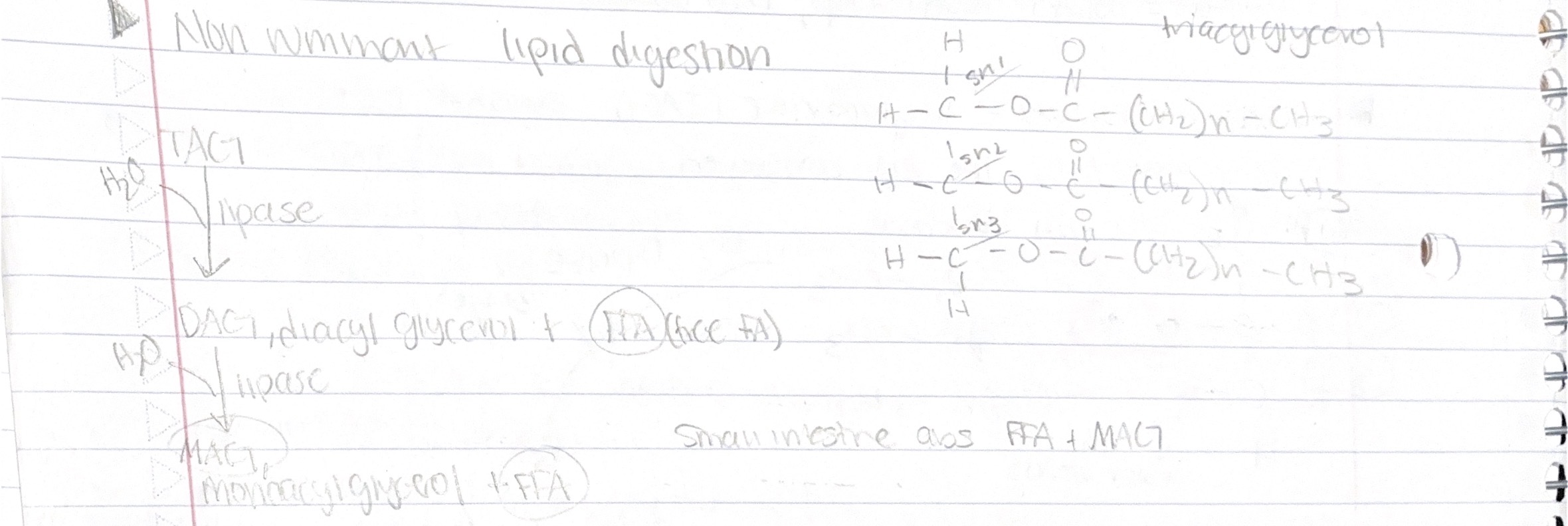
Non ruminant lipid digestion - stomach activity
Lingual lipase: produced by salivary glands, active in stomach
Gastric lipase : produced by chief cells in stomach
Shared characteristics of LL and GL
Produced continuously, production increases with increased fat intake
Both are stable and active at low pH of stomach
Prefer Hydrolyzes short to medium chain FA
Act on FA at sn3 position
Emulsification and 2 types
Increase surface area of fat droplets by making many small fat droplets
Physical emulsification: takes place in stomach and small intestine
Mixing of food/digesta and movement of food/digesta into SI
Chemical emulsification: takes place in SI, maintains small fat droplets
Facilitated with bile (made of cholesterol, stored in gallbladder, synthesized in liver) coats fat droplet to stabilize it
Bile is amphipathic, hydrophobic and hydrophilic
Non ruminant lipid digestion - Proteins in Si to digest TAG
Pancreatic lipase: Hydrolyze FA from TAG at sn1 and sn3 position
Procolipase: not an enzyme, produced by pancreas, activated to colipase by trypsin
Procolipase with trypsin → colipase
Colipase: has hydrophobic region that can interact with fat droplet
Creates binding site for pancreatic lipase
Non ruminant lipid digestion - mouth digestion of TAG
Mouth, minimal digestion (TAG)
Lingual lipase in mouth (sn3 position on TAG)
Decreases particle size
Hydrolyzes TAG into DAG with LL and water

Non ruminant lipid digestion - stomach digestion
Mostly TAG, some DAG, FFA
Gastric lipase sn3, physical emulsification
TAG hydrolyzed with lingual lipase and gastric lipase with water to produce DAG

Non ruminant lipid digestion - small intestine
Mostly TAG, some DAG and FFA
3 phases
1. Emulsification: physical (mixing), chemical (bile)
2. Enzymatic: pancreatic lipase (sn1 and sn3 position), procolipase with trypsin → colipase
TAG is hydrolyzed with pancreatic lipase with water to produce FFA and DAG, and the again to produce FFA and monoacylglycerol
Sn2 position left with FA
3. Absorption, MAG + 2FFA (diffuse into enterocyte, no transporters)
Bile absorbed in ileum
Li/cecum, undigested lipids and acted on by microbes
Almost all lipid absorb in small intestine

Lipid digestion in enterocyte - FA
FA less than or equal to 10 carbons, move through enterocyte and directly enter the blood
In the blood, albumin binds FA and takes it to liver
FA more than or equal to 12 carbons, subjected to intracellular TAG reformation
MAG + FFA → releases H2O → DAG + FFA → releases H2O → TAG
Done by acylCOAsynthetase
Endoplasmic reticulum
Accumulate TAG, ADEK, cholesterol into fat particle
Add protein, B48, to particle
B48: apolipoprotein that stabilizes lipoprotein (fat particle), confers specificity (name tag, exogenous lipid), and enables lipoprotein lipase to hydrolyze TAG into DAG and FFA
Lipoprotein lipase: located on surface of muscle and adipose tissue
Lipid digestion in enterocyte - Golgi apparatus and chylomicron
Lipoprotein is pinched off as lipid vesicle
Golgi apparatus, CHO attached to lipoprotein → chylomicron
Chylomicron: complete fat particle (82% TAG, 7% phospholipid, 2% cholesterol, ADEK, 9% protein)
Exocytosed into lymphatic circulation into blood slowly
Lipoprotein lipase takes TAG and makes it into DAG and FFA in muscle and adipose tissue
Used for energy and storage
Chylomicron remnant: devoid of TAG, removed by liver and metabolizes it
Proteins summary
Lingual lipase: is in stomach, breaks ester bond and does TAG digestion
Gastric lipase: stomach, breaks ester bond and does TAG digestion
Pancreatic lipase: in small intestine, breaks ester bond and does TAG digestion
Procolipase (not enzyme): small intestine, activated to colipase by trypsin and helps PL
Proteins summary Part 2
Trypsin: small intestine, activates Procolipase to colipase
AcylCOAsynthetase: in enterocyte, synthesizes TAG to in enterocyte
B48 (not enzyme): in chylomicron; stabilizes, names, and allows lipoprotein lipase to work
Lipoprotein lipase: in muscle and adipose tissue, takes TAG and hydrolyzes it to DAG and FFA
Albumin: not an enzyme, in blood and transports FA less than 10 carbons to liver
Pig digestion lipids - mouth and stomach
In mouth TAG is consumed, mouth reduces particle size and produces lingual lipase (attacks sn3 position of TAG)
Gastric lipase produced in stomach, attacks sn3 position of TAG
In stomach, through lingual lipase or gastric lipase and water, TAG is hydrolyzed to mostly TAG but some DAG and FFA
In stomach, physical emulsification occurs
Pig digestion lipids - liver, pancreas, duodenum
Bile is produced in liver which is stored in gallbladder, then goes to duodenum
Enterohepatic recycling of bile from ileum (absorbed ) and sent back to liver
Pancreas produces pancreatic lipase and procolipase
Fat droplet in duodenum (TAG, DAG, and FFA), CL and PL attached to fat droplet
In duodenum, there is physical and chemical emulsification (bile)
Pig digestion lipids - jejunum
Through absorption and digestion of lipids, 2FFA and MAG released in jejunum
In jejunum, procolipase to colipase by trypsin
In enterocyte, fatty acids with less than or equal to 10 carbons and transported into blood by albumin
Also in enterocyte, fatty acids with more than or equal to 12 carbons and MAG are converted into TAG by acylCOAsynthetase, which turns into chylomicron
Exocytosed into lymphatic and then enters blood
Chylomicron through blood is sent to muscle and adipose tissue for energy or fat synthesis
Chylomicron is also hydrolyzed into DAG and FFA through lipoprotein lipase
Chylomicron remnant is sent to liver
Pig digestion lipids - ileum and large intestine
Bile from ileum used for enterohepatic recycling to liver
In large intestine mpl synthesis is excreted
In large intestine, after digestion and absorption of lipids, two things occur:
1. Hydrolysis, making ester bonds, produces glycerol which produces VFA (B) is then absorbed
2. UFA → SFA through hydrogenation (addition of H2), excreted
Enterocyte - lipid digestion
Fat droplet with TAG, FFA, and MAG
FA with less than or equal to 10 carbons diffused into enterocyte and then goes into blood (binded with albumin) to liver
FA with greater than or equal to 12 carbons and MAG converted to TAG with acylCOAsynthetase
Produces release of 2H2O, helps produce 2 ester bonds for TAG
TAG goes to endoplasmic reticulum and accumulates, B-48 bound to TAG
TAG goes to Golgi apparatus and now has carbohydrates attached to it, becomes Chylomicron
Chylomicron is Exocytosed from enterocyte and enters lymphatic and into blood with time
Chylomicron enters muscle and adipose tissue and then becomes Chylomicron remnant (devoid of TAG) and goes back to liver
With lipoprotein lipase and water, TAG from Chylomicron is hydrolyzed into DAG and FFA and absorbed into muscle and adipose tissue