AP Psychology (all terms)
 Call Kai
 Learn
 Practice Test
 Spaced Repetition
 Match
 Flashcards
 Knowt Play
1/71

There's no tags or description
Looks like no tags are added yet.
72 Terms
Psychology
The scientific study of behavior and mental processesthat incorporates various fields such as biology, sociology, and anthropology. It seeks to understand individuals and groups by establishing general principles and researching specific cases.
Functionalism
A school of thought in psychology that focuses on how mental and behavioral processes function to enable adaptation and survival in an environment. It emphasizes the purpose of consciousness and behavior.
Humanistic psychology
A psychological perspective that emphasizes the study of the whole person and the uniqueness of each individual. It focuses on concepts such as self-actualization, personal growth, and the importance of free will.
Nature-nurture issue
The debate concerning the relative contributions of genetic inheritance and environmental factors to human development and behavior.
Natural selection
The process through which organisms better adapted to their environment tend to survive and produce more offspring. This concept, proposed by Charles Darwin, explains the evolution of species over time.
Levels of analysis
A framework for understanding psychological phenomena from different perspectives, including biological, psychological, and social influences.
Psychiatry
A branch of medicine focused on the diagnosis, treatment, and prevention of mental health disorders.
Biopsychosocial approach
An integrative framework that explains behavior, mental processes, and health through the interaction of biological, psychological, and social-cultural factors.
Basic research
Pure, theory-driven science aimed at expanding the general knowledge base and understanding fundamental psychological processes, rather than solving an immediate, real-world problem.
Applied research
Scientific study aimed at solving practical, real-world problems rather than simply building abstract theory
Counseling psychology
A branch of applied psychology that helps people improve their well-being, cope with everyday life challenges, and navigate major life transitions or career choices.
Clinical psychology
The branch of psychology focused on assessing, diagnosing, and treating psychological, emotional, and behavioral disorders.
Hindsight bias
The tendency to believe, after learning an outcome, that you would have predicted or foreseen it all along.
Critical thinking
Thinking that does not blindly accept arguments and conclusions, instead examining assumptions, discerning hidden values, evaluating evidence, and assessing conclusions.
Theory
An explanation using an integrated set of principles that organizes observations and predicts behaviors or events. Supported by evidence, hypotheses, and testable predictions.
Hypothesis
A specific, testable prediction about the relationship between two or more variables, often written as an “if-then” statement.
Operational definition
A precise, measurable statement of the exact procedures or methods used to manipulate or measure a variable in a study
Replication
Repeating a research study — usually with different participants, researchers, or settings — to see if the original findings hold up.
Case study
A descriptive (non-experimental) research method in which a researcher examines one individual — or a very small group — in great depth, often over an extended period, to gain detailed insights and generate new hypotheses.
Survey
A self-report data collection tool — typically a questionnaire or interview — used to gather information about a sample’s thoughts, feelings, attitudes, opinions, or behaviors.
False consensus effect
The cognitive bias of overestimating how much other people share your beliefs, attitudes, values, and behaviors.
Population
The entire group of individuals (or subjects) sharing a specific characteristic that a researcher wants to study and draw conclusions about
Random sample
A group of participants chosen from a larger target population by chance so that every member of that population has an equal probability of being selected.
Naturalistic observation
A descriptive research method in which researchers watch and record the behavior of subjects in their natural, everyday environment without manipulating variables or interfering.
Correlational study
A non-experimental research design that measures two or more variables as they naturally occur to determine how strongly and in what direction they are related
Scatterplot
A graph that plots paired numerical values for two quantitative variables as individual dots on an x and y axis to show how strongly they relate
Illusory correlation
The perception of a relationship between two variables, events, or groups when none actually exist
Experiment
A research method in which a researcher manipulates one or more independent variables under controlled conditions to observe their effect on a dependent variable
Double-blind procedure
An experiment design in which neither the participants nor the researchers working with them know who is in the experimental (treatment) group and who is in the control (placebo) group
Placebo effect
A real change in a person’s symptoms, behavior, or experience caused by their expectation that a treatment will work, rather than by any active ingredient or mechanism in the treatment itself.
Experimental condition
The part of an experiment that exposes participants to the treatment
Control condition
The baseline group in an experiment that does not receive the experimental treatment or manipulation of the independent variable
Random assignment
Placing study participants into experimental and control groups by chance so that every participant has an equal probability of being in any group
Independent variable
The factor a researcher intentionally manipulates or changes in an experiment to observe its effect on a dependent variable.
Dependent variable
The outcome or response measured by a researcher to see how it is affected by an independent variable.
Mode
The most frequently occurring value or score in a data set, serving as a measure of central tendency.
Mean
A measure of central tendency that represents the arithmetic average of a set of scores. Ex. (10+11+3)/3
Median
A measure of central tendency defined as the middle score or value in a data set when all the values are arranged in numerical order (from smallest to largest)
Range
A measure of variability (spread) that equals the difference between the highest and lowest scores in a data set.
Standard deviation
A measure of variability that shows how much scores in a data set typically vary from the mean.
Statistical significance
A conclusion that a difference or relationship found in a study’s data is unlikely to happen by chance alone.
Culture
The enduring behaviors, ideas, attitudes, values, traditions, and artifacts shared by a group of people and transmitted from one generation to the next.
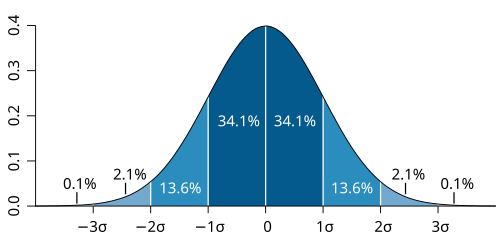
Normal distribution
A symmetrical, bell-shaped frequency distribution where most scores cluster around the center and taper off equally toward both extremes.
Bimodal distribution
A frequency or probability distribution with two distinct peaks, meaning two values or score ranges occur more frequently than others.
Confirmation bias
The tendency to seek out, interpret, and remember information in ways that support pre-existing beliefs or expectations, while ignoring or discounting contradictory evidence.
Overconfidence
The tendency to be more confident than correct — specifically, overestimating the accuracy of one’s knowledge, judgements, and physical or mental abilities.
Percentile rank
The percentage of scores in a comparison (norm) group that fall below a specific score. It shows a score’s relative standing within a distribution, not the percentage of questions answered correctly.
Regression toward the mean
The tendency for extremely high or extremely low scores or measurements to move closer to the average (mean) upon retesting or in subsequent measurements.
Convenience sampling
A non-probability sampling method in which researchers select participants who are easily accessible, nearby, and willing to take part rather than choosing them randomly or systematically.
Effect sizes
A numerical measure of how big or meaningful a finding is. A study can have a statistically significant result with a very small effect size — meaning an effect likely exists, but its real-world impact is tiny.
Peer review
The pre-publication evaluation of a research study by independent experts in the same field to check its methodology, accuracy, validity, and conclusions
Third variable problem
Occurs when an unmeasured outside factor influences two correlated variables, creating a false or misleading impression that they cause each other.
Confounding variable
An outside factor — other than the independent variable — that influences the dependent variable and clouds the true cause-and-effect relationship in a study.
Meta-analysis
A quantitative research method that statistically combines data from multiple existing studies on the same topic to find an overall effect size or trend.
Empiricism
The view that knowledge comes from sensory experience and that science should rely on observation and experimentation to test ideas and evaluate claims. Experience over innate ideas.
Biological psychology
The branch of psychology that studies the physical and chemical links between biology, behavior, and mental processes.
Neuron
A specialized nerve cell that acts as the basic building block of the nervous system, transmitting information through electrical signals (action potentials) and chemical signals (neurotransmitters).
Dendrite
The branch-like extensions of a neuron that receive incoming chemical and electrical messages from other neurons or sensory cells and carry them toward the cell body (soma).
Axon
The long, cable-like projection of a neuron that carries electrical impulses (action potentials) away from the cell body (soma) toward other neurons, muscles, or glands
Myelin sheath
A fatty tissue layer (composed of glial cells) that segmentally encases the axons of many neurons.