Intro to Criminal Justice
 Call Kai
 Learn
Learn Practice Test
 Spaced Repetition
 Match
Match Flashcards
 Knowt Play
1/69

Earn XP
Description and Tags
quiz 1-3
Name | Mastery | Learn | Test | Matching | Spaced | Call with Kai | Chat |
|---|
No analytics yet
Send a link to your students to track their progress
70 Terms
We will see that the Criminal Justice System is…
◦ A large and intricate network
◦ Not Black and White
◦ A means to deliver justice
◦ Framed and represented through media to deliver a message
◦ Is an intricate web which offenders may navigate
◦ Crime is variable, it has a different shape and different definition based on the individual
◦ Crime and laws may be manipulated through media, which shapes how we view crime and the law
What is “The System”?
◦ The Criminal Justice System:
◦ Law Enforcement : ◦ Police and how we respond to crime
◦ Courts: The judicial response to crime
◦ Corrections: How deliver justice and house “criminals”
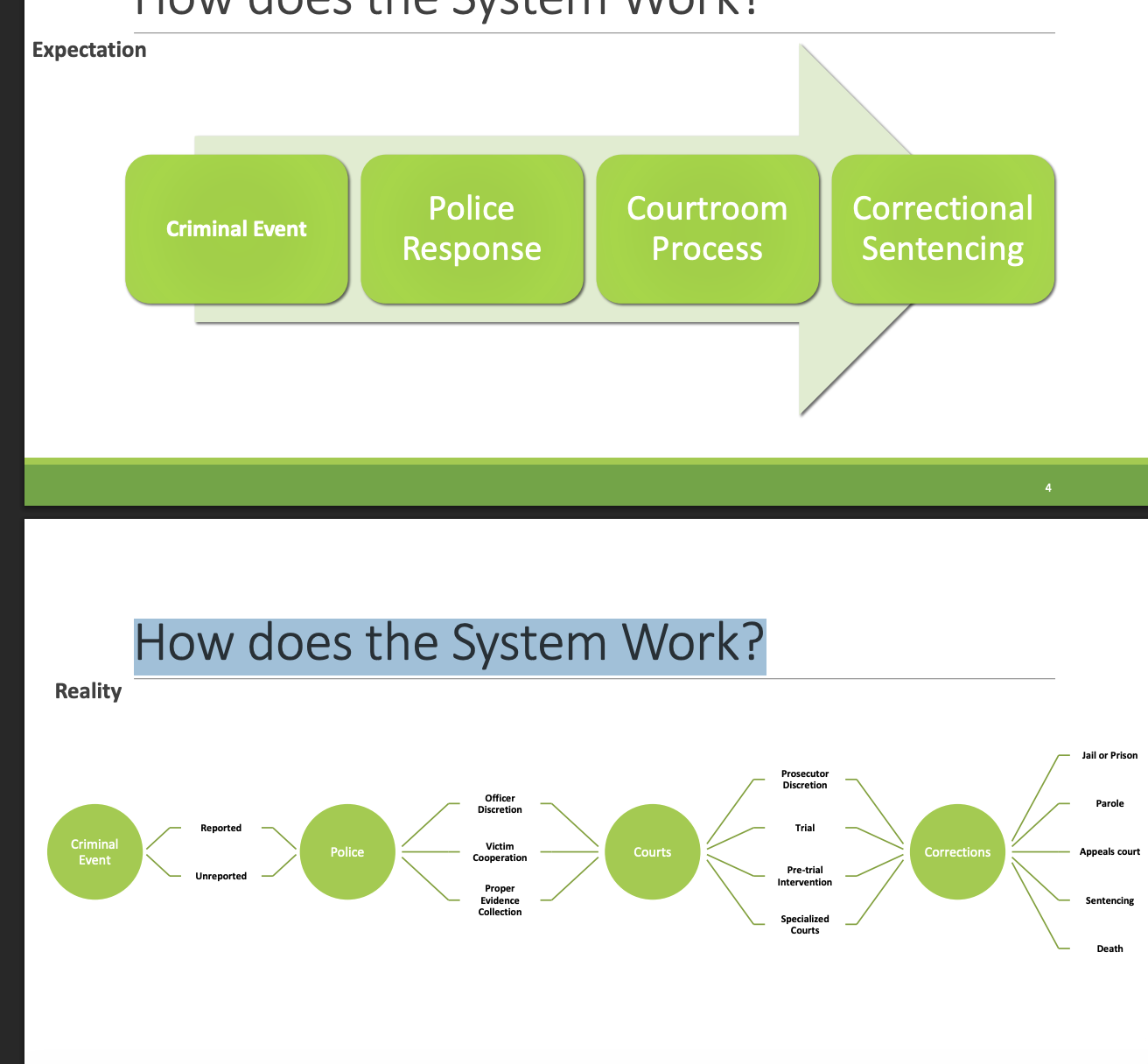
How does the System Work?
The Size of the System
Since the 1980s…:
• The criminal justice system has experienced exponential growth
• Growth of the system does not necessarily mean growth in crime
Because…:
• Violent crime and property crime has experienced consistent decrease (around the 2000s)
• Increased rates of people intertwined with the criminal justice system
• (BJS, 1980 - 2016) 1 in 38 adults have had experiences with the criminal justice system
The Cost of the System
Statistics:
◦ Estimated $212 billion a year
◦ Jails/Prisons spend ~$14,000 – $69,000 a year per inmate
◦ Estimated 2.4 million employees - Across all three branches of the criminal justice system
◦ For those of you who pay taxes: ~$670 a year in taxes goes to the CJ System
But why?
◦ Employees, program costs, maintenance
◦ Tough On Crime Mentality
◦ Promotes punishment
◦ Disregards Humanity
◦ Demonizes Criminal Restoration
Jails v. Prisons
Speaking of the elevated cost of our criminal justice system, a large contributor to the budget is the Correctional system.
◦ We know the criminal justice system incarcerates individuals, but it is a bit more complicated than that
The correctional system in the United States utilizes (roughly) two types of carceral settings:
◦1. Jails:
◦ (Usually) local facilities which temporarily house inmates who are awaiting trial
◦ Short-term incarceration for short
◦2. Prisons:
◦ Long-term carceral settings
◦ Inmates sentenced to these facilities have been formally convicted
Sounds complicated and/or complex, but it is the system we develop in response to crime.

What is Crime?
The breaking of a law, which the criminal justice system or some other authority prescribes punishment.
◦ Authority defines crime through law
◦ Crime remedied through punishment
◦ Does not address morality
◦ Crime does not equal Wrongdoing
Types of Crime

Definitions of Crime

Purpose of the System

Public Policy & the System
So how do we define crime? Who creates the definition of what crime is?
Consensus:
◦ The laws of the people
◦ The law we agree with
Conflict:
◦ The laws of the ruling class
◦ The law we come into conflict with and may disagree on
3. Interactionist:
◦ The laws of the moral entrepreneurs
◦ The law that intersects with society and its evolution over time

The System in the Media
Media:
◦ Physical & Digital Content that we consume in our daily lives, intentionally or not.
ex: ◦ Newspapers ◦ Network News ◦ Facebook, Instagram, Twitter (X) ◦ YouTube and Spotify Podcasts ◦ Tik Tok
◦ Physical & Digital Media can be extremely helpful and keep us up to date on recent criminal-justice related events. BUT there are some concerns…
The System in the Media pt2
We consume content, which is framed (edited) to deliver a message
Delivered through:
1◦ Infotainment
Sensationalization of crime and the system
◦ Edited and framed to promote beliefs and ideas
2. ◦ Narrowcasting:
◦ Tunnel vision of information reported
◦ Delivered to promote a message, belief, or ideal
Common framing in Criminal Justice:
◦ Faulty System, Rampant Violence, Stranger Danger, Social Breakdown, Racist System
The System in the Media pt3
We consume content, so what?
Physical & Digital Media entertains us, enlightens us, and keeps us informed, but we must also consider how it can (potentially) manipulate us. ◦
Spread of potentially harmful ideas through disinformation or misinformation. ◦ -1. Trivial Harm:
◦ All cases go to trial
◦ How to talk to police
◦ 2. Dangerous Harm:
◦ All criminal offenders are mentally ill
◦ Black on White epidemic
◦ Incarceration is the only solution
Outcomes
Crime is:…
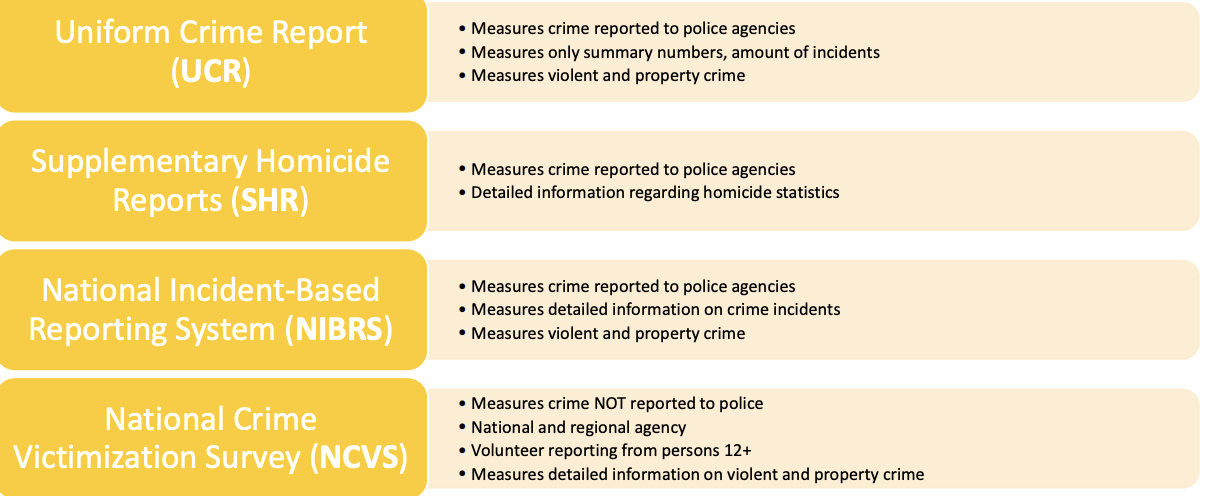
◦ Measured by a variety of agencies, including but not limited to, law enforcement agencies
◦ Measured by data
◦ Observed to determine trends, hotspots, and behaviors
◦ Observed to develop theories
What is Crime
Crime is considered:…
◦ The breaking of a law, which the criminal justice system or some other authority prescribes punishment.
Not only do we categorize crimes:
◦ Violent Crimes
◦ Property Crimes
◦ White Collar Crimes
But we also attempt to measure or attempt to measure these crimes:
◦ We have to categorize in order to measure
Crimes we measure;
• Homicides'
• Violent Crimes
• Property Crimes
• Crimes involving firearms
• Crimes involving illegal drugs
• Trafficking
Measurement of Crime
What is being measured in crime?
◦ Violent Crimes
◦ Non-Fatal Violence
◦ Property Crime
◦ Victimization
◦ Criminal/Deviant Behaviors
◦ Cyber Crime
◦ Terrorism
◦ White-Collar Crime
Why do we measure crime?
1 Prevalence:
◦ The commonality of crime.
◦ How often do incidents occur?
2 Policy:
◦ The policy shift in response to crime.
◦ What incidents require official response?
3 People:
◦ Those who are affected by crime.
◦ Which groups/peoples are affected by crime?
Measurement of Crime pt.2
Who Measures Crime?
1◦ Law Enforcements:
◦ Federal Bureau of Investigation
◦ Police departments and agencies
◦ Law enforcement and police collecting their own data as they respond to crime
2◦ National Agencies:
◦ National Bureau of Justice Statistics
◦ National Crime Victimization Survey
◦ Rather than rely on law enforcements, they independently gather data
3◦ Third Parties:
◦ Independent Researchers
◦ Collect the data themselves
How do we measure crime?: Photo
Measurement of Crime pt.3
How is it being Classified?
There are several approaches and limitations when measuring crime:
◦ Group A & B Crimes:
◦ Classifying offenses into specific criteria
◦ Based on serious of crimes, similar to misdemeanors or felonies
2 ◦ Hierarchy Rules:
◦ When measuring crime, only the most serious crime committed during the incident is recorded
◦ Rather than measuring the entire event, we only measure the most serious offense
◦ There is
3 ◦ Dark Figure of Crime:
◦ inevitable a portion (or percentage) of crime that cannot be measured
◦ Crime that is unknown to the police: ◦ Due to fear of reporting ◦ Due to lack of prosecution ◦ Due to lack of victim to report
Measurement of Crime pt.4
Goal: We want to measure the safety of our neighborhood while we are in college
◦ Who might be involved?: ◦ City Police, College PD, Student Organizations ◦
We might collect: ◦ Burglary/robbery rates ◦ Dates/times of incidents ◦ Types of items typically stolen
◦ So the following changes can be made: ◦ Better locks ◦ More patrols
What else might we want to measure? ◦ Victimization ◦ Items being stolen ◦ Targets being selected
◦ Effectiveness of current crime preventative techniques: ◦ Foot/traffic patrols ◦ Alarm towers ◦ Ordinances and policies

What Data Can Do
Sampson & Laub (2003): ◦ Examination of 500 youths from Chicago ◦ Independent interviews following individuals from age 7 to 70.
Prison Policy Initiative (2020): ◦ Contact with police by racial identity ◦ Sourced from Bureau of Justice Statistics
Federal Bureau of Investigation (2026): • Homicides reported in the United States • Sourced from the Uniform Crime Report
Theory
Data can also…
◦ Be used to develop or test criminological theory
◦ Or be used to develop theories as to why crime occurs
◦ The collection of data and look at incidents, crime trends, offenders, and victims can support the strength of theory. ◦
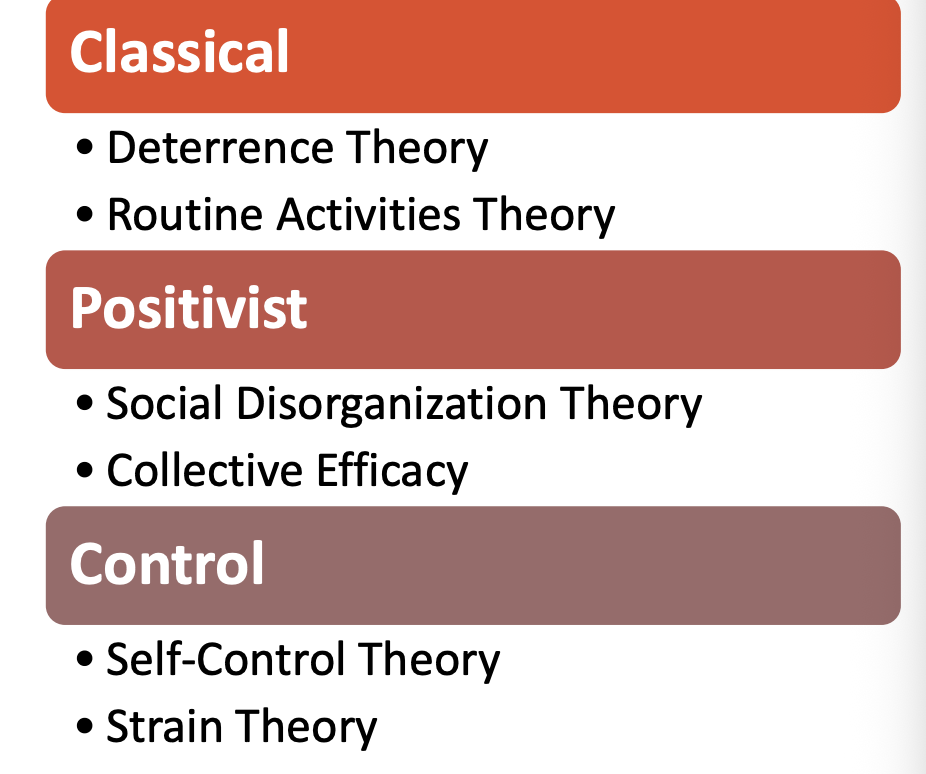
Theories are lenses in which we view crime and criminal events, they are categorized…
criminological theory: photo

Theory pt.2
additional theories: photo
Theory
In summary…
◦ Crime data collection can develop into criminological theory ◦
Crim Theory are lens in which crime & behaviors can be examined
◦ Crim Theory offers an explanation into how and why crime occurs. As well as who it effects or is involved.
However…
◦ Theory is not perfect
◦ No one theory can explain all crime
◦ But some can definitely try
◦ Theory is testable
The Law
We know about crime & how we respond to people breaking the law. But what is the law?
What God says is law
What a King or sovereign decides
A Collection of principles
Collective formal and informal rules
Where does the Law come from?

So what?

The Law
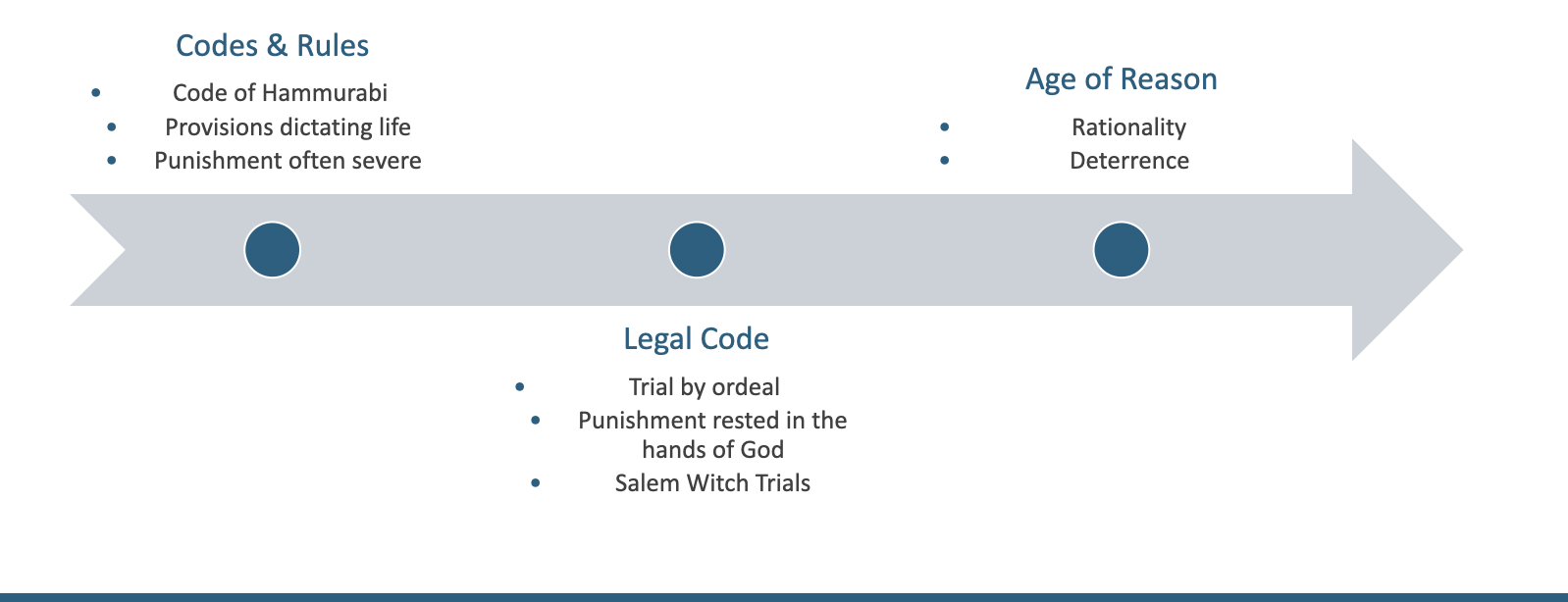
Codes and Rules
Codes of Hammurabi
(~1700 BC) King of Babylon designed regulations and an early form of Rule of Law for his subjects
Structured through “IF…THEN” scenarios
Designed to prevent the strong from oppressing the weak
Legal Code
Giles Corey
(1692) Massachusetts Farmer
He and his wife accused of witchcraft
Denied the allegations and refused to plea
If plead guilty…
If plead not guilty…
If refusing to plea…
Pressed with stones until he decided to plea his case
“More weight”
Age of Reason
The Rule of Law – Individuals and the system will uphold the constitution & Law.
Collective agreement of individuals within a society
Collective agreement to uphold law, not people
Collective agreement legitimizes the systems
The law are rules, regulations, and ethics we agree to uphold.

Rule of Law
Connects all the pieces of the system. Work in conjunction with one another

Types of Law
Procedural Law: The rules of the court
The laws which determine the proceedings of the court and criminal justice system
Rules which determine how cases are handled and how charges are determined
Dictated by case law & precedent
Ex: Marijuana and its varying policies across states
Substantive Law: The rules for the people
The laws which determine how individuals are treated in the criminal justice system.
Rules that determine the rights of individuals
Dictated by the Bill of Rights
Ex: Right to remain silent, right to an attorney, due process
Civil Law
The disagreement between two or more individuals or groups, which can’t be resolved without court intervention.
Focuses on liability and negligence of groups or individuals who cause harm.
Damages or punishment is typically monetary in value
Ex:
Slander
Liable
Defamation
Contested will
Personal Injury
Divorce
Class action lawsuits
Classification of Criminal Law
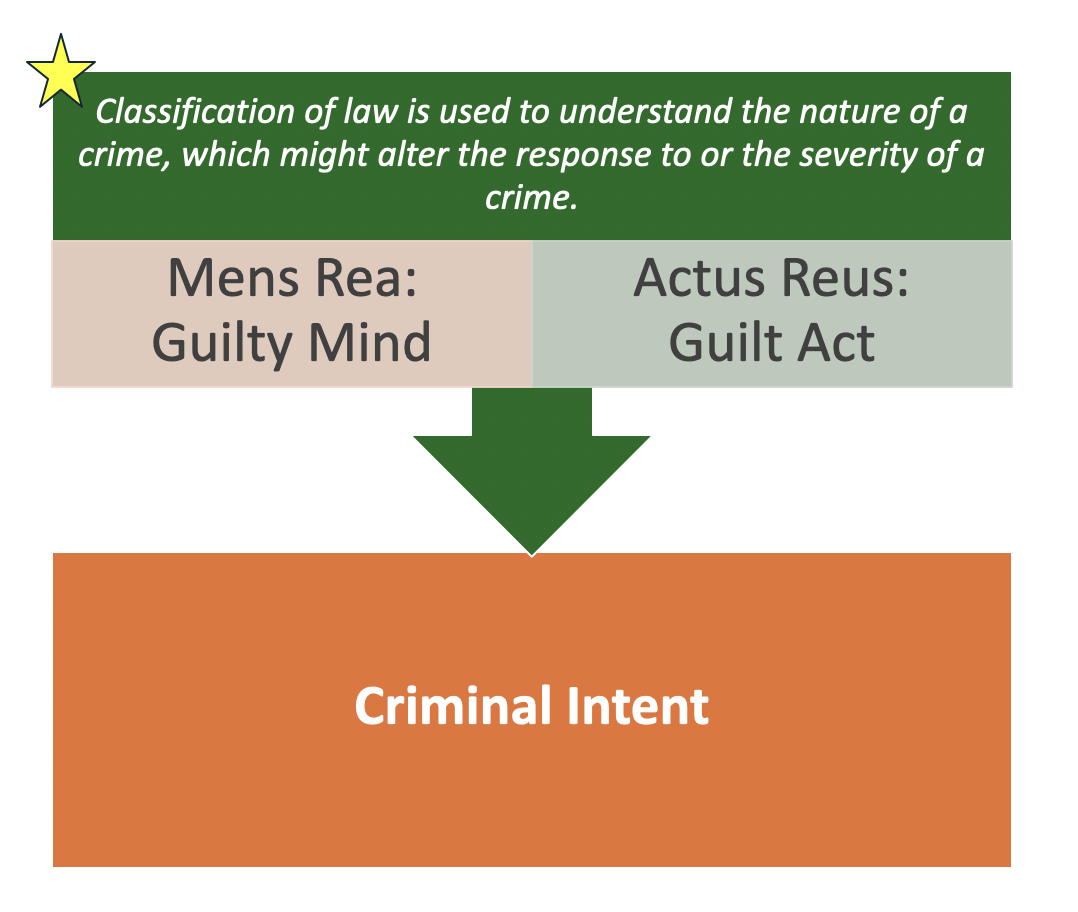
Classification of Criminal Law
Prosecution requires proving criminal intent beyond a reasonable doubt, proving the guilty mind and the guilty act.
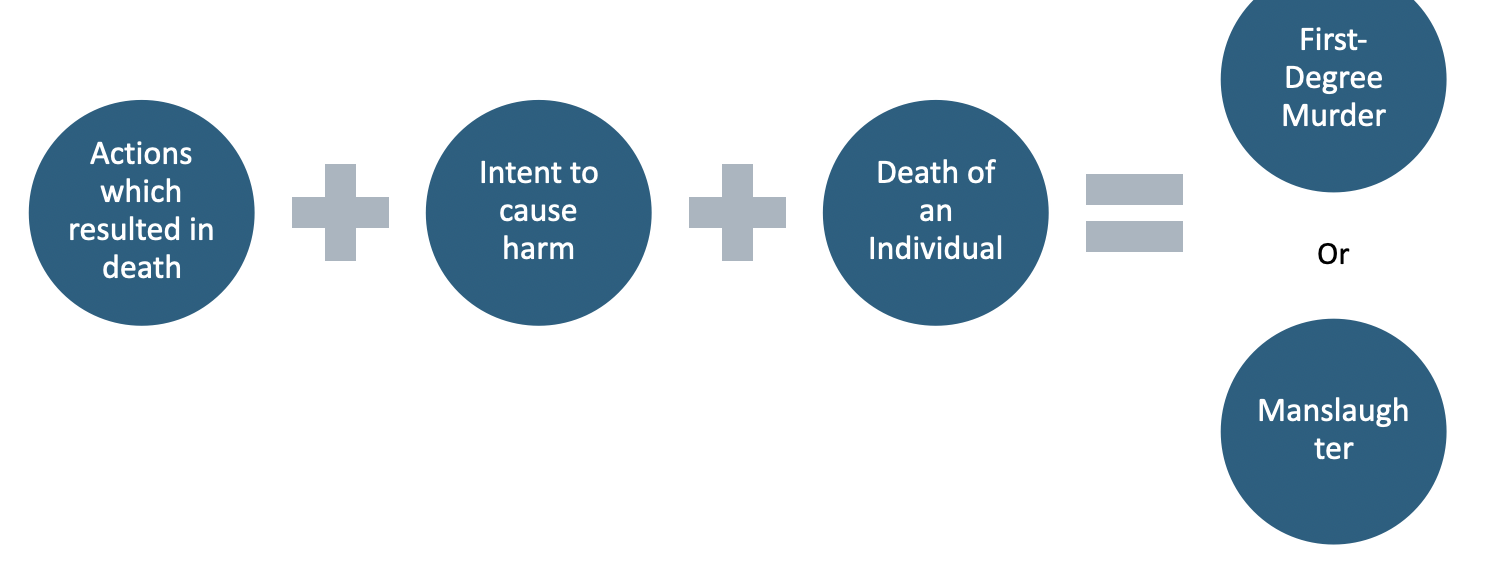
Classification of Law
1: Felonies
Serious Charges
Vary in degree of severity
1st – 3rd degree
Capital
Carry very heavy consequences
1+ years of incarceration
Loss of rights
Life sentences
Death penalties
Misdemeanors
Less serious charges
Physical disputes
Traffic Infractions
Less severe punishments
>1 year of incarceration
Fines
Pre-trial intervention programs
Criminal Defense
Contrary to popular belief….
Criminal charges are NOT an indication of guilt
Charges are NOT the same as a conviction
An arrest does NOT lead directly to sentencing
Police DO not make mistakes
Defendants are entitled to defense

Legal Defenses

Rights of the Victims
Why offer victims rights?
Protect victims who report crimes
Provide Justice
Participation is sometimes needed
Substantive law also dictates that victims of crimes are entitled to rights and protections
The right to attend criminal proceedings
The right to be heard and participate
The right to be informed of events and proceedings
The right to protection from harassment and intimidation
The right to restitution
The Police
When we think about the police, we think about:
◦ ‘Peacekeepers, first responders to trouble, officers who protect and serve.’
◦ But also….
◦ ‘Occupying forces, abusers, discrimination, corruption, and pigs’
How did we get here?
Early English Policing
Colonial Policing
Professional Policing
Early English Policing
◦ Informal system of policing composed of volunteers
◦ Constables who held no ‘real’ authority
◦ Borhs who were a collective looking out for one another
◦ Policing as an unofficial force. Burden of ensuring justice is up to the victim, communities, or states.
Watchmen= Early security services; tasked with patrolling communities and property throughout the night
Sheriffs= Agents of policing tasked with pursuing and apprehending offenders
Thief Takers= Vigilantes hired by victims to captures those accused of offending
Bounty Hunters= Vigilantes hired by the state to capture those accused of offending
Metropolitan Policing Act of 1829:
• Developed by Sir Robert Peel
• Structure in policing
• Guidelines for police officers
• Cooperation, efficiency, impartiality, exercise of force & authority
• Birth of Modern Policing
Colonial Policing
Early (pre)United States:
◦ 13 Original Colonies were independent and sovereign states (under the British Crown)
◦ Colonies did not always share laws, finances, resources
Each colony held sovereignty and control over its own application of law and response to crime:
◦ Absence of a large, unified, and standardized police force
However, there are similarities… :
◦ Disparities in payment
◦ Law enforcement coordinated (typically) by large landowners
◦ Protected land and property
What did Colonial Police look like?
1. Colonial Sheriffs:
◦ Acted reactively to crime and offered responses to citizen complaints.
◦ Did not (usually) engage in patrols
◦ Paid through completion of tasks.
◦ Tax Collection offered the
2. Vigilante groups:
◦ Self-appointed actors who delivered justice according to their own rules
◦ Acted because of a dissatisfaction with the current criminal justice system
◦ Charles Lynch
3. Slave Patrols:
◦ ‘Policing groups’ which hunted and punished suspected escaped slaves.
◦ Members were appointed to patrols through state militias
◦ Armed with firearms and whips
Professional Policing
In the 19th Century, policing shifted into blue collar and professional agencies, starting in major cities such as Boston and NYC
Leaning on education, technology, and training for police advancement
August Vollmer:
◦ Marshal in Berkeley, CA
◦ Believed policing should be politically independent, educated, trained, and well paid
◦ Introduced codes of ethics into policing
◦ Banning political corruption and gifts
◦ Prohibiting the Third Degree or beating individuals for information
Advancing Professionalism- Education
Police Training:
◦ Vollmer would introduce summer courses on policing
◦ Introduced the idea of police academies and education courses for police officers
Introduces the concepts of:
◦ Standardized trainings
◦ Standardized practices
◦ Standardized regulations
◦ Role-playing
College Degrees
◦ Vollmer
◦ Established the Berkley Police School
◦ Complete training while off duty
◦ Academic learning from experienced personnel
◦ Academics, experience professionals
◦ Learn policing topics such as:
◦ Law, police methods, criminal justice technology, marksmanship
◦ Only 9% of states require police officers to hold a two-year degree (AA)
Academia
◦ Introduction to the sharing of ideas, research, and experience
◦ Peer-reviewed Research and analysis:
◦ Examining Policing Methods
◦ Examining Policing Policy
◦ Examining effectiveness of programs
◦ Examining effectiveness of tools/weapons
◦ International Association of Chiefs of Police and other professional organizations
Benefits of education:
◦ Consistent and quality policing
◦ Departure from vigilante-style policing
Advancing Professionalism- Technology
◦ The Intertwining of science and scientific reasoning in policing
◦ Modus Operandi – identification of crime patterns
Patterns such as:
◦ Making connections between crimes and possible offenders
◦ Making connections between victims and their crimes
◦ Making connections between location of incident
Technology also introduces:
◦ Radio & communications technology: Walkie-Talkies
◦ Forensic evidenc: Blood splatter, fibers, hairs, DNA evidence, tire/track impressions
◦ Police vehicles: Patrol vehicles & Paddy Wagons
◦ Weaponry: Armed law enforcements, Lethal and Non-lethal force, Military style arming of police
Use of Dogs
The use of Canine officers is a development in police technology
◦ Training programs developed in late 1800s and have persisted
Pros: ◦ Drug & Explosives Identification, scent tracking
Cons: ◦ Dogs also used to detain suspects ◦ Use of dogs to quell civil unrest ◦ Symbolize aggression
Advancing Professionalism (diversity)
Women Officers:
◦ Operated as clerical support for police officers
◦ (1960s) sworn officers that were women began patrolling.
Black Officers:
◦ Early policing targeted and scrutinized black individuals
◦ 1870s saw the presence of sworn black police officers
◦ Faced discrimination and scrutiny through the 1960s
LGBTQ+ Officers:
◦ Difficult to determine their integration in policing
◦ Faced extreme scrutiny through 1980s with some improvement in the 2000s
Remember: People view the police differently:
◦ Policing has historically been lacking diversity.
◦ Diversity in policing offers more perspectives, experiences, and ideas which expand policing
Unrest in Policing
The age of professionalism in policing occurred during the 1960s.
◦ Developments in policing challenged by the Civil Rights Movement and the increasing civil unrest
We see the conflict between police and the public.
◦ Police are supposed to Protect & Serve
◦ Conflict in maintaining “Law & Order”
◦ Conflict in establishing equal rights and protections
Introduction of legislation
◦ Civil Rights Act (1964) ◦ Outlawing of racial, ethnic, minority, and women discrimination ◦ Voting Rights Act (1965) ◦ Outlaw of discriminatory practices in voting
◦ Omnibus Crime Control and Safe Streets Act (1968) ◦ Firearm and police wiretapping regulations ◦ Admissibility of confessions in policing ◦ Crime Reduction
Challenges Continue…
◦ Black individuals cited at greater rates for basic infractions (Carter & Johnson, 2023)
◦ Black and Hispanic are stopped at greater rates during Stop and Frisk (Gelman et al., 2007)
◦ The disproportionate exercise of authority in even the most mundane interactions (Voight et al., 2017)
But there are benefits…
◦ Police are perceived more positively through fair treatment (Donner et al., 2015)
◦ Police change and shape their attitudes/behaviors to gain more favorable outcomes (Hinds & Murphy, 2007)
◦ Cooperation of law varies with perceptions of legitimate police action (White et al., 2016)

Modern Policing
Responabilites of Police:
◦ Depends on their role
◦ Patrol, Traffic, Detectives, Administrative
Police will typically…
◦ Enforce traffic laws
◦Respond to calls for service
◦ Patrol our neighborhoods
◦ Arrest offenders
◦ Conduct investigations
A Powerful tool that modern police, and other authorities, wield is discretion
◦ Discretion is the ability and authority to carry out actions or to withhold action
◦ Discretion is left to the decision of the individual wielding it
◦ Discretion turns police officers into policy makers, or street level bureaucrats (Lipsky, 1980).
An officer can exercise discretion to:
◦ Stop someone that they think looks suspicious
◦ Let someone off with a warning instead of a ticket
◦ Or reduce the infraction
◦ Search a suspect's car if they believe they are transporting drugs
◦ Arrest a suspect on reasonable suspicion
◦ Not make an arrest in a domestic violence situation
◦ Shoot a suspect they believe is reaching for a weapon
Roles of the Police

Modern Policing
Corruption in policing has provided criticism of police and hurts professional police development.
◦ Corruption entails police misconduct, engaging in bribery, violating codes of ethics and laws.
◦ Acts of corruption
◦ Accepting gifts or bribes
◦ Negligence of discretion
◦ Extortion
◦ Excessive force and physical violence
Rotten Apple Theory:
◦ Grass Eaters – Passive participants to corruption
◦ Meat Eaters – Active engagers in police corruption
Documentary:
◦ Examination of 75th precinct of the NYPD (1980s)
◦ Police Corruption
◦ Focuses on two corrupt NYPD officers
◦ Taking bribes
◦ Protecting drug dealers
◦ Drug trafficking
Mollen Commission:
◦ Internal affairs investigation in severe police corruption in the NYPD
◦ Arrest of dozens of NYPD officers
◦ Refusal to testify against other officers
Police Organization
Police agencies vary in size, structure, and organization.
◦ No one standardization for police
◦ However, there is typically a hierarchy of authority.
◦ Variations in policing agencies
◦ Local Police Departments
◦ Town Police Departments
◦ Sherriff's Office
◦ College Police Departments
Military-style hierarchy within police departments
◦ Led by a Police Chief Divisions in policing, with their own chains of command, which oversee specific goals
◦ Patrol
◦ Investigations
◦ Technical Service
◦ Community Services (or other services)
In Modern Policing, the police have become more organized, expansive, and are a fixture of American
Society Conflicts arise when:
◦ Expectations of policing do not meet reality
◦ Non-standardized police departments have inconsistent organization, standards, and expectations for officers.
◦ Conflicting jurisdictions
◦ Disorganization of policing leaves room for corruption and abuse of power.
Why Modern Policing?
1.Community Policing: Model of policing where police are integrated members of the community
• Policing where the police, don’t look like police
• Supporting and engaging with the communities, rather than policing them
• Remove formal social controls/authorities
• Support informal social controls and leaders
2.Problem-Oriented Policing: Policing driven by analyzing problems surrounding crime and the community
• Identification of problem and implementing responses
• Utilizes theory • SARA Model (Scan, Analyze, Response, Assessment)
• Broken Windows Theory
• Crime Triangle
• Offender, Place, Victim
3.Evidence-Based (Intelligence) Policing: Policing through empirical evidence, intelligence, and risk management
• Top-down approach
• Risk and Resource management
• How to work with the resources available
• CompSTAT
• Gathering up to date and accurate crime data at the neighborhood level
• Targeted efforts on crime trends and locations
• Target offenders, manage hotspots, and identify crime links
Police Culture
Gender:
Policing has been a traditionally masculine & male dominated field
◦ Policing requires strength, power, and is heroic
◦ Is this an accurate portrayal of policing?
Women in Policing:
◦ Offered pushback on strength & physicality nature of policing
◦ Offer a different style of policing
◦ More than men, women police officers will prioritize
◦ Avoiding using force
◦ De-escalation through communication
Lifestyle:
◦ Policing has evolved past a profession
◦ Policing is no longer seen as just a job; it is seen as a sub-culture and way of life.
Perpetuated by movements and slogans:
◦ Copaganda
◦ Blue Lives Matter
◦ Thin Blue Line
◦ Back the Blue
Targeted changes to police is seen as an attack on police as people, rather than their jobs. Leads to difficulties in widespread change and development
Resistance to Change
Challenges:
◦ Blue Wall of Silence:
◦ ‘Snitching’ or reporting another officer's behaviors are prohibited. May result in being ostracized or not a ‘team player’.
◦ May not respond to requests for back-up or offer delayed assistance
◦ Blue Flu:
◦ Police are unionized, but strikes are illegal and not permitted
◦ Officers will unanimously call-out sick
◦ Shortage of patrol officers
Testilying:
◦ Officers lying or giving false testimony while under oath in court.
Controversies in Policing

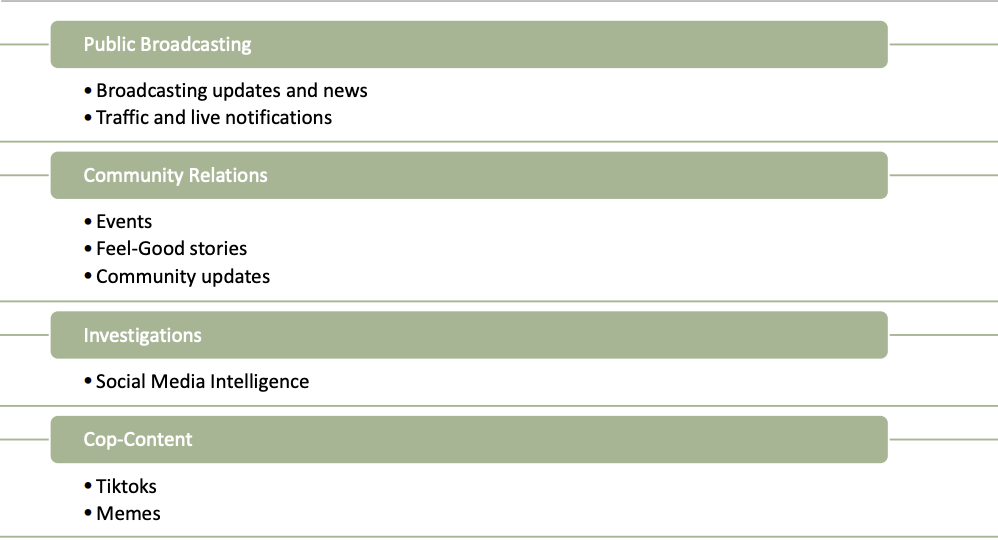
Social Media and Policing
Police adapt and implement new technologies. This includes social media.
◦ Police will share updates, reports, crime prevention techniques, and safety advisories with the community
◦ Police will create/maintain public social media profiles
◦ TikTok, Twitter, Facebook, Instagram
Goals:
◦ Increase communication
◦ Increase positive police-community relations
◦ Increase organization legitimacy