Cell Signaling in Physiology: Receptors, Pathways, and Regulation
 Call Kai
 Learn
Learn Practice Test
 Spaced Repetition
 Match
Match Flashcards
 Knowt Play
1/23

There's no tags or description
Looks like no tags are added yet.
Name | Mastery | Learn | Test | Matching | Spaced | Call with Kai | Chat |
|---|
No analytics yet
Send a link to your students to track their progress
24 Terms
What is the chemical nature of receptors?
Receptors are proteins, often glycoproteins, with specific ligand-binding sites.
Where are plasma membrane receptors located?
They are located on the cell surface and bind messengers that cannot readily cross the lipid bilayer.
What type of messengers do intracellular receptors bind?
Intracellular receptors bind lipid-soluble messengers that can cross cell membranes.
Why do different cells respond differently to the same chemical messenger?
Different cell types may express different receptor subtypes or have different intracellular signaling machinery.
What is down-regulation in cell signaling?
Down-regulation is the decrease in receptor number or responsiveness due to prolonged/high messenger exposure.
What is up-regulation in cell signaling?
Up-regulation is the increase in receptor number or responsiveness due to prolonged low stimulation or receptor blockade.
What is the first step in the action of a messenger on a cell?
The messenger binds to its specific receptor.
Describe the pathway for lipid-soluble messengers.
Lipid-soluble messengers diffuse across the plasma membrane, bind to intracellular receptors, and regulate DNA to synthesize new proteins.

What are the major classes of plasma membrane receptors?
1. Ligand-gated ion channels, 2. Receptors with intrinsic enzyme activity, 3. Receptors associated with cytoplasmic kinases, 4. G-protein-coupled receptors (GPCRs).
What happens when a membrane ion channel opens?
Ions move down their electrochemical gradients, changing membrane potential and/or intracellular ion concentration.
What distinguishes intrinsic enzyme receptors from JAK-associated receptors?
Intrinsic enzyme receptors have catalytic activity in their cytoplasmic domain, while JAK-associated receptors lack intrinsic kinase activity and activate JAKs.
What is the function of plasma-membrane G proteins?
G proteins couple activated GPCRs to intracellular effectors, regulating enzymes or ion channels.
Describe the adenylyl cyclase-cAMP signaling pathway.
In this pathway, a messenger activates GPCR, which activates Gαs, stimulating adenylyl cyclase to convert ATP to cAMP, leading to a cellular response.

What is the role of phospholipase C in cell signaling?
Phospholipase C cleaves PIP₂ into IP₃ and DAG, which activate calcium release and protein kinase C, respectively.
How does the Ca²⁺-calmodulin system function?
Increased cytosolic Ca²⁺ binds calmodulin, activating target proteins and enzymes, influencing various cellular functions.
What is the significance of receptor regulation in homeostasis?
Receptor regulation (up-regulation and down-regulation) helps maintain cellular responses within a useful range, adapting to changes in stimulation.
What is the role of second messengers in cell signaling?
Second messengers amplify the signal from receptors and initiate various intracellular responses.
What is the effect of Na⁺ or Ca²⁺ entry through ion channels?
Na⁺ or Ca²⁺ entry commonly depolarizes the membrane, while K⁺ exit typically hyperpolarizes it.
What is the role of Gαs in the adenylyl cyclase pathway?
Gαs stimulates adenylyl cyclase, leading to increased levels of cAMP.
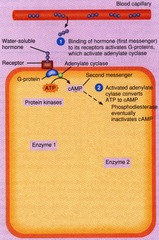
What happens to cAMP after its role in signaling?
cAMP is degraded by phosphodiesterases, and phosphate groups are removed by phosphatases to terminate the signal.
What is the function of the JAK-STAT pathway?
The JAK-STAT pathway involves receptor-associated JAKs phosphorylating receptor sites and STAT proteins, which regulate transcription.
What is the role of DAG in cell signaling?
DAG activates protein kinase C, which plays a role in various signaling pathways.

How does specificity in cell signaling occur?
Specificity arises from receptor expression and the presence of specific intracellular signaling proteins.
What is the overall process of cell signaling?
Chemical messenger binds to a receptor, initiating a signal transduction pathway that leads to a cellular response.