MACY'S Chapter 9 Anatomy Questions
 Call Kai
 Learn
 Practice Test
 Spaced Repetition
 Match
 Flashcards
 Knowt Play
1/59

There's no tags or description
Looks like no tags are added yet.
60 Terms
The fulcrum lies between the applied force and the resistance in a first-class lever.
True
False
True
Most of the skeletal muscle fibers in the body are called ________ fibers, in reference to their duration of contraction following stimulation.
Option A
All of the answers are correct.
Option B
red
Option C
fast
Option D
slow
Option E
intermediate
Option C
fast
What is the significance of the change in membrane potential of the T tubules within the sarcolemma?
Option A
This change is caused by the displacement of actin and myosin molecules.
Option B
None of the answers are correct.
Option C
It has no role, because this phenomenon does not occur.
Option D
It triggers the sarcoplasmic reticulum to release calcium ions.
Option E
This change is caused by the release of actin and myosin molecules.
Option D
It triggers the sarcoplasmic reticulum to release calcium ions.
Approximately how many skeletal muscles are there in the adult human muscular system?
Option A
206
Option B
50
Option C
700+
Option D
116
Option E
thousands
Option C
700+
The steady increase in muscular tension produced by increasing the number of active motor units is called ________.
Option A
A muscle twitch
Option B
Peak tension
Option C
Muscle tone
Option D
Recruitment
Option E
Muscle spindles
Option D
Recruitment
The connective tissue surrounding a fascicle is called ________.
Option A
a tendon
Option B
perimysium
Option C
endomysium
Option D
epimysium
Option E
an aponeurosis
Option B
perimysium
The enzyme that is partly responsible for shutting down a muscle contraction is ________.
Option A
acetylcholinesterase
Option B
titin
Option C
actinin
Option D
actinase
Option E
glycolytic enzyme
Option A
acetylcholinesterase
The attachment of a muscle to a bone is called ________.
Option A
a ligament
Option B
a capsule
Option C
an aponeurosis
Option D
a bursa
Option E
either a tendon or an aponeurosis
Option E
either a tendon or an aponeurosis
When all of the motor units of a muscle contract at the maximal rate of stimulation, it leads to the production of ________.
Option A
peak tension
Option B
multiple motor unit summation
Option C
fast, long contractions
Option D
the fastest contraction
Option E
the longest contraction
Option A
peak tension
Which of the following is a function of skeletal muscle?
Option A
produce skeletal movement
Option B
maintain posture
Option C
support soft tissues
Option D
All of the answers are correct.
Option E
maintain body temperature
Option D
All of the answers are correct.
Tropomyosin and troponin are which of the following types of molecules?
Option A
secretory protein
Option B
regulatory protein
Option C
accessory protein
Option D
functional hormone
Option E
enzyme
Option B
regulatory protein

Identify the muscle or muscle category indicated by Label B.
Option A
Bipennate muscle
Option B
Supinator muscle
Option C
Rectus abdominis muscle
Option D
Convergent muscle
Option E
Parallel muscle
Option C
Rectus abdominis muscle
When a resting muscle contracts only enough to produce tension without movement, this is an example of ________.
Option A
hypertrophy
Option B
twitch
Option C
muscle tone
Option D
activation
Option E
atrophy
Option C
muscle tone
The portion of a sarcomere that contains the M line, H band and the zone of overlap is the ________.
Option A
Z line
Option B
A band
Option C
M line
Option D
H band
Option B
A band
How does a muscle named lateralis differ from one named latissimus?
Option A
Lateralis refers to the side of the organism, whereas latissimus refers to the width of the structure.
Option B
Latissimus means the structure is larger than one that is merely lateralis.
Option C
A latissimus structure is always deep to a lateralis structure.
Option D
Two muscles so named would always have completely different functions.
Option E
There is no difference; the two terms are synonymous.
Option A
Lateralis refers to the side of the organism, whereas latissimus refers to the width of the structure.
In the case of the triceps brachii, the shoulder is the ________; the olecranon is the ________.
Option A
insertion; origin
Option B
None of the answers are correct.
Option C
synergist; fixator
Option D
origin; insertion
Option E
agonist; antagonist
Option D
origin; insertion
The sarcoplasmic reticulum is (the) ________.
Option A
extension of the skeletal muscle sarcolemma into the cell
Option B
a membrane complex in skeletal muscles similar to smooth endoplasmic reticulum
Option C
cytoplasm of skeletal muscle fibers
Option D
a membrane complex in skeletal muscles similar to rough endoplasmic reticulum
Option E
sarcolemma of skeletal muscle fibers
Option B
a membrane complex in skeletal muscles similar to smooth endoplasmic reticulum
A muscle whose contraction is mostly responsible for a movement is said to be the ________ for that movement.
Option A
agonist and prime mover
Option B
fixator
Option C
agonist and fixator
Option D
synergist
Option E
antagonist
Option A
agonist and prime mover
A very good sprinter is likely to have ________.
Option A
more slow twitch fibers than average
Option B
average muscles; performance is based solely on training
Option C
more intermediate fibers than average
Option D
None of the answers are correct.
Option E
more fast twitch fibers than average
Option E
more fast twitch fibers than average
Which of the following events occurs first?
Option A
Myosin cross-bridges attach to actin.
Option B
Calcium ions are released from the sarcoplasmic reticulum.
Option C
The myosin head binds ATP and detaches from actin.
Option D
The myosin head pivots toward the M line.
Option E
Calcium binds to troponin.
Option B
Calcium ions are released from the sarcoplasmic reticulum.
The steady increase in muscular tension produced by increasing the number of active motor units is called ________.
Option A
A muscle twitch
Option B
Muscle tone
Option C
Recruitment
Option D
Muscle spindles
Option E
Peak tension
Option C
Recruitment
A space that separates the expanded tip of the axon at the neuromuscular synapse from the motor end plate is the synaptic vesicle.
True
False
False

Identify the muscle or muscle category indicated by Label A.
Option A
Bipennate muscle
Option B
Convergent muscle
Option C
Parallel muscle
Option D
Rectus abdominis muscle
Option E
Supinator muscle
Option C
Parallel muscle
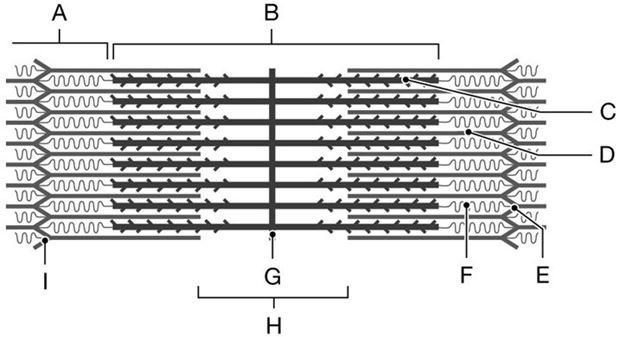
Identify the specific structure indicated by Label B.
Option A
Z disc
Option B
Incorrect:
Titin
Option C
M line
Option D
A band
Option E
H band
Option D
A band
An intermediate fiber contracts fast, but it has more ________ and greater resistance to fatigue than a fast fiber.
Option A
oxygen-binding pigments
Option B
myoglobin
Option C
calcium ions
Option D
ribosomes
Option E
mitochondria
Option E
mitochondria
Which of the following events occurs first?
Option A
Myosin cross-bridges attach to actin.
Option B
Calcium binds to troponin.
Option C
The myosin head pivots toward the M line.
Option D
The myosin head binds ATP and detaches from actin.
Option E
Calcium ions are released from the sarcoplasmic reticulum.
Option E
Calcium ions are released from the sarcoplasmic reticulum
Skeletal muscle fiber contractions are caused by the interaction between the ________ and the ________ filaments of the sarcomeres.
Option A
titin; thick
Option B
thin; nebulin
Option C
titin; thin
Option D
thin; thick
Option E
thick; nebulin
Option D
thin; thick
Which of the following is/are properties of a lever?
Option A
It is the effort produced by the muscle contraction.
Option B
It is the weight that opposes the applied force.
Option C
It is a flexible structure.
Option D
It moves on a fulcrum.
Option E
All of the answers are correct.
Option D
It moves on a fulcrum.
The smallest functional units of the muscle fibers are the ________.
Option A
neuromuscular synapses
Option B
fascicles
Option C
myofilaments
Option D
cisternae
Option E
sarcomeres
Option E
sarcomeres
The number of cells per motor unit in the leg muscles can reach up to ________.
Option A
one hundred
Option B
millions
Option C
many thousands
Option D
hundreds
Option E
less than a dozen
Option C
many thousands
The Z line is comprised of thick filaments attached to interconnecting proteins, delineating the ends of the sarcomere.
True
False
False
The adductor magnus muscle is so named, partially due to the ________.
Option A
orientation of its muscle fibers
Option B
size of the muscle
Option C
location of the muscle
Option D
parallel versus pennate arrangement of its fibers
Option E
shape of the muscle
Option B
size of the muscle
Which of the following words means slender?
Option A
latissimus
Option B
brevis
Option C
major
Option D
gracilis
Option E
longissimus
Option D
gracilis
The epimysium, which separates the muscle from surrounding tissues and organs, is connected to the ________.
Option A
deep fascia
Option B
superficial fascia
Option C
subserous fascia
Option D
aponeuroses
Option E
None of the answers are correct.
Option A
deep fascia
The expanded portion of the axonal branch that faces a region of the sarcolemma is called an axon terminal.
True
False
True
Why are skeletal muscles called voluntary?
Option A
Their contractions can be consciously controlled.
Option B
Only these muscles are stimulated to contract by the central nervous system.
Option C
These muscles maintain a constant rhythm of contraction.
Option D
Contraction of specific muscles occurs to maintain body posture and body position.
Option E
All of the answers are correct.
Option A
Their contractions can be consciously controlled.
A lever in which the load is between the fulcrum and the applied force is a ________.
Option A
first-class lever
Option B
third-class lever
Option C
second-class lever
Option D
simple lever
Option E
complex lever
Option C
second-class lever
Each skeletal muscle fiber is controlled by a single ________.
Option A
triad of transverse tubule and terminal cisternae
Option B
motor neuron whose cell body is located inside the central nervous system
Option C
synaptic cleft
Option D
motor end plate
Option E
neurotransmitter
Option B
motor neuron whose cell body is located inside the central nervous system
The motor neuron releases acetylcholine, which then binds to receptors sites on a special region of the sarcolemma called ________ .
Option A
a fascicle
Option B
a T tubule
Option C
the motor unit
Option D
the sarcoplasmic reticulum
Option E
the motor end plate
Option E
the motor end plate
Smooth muscles are primarily used to ________.
Option A
generate heat
Option B
pump blood through the circulation
Option C
push fluid and solids along the digestive tract
Option D
pull on bones of the skeleton
Option E
provide voluntary movements to the body
Option C
push fluid and solids along the digestive tract
Which of the following events occurs first?
Option A
Calcium ions are released from the sarcoplasmic reticulum.
Option B
Calcium binds to troponin.
Option C
The myosin head binds ATP and detaches from actin.
Option D
Myosin cross-bridges attach to actin.
Option E
The myosin head pivots toward the M line.
Option A
Calcium ions are released from the sarcoplasmic reticulum.
Skeletal muscle fiber contractions are caused by the interaction between the ________ and the ________ filaments of the sarcomeres.
Option A
thick; nebulin
Option B
titin; thick
Option C
thin; nebulin
Option D
titin; thin
Option E
thin; thick
Option E
thin; thick
Which of these orders of functional muscle structures progresses from the smallest to largest in diameter?
Option A
myofibril, muscle fiber, fascicle, muscle
Option B
muscle, fascicle, muscle fiber, myofibril
Option C
muscle, muscle fiber, myofibril, fascicle
Option D
fascicle, myofibril, muscle fiber, filament
Option E
fascicle, muscle fiber, myofibril, muscle
Option A
myofibril, muscle fiber, fascicle, muscle
Typically, the insertion of a muscle is ________ to its origin.
Option A
medial
Option B
lateral
Option C
distal
Option D
proximal
Option E
deep
Option C
distal
Tropomyosin and troponin are which of the following types of molecules?
Option A
enzyme
Option B
secretory protein
Option C
accessory protein
Option D
regulatory protein
Option E
functional hormone
Option D
regulatory protein
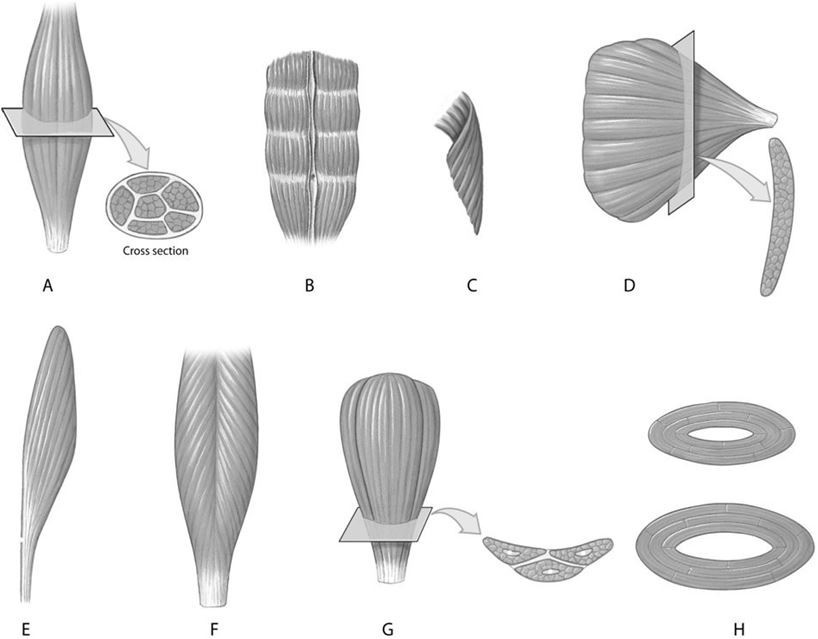
Identify the muscle or muscle category indicated by Label B.
Option A
Deltoid muscle
Option B
Parallel muscle with tendinous bands
Option C
Supinator muscle
Option D
Parallel muscle
Option E
Bipennate muscle with extended tendon
Option B
Parallel muscle with tendinous bands

Identify the specific structure indicated by Label A.
Option A
Schwann cell
Option B
Myosatellite cell
Option C
Myoblast
Option D
Motor neuron
Option E
Motor end plate
Option D
Motor neuron
When a resting muscle contracts only enough to produce tension without movement, this is an example of ________.
Option A
atrophy
Option B
muscle tone
Option C
activation
Option D
hypertrophy
Option E
twitch
Option B
muscle tone
At the zone of overlap, each thin filament sits in a triangle formed by three thick filaments, and each thick filament is surrounded by six thin filaments.
True
False
True
Aging skeletal muscles develop increasing amounts of ________.
Option A
myofibrils
Option B
glycogen reserves
Option C
fibrous connective tissue
Option D
myoglobin
Option E
ATP
Option C
fibrous connective tissue
The connective tissue surrounding a fascicle is called ________.
Option A
an aponeurosis
Option B
epimysium
Option C
perimysium
Option D
endomysium
Option E
a tendon
Option C
perimysium
The layers of connective tissue surrounding a skeletal muscle from the inside to the outside in correct order are ________.
Option A
epimysium, perimysium, and endomysium
Option B
perimysium, epimysium, and endomysium
Option C
endomysium, perimysium, and epimysium
Option D
endomysium, epimysium, and perimysium
Option E
epimysium, endomysium, and perimysium
Option C
endomysium, perimysium, and epimysium
An intermediate fiber contracts fast, but it has more ________ and greater resistance to fatigue than a fast fiber.
Option A
oxygen-binding pigments
Option B
calcium ions
Option C
myoglobin
Option D
ribosomes
Option E
mitochondria
Option E
mitochondria
What type of muscular activity is present in a muscle at rest?
Option A
There is no activity.
Option B
Motor units activate in a random pattern to cause slight constant tension, known as muscle tone.
Option C
Motor units activate partially in a unified wavelike motion.
Option D
There are large amounts of short contractions.
Option E
There is some activity that causes the muscle to make continual tiny movements.
Option B
Motor units activate in a random pattern to cause slight constant tension, known as muscle tone.
The epimysium, which separates the muscle from surrounding tissues and organs, is connected to the ________.
Option A
superficial fascia
Option B
deep fascia
Option C
aponeuroses
Option D
None of the answers are correct.
Option E
subserous fascia
Option B
deep fascia
The attachment of a muscle to a bone is called ________.
Option A
an aponeurosis
Option B
a ligament
Option C
either a tendon or an aponeurosis
Option D
a capsule
Option E
a bursa
Option C
either a tendon or an aponeurosis
The adductor magnus muscle is so named, partially due to the ________.
Option A
size of the muscle
Option B
shape of the muscle
Option C
parallel versus pennate arrangement of its fibers
Option D
orientation of its muscle fibers
Option E
location of the muscle
Option A
size of the muscle
The fulcrum lies between the applied force and the resistance in a first-class lever.
True
False
True