Exam 3 Animal Science Review
 Call Kai
 Learn
 Practice Test
 Spaced Repetition
 Match
 Flashcards
 Knowt Play
1/89

Earn XP
Description and Tags
Lectures 17-24
90 Terms
Who is able to lactate?
mammalian class, animals with fur & mammary glands
monotremes
marsupials
Eutherians
Why lactate?
nourishment of young
survival (colostrum)
Reproduction
4 parts of lactation:
Mammogenesis: @ puberty
Structural development of the mammary gland
Ductal elongation promoted by estrogen
Minimal alveolar development - progesterone present in spurts
Lactogenesis: during pregnancy
Initiation of lactation
Ductal and alveolar growth - progesterone levels maintained
Galactopoiesis
Maintenance of lactation after birth
Involution
Regression of mammary gland to pre-pregnancy state at the end of lactation
Define colostrum
First milk produced after parturition
Has high protein content & maternal antibody content
immunoglobulins
Important for passive immunity
What factors affect milk production?
breed
stage of lactation
(Parity of dam) how many times a mom has given birth
type of feed
age of young
Exocrine gland
Developmentally related to salivary and sweat glands
Range from skin surface patch to variable number of defined glands
milk synthesized in specialized cells arranged in alveoli
Milk secreted outside the body via duct system
what two tissues makeup the utter?
Secretory : mammary epithelial cells (MEC) are cells that make and secrete milk
Connective: Fibrous tissue from collagen and fatty tissue from adipose
3 levels of secretory tissues?
Alveolus
Lobules
Lobes
Alveolus (1st level)
MEC found in a single layer lining the lumen (central cavity)
absorbs nutrients from bloodstream
Transforms nutrients into lactate, fat, protein in milk
Transfers newly synthesized milk into the lumen of the alveolus
Lobules (second level)
Clusters of 150-200 alveoli
Surrounded by a fine membrane of connective tissue
Drained by a common duct which end at the teats/nipples
Lobes (third level)
groups of lobules
surrounded by thicker connective tissue
Discharge milk into large ducts
Describe how hormones affect the development of mammary gland
tissue
Estrogen stimulates duct and cistern development
follicular phase of estrus cycle
lengthening and branching of ducts
epithelial components on end that will eventually become clusters of alveoli
Progesterone induces formation of alveoli
present in luteal phase
Causes duct cells to multiply
Enlarge and/or widen
Complete alveoli development when CL stays (gestation)
Somatotropin
A growth hormone involved in production of milk, released from pituitary gland
increases production of milk by the secretory cells
Causes 10-20% increase in milk production
What is rBST and how was it used? Why is it no longer common?
1980’s; drug companies produced sale of bovine somatotropin (BST) to be injected into cows to supplement natural levels of somatotropin
milk + meat treated with BST deemed as safe to consume as nontreated cows
protein treated as normal and is broken down in the stomach, rendering it inactive
How is milk released from the teat?
milk release facilitated by oxytocin
hormone produced in hypothalamus and released from pituitary gland
acts on myoepithelial cells which surround the secretory cells, causing them to contract
When milk is discharged, alveolus deflates so more milk can be produced
Oxytocin spikes inr esponse to:
seeing/hearing the offspring, feeling the suckling @ teat, sound of milk pump
What is mastitis and how is it treated?
Inflammation of the mammary gland due to bacterial infection
Treated with antibiotics…
MISCONCEPTION = antibiotics given to dairy cows are then directly consumed by humans
Federal law requires that antibiotics cannot be present in milk consumed by humans. Mastitis is generally avoided by producers so they don’t lose animals from their herd
Why is growth an important process to study in animal science?
Meat, milk, eggs, and fiber production are the most important sectors in agriculture…
body composition
feed utilization depends on the efficiency of growth
Partitioning of energy determines reproductive success, immunocompetence, and performance in terms of production
compare and contrast growth vs development
GROWTH
increase in body weight until maturity
includes everything from conception to maturity
increase in cell size and cell number
increase in the mass of structural tissue
DEVELOPMENT
coordination of all diverse processes until maturity
involves growth, cell differentiation, and changes in body shape, form, and function
What are the 3 tissues of interest in livestock production for growth?
Bone
Skeletal Muscle
Adipose Tissue
Describe a tissue growth curve. What does it show?
Demonstrates the slaughter point for optimal carcass tissue proportion. At some point and with the inherent growth potential of the specific animal involved, the proportions of muscle, bone, and fat are optimal.
Optimal carcass tissue proportions are attained @:
1,300 lbs for cattle
280 lbs for swine
120 lbs for lamb
Explain the important steps that occur in early mid and late gestation.
What happens during these steps?
Early: Maternal Recognition, Placental Growth, Cellular Differentiation
Mid: Organogenesis, Muscle Fiber, Intramuscular adipocytes → marbling (intramuscular fat)
Late: 75% of the growth of the ruminant fetus, maturation of important organs such as…
Small intestine
Lungs
Brain
What factors are influenced by maternal nutrition?
birth weight
Carcass quality
Growth performance
Puberty/fertility
health
Define hypertrophy vs hyperplasia
HyperPLASIA = increase in cell NUMBER
HyperTROPHY = increase is cell SIZE, muscle and fat tissues grow with age via hypertrophy
increase in number of muscle fibers prenatal, then increase in size
Define cellular differentiation and totipotency
totipotent = each cell has the potential to generate the entire organism (true “stem” cells)
Cellular differentiation: when cells can only express certain genes from the genome that are needed for their specialized function
What are the important steps in early embryonic development, and
what happens here?
Zygote: fertilization of an egg (haploid) by a sperm (haploid)
Cleavage: DNA is replicated but there is no cell growth
Morula: subsequent cell division leads to morula by cleavage
Blastula: morula cells continue to divide by mitosis, now inlcuding cell growth, to form blastula which includes a hollow core called blastocoel
ICM (inner cell mass): made up of stem cells that will become the animal/fetus
Trophectoderm: outer layer of cells of the blastocyst and will become fetal layer of placenta
Gastrula: multi-layered embryonic stage in 3rd week of gestation
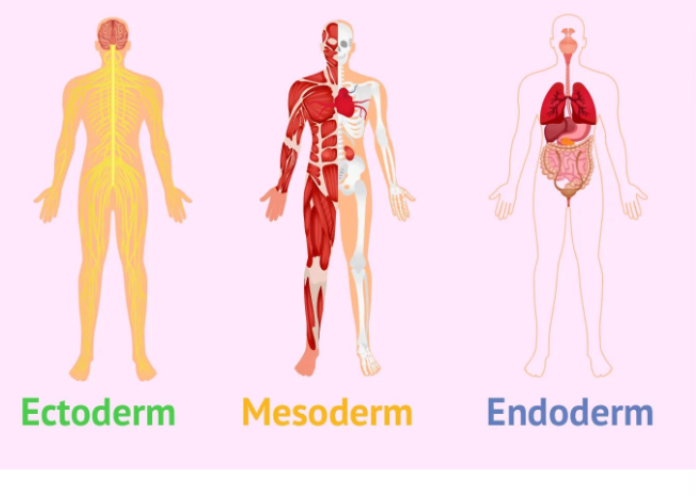
What are the 3 germ layers? What tissues do they differentiate into?
Ectoderm (outer layer) → gives rise to skin, nervous system, hair, nails
Mesoderm (middle layer) → gives rise to muscles, connective tissues (bone too), circulatory system
Endoderm (inner layer) → gives rise to most of the digestive tract, respiratory system and most internal organs (liver, lungs)
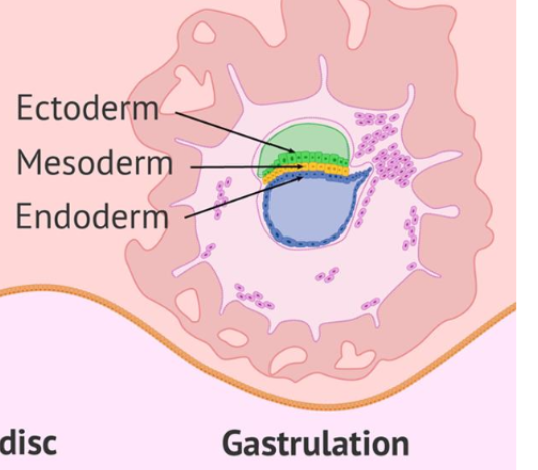
Define morphogenesis
formation of shape and form of tissues, organs, body pattern. The association of cells to form tissues, and tissues to form organs.
involves migration of cells
controlled by specialized gene expression (part of cell differentiation) to give cells specialized function
First organ systems to develop in animals are nervous system (ectoderm) and cardiovascular system (mesoderm)
How does growth change relative to puberty?
after puberty, growth slows
involves both hyperplasia and hypertrophy

How do muscles develop pre vs post-natally?
Pre
in embryo, muscle cell precursors fuse together and develop into myofibers that are long multinucleated cells
Post
Myofibers increase in length until maturity and myofiber diameter can increase or decrease after maturity based on use or “training”
What are the primary proteins in connective tissue?
Fibers are made of collagen and elastin proteins
What are the 4 kinds of fat-storing cells? How do they develop and
what is their value?
Visceral fat - surrounds and protects organs earliest development
Subcutaneous - ‘under skin’, fat provides insulation
Intermuscular fat - between muscles, provides energy
Intramuscular fat - within muscles, provides energy (aka marbling) latest development

What are bone cells? Where do bones elongate?
Bone cells are osteocytes.
Bones made of these and calcium + phosphorus
@ birth bones made of cartilage that ossifies after birth
bones elongate @ Birth plate
Describe some of the factors that affect growth prenatally
Prenatal
Litter size
Size & nutritional status of mother
Genetics of offspring
Describe some of the factors that affect growth pre-weaning
nutritional status of the mother
litter size
initial size and aggressiveness
Exposure to disease/parasites
Describe some of the factors that affect growth post-weaning
gender
genetics
nutrition
disease/parasite
social stress
environmental conditions
What is compensatory growth? Why is it relevant in the industry?
Rapid growth following a period of nutrient restriction
during periods of under-nutrition, animals reduce metabolic rate and temporarily shrink demanding organs like gut and liver to conserve energy
Once normal, abundant, or high-quality nutrition returns, the body triggers a rapid growth spurt
Restricted animals increase their feed intake relative to their body weight (sometimes eating more than well-fed)
Common in livestock production
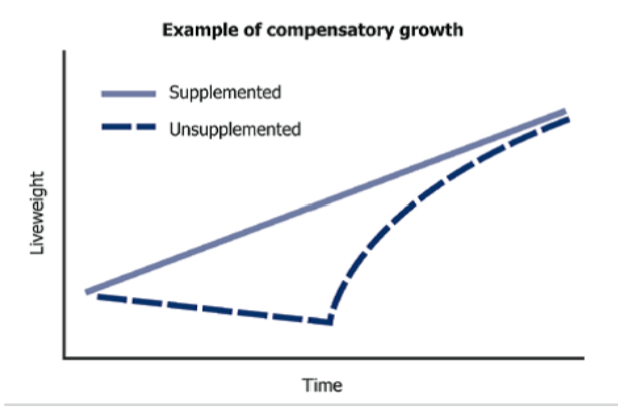
How does compensatory growth recovery work out short-term vs long-term?
Short-terms: Mild to moderate short-term restrictions allow for strong recovery
Long-term: Severe, prolonged deprivation can permanently stunt growth or result in only partial compensation
older cattle, yearlings, or weaned animals compensate much better than young, unweaned calves
Why do we do compensatory growth on purpose?
In temperate or seasonal climates, producers often feed cattle a low- cost, lower-energy diet (like poor-quality hay) to keep growth slow and cheap during expensive winter months, planning to let them "catch up" on cheap spring and summer grass
Some feedlots restrict feed intake slightly when cattle first arrive shrink internal organs temporarily, lowering maintenance energy costs before switching to unrestricted high-energy feed
What is the difference between hyperplasia and hypertrophy for
muscles?
Hyperplasia
increase in NUMBER
addition of muscle cells
prenatal
Hypertrophy
increase in SIZE
addition of contractile proteins
Postnatal
How is muscle growth affected?
Sex, age, nutrition, environment, genetic, etc.
What are the 4 main functions of muscle? The 3 main types?
Movement
Support
Maintenance of body temperatures
Dietary protein source (muscle foods)
3 Main Types: SKELETAL, smooth, cardiac
What are the 3 ways that muscle generates ATP (do they use
oxygen? Are they for quick or sustained muscle contraction?)
DIRECT PHOSPHORYLATION
Uses stored ATP and creatine phosphate
Very rapid ATP production
Supports muscle contraction only for seconds
ANAEROBIC GLYCOSIS
breaks down glucose or glycogen without oxygen
Produces ATP quickly
Generates lactate as a byproduct
OXIDATIVE PHOSPHORYLATION
occurs in mitochondria
uses oxygen to completely oxidize nutrients
produces most ATP and supports long-term muscle activity
What happens to these pathways during slaughter? How does the switch to anaerobic metabolism affect the meat?
Exsanguination interrupts supply of oxygen to the muscles which shifts from aerobic to anaerobic pathways.
Direct phosphorylation and anaerobic glycolysis still work, but oxidative phosphorylation stops.
Switch from aerobic metabolism → anaerobic glycolysis is crucial after death. As glycogen is converted to lactate, pH declines, ultimately influencing meat quality, color, tenderness, and water-holding capacity
Describe the change in pH of meat
pH of living muscle ~7.2
pH of meat 5.4-5.5
anaerobic glycolysis produces lactic acid as a byproduct
Accumulation of H ions causes muscle pH to
DECLINE from 7.0- 7.2 to an ultimate value of 5.4-5.5
What is water holding capacity? Explain the 3 ways this is important
The ability of meat to retain water during applications of external forces such as cutting, heating, grinding, or pressing
Economic impact
Meat sold by weight (water makes up 75%)
poor WHC means losing moisture during storage and packaging, directly shrinking the sellable weight and reduces profit margins
Eating quality
High WHC means moisture remains → juicy meat
Nutritional/safety factors
low WHC meat means fluid leaks onto trays. Unappealing to consumers, profits decrease
Poor WHC→ meat looks pale
How is muscle pH related to water holding capacity?
WHC is LOWEST when pH nears the *isoelectric point of muscle proteins
isoelectric point: # of + and - charges are equal
Describe the issues pale, soft, exudative pork and dark, firm and dry
beef
PSE pork
Extremely rapid rate of pH decline results in low muscle pH, while the muscle temperature is high
PSE muscles tend to have low ultimate pH values (less than 5.5)
Pork can have pH values of 5.4-5.6 and still exhibit PSE characteristics
Dark, firm, and dry beef
Caused by depletion of muscle glycogen:
Psychological Stress like fear or excitement
Physical Stress from handling, illness, and injury
Environment Stress from weather extremes, long-term restriction of dietary energy
What is rigor mortis and how does it happen?
definition: temporary physical and chemical process that causes the muscles of a body to stiffen and lock in place after death
Creatine phosphate & glycogen are depleted → Muscle slowly depletes ATP → Permanent actomyosin cross-bridges are formed → Loss of extensibility and muscle shortening
Describe the following pre-harvest factors: breed/genetics, sex, age,
diet, and handling. How do these factors influence meat quality
breed/genetics
differences in muscle development, marbling, tenderness, flavor, and fat content (wagyu vs angus, dairy vs beef)
Sex
mainly affects palatability (influence of sex hormones, uncastrated animals)
Age
effects appearance and palatability
older animals: darker color, tougher
harvesting too young prevents mature development of marbling
Diet
affects palatability & appearance
Flavor (grass-fed)
Handling
affects palatability & appearance
DFD and PSE can be caused by stressful handful
Explain the 3 humane slaughter methods discussed in class
Chemical: CO2 poisoning
sheep, calves, pigs
functions like anesthesia before animals are killed, or to kill directly
Mechanical: captive bolt stunning
sheep, swine, goats, calves, cattle, horses, mules, others
Render animals unconscious
must penetrate brain with a high concussive impact
Mechanical: gunshot
cattle, calves, sheep, swine, goats, horses, mules and others
bullet or projectile into brain, produce immediate unconsciousness
Define animal behavior and some examples (cognition, learning, social interactions, movement)
Definition: An action, activity, or process which can be observed and measured, and which is generally initiated by an external or internal stimulus
Examples:
Cognition - thinking and understanding
Learning - Critical feature of behavior that can occur without moving a muscle
Social Interactions - maternal behavior
Movement - walking, sitting, eating
Explain some of the benefits to studying applied animal behavior for farm animals, companion animals and zoo animals/wildlife
Farm - safety for handlers, feeding/social/reproductive behaviors, animal welfare assessment
Companion - public safety, preventing/managing behavior problems, human-animal bond
Wildlife/zoos - natural behaviors in a captive environment, disease detection, safe handling, behavior plans for abnormal behaviors via animal welfare act
Why do animals interact with the environment? What is the benefit?
Promotes FITNESS
How well animal uses behavioral repertoire in order to survive long enough to reach age of sexual maturity
How well animal uses behavioral repertoire in order to reproduce
Behavioral repertoire will often include behaviors that range from being rigid to flexible
Define a behavioral repertoire and how it relates to interaction with the environment
“survival toolbox”
total collection of actions, skills, behaviors an animal is capable of performing in their environment. A larger repertoire associated with more complex animals who face more challanges
Provide some examples of what an animal must do in order to survive and reproduce
Survive:
explore for food & shelter
avoid being killed
communicate
negotiate social interactions
Reproduce:
explore for mates
provide for young
communicate
negotiate social interactions
*animals cannot engage at all these at the same time
Explain behavioral tradeoffs and how they relate to fitness. What is an example of this? (rooster call)
There is a COST to fitness and a BENEFIT to fitness.
Rooster call example:
Calling when males present has NO benefit but a cost of compromised survival (less food)
Calling when females are present has a cost of compromised survival (less nutrition) but is outweighed by a benefit of improved chances of reproducing
Describe the costs and benefits of group living
Benefits
Detecting, acquiring, defending FOOD
EVADING predators
THERMAL benefits
Facilitates development of more complex social behaviors and interactions
Costs
More competitors
greater risk of disease transmission
increased cannibalism of young
inbreeding
easily detected
Define competition and how it is influenced by distribution of resources
Time and space matters, unequal and clustered distribution of resources usually negatively impacts most animals and benefits a small majority
How do animals resolve these disputes? Define RHP
fighting or surrendering
RHP (resource holding potential): potential to win an all-out fight!
What is dominance? What is the benefit of being dominant?
reflects the relationship between animals that is established over multiple encounters/time.
Benefit → dictates priority over a resource.
What is aggression? When is it used? Explain offense vs defense aggression and why an animal might do one vs the other
Definition: An act (attack) or threat of an act by one individual that threatens to harm another
Used when threat is ineffective.
Offensive → Animal perceives resource opportunity and…
Threaten the other animal if it does not leave
If threat is ineffective, may attack
Defensive → Animal perceives threat to their safety or resources by another animal and…
Becomes fearful
Shows defensive threats (looks larger, shows weapons)
If threat is ineffective, attacks
What is a submissive display? Why show submission?
Giving up preferential access to resources
Inhibitory stimulus (cut-off signal) to opponent
Visual displays (e.g., reducing size, rolling on
side/back), vocalizations (whine, yelp)
Avoidance or displacement behaviors
I won’t attack you, don’t attack me
What is passive vs active avoidance?
Active: giving way to approaching dom animal
Passive: Freeze, avoid eye contact in presence of dom
Name some common maternal behaviors around birth
Preparing a suitable location for birth
Licking newborn to stimulate movement, clean, develop bond
What influences maternal behavior? (genetics, experience,
hormones, vagocervical stimulation, stimuli)
Genetics
gene expression in mom affects levels of oxytocin + dopamine
Genes in offspring influence placenta and prenatal develop. → alters mother’s investment + behavior
Experience
First-time moms more likely to reject neonate
Experiences mom may show mothering behaviors w/o hormonal influence
Virgin fe/males show mothering traits with high exposure to neonates
Hormonal priming
progesterone, estrogen
Vagocervical stimulation
causes release of oxytocin (bonding hormone)
Stimuli from neonate
scent of amniotic fluid, facial characteristics, erratic movements, care-seeking behavior
What are pheromones? How can we use them to help animals?
A chemical secreted by an animal that influences the behavior or development of others of the same species
When mother releasing ‘appeasing’ pheromone near parturition:
attracts neonates
products adapt this for behavioral modification
Compare and contrast altricial vs precocial species and their abilities at birth
Altricial = ‘requiring nourishment’, neonate are helpless
Precocial = born able to move & forage at early age
What is the mother-young bond? What are some intervals that are important to bonding? How can we assist a broken bond?
def in name, essential for neonatal survival
Intervals: Length of time neonate will b accepted, length of time needed for mom to recognize, & length of time can be separated after initial bond
Broken Bond?
1. Important not to interfere with the development of the bond
2. If mom rejects offspring, try to get her to change her mind
3. If mom still rejects, find surrogate mom
4. Last resort should be to hand-rear
Compare imprinting to bonding and how they differ
Imprinting = Immediate, long-lasting, learned response to a large visual cue in the young animal’s environment. Usually occurs in precocial birds that move and fly early in life.
Bonding = Relationship formed between mother and young using oral and tactile cues from both. Both altricial & precocial mammals form bonds, non-visual cues especially important for altricial species
What happens when we disrupt the bond between mother and offspring?
Piglets weaned before 2 weeks of age (vs. at 3 weeks) show:
Decreased gene expression in hippocampus
Cognitive deficits
More abnormal and aggressive behaviors
Dairy calves and cows develop a strong
bond within minutes after birth. Distress
responses to separation escalate when
separation is delayed
What is an abnormal behavior? Why do we call it abnormal?
Abnormal because there is little evidence that natural selection would favor animals with these behaviors, and they do not happen in nature
Describe some of the different types of behaviors
Source behavior redirected to inappropriate target
Naval/cross sucking in dairy calves
Behavior occurs in absence of stimuli
fly snapping in dogs
Displayed out of context as a means of displacing an underlying emotion/motivation
anxiety, excitement, frustration
Movements intend to change activity, like escape
cage rearing in lab mice
What is a stereotypy? What are the themes of species and their most commonly performed stereotypies?
Stereotypies = repetitive, invariant behavior patterns with no obvious goal
oral behaviors in ungulates, pacing in carnivores
Why do stereotypies occur?
Pain = behavior helps alleviate pain/discomfort from condition
Motivational = sustained elicitation of a motivation to perform a certain behavior
Coping = behavior reduces stress and leads to positive reinforcement
Pathology = brain is unable to ‘disinhibit behavior
Why can’t we just try to force the behaviors to stop by using aversive techniques?
Doesn’t get to the root cause of the problem and is only a temporary solution
How can we make management recommendations to mitigate abnormal behavior performance?
Creating complex and species-specific environments for animals at a young age so these behaviors do not begin and become pathological (highly difficult to stop)
Preventative treatment is key
In carnivores, what is some of the evidence for why pacing occurs?
They are experiencing hunting behaviors pre-feeding times
What effect could SSRIs have on abnormal behaviors if used properly? Should these be a first step in addressing the issue?
Could resolve them in a matter of 8-9 weeks, shouldn’t come before therapies or evaluations.
Compare and contrast animal rights vs animal welfare. How can we apply these definitions to examples?
Rights = a philosophy and political movement which believes in equal standing of animals in relation to humans in society. Ex. PETA
Welfare = philosophy and science concerned with the care and well-being of the animals who are most impacted by humans. Ex. ASPCA
Who is Temple Grandin, and what was her field of study?
A world-renowned animal welfare scientist. Inventor of cattle chute and an autism advocate.
What is animal ethics? How can we define sentience?
ethics: A branch of philosophy which deals directly with how humans should treat non-human animals
sentience: animal’s ability to be aware of feelings + sensations
Name two ethical frameworks we can use to approach moral dilemmas about animals
Utilitarianism → an action is right if and only if it produces the most overall good possible. Consequences are only thing that matters
Kantianism → a moral truth is always true, regardless of context. Hurting someone, regardless of reason/consequence, is wrong.
Explain the nuance of the Marius the giraffe story
Healthy 2-year old male giraffe at the Copenhagen zoo
genes were over-represented in the captive population, unsuitable for future captive breeding
Zoo decided to euthanize him in 2014 despite offers to relocate him
gunshot used so meat was still valuable
publicly executed and dissected for ‘educational purposes’ then fed to zoo’s lions
What are the 5 freedoms? How do these contrast from the 5 domains? Why should we focus more on the 5 domains vs freedoms?
Freedom from Hunger or Thirst
Freedom from discomfort
Freedom from pain, injury, or disease
freedom to express normal behavior
Freedom from Fear and Distress
BUT as welfare became more scientific, we must center our frameworks with positive welfare states…
Nutrition
Environment
Health
Behavioral Interactions
Mental State
Describe the three circles Fraser framework and the Dawkins definition
Fraser framework consists of
Natural living
affective state
basic health and functioning
Dawkin’s definition: Health and what an animal wants
What 3 tools can we use to assess welfare? Apply these ideas to an example
Affective State
Natural Living
Basic Health and Functioning
Affective state: How can we measure this? What is a judgement bias test? How can we use behaviors?
Behavioral Cues: vocalizations, abnormal behavior, body language
Judgement Bias Tasks: assesses the current state of an animal as more optimistic or pessimistic. animals trained to recognize one cue as + and one as -, responses are good or bad.
Natural living: How can we assess if an animal is living “naturally”? How can we measure motivation of an animal?
By comparing their behaviors in the wild to ones in captivity → determine what they’re motivated to do. Is environment in captivity similar to in the wild?
Motivation measured by how hard an animal is willing to work to perform that behavior or resource
Basic health/function: What indicators can we use to assess the basic health and functioning of animals? What is one complication on relying on physiological
metrics for assessing a welfare concern?
For assessment: behavioral cues like sickness behaviors
anorexia, lethargy, seeking isolation
pain behaviors and grimace scales + lameness
Physiological metrics used to measure stress
Eustress and distress
How can we measure stress?
Glucocorticoid secretion
increased cortisol can indicate increased stress
Breath Rate
increased breath rate indicates increased stress
Heart Rate and Heart Rate Variability (HRV)
increased heart rate can indicate increased stress, and changes in HRV can indicate stress
Temperature
slightly increased temperature can indicate increased stress
key words: CAN INDICATE (exercise for example increases heart rate but is good for you)