Health behaviour change
 Call Kai
 Learn
 Practice Test
 Spaced Repetition
 Match
 Flashcards
 Knowt Play
1/24

There's no tags or description
Looks like no tags are added yet.
Name | Mastery | Learn | Test | Matching | Spaced | Call with Kai | Chat |
|---|
No analytics yet
Send a link to your students to track their progress
25 Terms

B - this is false - chronic diseases result in more deaths per year

F - mainly due to advances in modern medicine like hygeine, understanding of pathogens and their spread and public health measures.
Why is knowing how to live a healthy lifestyle not always enough to successfully change unhealthy behaviours?
Knowing what is healthy does not automatically lead to behaviour change. People may face barriers such as limited time, money, resources, motivation, or confidence.
For example, someone may know that smoking is harmful but still struggle to quit because smoking has become a deeply ingrained habit.
Health Behaviour change
Health behaviour change is the process of developing healthy behaviours and overcoming unhealthy ones.
It can be difficult because knowing a behaviour is unhealthy does not automatically motivate change. Psychological barriers, established habits, low self-efficacy, and perceived disadvantages of changing can prevent someone from taking action.
What are the four main cognitive factors that influence health behaviour change?
Perceived threat: Believing that continuing a behaviour could lead to serious health problems.
Perceived benefits vs. barriers: Believing that the health benefits of changing outweigh the difficulties or disadvantages.
Self-efficacy: Having confidence in your ability to successfully perform the healthier behaviour.
Cues to action: External triggers or reminders that motivate someone to begin changing their behaviour.
Why is self-efficacy particularly important for successful health behaviour change?
Self-efficacy is one of the strongest predictors of successful behaviour change because people who believe they can successfully change a behaviour are more likely to take action, remain motivated, and overcome obstacles.
For example, someone who believes they can quit smoking is more likely to attempt quitting and persist through challenges.
Cues to Action
Triggers or reminders that motivate an individual to begin changing a health-related behaviour.
Common cognitive barriers to health behaviour change

Self efficacy is critical - one of the most important predictor for health behaviour change
Someone whos ready to change their health behaviour may say these things.

Someones who's not motivated to health change their behaviour would say this

Far less likely to initiate health behaviour change as compared to above
Health Belief Model
The Health Belief Model explains why people may decide to change their health behaviours based on their beliefs about:
The seriousness and likelihood of a health threat.
The benefits and barriers of changing.
Their confidence in their ability to change (self-efficacy).
Cues that motivate them to take action.

Bounded Rationality
A cognitive bias wherby people tend to make decisions that are good enough rather than perfect rational ones
Why is the Health Belief Model limited in explaining real-life health decisions?
The model assumes people make rational decisions by carefully evaluating health threats and weighing the benefits and barriers of changing.
However, people experience bounded rationality, meaning they have limited time, information, and mental capacity to evaluate every option. As a result, they may make decisions that are simply good enough rather than the healthiest or most rational choice.
Transtheoretical Model of behaviour change
The Transtheoretical Model explains how people change their behaviours through a series of stages.

What is the difference between the Health Belief Model and the Transtheoretical Model?
The Health Belief Model explains why people change their health behaviours.
The Transtheoretical Model explains how people change by moving through different stages.
What are the stages of the Transtheoretical Model?
Pre-contemplation
Contemplation
Preparation
Action
Maintenance
Relapse
An optional stage would be terminantion
Pre-contemplation

Contemplation

Aware of problem but haven't yet committed to changing it
Smokers are in this stage often where they know smoking is bad - and would like to quit but haven't made any real steps to quit yet.
Preparation

Action

continual effort toward integratign behaviour into ones lifestyle4
Maintenance
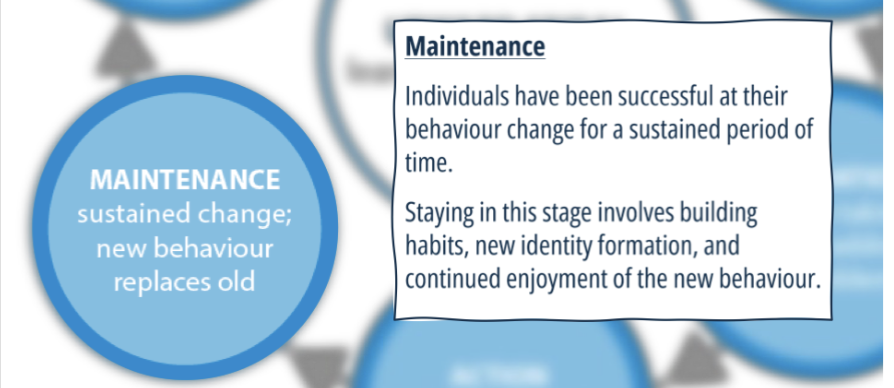
How long this stage lasts depends on the complexity of the behaviour. Like getting into exercise stage could be months or years.
Relapse

Moving into this stage isnt failure - failure happens when they stop trying to change it
Termination
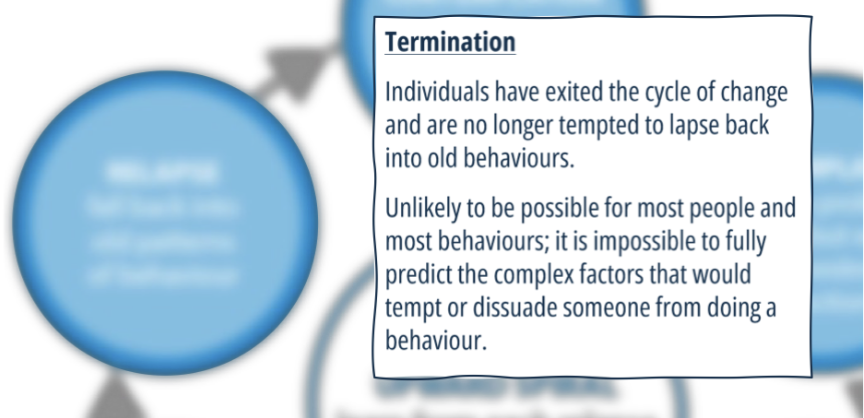
Not really realistic to say someone can never be tempted to return to their old behaviours at best - we can hope for comfident maintence - where we are mindful of the factors that could negatively impact baviour but we are confident that we can overcome them and not fall back into relapse.
Is behaviour change in the Transtheoretical Model linear?
Behaviour change does not always follow a fixed order. People may move forward or backward between stages, progress at different speeds, or skip stages entirely.
theoriesmust balance specificity and applicability
Theories must be specific enough to explain behaviours clearly, but broad enough to apply to different people and situations.