Microbio: Exam
 Call Kai
 Learn
 Practice Test
 Spaced Repetition
 Match
 Flashcards
 Knowt Play
1/23

There's no tags or description
Looks like no tags are added yet.
24 Terms
What is ecological stoichometry
general idea
why is this helpful
how does C:N differ between fungi & bacteria?
The ratio of elements essential for life (eg CHONPS. K, Ca, S, Mg, Fe, B, Cl…….. metals) in each organism
eg C:N. How much C they need, relative to N, to create their req biomass, get energy, do their whatever function
these differ between organisms depending on their niche, so can be insightful to look at these.
(diff organisms)
bacteria ) C:N, 4.6:1
bacteria, still need C and N for survival, but low biomass means they need little C.
fungi ) 8.3:1
fungi are more C rich, having more biomass and lower turnover, so they invest more C in growth (Req more C)
plants ) 23.4:1
lots of biomass so lots of C req to uphold this. Easily got with PS generating C for them from CO2, so they cann have this large requirement.

Mineralisation
How does this fit into the N cycle
What is the process
what drives it
Mineralisation aka Decomposition. (Biomass => NH4+ / Nitrate). moving N out of biomass, back into the environment
the opposite would be Assimilation (NH4+ INTO biomass)
(Process)
So this is the complete release of minerals (particularly N) from organic molecules => Inorganic forms (Back to environmental baselines)
The complete release - Decomposition is a step involved, lots of decomposition finalises to mineralisation.
Key to nutrient cycling back to the environment, from dead organic matter.
(What drives it?)
Stoichometry of the organism that created that organic matter (Stoichometry of the organic matter being broken down)
bacterial decomposers have a 4:1 C:N, so with rich C:N organic matter to break down (super rich = 8:1), you’d think N would become limiting, and C would be in excess
HOWEVER, N is used for one thing (Making biomass) while C is used for biomass AND energy, lots is released as CO2, so it becomes the limiting nutrient,
especially with bacteria making less biomass, the excess N from the required C in the ratio, can be released back to the environment in inorganic form.

How may mineralisation switch to assimilation?
aka Immobilisation.
When a decomposer encounters organic matter with a high C:N ratio (think 60:1) N becomes the limiting element. They no longer release it, as they can get enough C without N becoming overflow
So they start assimilating the N (taking it up from the environment NH4+ => Biomass) as they require it for survival (Decomposing, but not releasing the N back to inorganic form)
Mineralisation < 30:1 < Immobilisation

If bacterial decomposers are immobilising N from organic matter, how is it ultimately released back for inorganic availability (Mineralisation)?
Top-down regulation (predators, phages)
Enables a large flow of C & N & energy, despite bacteria having a low biomass.
(Predation)
Like how bacteria mineralising will have N in excess due to the sheer amnt of C needed for biomass and released as CO2 for energy burning, their predators (eg Nematodes) face the same situtation when consuming prey (bacteria!)
this means that ultimately bacterial immobilised N is released as inorganic N, from excretion from the predators, as N becomes in excess.
Additionally when the nematodes arre predated or die (bacteria can break them down.)
(Bacteriophages)
upon infection, they can lyse bacterial cells which releases the N back to the soil

How do fungi tend to behave in immobilisation / mineralisation & C:N Ratios?
They have high biomass, and low E flow, with slow cycling.
This means they are more bottom up regulated (by the limitations for growing biomass, they are regulated by the nutrients)
So they tend to immobilise (C is fine, but N becomes limiting, and they dont have extra to give)
What is the idea of Teleology in Microbiology?
Teleological thinking. We often see microbes as functioning for a wider ecosystem benefit (eg decomposition, purpose of decomposing, to release N for plants etc)
However, their sole function is to reproduce. The processes they do along the way, serve to make Energy and fulfillent of reproduction out of their particular niche, each and all inhabited.
CONSIDER => What purpose does the organism get from this process, why is it occurring in this respect (rather than how the ECOSYSTEM is benefitting)

What problem do plants have with N aquisition?
in an immobilisation dominated ecosystem, like with fungi taking N into biomass, bacteria immobilising N (or being cycled but as few)
typical for plants also, to live in a high C:N ratio environment, due to plant litter increasing the C relative to N in the surrounds (plants have lots of C as they can make their own sugars)
amplified in anaerobic (Anoxic soils), where denitrification occurs and limits NH4+ environmentally available N.
=> Plants are highly N limited
(Solutions?)
Plants could forage (make more roots, search for N available) but bacteria are everywhere in the soil, and theres a low chance of finding an area with few (and abundant N. TThe\y have already immobilised it)
Instead…
Priming, or partnerships with N fixers (Mycorrizas, less common)

what is priming?
how is this achieved
what does this involve
Priming is an important process for plants to obtain N when it becomes limiting (Immboilisation-driven ecosystem, high C around due to leaf litter from high C biomass)
(the process)
1) Plants put out lots of sugars, accessible C, via the roots
2) Bacteria start growing, taking up this C (pumped with energy), making biomass
3) Bacteria start becoming N limited (lots of C, little N, but they want to make biomass)
4) Due to their quick turnover and inhabitance of weird niches, they can start producing weird enzymes, and working hard to degrade ANY reminant N in the soil, just to obtain enough to survive and grow
5) Eventually they run out of C and die / predation occurs / phage => All this N is released in an available form for the plant to take up
(In essence)
Giving the bacteria good C, so that they do the hard work to squeeze any leftover N out of hard-to-reach places (complex organic matter and compounds), but then take away this C so they die and release it all in a nice package around your roots
Basically all about life timescales, bacterias cycle 1-3 days, so quickly live and die and release N, as they cannot last longer and outcompete the roots (1-3 month turnover)
=> Roots can wait out the low N conditions (1-3 months) Bacteria cannot (1-3 days)
=> As the root tip grows thru, the part of the root needing N is nicely positioned at this release
=> A mix of dying, predation, to relase N

Describe freeliving N fixing bactiera
problems with this lifeestyle
how they carry it out therefore
give some species examples
(Freeliving N-fixing bacteria)
a tiny but important group responsible for turning atmospheric N2, into NH4+, available enironmentally through the ecosystem upon release into the soil
the problm is - most are aerboes req O2 for respiration, but O2 destroys Nitrogenase enzyme (that enables N fixation)
so they req specialised structures
(Examples)
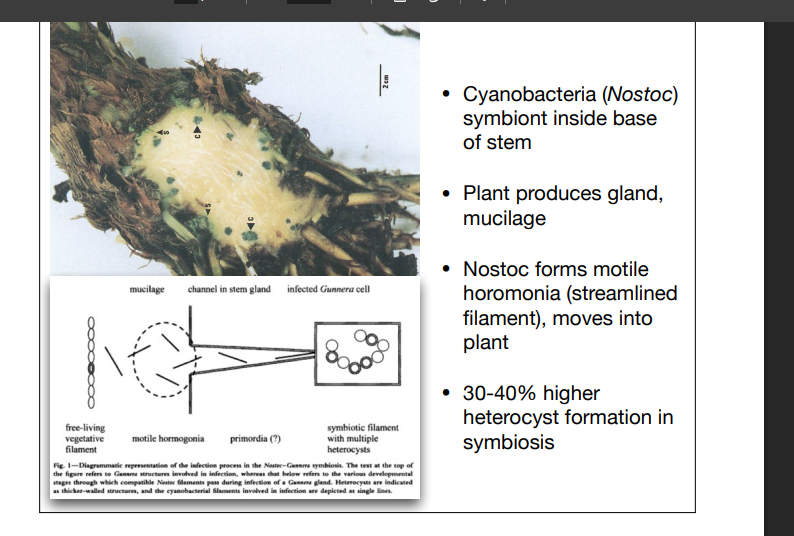
Anabaena & Nostoc) cyanobacteria, where cells differentiate to form heterocysts that soley do N fixation rather than using O2 for PS. Neighbouring community cells do PS for them, and dont fix N
=> A divison of labor of sorts, to fix N
Azotobacter ) forms a thick slime layer surrounding them that thickens in higher O2. this along with other mechanisms, manages O2 flow into the cell (flows in thinner etc)

Describe how freeliving N bacteria may symbiose with plants?
Give some species examples
the general idea, plants create specialised cells to host the N-fixers, and the plants provide them with sugars so they dont have to intake O2 to make sugars themselves (this also incr efficiency, fixing 30-40% more N than freeliving)
this protects the Nitrogenase enzyme, so they can continue fixing N, (N2 => NH4+) which the plant has available as excess
=> Symbiosis of freeliving N fixers, to become symbiotic & Not freeliving
(Examples)
Nostoc ) cyanobacteria is attracted by Muculage produced at the plant surface/stem. => moves through a channel in the stem => infects plants cells => cells and Nostoc spsecialise to house it and Nostoc forms heterocysts
Pacific Axolla / Retoreto ) these plants float on waters surface as roots dangle down. they create air bubbles in cells (muculage cavity to control O2 conc) => muculage to attract (Anabaena azollae Cyanobacteria) => taken into the plant => Symbiosis
=> Axolla floated in rice paddies as a form of natural fertiliser.
How does Nodulating N fixation symbiosis occur?
how may it have evolved?
Is a highly evolved process with lots of steps.
(Signalling)
plant produces compound to signal N fixing bacteria (Isoflavonoids)
This triggers Nod genes in bacterium => Nodule Factors (NFs) encoded for => Signals back to the plant
(Nod genes encoded on a plasmid, with lots of specificity, so can transfer btwn strains and be transmissable)
(Nodule Formation)
NFs from the bacteria, signal for the plant root to deform and form an infection threat
bacteria can swim thru this, down into the root, being attracted by the Isoflavonoids
Cell divison occurs to form the nodule (Symbiosome), as bacterial cells differentiate and vascular tissue forms associated.
(Evolution)
legumes (the main group for this to occur) have a varying ability to do so. some do the full thing, some just have bacteria that colonies naturally forming cracks in the roots
therefore it likely didnt evolve all at once, in intermediates (eg colonised cracks => colonised and retained in infection threads no nodule => infection threads and nodule)

What are the two bacterial families with species that do Nodulating N-fixation
what is the evolutionary idea
for plants, all nodulating plants are in a clade, but not all clade members nodulate. (maybe evoled once, but lost lots)
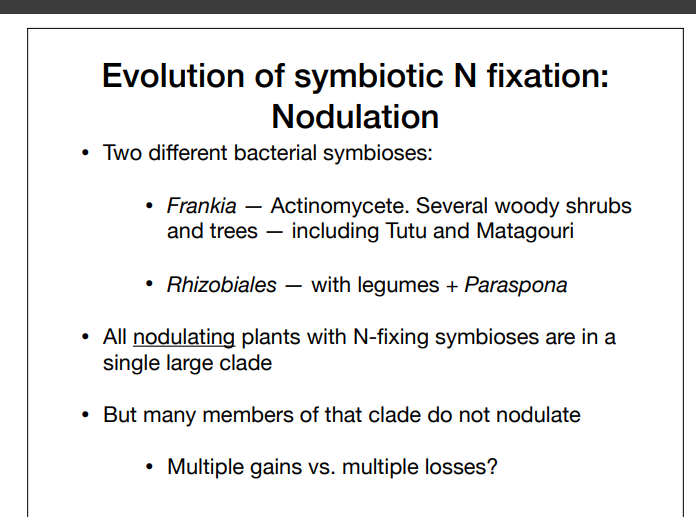
for bacteria, all nodulating bacteria are in Frankia or Rhizobiales families, but not all family members nodulate (seperate evolition, but loss within the families)
both are freeliving N fixers that can become symbiotic, so dont even nodulate all of the time.
(Frankia)
Actinomycete, that nodulate several woody shrubs & trees (eg Tutu)
form filamentous groups alike hyphae but much smaller (hence the Actinomycetes name, once thought to be fungi), they are important for decomposition (produce the soily smell of soil)
only some fix nitrogen. only some fix N and form nodules
(Rhizobiales)
Nodulate legumes & Paraspona
a huge group, n fixing freeliving, and nodulation not all related within. it has been gained and lost, so cannot infer traits at the genus level and must look at species to know their characetristics
some specificity for legumes (eg Soybeans req specific strain)
What is the nature of nodulation evolution in plants?
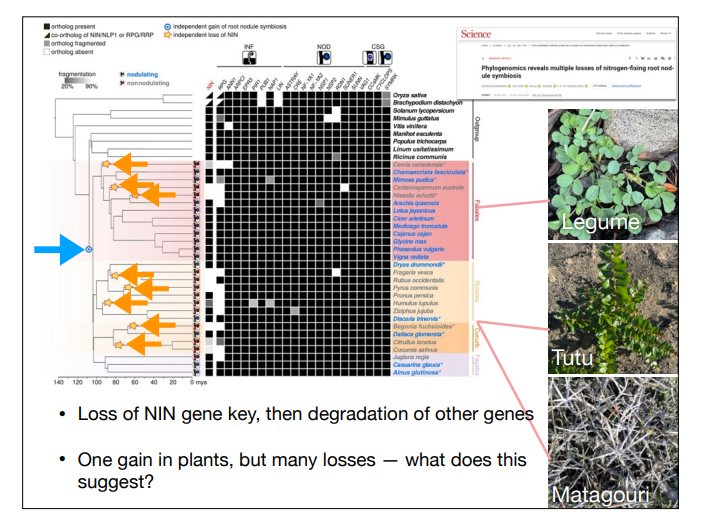
Has been evolved exactly once, rather than likely various in Bacteria (Rhizobiales & Frankia for eg)
All nod plants share a common ancestor (In a single clade), but most plants in that clade dont nodulate nor fix N
so the thought, did they all gain N fixation seperately? or did it get lost many times?
=> Genome analysis found the same genes associated with Nodules (Evolved as a single event). Loss of NIN (Nodule Inititaion) gene, related to loss of nodulation
A beneficial adaptation, but an expensive tradeoff that reslts in losses to favor other less expensive strategies.
What are the 2 types of nodules plant & bacteria symbiosis can form, and how do these differ
(Determinate)
Round, no zonation
(Indeterminate)
Elongated, zones formed, endoreduplication of DNA - chromosomes double & triple, for the cells housing the bacteria.
bacterial cells start to form bacteriods, sweling and forming Y&T shapes. These are still alive, but have increased number of nucleoids & DNA copies
their membranes are leaky, but they still have metabolic activity.
=> This occurs as they try to make more DNA to encode for more N fixing enzymes, can transcribe multiple at a time (an enzyme driven process)
=> Their membranes are leaky due to exhcnaging nutrients with the plant (sugars in, N out) and also because less energy needed to invest in protection

How does Rubisco carry out Photorespiration?
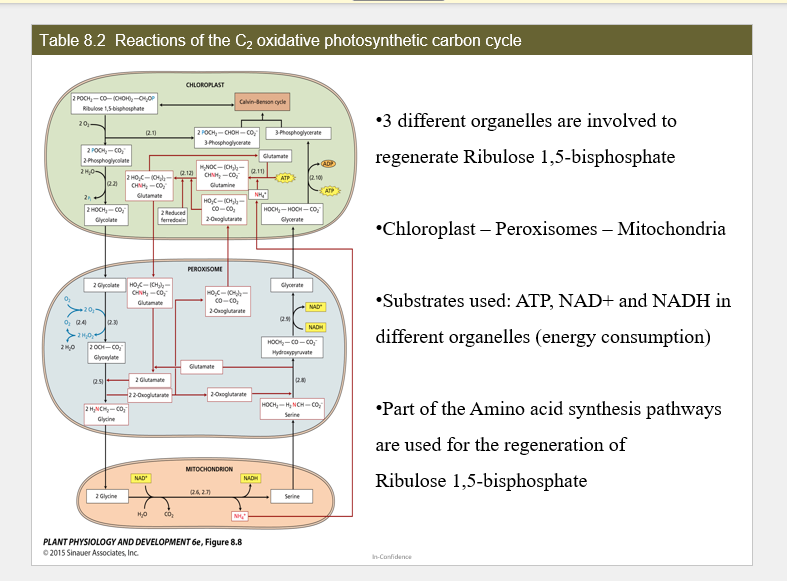
When it happens to do oxygenase activity, to fix O2 onto R15BP instead of CO2. So in the CB cycle, 2× 3-Phosphoglycerate arent made. 1x Phosphoglycerate (3C sugar) + 1x Phosphoglycolate (2C sugar) as we arent adding the extra C
3C sugar can continue onto CB cycle, to be used to make Glucose (sucrose, starch, lipids) or to regenerate R15BP (5x req => 3xR15BP, so cycling can continue)
The 2C sugar however, must go through a lengthy, various organelle, Energy expensive process, to regen R15BP.
But not an entire loss, the lengthy pathway makes for side rxns to generate AAs. We ultimately lose out on 1ATP & 1G3P to make an AA, so can be beneficial when sugar isnt under high demand
(the process)
Chloroplast ) 3-phosphoglycolate => glycolate => Transported into Peroxisome (closeby)
Here, various pathways and conversions occur.
=> Glycine => Transported to Mitochon => Serine => Transported to Peroxisome.
Serine with various additions, and reduction with NADH => Glycerate => Transported to chloroplast
Glycerate phosphorylated with 1ATP (ATP gen from light rxns likely) => 3-Phosphoglycerate, and can continue on thru CB cycle => Make G3P => Make glucose / regen R15BP
(In summary)
Using various organelles, NADPH, and 1ATP in the final step, to use AA synthesis pathways, and convert 3-phosphoglycolate thru Glycine thru Serine ultimately to 3-phosphoglycerate to be fed into CB cycle again
Gen AAs along the way, so is useful as well. Arent just making waste productions.