Human Anatomy: Major Skeletal Muscles, Actions, and Compartments
 Call Kai
 Learn
 Practice Test
 Spaced Repetition
 Match
 Flashcards
 Knowt Play
1/40

There's no tags or description
Looks like no tags are added yet.
41 Terms
Orbicularis oculi
Surrounds the eye. Closes the eyelids—blink or squeeze your eyes shut.

Orbicularis oris
Surrounds the mouth. Closes and purses the lips—make a kissing shape.

Muscles of facial expression
Move facial skin to produce expressions such as smiling and frowning. Innervated by CN VII, the facial nerve.
Masseter
Side of the jaw. Elevates the mandible—closes the jaw during chewing. Innervated by CN V3 trigeminal.

Temporalis
Temple region above the ear. Elevates and retracts the mandible—closes the jaw and pulls it backward. Innervated by CN V3 trigeminal.

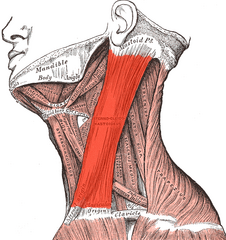
Sternocleidomastoid
Front and side of the neck. Both sides together flex the neck; one side turns the face toward the opposite side. Innervated by CN XI accessory.
Rectus abdominis
Front of abdomen; six-pack muscle. Flexes the vertebral column—curls the trunk forward. Also compresses the abdomen.

External oblique
Superficial lateral abdomen. Laterally flexes the trunk and rotates it toward the OPPOSITE side. Also compresses the abdomen.

Internal oblique
Deep to external oblique. Laterally flexes the trunk and rotates it toward the SAME side. Also compresses the abdomen.

Transversus abdominis
Deep abdominal layer with horizontal fibers. Compresses the abdomen and stabilizes the trunk—brace your core.

Erector spinae
Along the back beside the spine. Extends and laterally flexes the vertebral column—straightens the back and bends it sideways.

External intercostals
Superficial muscles between ribs. Elevate the ribs during inhalation—help expand the chest.
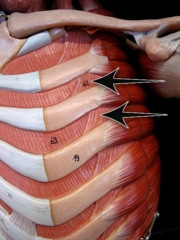
Internal intercostals
Deep muscles between ribs. The interosseous portion depresses the ribs during forced exhalation.

Deltoid
Shoulder cap. Primarily abducts the arm at the shoulder—raises the arm out to the side.
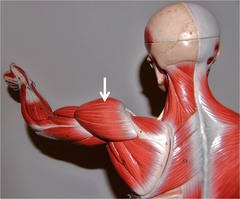
Latissimus dorsi
Broad middle and lower back muscle. Adducts and extends the arm at the shoulder—pulls the arm inward and backward.

Pectoralis major
Large superficial chest muscle. Flexes, adducts, and medially rotates the arm at the shoulder—moves it forward, inward, and turns it inward.

rotator cuff muscles
Surround the shoulder joint. Stabilize the humeral head; assist shoulder abduction and medial/lateral rotation. Group includes supraspinatus, infraspinatus, teres minor, and subscapularis.

Trapezius
Superficial upper back and neck. Elevates, depresses, and retracts the scapula—moves shoulder blades up, down, and toward the spine.

Rhomboids
Between the medial scapula and spine, deep to trapezius. Retract the scapula—pull the shoulder blade toward the spine.

Pectoralis minor
Deep to pectoralis major. Protracts the scapula—pulls it forward. Assists forced inhalation when the scapula is fixed.

Serratus anterior
Saw-toothed muscle along the lateral ribs. Protracts the scapula and holds it against the rib cage—reach forward in a punching motion.

Biceps brachii
Front of upper arm. Flexes the elbow and supinates the forearm—bends the elbow and turns the palm up.

Brachialis
Front of upper arm, deep to biceps brachii. Flexes the elbow—bends it.

Brachioradialis
Thumb side of forearm. Flexes the elbow, especially with the forearm in the neutral thumb-up position—hammer curl.

Triceps brachii
Back of upper arm. Extends the elbow—straightens it.

Anterior arm compartment
Front of upper arm. Primarily flexes the elbow.

Posterior arm compartment
Back of upper arm. Primarily extends the elbow.
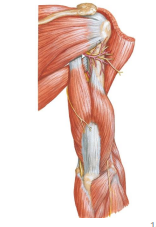
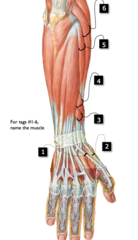
Anterior forearm compartment
Palm side of forearm. Flexes the wrist and fingers, moves the wrist side to side, and includes pronation—turning the palm down.

Posterior forearm compartment
Back of forearm. Extends the wrist and fingers, moves the wrist side to side, and includes supination—turning the palm up. Brachioradialis is an elbow-flexing exception.
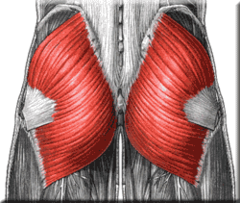
Gluteus maximus
Large superficial buttock muscle. Primarily extends the hip—moves the thigh backward or helps you rise from a chair.
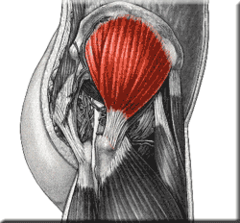
Gluteus medius
Upper outer hip. Abducts the hip—moves the thigh sideways. Stabilizes the pelvis during walking.
Iliopsoas
Deep front of hip. Flexes the hip—lifts the thigh toward the trunk.

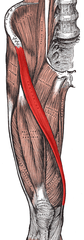
Sartorius
Long diagonal strap across the front of the thigh. Flexes the hip and knee; also assists hip abduction and lateral rotation.
Vastus lateralis
Outer anterior thigh; part of quadriceps. Extends the knee—straightens it.
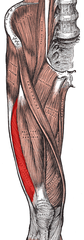
Anterior thigh compartment / Quadriceps
Front of thigh. All quadriceps extend the knee. Rectus femoris also flexes the hip; the other quadriceps do not cross the hip.

Medial thigh compartment / Adductors
Inner thigh. Primarily adducts the hip—brings the thigh toward the body's midline.

Posterior thigh compartment / Hamstrings
Back of thigh. Flexes the knee and extends the hip; the short head of biceps femoris acts only at the knee.

IT band
Connective tissue band along the outer thigh. Transmits muscle force and helps stabilize the hip and knee. It does not actively contract.

Anterior leg compartment
Front of lower leg. Primarily dorsiflexes the foot—lifts the foot toward the shin.

Lateral leg compartment
Outer lower leg. Everts the foot—turns the sole outward. Also assists plantar flexion.

Posterior leg compartment / Calf
Back of lower leg. Primarily plantar-flexes the foot—points it downward or raises the heel. Gastrocnemius also flexes the knee.
