intro and tree form
 Call Kai
 Learn
Learn Practice Test
 Spaced Repetition
 Match
Match Flashcards
 Knowt Play
1/39

There's no tags or description
Looks like no tags are added yet.
Name | Mastery | Learn | Test | Matching | Spaced | Call with Kai | Chat |
|---|
No analytics yet
Send a link to your students to track their progress
40 Terms
silviculture
the theory and practice of controlling forest establishment, composition, structure, quality and growth (how it establishes, develops, and regenerates) to achieve the objectives of management
art and science of manipulating forest stands to achieve our objectives - such as the production of goods and services
history of silviculture
german origins, other origins in Asia more similar to agroforestry
until the 70s they focused on timber extraction, 80s-90s focused on multi-use forestry, now we are concerned with sustainable forest management - the future of trees is just as important as the harvest, future and replanting esp with concerns of climate change and unpredictability
why silviculture matters
connects ecology to action, regenerates forests after harvest or disturbance, tends stands for resilience, improve value and ecosystem services, adapts forests to climate / fire / pests / changing social expectations
challenges with herbicides
used to control competing vegetation such as grasses and understory, goal to increase tree growth
alternatives are also needed
considerations include biological and physical environment, operational constraints, policy, social, economic, and management objectives of course
what do we need to take into account with silviculture? (3)
economy - harvest, timber, firewood
ecology - environmental protection
social benefit - local population, recreation, etc
what do we do for silviculture?
site prep, seedlings, brushing, herbicides, etc
prescription plans depend on objectives / management goals - ex promoting biodiversity, maximizing timber yield, reduce fire risk, reduce erosion, etc
adaptive management in silviculture
use best available knowledge to make decisions
monitor results
adapt or modify practices based on observations
silviculture trends in AB
harvest is 22.5M m2 (2/3 of this conifer)
harvest area is increasing, doubling in past 30 years
most harvested area is planted, increase in herbicide use, but recent decrease
decrese in site prep
mostly spruce, but pine has also been increasing
how does tree growth begin?
leaf area capture light → photosynthesis fixes carbon → carbon allocation to leaves, stem, roots → growth in height, diameter, and crown
growth is controlled by leaf area - leaves grow trees
tree growth vs yield
the change in attribute of a tree or stand over a fixed time interval, biological production rate concept
vs the quantity of the attribute of a tree or stand at a given point in time, can be known as cumulative growth, is a accumulation or removal concept
sigmoidal growth curve pattern / logistic growth curve (S) holds true for many tree and stand level parameters (height, DBH, BA, volume, leaf area)
tree growth form
competition for light and space affects crown, branches and roots
forest grown vs open grown
forest grown
more competition, more trees in the same space, condenses
open grown
less competition, individual / few trees with more space
have larger leaf area

live crown ratio
proportion of the total stem length covered by living branching, as a percentage of total height
% = live crown length / total tree height *100
higher ratio indicates there is a longer crown length in proportion to height
influenced by stem density, shade tolerance, and type of trees
live crown length
from the base of the crown to the top of the crown / tree
crown width
take N-S and W-E widths of crown, perpendicular widths, and then take the average
friction is the abrasion between branches caused by wind, shyness is the empty space between crowns cause by wind probs
site index
common measure of productivity
top height at a given age, height is closely related to stand volume (but independent of density)
developed for single species, even-aged stands
so if you know the height and age of a tree you can find the volume
use the variables you do know to obtain what you don’t, useful for growth modelling
slenderness coefficient
height / DBH
preferred to be higher
excurrent branching
strong central leader (grows faster than lateral branches), common in conifers - grow as high as possible to reach light
strong apical dominance, control by gravity
crown architecture
decurrent branching
several major branches, less apical control / weak apical dominance, leader grows no faster than the lateral branches
rounded crowns and flat tops, common of broadleaf / hardwood trees
more likely to respond to light - bend towards canopy gaps
crown architecture
shade intolerant trees
put most of their growth in leaders in deep shade
race for sunlight or they will die
ex lodgepole pine and aspen
shade tolerant trees
leader is shorter than the lateral branches, sit and wait approach, respond to canopy gaps, seedling bank
ex balsam fir, sugar maple, beech
less competition / lower density
more lateral growing space, large and deep crowns, more persistent branches
more competition / higher density
restricted crown width, lower light beneath canopy, branch mortality and crown recession
competition in silviculture
generally prefer a lower density in forestry, but then need to pay the cost of thinning (balance)
in dense stands, height is maintained by DBH is constrained
we prefer taller trees, but exposing very slender trees means risk of the elements
indeterminate shoot growth
some shoot extensions are developed in the previous season and some are developed through the current season, promotes very rapid growth in good growing conditions
ex poplar, birch, ash, larch, elm
determinate shoot growth
all of the seasons shoot extension is preformed in the winter bud the previous year, allows for quick development of leaves in the spring
common in areas with a distinct dormant period
ex spruce, fir, ash, oak, pine
branching problems
ramicorn branch - upturned and competes with the main stem, occurs when terminal leader is killed and so other branches compete
water sprouts - release of buds on the main stem, common when bole exposed after thinning or pruning
lammas shoots - late season flush of terminal bud = susceptible to frost, could be fertilization issue
why do crowns differ?
1) genetics: species traits, branching patterns, shade tolerance
2) environment: light, moisture, wind, frost, space
3) competition: stand density, crown overlap, neighbours
4) management: thinning, pruning, damage - role of silviculture
tree form is the interaction between these, not just one or two causes
branch mortality / natural pruning
shading can cause low branch carbon balance → causing mortality → branch shedding, and clearer bole (main stem)
density and light environment influence branchiness, knot development, stem form and wood quality (as knots have lower quality got timber)
knots
records where a branch was incorporated into bole wood
live / tight: the branch is alive when stem wood grows around it, tissue intergrown
dead / loose: branch dies before it is enclosed, is less integrated so may fall out during processing
good vs bad pruning
retains natural architecture, avoid unnecessary large wounds, clear objectives
vs large cuts / topping, stress responses, weakly attached new shoots
artifical pruning
investing in more clear wood, remove selected branches early so knotty core gets covered up
good candidates include selected crop trees, vigorous trees, small branches, enough future diameter growth to add clear wood
remember trade off as leaves grow trees, can’t remove too much growth, and also is costly
how can we change the health of a tree?
pruning, provide nutrients, thinninga
allocation of photosynthates
respiration, height growth (foliage and buds), new roots, carbohydrate storage, diameter growth, protective secondary chemicals
height growth is generally maintained preferentially for species
juvenile wood
10-20 years of first growth, wood has lower specific gravity, short fibers, low strength, low cellulose, and low yield of pulp
important to distinguish as yield volume, future actions, etc change
mature wood
develops further from the apical meristems and is characterized by more stable physical properties and greater strength than juvenile wood
important to distinguish as yield volume, future actions, etc change
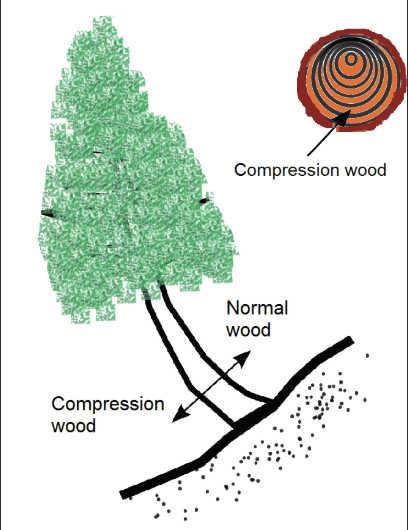
reaction wood
wood with distinct anatomical characteristics produced in boles (trunk) or leaning trees or in wood with unusual center of gravity, can be caused by high winds
more warping in lumber, wood contributes to distortion and warping during processing
compression and tension wood
compression wood
more wood on the lower surfaces (acute angle) of the leaning bole
in conifers
a type of reaction wood
tension wood
more wood on the upper surfaces (obtuse angle) of the leaning bole, in hardwoods like aspen
type of reaction wood