AP Biology Unit 1: Chemistry of Life
 Call Kai
 Learn
Learn Practice Test
 Spaced Repetition
 Match
Match Flashcards
 Knowt Play
1/193

Name | Mastery | Learn | Test | Matching | Spaced | Call with Kai | Chat |
|---|
No analytics yet
Send a link to your students to track their progress
194 Terms
Scientific Method
a step-by-step process used by scientists to investigate questions, gather evidence, and draw conclusions based on experiments and observations
Hypothesis
a testable explanation for an observation
explains the relationship between variables and what the researcher expects to happen to one variable if another changes
Hypothesis Tests
statistical test procedures to test hypotheses about a population based on a sample
Null Hypothesis
hypothesis that there is no effect or no difference between two groups of data
observations are due to chance
Alternative Hypothesis
hypothesis that there is a relationship/effect/difference between the two groups of data
observations are due to a nonrandom cause
Why do we need a null hypothesis for testing?
provides a baseline, which we can use to compare our sample results to
How many trials are needed at least for each control and experimental group?
3
Control
used for comparison to the experimental group
helps validate statistical analysis and increase confidence in conclusions drawn from the experimental results
Negative Control
group NOT exposed to any treatment OR exposed to a treatment known to have NO effect
ensures there is NO effect when there should be NO effect
Positive Control
group not exposed to IV but is exposed to a treatment known to HAVE an expected effect
ensures the experimental setup can produce a known effect
provides a reference point for what a known effect looks like
Experimental Group
receives the experimental treatment (IV) being tested to observe its impact on the outcome (DV)
Independent Variable
the one factor that is changed between all groups; what is being manipulated
graphed on x-axis
Dependent Variable
factor that is measured and affected by the IV
graphed on the y-axis
Constant
factors kept consistent for all groups to ensure only the IV affects the outcome
aka controlled variables
Statistics
methods used to collect, process, or interpret quantitative data
In biology, helps us understand important information by:
summarizes our observations
makes predictions based on a summary
helps scientists:
avoid jumping to conclusions
be cautious about generalizations
Descriptive Statistics
methods used to summarize or describe observations/samples
measures of central tendency (mean, median, mode)
measures of variability (range, standard deviation, variance, skewness, quartiles)
Inferential Statistics
using observations to make estimates or predictions; generalizing from a sample to a wider population
SEM, confidence intervals
hypothesis tests (Chi-square, ANOVA, t-test)
Sample
a small, random group selected from a population
used to make inferences about a population
Population
all members of a group being studiedd
What is the shape of a normal distribution?
symmetric, unimodal

What is the shape of a uniform distribution?
symmetric, all outcomes equally likely

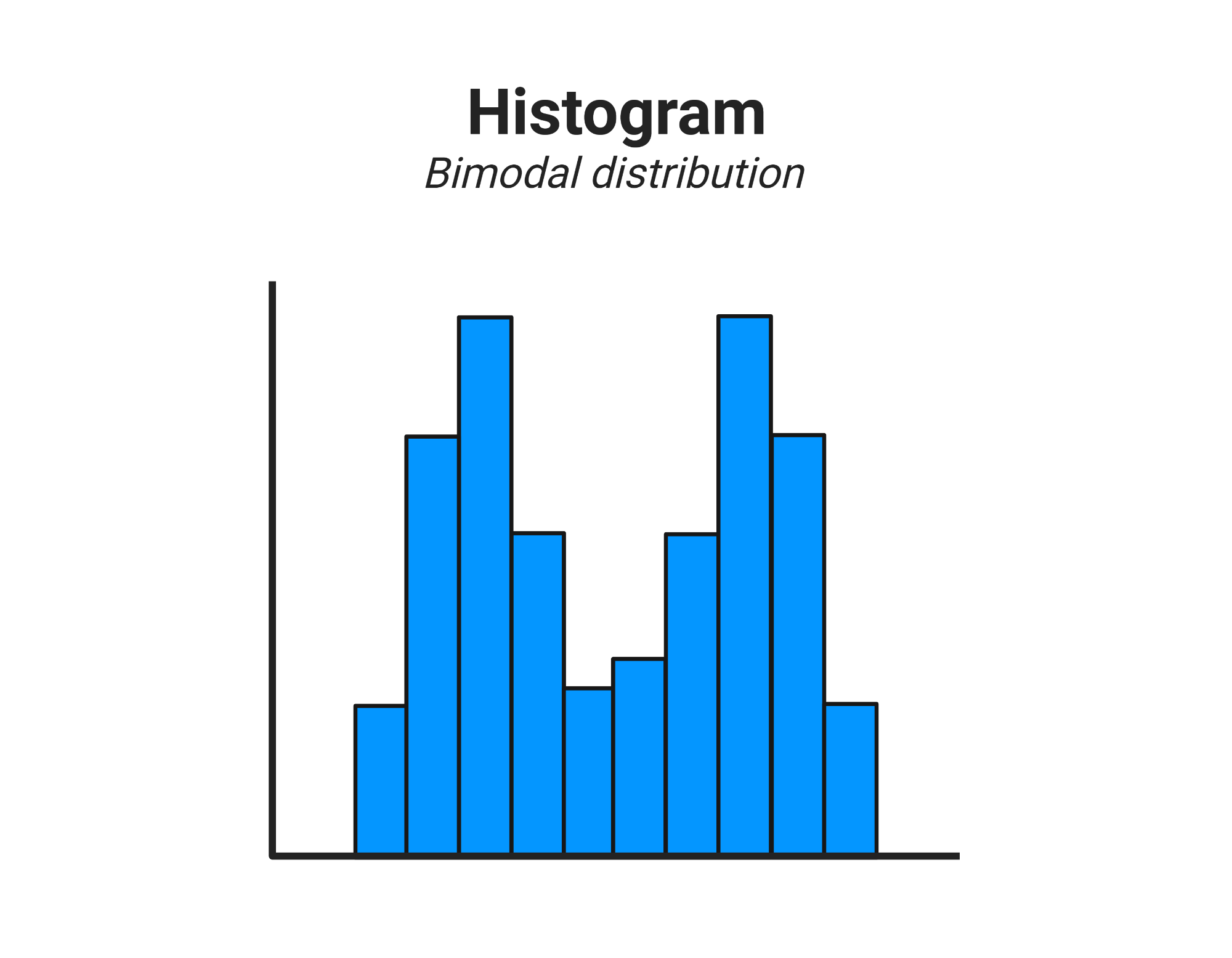
What is the shape of a bimodal distribution?
symmetric, two modes
What is the shape of a positive skewed distribution?
right skewed, unimodal

What is the shape of a negative distribution?
left skewed, unimodal

We can describe the data distribution by its _____, its ______, and its __________.
shape, center, variability (spread)
What distribution do most biological examples follow?
normal distribution
Central Tendencies
the center can be described by the mean, median, and mode
Mean
the average of the data set
sensitive/most affected by outliers
most preferred in approximately normal distributions
Median
the middle number in a range of data points
preferred measure of central tendency in skewed distributions
Mode
value that appears most often
used in categorical data (i.e. surveys)
used when looking for most common outcome
The ______ ____ serves as an ________ for the population mean.
sample mean, estimate
Variability
the degree to which data are spread out in a data set
helps give a more complete summary of a distribution
can be measured using range, standard deviation, and IQR
Standard Deviation
the average amount by which all the values deviate from the mean; measures the spread of data
used in approximately normal distributions

What does a low (small) standard deviation mean?
data is closer to the mean; less spread out
What does a high (large) standard deviation mean?
data is farther from the mean; more spread out
Interquartile Range (IQR)
measures the spread of the middle 50% of data
used in non-normal distributions (e.g. skewed)
How do you find IQR?
Q3 - Q1
Confidence Interval
a range of values in which we are 95% confident the true population mean will fall within
Standard Error of the Mean (SEM)
used to assess how accurately the sample mean estimates the population mean

What does it mean if the error bars overlap?
there is not a statistically significant difference between the means; observed changes are due to chance
Chi-sqaure
a form of statistical analysis used to compare the actual counts/frequencies (observed) with the expected counts/frequencies
determines if the expected data is a “good fit” for the observed data
determines if deviations are random or due to other circumstances
analyzes categorical data
tests the null hypothesis

Matter
anything that has mass and takes up space
rocks, metals, oils, gases, organisms, etc.
Element
a substance that cannot be broken down into other substances by chemical reactions
Compound
a substance consisting of two or more different elements combined in a fixed ratio
H2O
NaCl
Essential Elements
CHOPN
Carbon, Hydrogen, Oxygen, Phosphorous, Nitrogen
essential for survival and reproduction
Trace Elements
required by an organism in very small quantities
Atomic Number
number of protons
Atomic Mass
number of protons + neutrons averaged over all isotopes
Group
elements in the same vertical column; same number of valence electrons
Period
elements in the same horizontal row; same total number of electron shells
Elements want to be ______.
stable
How do elements become stable?
forming chemical bonds with other elements
Octet Rule
elements will gain, lose, or share electrons to complete their valence shell and become stable (like noble gases)
Valence Shell
outermost layer of electrons in an atom
Chemical Bonds
an attraction between two atoms, resulting from the sharing or transferring of valence electrons
Electronegativity
the measure of an atom’s ability to attract electrons to itself
on periodic table:
increases left to right
decreases going down
Covalent Bonds
when two or more atoms share elections
usually between two nonmetals
What do covalent bonds form? (hint: there’s two)
molecules and compounds
What are the two types of covalent bonds?
nonpolar covalent and polar covalent
Nonpolar Covalent
electrons are shared equally between two atoms
example: O2
Polar Covalent
electrons are not shared equally between two atoms
example: H2O
results in partial charges
Ionic Bonds
the attraction between oppositely charged atoms (ions)
usually between metals and nonmetals
metal transfers electron to nonmetal
What do ionic bonds form? (hint: there’s two)
ionic compounds, salts
NaCl
LiF
When do ionic bonds occur?
when there is a transfer of electrons from one atom to another atom forming ions
Cation
positively charged ion
Anion
negatively charged ion
Hydrogen Bonds
the partially positive hydrogen atom in one polar covalent molecule will be attracted to an electronegative atom in another polar covalent molecule
type of polar covalent bond
Intermolecular Bond
bond that forms between molecules
Why do hydrogen bonds occur?
electrons are not being shared equally between atoms, resulting in hydrogen having a partial positive charge and the electronegative atom to have a partial negative charge
example: hydrogen bonds between water molecules
What type of bond are hydrogen bonds?
polar covalent
Polarity
polar covalent bonds created by unequal sharing of electrons between oxygen and hydrogen within the molecule of water
Cohesion
attraction of molecules for other molecules of the same kind
example: H2O to H2O
held together by hydrogen bonds
What does cohesion allow for?
transport of water and nutrients against gravity in plants
What is cohesion responsible for?
surface tension
Surface Tension
surface H2O molecules experience greater inward pull because there are no molecules above them to balance the forces
Adhesion
the attraction to other molecules that are polar or have charge
example: H2O to other molecules
Why does adhesion occur?
the polarity of H2O
What does adhesion allow in plants?
allows water to cling to the cell walls to resist the downward pull of gravity
Capillary Action
the upward movement of water due to the forces of cohesion, adhesion, and surface tension
When does cohesion occur?
when adhesion is greater than cohesion
What is capillary action important for?
the transport of water and nutrients in plants
High Specific Heat
H2O resists changes in temperature
How does water have a high specific heat?
hydrogen bonds
What is the importance of water’s high specific heat?
moderates air temperature
large bodies of water can absorb heat in the daytime and release heat at night
stabilizes ocean temperature
benefits marine life
organisms can resist changes in their own internal temperature
High Heat of Vaporization
water requires a large amount of energy to evaporate due to strong hydrogen bonds
Evaporative Cooling
as water molecules evaporate, the surface they evaporate from gets cooler
example: sweating
Why is evaporative cooling important?
moderates Earth’s climate
stabilizes temperatures in lakes or bonds
prevents terrestrial organisms from overheating
example: sweating
prevents leaves from becoming too warm in the sun
Density
as water solidifies it expands and becomes less dense
Solvent
dissolving agent in a solution
Solution
homogeneous mixture of 2+ substances
Solute
substance that is dissolved
Why does water expand as it solidifies?
hydrogen bonds
pH
a measure of how basic or acidic (alkaline) a solution is
Acid
substance that releases hydrogen ions (H+) when dissolved in water
Base
a substance that accepts H+ or releases hydroxide ions (OH-)
What can water dissociate into?
hydrogen (H+) and hydroxide ions (OH-)
Buffer
a solution that resists changes in pH when an acid or base is added
What do buffers help maintain?
pH stability
Organic Chemistry
the study of compounds with covalently bonded carbon
Organic Compounds
compounds that contain carbon and hydrogen