Non-Ruminant Lipid Digestion
 Call Kai
 Learn
 Practice Test
 Spaced Repetition
 Match
 Flashcards
 Knowt Play
1/55

There's no tags or description
Looks like no tags are added yet.
56 Terms
What produces lingual lipase (LL)?
The salivary glands
What produces gastric lipase?
Chief cells in the stomach
What results in lingual lipase and gastric lipase production when it increases?
There is a production increase in lingual lipase and gastric lipase with an increase in fat
Shared characteristics of Lingual lipase (LL) and Gastric lipase (GL):
Produced continuously
Both are stable and active at the low pH of the stomach
Both prefer to hydrolyze short- to medium-chain fatty acids
Both act on fatty acids at the Sn3 position
Where do lingual lipase and gastric lipase act on fatty acids?
Both act on fatty acids at the Sn3 position
Which fatty acid chains do lingual lipase and gastric lipase prefer to metabolize?
Both prefer to hydrolyze short- to medium-chain fatty acids
What is the ideal pH for lingual lipase and gastric lipase to function?
Both are stable and active, and the low pH of the stomach
How are lingual lipase and gastric lipase produced?
Both are produced continuously
Production increases with an increase in fat intake
Emulsification
Increases the surface area of fat droplets by making many small fat droplets
Where does physical emulsification occur?
Stomach & small intestine
What is physical emulsification?
Mixing of food/digesta & movement of food/digesta into the small intestine
Where does chemical emulsification occur?
Small Intestine
What does it mean that chemical emulsification maintains small fat droplets?
Bile salts prevent small fat droplets from merging into larger droplets, maintaining a large surface area for pancreatic lipase to digest fat.
Where is bile stored?
Gallbladder
Where is bile synthesized?
The liver
What is bile made from?
Cholesterol!
The liver converts cholesterol into bile acids, which are used to make bile salts that emulsify fats in the small intestine.
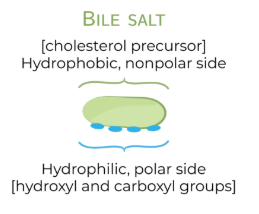
What is the polarity of bile?
Bile is amphipathic!
It has both hydrophilic (water-attracting) and hydrophobic (water-repelling) regions
Pancreatic lipase
Hydrolyzes fatty acids from TAG at Sn1 and Sn3 positions
Where is procolipse produced?
The pancreas
What enzyme activates procolipase into colipase?
Trypsin

What is the polarity of colipase?
Colipase has a hydrophobic region
Why is the hydrophobic region of colipase important for fat digestion?
It interacts with the hydrophobic fat droplet, helping anchor pancreatic lipase to its surface so lipase can digest triglycerides.
How much fat digestion occurs in the mouth?
Only minimal digestion occurs.
What enzyme initiates fat digestion in the mouth?
Lingual lipase, which is secreted by glands associated with the tongue
Which position on TAG does lingual lipase primarily attack?
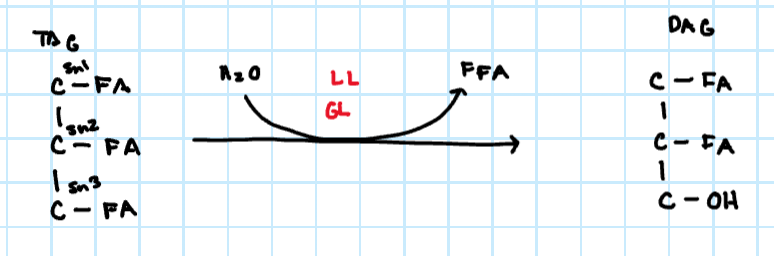
The sn-3 position, releasing one FFA and leaving a DAG molecule.

What are the products of lingual lipase acting on TAG?
One free fatty acid (FFA) and one diacylglycerol (DAG)
The purpose is to reduce particle size!
What is the chemical reaction catalyzed by lingual lipase?
TAG + H₂O → DAG + FFA
Water is used to hydrolyze one ester bond, releasing one fatty acid
What happens to dietary fat in the stomach?
Gastric lipase continues TAG digestion, while stomach contractions physically mix and disperse the fat.
Which enzyme is responsible for fat digestion in the stomach?
Gastric lipase, which hydrolyzes ester bonds in TAG
Which TAG position does gastric lipase primarily attack?
The sn-3 position
What are the products of gastric lipase acting on TAG?
DAG and a free fatty acid (FFA).
What is the difference between physical mixing and enzymatic fat digestion?
Physical mixing breaks fat into smaller droplets without breaking its chemical bonds
Enzymatic digestion uses lipases to hydrolyze ester bonds and release fatty acids.
What are the three phases of fat digestion in the small intestine?
Emulsification.
Enzymatic digestion.
Absorption.
What are the two types of emulsification that occur in the small intestine?
Physical emulsification through mixing and chemical emulsification through bile salts.
What is chemical emulsification in the small intestine?
Bile salts help disperse fat into small droplets and stabilize them, reducing the tendency of the droplets to merge into larger droplets
Why is maintaining small fat droplets important for digestion?
Small droplets provide a larger total fat-water interface, allowing pancreatic lipase to access and hydrolyze more TAG
How does bile's amphipathic nature help emulsify fat?
Their hydrophobic regions interact with fat, while their hydrophilic regions interact with the watery intestinal contents
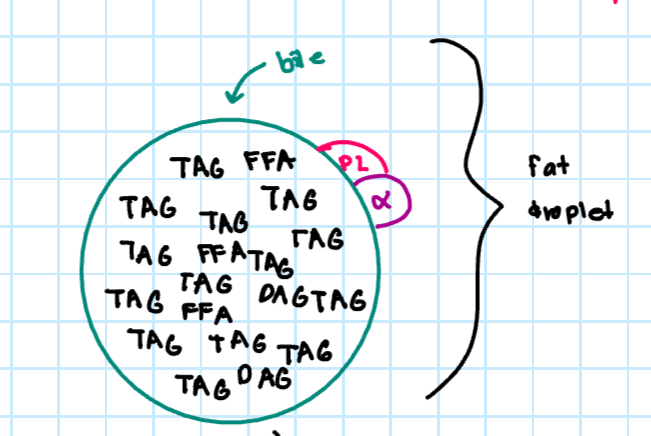
What substances are present in a fat droplet during intestinal digestion?
The droplet contains primarily TAG, with some DAG and FFAs as digestion proceeds. Bile salts and other surface-active lipids help stabilize the droplet's surface.
Which enzyme is primarily responsible for digesting TAG in the small intestine?
Pancreatic lipase, which is secreted by the pancreas and acts in the small intestine.
Which positions on TAG does pancreatic lipase primarily hydrolyze?
The sn-1 and sn-3 positions, leaving the fatty acid at sn-2 attached to glycerol
What are the main products of pancreatic lipase digestion of TAG?
wo free fatty acids (FFAs) and one 2-monoacylglycerol (2-MAG).

What is the first step of pancreatic lipase digestion?
Pancreatic lipase hydrolyzes one ester bond in TAG, producing DAG and one FFA.

What is the second step of pancreatic lipase digestion?
Pancreatic lipase hydrolyzes another ester bond in DAG, producing 2-MAG and a second FFA

What is the overall chemical reaction for pancreatic lipase digestion of TAG?
TAG + 2 H₂O → 2-MAG + 2 FFAs
What is procolipase?
Procolipase is the inactive precursor of colipase, a protein that helps pancreatic lipase function at the surface of fat droplets.
Why is colipase needed for pancreatic lipase activity?
Bile salts can interfere with pancreatic lipase binding to the fat-water interface. Colipase helps anchor pancreatic lipase to the fat droplet so digestion can proceed.
Why does the diagram show time passing during pancreatic lipase digestion?
Pancreatic lipase needs time to hydrolyze TAG progressively. As reactions proceed, TAG decreases while DAG, FFAs, and MAG are produced

What is the third phase of fat digestion?
Absorption, during which the products of lipid digestion cross the intestinal lining and enter the body.
What are the main products of TAG digestion that are absorbed in the small intestine?
Mainly 2-MAG and free fatty acids (FFAs).
How do 2-MAG and FFAs reach the absorptive surface of the small intestine?
They are carried through the watery intestinal contents in mixed micelles, which deliver lipid digestion products to the enterocyte surface
They diffuse into the enterocytes!! NO TRANSPORTER!
What are enterocytes?
nterocytes are absorptive epithelial cells lining the small intestine that take up nutrients, including products of fat digestio
What happens to long-chain FFAs and MAG after they enter enterocytes?
They are generally reassembled into TAG and packaged into chylomicrons for transport through the lymphatic system before entering the bloodstream.
Where are bile salts primarily reabsorbed?
In the ileum, the final portion of the small intestine
What happens to bile salts after they are reabsorbed?
They return to the liver through the portal circulation and can be reused to produce bile.
What can happen to lipids that are not digested or absorbed in the small intestine?
They can pass into the large intestine or cecum, where intestinal microbes may act on them.
Structure of TAG:
