L21 - Pyrimidines
 Call Kai
 Learn
Learn Practice Test
 Spaced Repetition
 Match
Match Flashcards
 Knowt Play
1/22

There's no tags or description
Looks like no tags are added yet.
Name | Mastery | Learn | Test | Matching | Spaced | Call with Kai | Chat |
|---|
No analytics yet
Send a link to your students to track their progress
23 Terms
Nucleotides Vs. Nucleosides
Major purine bases
Major pyrimidine bases
Nucleotides have a nitrogenous base, a pentose, and 1+ phosphate
Nucleosides have everything except a phosphate group
Purines: Adenine and Guanine
Pyrimidines: Thymine, Cytosine, and Uracil


What structure is this? Purine or Pyrimidine?
Adenine; Purine

What structure is this? Purine or Pyrimidine?
Guanine; Purine

What structure is this? Purine or Pyrimidine?
Thymine: Pyrimidine

What structure is this? Purine or Pyrimidine?
Cytosine: Pyrimidine

What structure is this? Purine or Pyrimidine?
Uracil: Pyrimidine
Importance of nucleotides
Carry chemical energy; A nucleotides make up many enzyme cofactors (Co-A, NAD+, FAD, etc.), they also serve as signaling molecules

Nucleotide biosynthesis pathways
Dietary: Ingested nucleic acids are degraded via nucleases
de novo pathways: Begins with metabolic precursors
AAs, ribose 5-phosphate, CO2, and NH3
Bases are synthesized while on ribose
Pyrimidine ring is synthesized as orotate
Glu provides most amino groups
Gly is the precursor for purines
Asp is the precursor for pyrimidines
Salvage pathways: Recycle free bases and nucleosides released from nucleic acid breakdown
Phosphoribosyl-pyrophosphate Synthetase
Also known as Ribose Phosphate Pyrophosphokinase
Catalyzes the formation of 5-phosphoribosyl-1-pyrophosphate (PRPP), an important intermediate in many pathways
ribose 5-phosphate + ATP → PRPP + AMP

Pyrimidine Biogenesis General Pathway + info
Glutamine + CO2 → Carbamoyl Phosphate → Orotic Acid → UMP → UPD → dUDP or CTP
Notes: dUDP → dTMP
Orotate (Pyrimidine ring) formation allows pyrimidine synthesis
Ribose 5-phosphate is attached after the ring is formed
Aspartate and Carbamoyl phosphate provide the atoms for the ring structure of many molecules, including: Carbamoyl-aspartate, Orotate, OMP, UDP/UTP, CTP, and TMP

CPS-II (Activation of Pyrimidine Biosynthesis)
Carbamoyl phosphate synthetase II; cytosolic CPS that makes carbamoyl phosphate needed for pyrimidine synthesis (CPS-I is in Urea cycle [mitochondria])
Glutamine-dependent
Uses a transfer tunnel to move unprotonated ammonia from glutamine hydrolysis site to biosynthetic site; Tunnel prevents ammonia protonation and carbamate transfer in carbamoyl phosphate synthesis.
![<p>Carbamoyl phosphate synthetase II; cytosolic CPS that makes carbamoyl phosphate needed for pyrimidine synthesis (CPS-I is in Urea cycle [mitochondria])</p><p>Glutamine-dependent</p><p>Uses a transfer tunnel to move unprotonated ammonia from glutamine hydrolysis site to biosynthetic site; Tunnel prevents ammonia protonation and carbamate transfer in carbamoyl phosphate synthesis.</p>](https://assets.knowt.com/user-attachments/7137af0f-af7f-41b1-8464-e2d252a81016.png)
Carbamoyl pools in the cell
Mitochondrial pool: Urea
Cytosolic pool: Pyrimidine Nucleotides
Application: Urea cycle disorders (Ex. OTC enzyme disorder) may cause carbamoyl phosphate accumulation and leakage from the mitochondria into the cytosolic pool. Causes a downstream increase of orotic acid, causing orotic aciduria

Formation of Carbamoyl-aspartate (Step 1 Pyrimidine Biosynthesis)
Aspartate + Carbamoyl phosphate → N-Carbamoylaspartate (+ Pi) via Aspartate Transcarbamoylase (ATCase)
First committed step, regulated by CTP (Product inhibited)

Formation of Orotate (Step 2 Pyrimidine Biosynthesis)
N-Carbamoylaspartate → L-Dihydroorotate (+ H2O) via Dihydroorotase (DHO)
L-Dihydroorotate → Orotate via Dihydroorotate Dehydrogenase (DHODH) (Needs NAD+)

Formation of Orotidylate (OMP) (Step 3 Pyrimidine Biosynthesis)
Orotate → Orotidylate/Orotidine 5’-monophosphate via Orotate Phosphoribosyl transferase (Needs PRPP)
N-1 of ring attacks PRPP
Know Structure

Formation of Uridine 5’-triphosphate (UTP) (Step 4 Pyrimidine Biosynthesis)
OMP → UMP (+ CO2) via orotidylate decarboxylase (Without enzyme this reaction would take billions of years)
UMP → UTP (Needs 2ATP)
UMP is phosphorylated to UDP/UTP by kinases
Know Structure

Formation of Cytidine 5’-triphosphate (CTP) (Step 5 Pyrimidine Biosynthesis)
UTP + Gln + ATP → CTP + Glu + ADP + Pi via Cytidylate Synthetase (CS2 in humans)
Used for DNA and RNA nuc synthesis
Activated by GTP

Formation of dTMP
Related to nuc synthesis so use dTMP
dUMP → dTMP via thymidylate synthase
Requires N5,N10-Methylenetetrahydrofolate which turns into Dihydrofolate during dTMP synthesis
To recover

N5,N10-Methylenetetrahydrofolate recovery
N5,N10-Methylenetetrahydrofolate → Dihydrofolate via Thymidylate Synthase
Dihydrofolate → Tetrahydrofolate via Dihydrofolate Reductase
Tetrahydrofolate → N5,N10-Methylenetetrahydrofolate via Serine Hyderoxymethyltransferase

The CAD Complex
Formed by the first three enzymes associated with Pyrimidine Biogenesis Pathway:
CPS-II
Aspartate Transcarbamoylase (ATCase)
Dihydroorotase
CPS-II inhibited by UTP and activated by PRPP

What type of inhibition controls ATCase
Aspartate transcarbamoylase catalyzes the first reaction in pyrimidine biosynthesis
Inhibited by end-product CTP
Accelerated by ATP

CTP synthetase
Two forms CS1 is related to lipid synthesis; CTP Synthetase 2 (CS2) specifically
Catalyzes UTP → CTP; Activated by GTP (Balancing amounts of C/G)
Enzyme deficiency affects cell growth and development
Catabolism of Pyrimidines
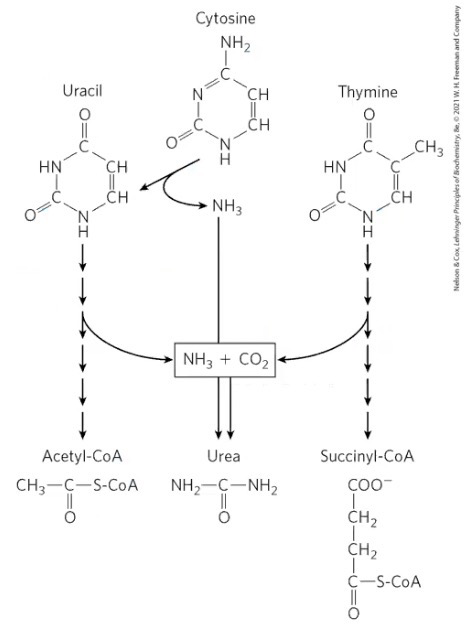
Pathways for degradation all lead to NH4+ production/Urea synthesis
Carbons of thymine are degraded into Succinyl-CoA
Carbons of cytosine and uracil are degraded to Acetyl-CoA