Bio Lab Nervous
 Call Kai
 Learn
 Practice Test
 Spaced Repetition
 Match
 Flashcards
 Knowt Play
1/123

There's no tags or description
Looks like no tags are added yet.
124 Terms
Neuron
Basic unit of nervous system
Neuroglia
Support the neuron
Glial cells
Neuroglia
Astrocytes
Regulate what enters the CNS by surrounding localized capillaries
Microglia
Phagocytic cells that destroy pathogens and debris
Olgiodendrocytes
Provide insulating myelin sheath around axon
Ependymal
Produce cerebral spinal fluid which circulates nutrients
Schwann cell
Provides myelin sheath around axon
Satellite cell
Surround neuron body and regulate material exchange
Two Neuroglia that provide myelin sheath
Oligodendrocyte and Schwann
Two Neuroglia that regulate material exchange
Satellite and astrocyte
Neurotransmitters
Chemical messengers stored inside synaptic vesicles
Synaptic cleft
Where neurotransmitters are released into
Receptors
Receive neurotransmitters
Post synaptic membrane can be
Dendrite, muscle, or endocrine gland
Endoneurium
Surrounds individual myelinated axons
Perineurium
Surrounds individual fascicles
Epineurium
Surrounds entire nerve
6 regions of brain
Cerebrum, mesencephalon, cerebellum, pons, diencephalon, medulla oblongata
Cerebrum
Conscious though and higher learning
Cerebrum 4 lobes
Temporal, occipital, parietal, frontal
Gyri/gyrus
Folds (hills) in cerebrum to increase surface area
Sulci
Valley in cerebrum to increase surface area
Corpus callosum
Connects two hemispheres of cerebrum
Arbor vitae
“Tree of life” branched structure that looks like trees in cerebellum
Cerebellum
Monitor body position and coordinate movement (2 hemispheres)
Diencephalon includes
Thalamus and hypothalamus
Thalamus
Interprets sensory information
Hypothalamus
Emotions, instincts, and link to endocrine system
Brain stem
Conduct basic house keeping and survival tasks of body
Brain stem includes
Mesencephalon, pons, medulla
Mesencephalon
Midbrain, subconscious processing visual and auditory reflexes
Pons
Relay station
Medulla
Coordinating breathing and heart patterns, also swallowing reflex
Ventricles function
Produce and circulate CSF (cerebral spinal fluid)
Choroid plexus
Where most CSF is produced, tangled mass of capillaries hanging from roof of third and fourth ventricles
Meninges layers (superficial to deep)
Dura mater, arachnoid mater, pia mater
Dura mater
Periosteal and meningeal
Arachnoid mater
Subarachnoid space that houses CSF
Ependymal cells
Produce CSF in choroid plexus
I
Olfactory nerve
II
Optic nerve
III
Oculomotor nerve
IV
Trochlear nerve
V
Trigeminal nerve
VI
Abducens nerve
VII
Facial nerve
VIII
Vestibulocochlear nerve
IX
Glossopharyngeal nerve
X
Vagus nerve
XI
Spinal accessory nerve
XII
Hypoglossal
Olfactory nerve function
Smell (Sensory)
Optic nerve function
Sight (sensory)
Oculomotor nerve function
Eye movement and pupil reflex (motor)
Trochlear nerve function
Eye movement (motor)
Trigeminal nerve function
Face sensation and chewing (Sensory and motor)
Abducens nerve function
Eye movement (motor)
Facial nerve function
Face movement and taste (motor and sensory)
Vestibulocochlear nerve function
Hearing and balance (sensory)
Glossopharyngeal nerve function
Throat sensation, swallowing, and taste (sensory and motor)
Vagus nerve function
Taste, slows heart rate, senses blood pressure, stimulates digestive organs (sensory and motor)
Spinal accessory nerve function
Neck movement (motor)
Hypoglossal nerve function
Tongue movement (motor)
Pairs of spinal nerves
31
Naming first seven spinal nerves
According to vertebrae below the nerve
Naming 8-13 spinal vertebrae
According to the vertebrae above
Gray matter
Neuron cell bodies and unmyelinated processes
White matter
Myelinated axons, superficially surround gray matter in spinal cord
Dermatomes
Zones in body that each spinal nerve serves

A
Dendrites

B
Nissl bodies

C
Nucleus

D
Axon hillock

E
Node of Ranvier
F
Schwann cells

G
Collateral axons

H
Telodendria

I
Synaptic knobs

J
Perikaryon (surrounding nucleus)

K
Nucleolus

L
Dendritic spines

A
Ependymal cells

B
CNS neuron

C
Process of astrocyte

D
Astrocyte

E
Blood vessel (capillary)

F
Myelin sheath

G
Process of oligodendrocyte

H
Oligodendrocyte

I
Microglial cell
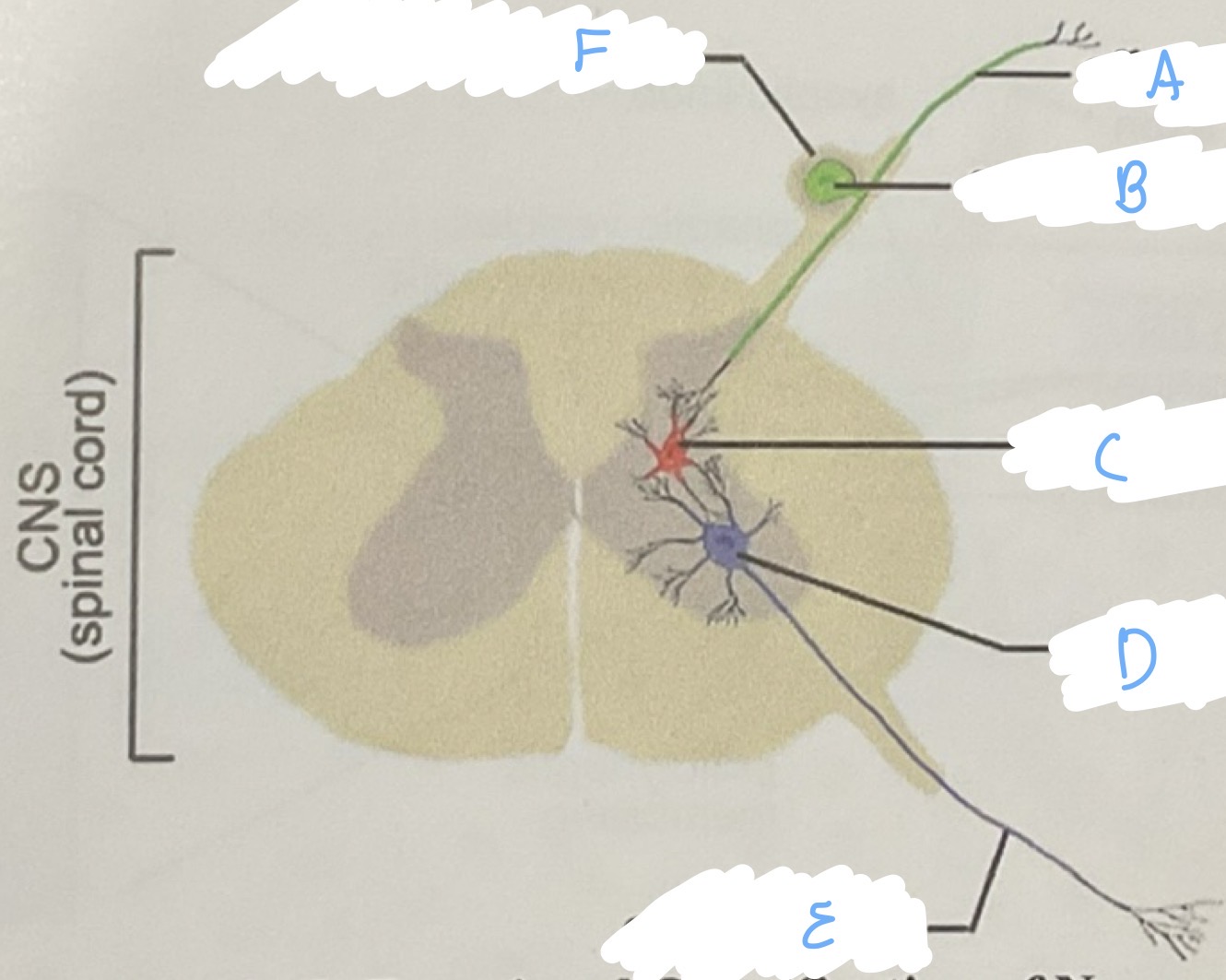
A
Afferent fiber

B
Sensory neuron

C
Interneuron

D
Motor neuron

E
Efferent fiber

F
Peripheral ganglion

A
Axon

B
Endoneurium

C
Perineurium