Thermochem & Quantum Mechanics Concepts
 Call Kai
 Learn
 Practice Test
 Spaced Repetition
 Match
 Flashcards
 Knowt Play
1/48

There's no tags or description
Looks like no tags are added yet.
49 Terms
Enthalpy of Reaction
Energy change for a specific chemical equation based on its given stoichiometric coefficients
Enthalpy of Formation/Reaction Equation
ΔH°rxn = Σ (n ΔH°f(products)) - Σ (m ΔH°f(reactants))
Enthalpy of Formation / Heat of Formation
Energy change when 1 mole of a compound forms from its pure elements. Pressure is 1 bar, temperature is 289.15 K, concentration is 1M
Bond Dissociation Enthalpies
Only works when all components are gases. The amount of energy needed to break a specific chemical bond in a gaseous molecule by homolytic cleavage
Bond Dissociation Enthalpies Equation
ΔH = Σ(Bond Enthalpies of Reactants) - Σ(Bond Enthalpies of Products)
Wavelength (λ)
distance between two peaks or troughs in a wave
Frequency (ν)
number of waves (cycles) per second that pass a given point in space
Speed (c)
speed of light (3.00×10⁸ m/s)
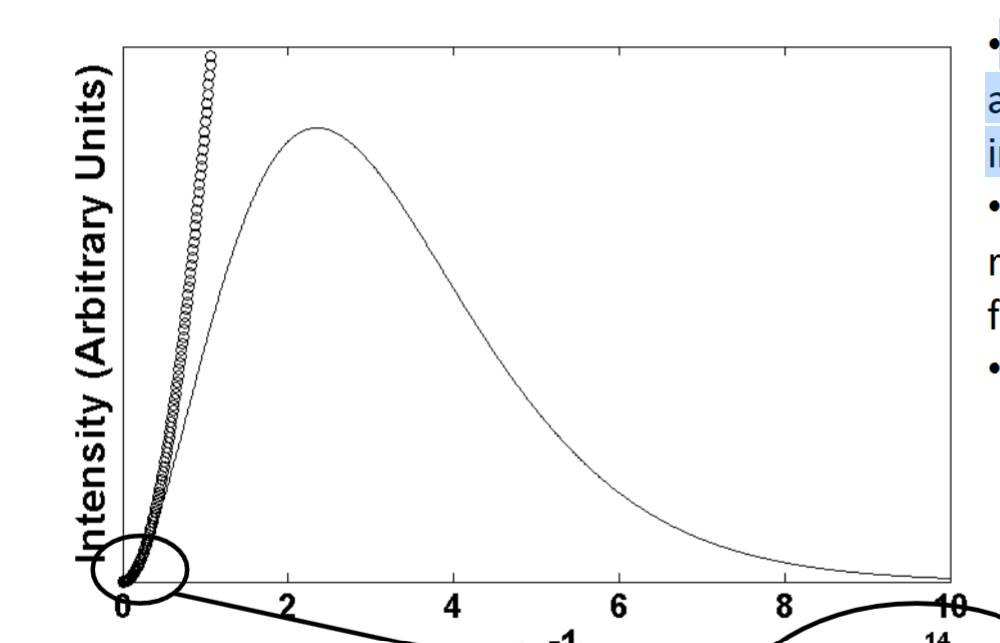
Blackbody Radiation
Ideal object which absorbs and emits all frequencies of radiation
Ultraviolet Catastrophe
Intensity with the classical approach diverges with increasing
Planck’s Constant
6.626x10^-34 J∙s
Energy of n Photons
∆Ephoton=nhν
Wavelength → Frequency Equation
c=λν
Frequency → Energy Equation
E = hv
Wavelength → Energy Equation
E=hc/λ
Electron Kinetic Energy Equation
KE=hν−ϕ
Energy of an Electron Level Equation
En=−2.18×10^-18(1/n²)
Energy Change During Transition Equation
ΔE=Ef−Ei
Number of Photons Equation
total energy/energy per photon
What does intensity control in the photoelectric effect?
The number of photons and the number of electrons emitted.
What does frequency control in the photoelectric effect?
Whether electrons are emitted.
The kinetic energy (KE) of emitted electrons.
Work function (ϕ)
The minimum energy required to remove an electron from a material.
What did classical physics predict about intensity?
Increasing intensity should increase electron KE. (which is wrong)
What did classical physics predict about low-frequency light?
Any frequency should work if the intensity is high enough. (which is wrong)
In the Bohr model, what does a higher n mean?
Higher energy
Farther from nucleus
What did de Broglie propose?
Matter can exhibit wave-like behavior. (which is true)
What does an orbital tell us?
The probability of finding an electron in a region of space.
Node
A region where the probability of finding an electron is zero.
Heisenberg Uncertainty Principle Equation
Δx * Δmu >= h / (4 π)
Schrodinger Equation
Ĥψ = Eψ
Wave Function
describes an atomic orbital, not an electron following a circular path around the nucleus
Principal Quantum Number (n)
defines the “shell” of orbitals
Angular Quantum Number (l)
determines the “subshell”, can have values of 0 to n-1
Magnetic Quantum Number (ml)
orientation of the orbital, between -l to l
Electron Spin Quantum Number (ms)
shows magnetic moment with two values, has values of ½ and -1/2
Pauli Exclusion Principle
no two electrons in an atom can have the same four quantum numbers (orbitals can only hold 2 electrons)
De Broglie Wavelength
λ = h / (mv)
Aufbau Principle
electrons are added to hydrgoen-like orbitals from the bottom up
Hund’s Rule
lowest energy configuration for an atom is the one having the maximum number of unpaired electrons allowed by the Pauli Exclusion Principle in a set of degenerate (same energy) orbitals
Periodic Trend: Moving across a row
increases nuclear charge
Periodic Trend: Moving down a column
increases electron shielding
Ionization energy & nuclear charge
increases from left to right
Electron Affinity
energy released as an atom accepts an electron
- electron affinities increase left to right across a row
Atomic size across a row
decrease in atomic radius
Atomic size down a column
increase in atomic radius
Isoelectric Series
ions with the same number of electrons
Electronegativity across a row
increased nuclear charge
Electronegativity down a column
increased shielding
decreased electronegativity
Lattice Energy
energy released when gaseous ions form an ionic solid