ECON 2 Fall 2026 Midterm Flashcards
 Call Kai
 Learn
Learn Practice Test
 Spaced Repetition
 Match
Match Flashcards
 Knowt Play
1/109

There's no tags or description
Looks like no tags are added yet.
Name | Mastery | Learn | Test | Matching | Spaced | Call with Kai | Chat |
|---|
No analytics yet
Send a link to your students to track their progress
110 Terms
What is the scarcity principle?
Having more of something means having less of something else
What is the cost-benefit principle?
Take an action if and only if its benefits outweigh its costs
What is opportunity cost?
The value of what must be forgone to undertake an activity. The opportunity cost of a good bought in the market is typically its price. Examples:
Going to college: out-of-pocket costs (tuition, books) and forgone earnings while in schpool
What is scarcity?
Someone or something faces a constraint. People, firms, and countries all face constraints on what they can consume or produce. Can change over time.
What is the production possibilities curve (PPC)?
Diagram showing the combinations of two types of goods that could be produced in an economy just using all of the available inputs:
Labor (people’s time for work and abilities)
Capital (land, buildings, machines, factories)
Technology (knowledge, techniques, understanding)
What are consumption goods?
Goods and services that satisfy some current want for people. Example: Food, clothing, housing, legal services
What are investment goods?
Goods and services that will make us more productive in the future. Examples: Machines, buildings, infrastructure, education, R&D activities (research and development by firms)
What % of US production is for consumption and for gross investment?
75%, 25%
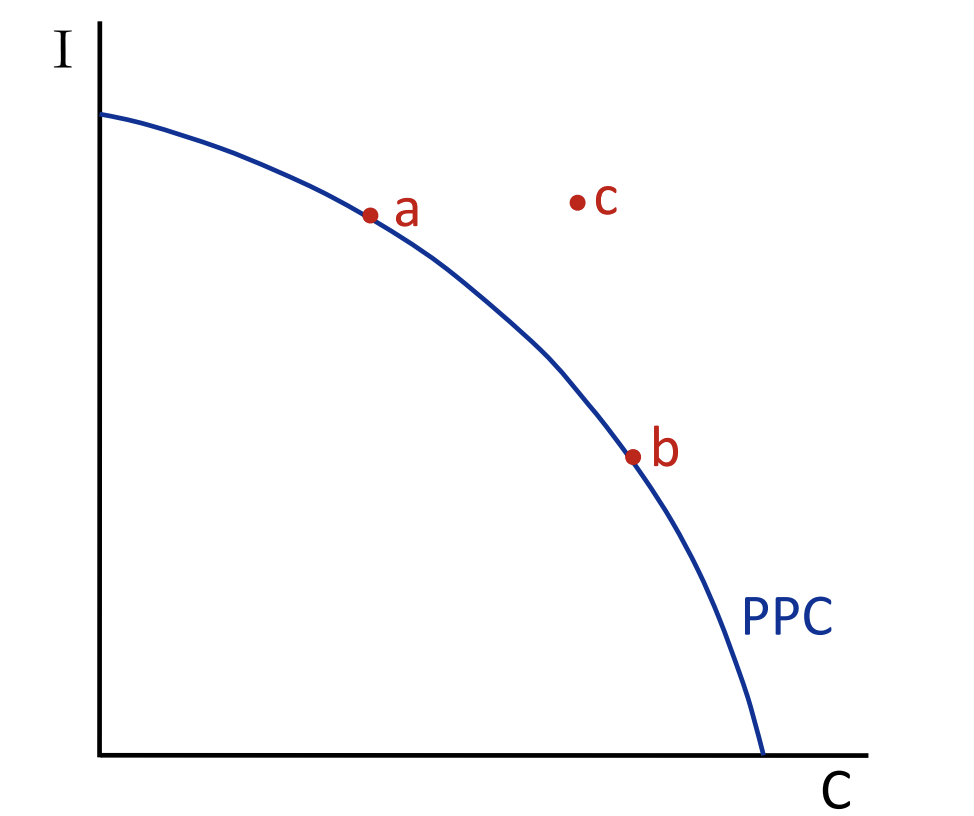
What point is unattainable?
Point C
What is the slope of PPC?
(minus) the opportunity cost of the good on the horizontal axis
What does it mean if the PPC is curved?
The opportunity cost of the good on the horizontal axis is rising as more is produced
What is productive efficiency?
When it is impossible to produce more of something without having to decrease the production of something else
What does it mean if the PPC moves outward?
Economic growth
What does it mean if the PPC moves inward?
Economic decline
What is a recession?
Time when unemployment is above normal and the economy is not producing at its full potential

What does Point D mean in the PPC?
Recession, the economy is not producing all it is capable of
What is comparative advantage?
The person who has the lower opportunity cost -
How to draw a specialized PPC?
Max output: for each producer, calculate the most of each good they could make (rate × time)
Endpoints: add up all producers' maximums of each good to get the y-intercept and x-intercept
Opportunity cost: for each producer, calculate the amount of the y-good given up per 1 unit of the x-good (y max ÷ x max)
Rank: order producers from lowest to highest opportunity cost of the x-good
Start at the top-left point (everyone making the y-good only)
Segment 1: move the lowest-cost producer fully to the x-good. Slope = −their opportunity cost. Move right by their x max, down by their y max.
Segment 2, 3, etc.: repeat with the next producer in the ranking
End at the x-intercept (everyone making the x-good only)
Check: slopes get steeper left to right, and the kinks sit at the cumulative x totals
What is absolute advantage?
Being able to produce more of a good than someone else, using the same amount of time and resources. Who is more productive in raw output.
What is “the market”?
Any group of buyers and sellers, an arrangement by which economic exchanges between people/firms take place
What is demand?
Buying side of the market, usually consumers. Negative relationship between the quantity demanded of a good and its price (“demand curves slope down”). This is because demand = marginal utility and marginal utility falls.
What is marginal utility?
Extra enjoyment you receive with an additional unit
What is supply?
The selling side of the market (generally producers). Positive relationship between the quantity supplied of a good and its price. Curves upward because marginal cost rises as production increases.
Market Equilibrium Key Assumptions
Consumers are price takers (makes sense if many small consumers)
Producers are price takers (makes sense if many small producers who don’t collude)
Together these are the competitive model
Where is market equilibrium?
The intersection between price and supply
What happens if the price is below the market equilibrium?
We have excess demand (shortage)
What happens if the price is above the market equilibrium?
We have excess supply (surplus)
What does ceteris paribus mean?
Other things being equal
What direction does the supply curve shift if there is an expansion of supply?
Outward/rightward. Quantity increases and the price decreases. Think the quantity at every price rises (shift right). Some factors that can cause this:
Innovation that increases productivity
Prices of inputs needed for production going down
More producers enter the industry
What direction does the supply curve shift if there is an decrease of supply?
Inward/upward. Quantity decreases and the price increases. Some factors that can cause this:
Regulation decreases productivity
Prices of inputs needed for production going up
Producers exit the industry
What direction does the demand curve shift if there is an decrease of demand?
Left/down. Quantity decreases and the price decreases.
What direction does the demand curve shift if there is an increase of demand?
Right/up. Quantity increases and the price increases.
What can shift demand curves?
Outward demand shifts (demand increases, shifts up)
New complementary good is released
– The price of a substitute good goes up
– People got richer
– The product becomes fashionable
Inward demand shifts (demand decreases, shifts
down)
– The price of a complementary good goes up
– The price of a substitute good goes down
– The product goes out of fashion or becomes obsolete
What are randomized experiments?
sample is randomized into treatment vs. control (like medical science experiment)
What is consumer surplus?
Area under the demand curve and above the market price. Difference between benefit and cost of buying Q1 units at price P1
What is producer surplus?
Area under the market price and above the supply curve
What is economic surplus?
Net gain to society from all trades that are made in a particular market. Consists of two components, consumer and producer surplus:
Consumer surplus: The benefit that consumers derive from consuming a good, above and beyond the price paid for the good
Producer surplus: The benefit producers derive from selling a good, above and beyond the cost of producing that good
Total economic surplus: Consumer surplus + producer surplus
How to find the total benefit from consuming Q1?
Area under the demand curve up to the specific quantity
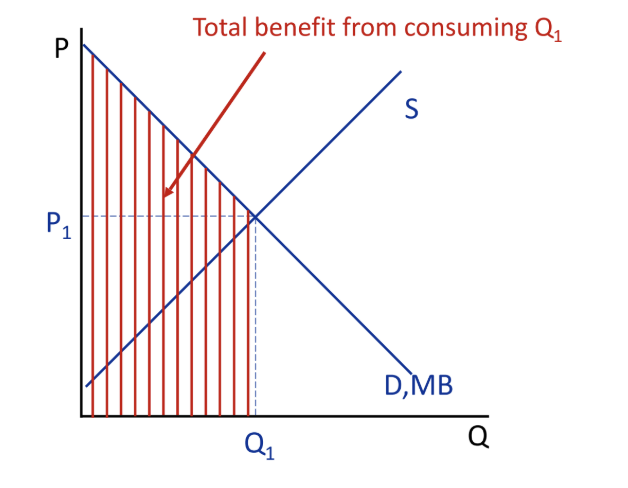
How to find the total cost of buying at a specific quantity?
P1 * Q1

How to find total cost of producing Q1?
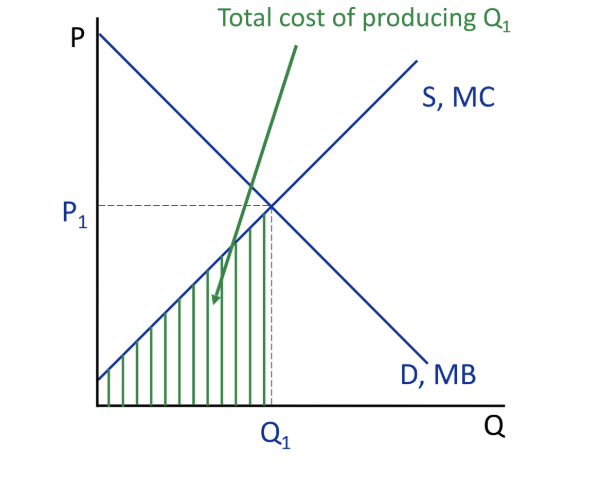
How to find total revenue from selling Q1?
P1 * Q1

What is allocative efficiency?
Where total surplus is as large as possible, makes no judgement about which side of the market we care about. Conditions for allocative efficiency:
Good is produced up to the point where MB = MC
Good is allocated to the consumers with the highest MB
The good is produced by the producers with the lowest MC
What is deadweight loss?
The reduction in economic surplus from denying trades for which benefits exceed costs when quantity differs from the efficient quantity. When Q is below market equilibrium Q2 or there is an excess of Q2. Basically when we produce at a quantity that is not market equilibrium. Note: deadweight loss triangle points toward the efficient allocation and grows outward to curren quantity.
What is the first theorem of welfare economics?
Competitive equilibrium where supply equals demand, maximizes total economic surplus, competitive markets are efficient. However, blind to distributional aspects
What is a price ceiling?
Maximum price, price is held below its equilibrium level. Will lead to a shortage, discourages the decrease in quantity demanded and increase in quantity supplied that automatically occur as the price rises. Good will have to be allocated in some way other than by price (e.g. queuing). Reduces total surplus but could increase consumer surplus at the expense of producer surplus
What is a price floor?
Minimum price, price is held above its equilibrium level. Will lead to a surplus. Reduces total surplus but could increase producer surplus at the expense of consumer surplus
What is the price elasticity of demand?
ED = Percentage change in quantity demanded / percentage change in price. Some important values (in absolute value):
Elastic: ED > 1
Inelastic: ED < 1
Perfectly inelastic: ED = 0
Perfectly elastic: ED = infinity
If price changes by 1%, then demand changes by ED%
ED = (1 / slope) * (P / QD)
When using a log-log scale…
Elasticity is 1/slope of demand curve and is constant if log-log demand is a straight line
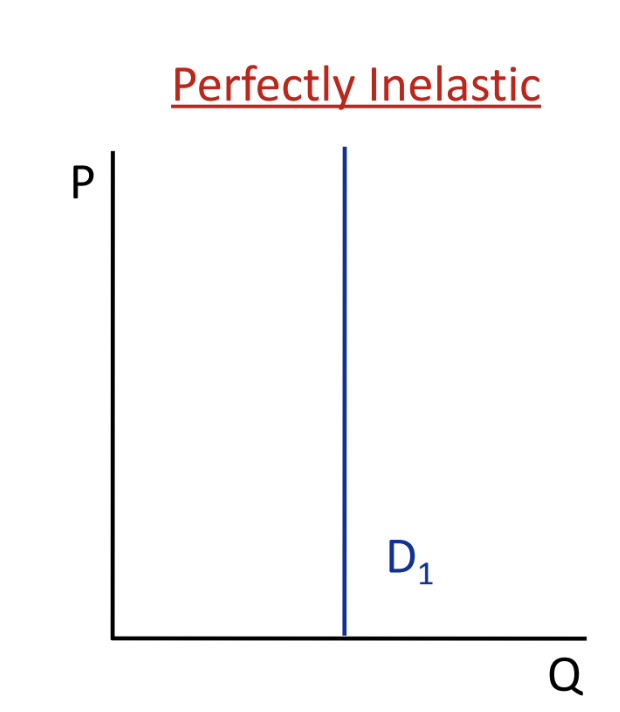
What does a perfectly inelastic demand curve look like?
Demand fixed regardless of price. Elasticity of demand = 0
What does an infinitely elastic demand curve look like?
Demand zero if P>P*, demand infinite if P<P*
Elasticity of demand = -infinite

What is elasticity in economics?
Measure of how much one economic variable responds to a change in another variable
What does an inelastic demand curve look like?
Demand is inelastic when demand curve is pretty steep. Demand is inelastic when there is no close substitute and when consumers need the good

What does an elastic demand curve look like?
Demand is elastic when demand curve is fairly flat. Demand is elastic when there is a close substitute or when consumers can do without the good

What is total expenditure equal to?
Price * Quantity. Prices might change, but what happens to total expenditure depends on how quantity responds, aka the elasticity
Does total expenditure increase or decrease when supply shifts inward?
Expenditure rises because blue loss is smaller than percent increase in green gain. If inelastic, total expenditure will rise and if elastic total expenditure will fall. But in the long run, demand will become elastic

What is the price elasticity of supply?
ES = Percentage change in quantity supplied / percentage change in price. If ES equal to:
ES > 1: Elastic
ES < 1: Inelastic
ES = 0: Perfectly inelastic
ES = Infinity: Perfectly elastic
What does a perfectly inelastic supply curve look like?
Supply fixed regardless of price
Elasticity of supply = 0

What does a infinitely elastic supply curve look like?
Supply zero if P>P*, supply infinite if P<P*
Elasticity of supply = infinite

When is supply inelastic?
When there is a resource constraint (typically short-run)
When is supply elastic?
Where there are no hard resource constraints (typically long-run)
Effects of a Tax On Producers
Tax collected on producers shift supply or MC curve upward because it’s like an extra MC producers have to pay. Quantity bought and sold declines, both sides feel the effects of the tax
Effects of a Tax On Consumers
Exact same effect as on producer, shifts demand or MB curve downward, it’s like a negative MB consumers have to pay
Two Ways of Visualizing Tax Revenues
Tax Revenue = Tax * Q2

Demand Elasticity and the Effects of a Tax
A tax will change the equilibrium quantity more, the more elastic demand (or supply) is. Consumers will bear more of the tax (and producers will bear less of the tax) → the less elastic demand is. Producers will bear more of the tax (and consumers will bear less of the tax), the less elastic supply is. Inelastic factors bear the tax while elastic factors avoid the tax
Welfare Effects of a Tax
Extracts surplus from consumers and producers
Distorts production below the competitive equilibrium and creates deadweight loss
Deadweight loss is larger when demand/supply are elastic
What is a subsidy?
Distorts production above the competitive equilibrium, so at the resulting level of production and consumption MB<MC. It’s like a negative tax and also creates deadweight loss
What is the slope of the demand curve inversely proportional to?
Elasticity
When is demand inelastic?
When demand curve is pretty steep
When is demand elastic?
When demand curve is fairly flat
What do we do when percentage changes are large?
We use logs and exponentials so they still sum
Effects of a Tax Overall
Drives a vertical wedge between demand and supply
The market price typically rises by less than the
amount of the tax, but it depends on the demand
elasticity
Both suppliers and demanders feel the effects
A tax collected from the consumer or from the
producer generates the exact same equilibrium
What is a household’s budget constraint?
The total amount the household spends cannot exceed its income. We can also assume spending equals income
What is the relationship between total and marginal utility?
Marginal utility is the derivative of utility (slope of the utility function). MU likely declines at different rates for different goods
What is the Rational Spending Rule?
A household is doing the best that it can (maximizing its utility) if the marginal utility derived from spending one more dollar on a good is the same for all goods

What is the substitution effect?
When the price of a good rises, a household wants less of the good and more of other goods, because the good is relatively more expensive.
What is the income effect?
When the price of a good rises, a household will need to think about spending less on all goods, because its budget constraint has changed for the worse. Its real income has declined
Utility From Total Consumption of All Goods Graph
u(c) is increasing
u(c) is concave, meaning u’(c) is decreasing

At what point do firms maximize profits?
Where MR = MC, Economic Profit: Profit = Total Revenue - Total Costs. Where TR = Price * Quantity Sold and TC = Opportunity Cost of All Inputs, technically. For a perfectly competitive firm, same as Price = Marginal Cost
What are three decisions a firm has to make?
Short-run choice of output: How much to produce today with the existing set-up?
Long-run choice of output: Expand or contract? Exit the industry? Enter the industry?
Both short-run and long-run – the choice of input mix: What combination of inputs (labor, capital, raw materials, and so on) to use to produce the output?
What is perfect competition?
Each firm knows that its behavior has no impact on the prevailing market price. Occurs in industries with many firms, each of which is small relative to the overall size of the market, and they don’t collude
Market vs Individual Firm Demand Curve
Market demand slopes down, but the demand “curve” that a small competitive firm sees is perfectly elastic at the prevailing market price because it can’t set a price higher than the market price cause people will just buy from other firms and if it sets it lower they’re losing out on money

What is marginal revenue?
The additional revenue a firm earns from selling one more unit of a product or service
What are fixed costs?
Costs that do not vary with how much is produced
What are variable costs?
Costs that do vary with how much is produced
What are total costs?
Sum of fixed and variable costs
What is marginal cost?
The change in total costs from producing one more unit
Because fixed costs do not change when one more unit is produced, marginal cost equals the change in variable costs from producing one more unit.
We assume upward MC because competitive model does not work well with declining MC (leads to monopoly)

How do firms decide to enter a market?
If MC < MR

Individual Firm’s Supply Curve
Same as its marginal cost curve, can think about the quantity supplied by the firm as a function of the market price (“horizontal” interpretation) or as a function of the quantity it produces (“vertical” interpretation)
Market and Individual-Firm Supply Curve
The market supply curve is also the marginal cost curve for the whole industry, can think about it as the horizontal sum of individual firms’ supply curves or the industry’s marginal cost curve
What effect will an improved production technology have on the market and individual firm?
Both will shift the supply curve out
What effect will an increase in the price of a input have on the market and individual firm?
Both will shift the supply curve in
What effect will the entry of a large number of new firms have on the market and individual firm?
Market supply curve will shift out
Does a change in the price of a good shift the supply curve?
No, it will cause a movement along the supply curve
What is Average Total Cost?
Total Cost / Quantity
What happens when ATC > MC?
ATC decreases with quantity
What happens when ATC < MC?
ATC increases with quantity
Where do the MC and ATC curves cross?
Lowest point of the ATC curve
How do you know if profits are positive, negative, or zero?
Depends whether P - ATC is positive, negative, or zero

Revenues, Costs, and Profits on a Graph

What signals are sent by profits?
If there are positive profits to be made: New firms will enter
If there are negative profits: Firms making negative profits will exit
If there are zero profits: There are no forces tending to cause either contraction or expansion of the industry