4.3B Co-ordination and control in animals
 Call Kai
 Learn
 Practice Test
 Spaced Repetition
 Match
 Flashcards
 Knowt Play
1/34

There's no tags or description
Looks like no tags are added yet.
35 Terms
What is a neurone?
The functional unit of the nervous system which transmits information.
What is a nerve?
A bundle of neurones grouped together.
What is an effector?
Part of the body that produces the response.
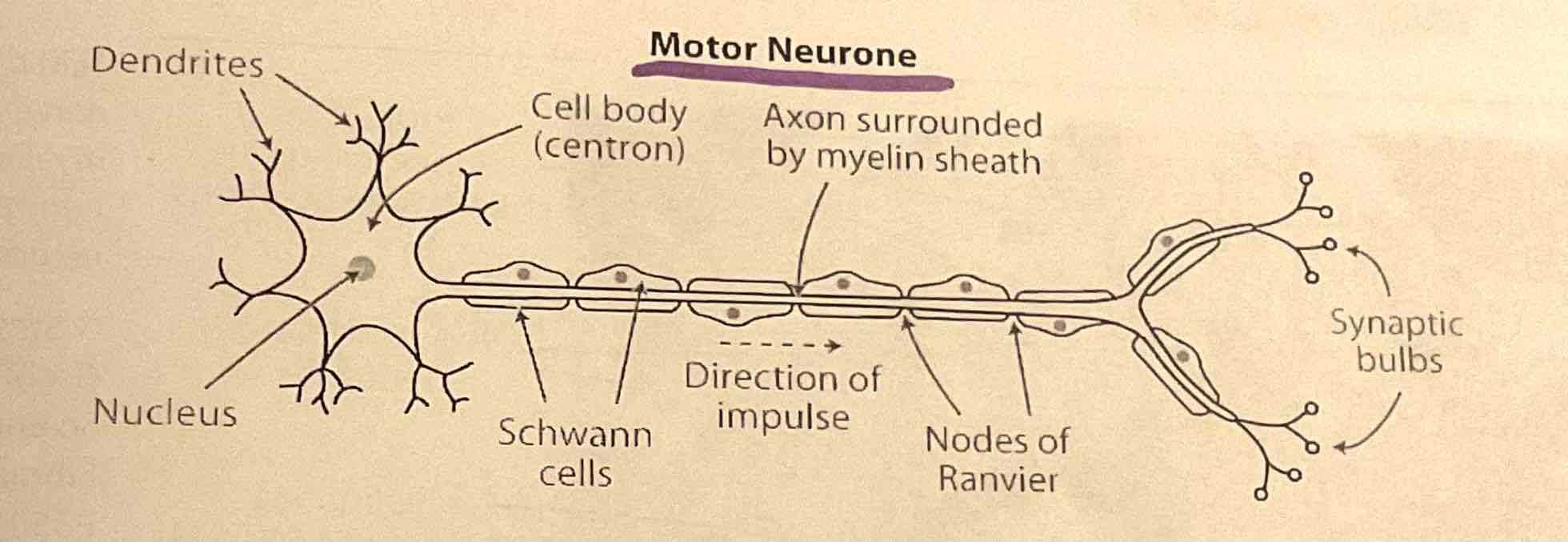
Cell body (centron)
Contains the nucleus.
Axon
Extensions which carry the nerve impulse away from the cell body.
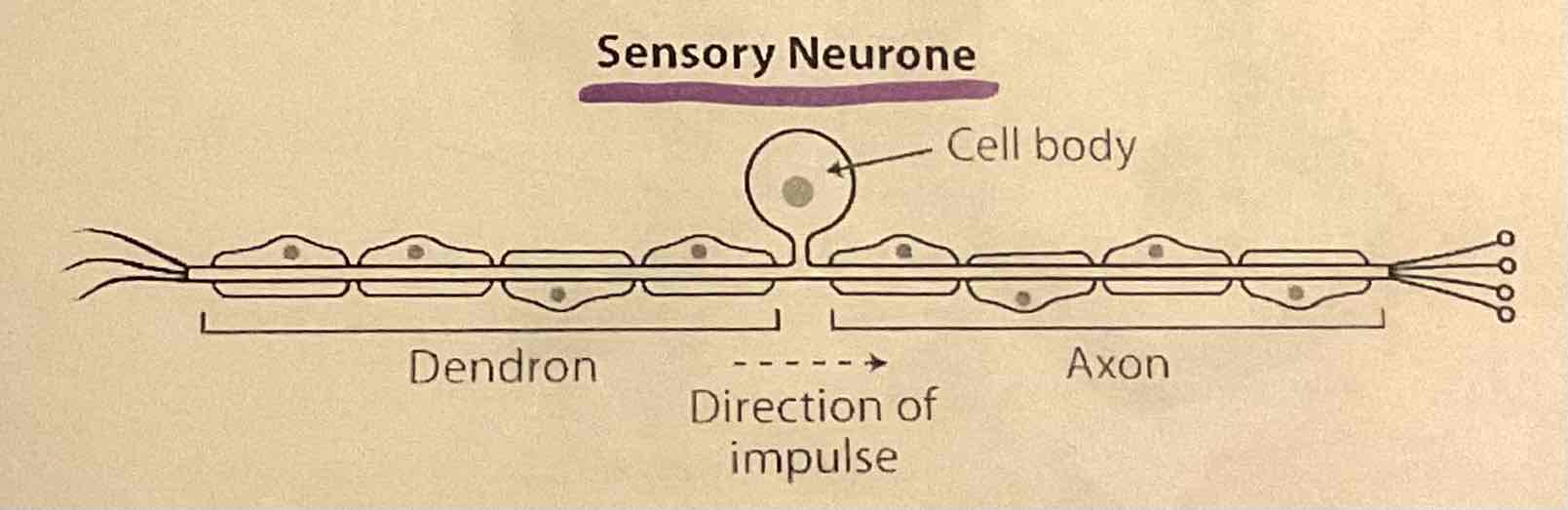
Dendrons
Extensions which carry impulses towards the cell body and may divide into small dendrites.
Schwann cells
Special cells which often sheath axons and dendrons with insulating myelin sheath - has a protective function and speeds up nervous conduction.
Nodes of Ranvier
Gaps between adjacent Schwann cells where the axon/dendron is exposed.
Synaptic bulbs
Axon terminals.
Motor neurone structure
Sensory neurone structure
Where would the cell body of a motor neurone be located? [1]
The CNS (grey matter).
Where would the cell body of a sensory neurone be located? [1]
Outside the CNS.
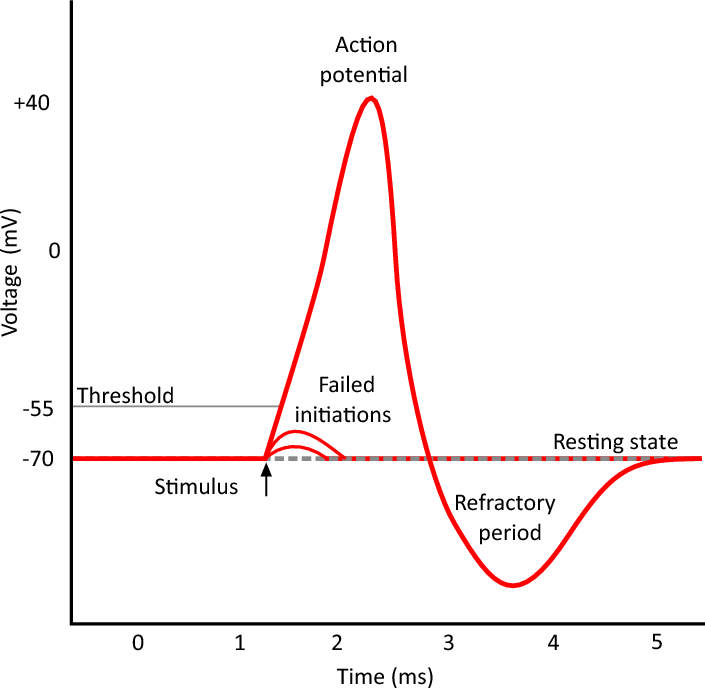
The nerve impulse
During the resting potential, the inside of a neurone membrane is negatively charged compared with the outside - polarised.
Potential difference = -70mV.
The large potential difference is due to the uneven distribution of sodium ions on the outside.
Depolarisation occurs as the membrane becomes permeable and positive ions diffuse into the axon.
At -55mV gated ion channels open increasing the rate of diffusion - threshold is reached.
The action potential is reached when the inside becomes +40mV (jumps from node to node).
Refractory period.
Repolarisation occurs as the positive ions diffuse and are actively pumped out of the axon.
A slight ‘overshoot’ as the inside of the axon membrane becomes slightly more negative (hyperpolarisation) than in the normal resting potential.
The resting potential is restored.
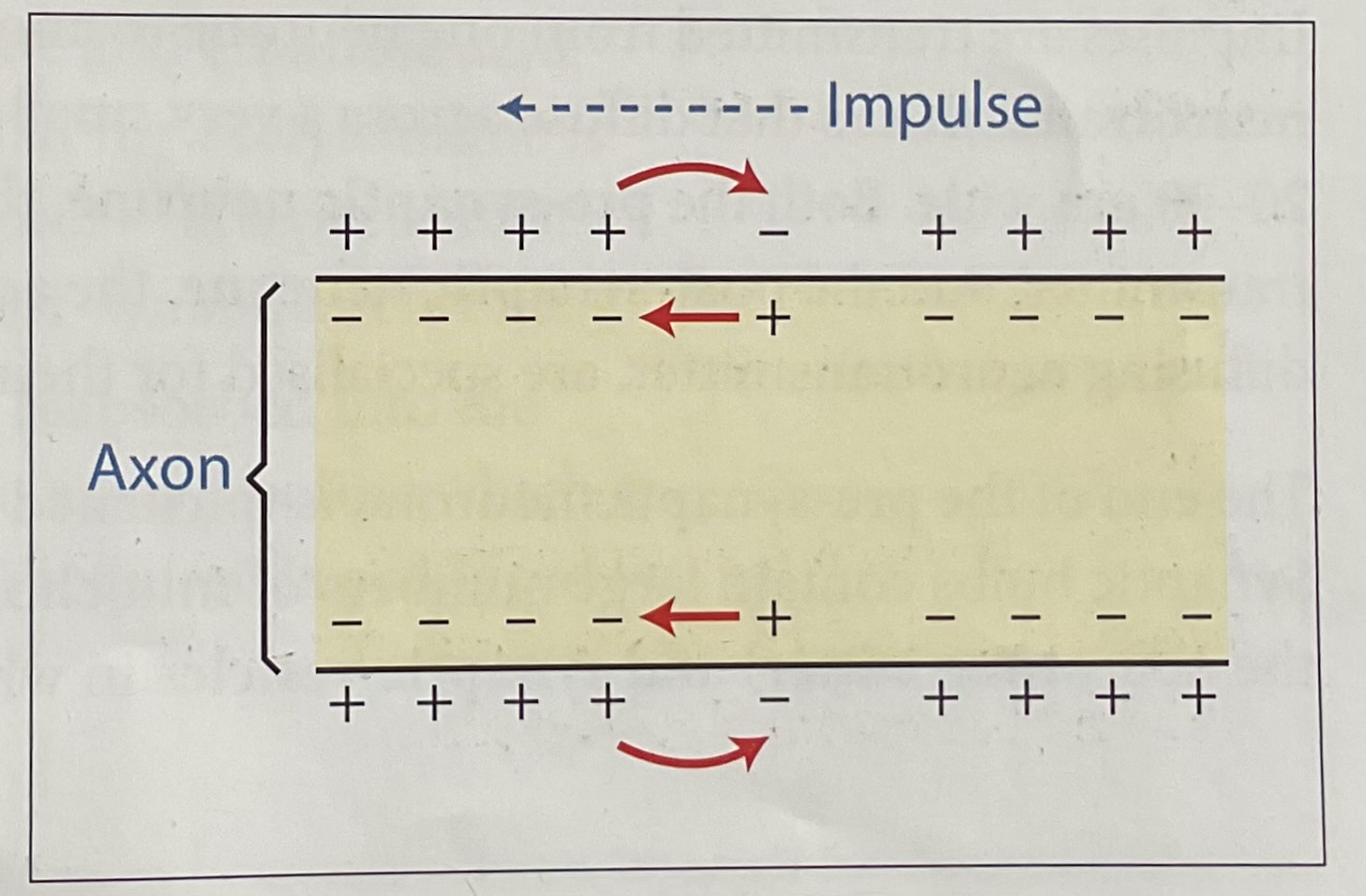
Propagation of a nerve impulse
Action potentials move rapidly along neurones.
As one part of the membrane becomes depolarised, it sets up local circuits with the areas immediately adjacent on either side.
Positive ions from the depolarised zone pass along the inside of the membrane towards the polarised zone immediately in front.
A similar effect occurs on the outside of the membrane.
What is the refractory period?
The inward movement of ions is prevented in that region of the neurone, preventing a further action potential to be generated for at least 1ms.
It ensures that the action potentials are propagated in one direction only.
It limits the number of action potentials that can be fired and ensures that each action potential is a discrete entity.
How does the myelin sheath help to speed up the rate of impulse transmission? [2]
Saltatory conduction - the action potential jumps from node to node so the membrane is depolarised.
Other factors that speed up impulse transmission
Greater cross-sectional area - less leakage of ions in a neurone with a larger diameter.
Temperature - affects the rate of diffusion of ions in neurone action.
What is the all-or-nothing law?
The membrane either becomes depolarised or it does not, it can’t be partially depolarised.
What is the threshold stimulus?
The level of stimulus a neurone requires before an action potential is produced.
What is a synapse?
The junction between two neurones or a neurone and a muscle.
Each synapse produces one specific neurotransmitter.
Synaptic bulb
The bulbous ending of the nerve axon containing mitochondria.
Synaptic vesicles
Contain the neurotransmitter substance.
Pre-synaptic neurone
The neurone bounded by the pre-synaptic membrane.
Post-synaptic neurone
The neurone bounded by the post-synaptic membrane.
Synaptic cleft
The narrow gap between the pre and post synaptic neurones.
Receptors
Large protein molecules in the post-synaptic membrane complementary to the type of neurotransmitter in the synapse.
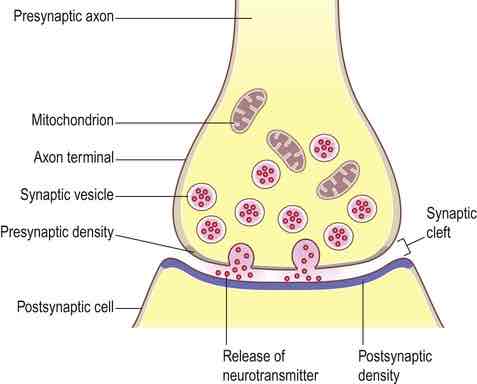
Transmission of synapses
When an impulse arrives, calcium ion channels open allowing the ions to diffuse into the synaptic bulb.
Calcium ions cause the synaptic vesicles move towards and fuse with the pre-synaptic membrane to release acetylcholine by exocytosis.
The acetylcholine diffuses across the synaptic cleft and binds to the receptor sites in the post-synaptic membrane.
The opening of sodium ion channels in the post-synaptic membrane cause the membrane to be depolarised and an excitatory post-synaptic potential (EPSP) is generated.
The threshold may be reached to produce an action potential.
Acetylcholinesterase breaks down the acetylcholine to prevent it continuously generating a new action potential in the post-synaptic neurone - allows repolarisation to begin.
The breakdown products, chlorine and acetyl, diffuse across the cleft and are reabsorbed into the synaptic bulb and are consequently re-synthesised and stored in the synaptic vesicles to be used again.
What role do mitochondria play during synaptic transmission? [2]
Provide ATP for the re-synthesis of neurotransmitter.
Functions of synapses
Allow nerve impulses to pass from neurone to neurone.
Ensure unidirectionality.
Provide integration and flexibility.
Prevent overstimulation.
Inhibitory synapses
Release a different neurotransmitter which makes it more difficult for an EPSP to form in the post-synaptic membrane.
The neurotransmitter leads to an influx of negative ions making the inside even more negative - hyperpolarisation.
Inhibitory post-synaptic potential (IPSP) is created.
More difficult for the EPSP to reach the threshold value and less likely to produce an action potential.
What are biological transducers?
Receptor cells that convert whatever form of energy they are sensitive to into a nervous impulse.
The effect of nicotine
Stimulates the release of acetylcholine and other neurotransmitters making action potentials more likely.
The effect of curare
Blocks receptors, preventing synaptic transmission - loss of muscle function.
The effect of opioids
Blocks the calcium ion channels so less transmitter substance is released and action potentials are less likely.
Can provide pain relief by reducing impulses coming from pain receptors.