Machine Theory Final
 Call Kai
 Learn
 Practice Test
 Spaced Repetition
 Match
 Flashcards
 Knowt Play
1/123

There's no tags or description
Looks like no tags are added yet.
124 Terms
Why should a chuck wrench never be left in the chuck?
Because it may fly and strike someone if the lathe is started
What are perhaps the most common causes of hand injuries in lathe work?
Correct
Making contact with sharp edges, corners, and projections
What form of filing is considered the safest on a lathe? How is this performed?
Correct
Left-hand filing is considered safest.
How is left-hand filing performed?
The left hand grips the handle while the right hand holds the tip of the file
Completely describe a Feed Reverse Lever
Located on the lathe headstock, it controls the lead screw feed direction—determining left- or right-hand threading—for feed and threading mechanisms powered through the headstock.
Completely describe a Lathe Bed
It serves as the foundation and backbone of the machine, where its rigidity and alignment directly govern machining accuracy. Precision ways sit along the top of the bed to guide sliding lathe components such as the carriage and tailstock.
Completely describe a Lathe Apron
It sits on the operator-facing side of the carriage and houses gears and feed clutches that transfer motion from the feed rod or lead screw to drive the carriage and cross slide.
Completely describe a Lathe Saddle
It forms the main bridge of the carriage, sliding along the bed ways to provide longitudinal travel while supporting the cross slide and compound rest.
Completely describe a Thread Dial
Positioned on the right side of the lathe apron, it indicates the proper moment to engage the half nuts with the lead screw so multi-pass thread cuts stay synchronized.
Completely describe a Half-Nut Lever
Use this strictly for thread cutting—never for general turning feeds. Move the entire carriage along the ways manually with the carriage handwheel or automatically via the apron power feed controls, and clamp it to the bed by tightening the lock screw.
Completely describe a Compound Rest
Mounted on the cross slide, the it swivels to any angle for cutting bevels and tapers, moves manually via its feed screw handle, and supports the tool post where cutting tools are clamped.
Completely describe a Tailstock
It slides along the bed ways and clamps anywhere on the bed to support one end of a workpiece or hold cutting tools (such as drills, reamers, and taps). It features a handwheel-operated sliding spindle—locked with a spindle clamp lever and bored for a standard Morse taper shank—along with upper and lower units adjusted via base screws to machine tapers.
What is the function of the gibs?
For adjustment of excessive clearance to remove backlash.
How does tool and toolholder overhang affect the setup?
Correct
It affects the rigidity of the setup.
What are the benefits of a quick-change toolholder over a standard tool post?
Rigidity, Accuracy, Versatility, Easing of Setting Tool Height
What is one of the most common toolholding devices used in the lathe tailstock?
A Drill Chuck
How are tools held in the tailstock?
A Morse Taper
List two advantages of using high-speed steel tools.
It doesn't lose hardness from heat being generated, and it is easily shaped by grinding.
How do you determine if a tool is right-hand or left-hand?
By looking at the end from the opposite side of the lathe. a right handed tool has the cutting edge to the right and vice versa.
What can be done to strengthen the tip of a turning tool?
Give it a larger nose radius.
What is the tradeoff strengthening the tip of a tool?
It will produce a better finish but will also create chattering if the setup isn't rigid enough.
When should a zero or negative rake be used? Why?
They should be used for brass or plastics, in order to prevent the tools for digging in.
Why should chips be broken up?
Chips that are not broken up will become long and stringy, making them very dangerous.
Name three things that promote chip-breaking.
Tool geometry - especially side and back rake angles, courser feed to speed ratios - especially for roughing, and maximum "safe" depth of cut
What will be formed if a chip breaker is ground too deep? What will this cause?
It forms a chip trap that may cause binding of the chip and tool breakage
A high-speed tool but can be easily overheated by using a glazed wheel that needs dressing or by exerting too much pressure. What does this cause in the tool?
Correct
It will form small cracks in the surface that can result in tool failure.
Describe an Independent Chuck.
It has jaws can be moved independently from each other.
What two procedures Independent Chucks are used for?
They can allow work on parts with irregular shapes, as well as allowing precise setups with a dial indicator.
Describe a Universal Chuck.
It has jaws that move equally with each other.
What is the purpose of a Universal Chuck?
Since the jaws self-center when tightened on a part, they are used in repetitive work that is mass produced.
What are collet chucks used for?
Are used in producing small, high precision parts
What should NEVER be done to a collet?
Never tighten it without a workpiece in it.
Explain completely how speed settings are to be set on geared head lathes.
With levers on the outside of the headstock. It may sometimes be necessary to rotate the spindle by hand to get the gears to mesh. Never try to shift gears with the motor running and the clutch lever engaged.
What lever is shifted in order to reverse the lead screw?
Feed Reverse Lever
If the same feed rate is selected for facing a workpiece and for turning the outside diameter, why would you not achieve the same surface finish (tool marks per inch) on some lathes?
Cross feeds are geared differently from longitudinal feeds—often around one-third to one-half of the longitudinal rate —and each lathe's cross feed ratio is usually listed on the quick-change gearbox index plate.
The half-nut is not used to move the carriage for turning. What is its only use?
Threading
Explain the process that can be used to determine if the lathe you are using is calibrated for single (radial) or double (diametrical) depth graduation?
Measure the diameter with a micrometer, move the tool a set amount on the dial to take a cut, re-measure the diameter, and check whether it decreased by 0.05 in or 0.100 in.
What is the maximum length a part should extend from the jaws when facing or attempting any other machining?
5x the Length of the Part Diameter
Should the point of the tool be set above, below, or at the center of the spindle axis when taking a facing cut?
Center
What could be used to help produce a better finish on a facing cut?
Cutting Oil
Why would you center drilling a workpiece on a lathe.
When the work is turned between centers, and when you need to use it as a starting drill.
Name two causes of Center Drill Breakage.
Feeding the drill too fast with the lathe speed too slow, or the tailstock is off center.
Explain the advantages of turning between centers.
A shaft can be flipped end for end without losing concentricity, and—provided the setup remains unchanged—a threaded part can be removed for inspection, reinstalled, and returned to threading in alignment.
Explain the disadvantages of turning between centers.
you cannot part off a workpiece, and you cannot drill, bore, or machine the end face.
Describe a Dead Center.
It is virtually obsolete, non-rotating, hardened to withstand machining pressures and friction
Describe a Ball Bearing Center.
It is used extensively; antifriction centers will withstand high-speed turning without overheating
Describe a Rolling Pipe Center
It is used for turning tubular material
Name three kinds of centers used in a tailstock.
A Dead Center, Ball Bearing Center, and Rolling Pipe Center
What are the advantages of turning a shaft between the chuck and tailstock?
It offers a quick, solid setup with positive drive
What are the disadvantages of turning a shaft between the chuck and tailstock?
It introduces jaw runout, which can transfer runout onto the shaft, and heavy cutting forces can push the workpiece into the chuck jaws, causing it to pull away and lose contact with the tailstock center.
What factors tend to promote increased chip curl so that safer chips are formed?
Coarser Feeds, Deeper Cuts, and Smaller Rake Angles
Explain the difference between pitch of a thread and threads per inch.
Threads per inch is the number of thread crests counted along 1 inch of thread length, whereas pitch is the distance from one thread crest to next adjacent thread.
Name the similarities Unified and American National Standard threads.
Both systems share the same basic geometry, practically identical thread forms, and a 60° included angle.
Name the differences Unified and American National Standard threads.
The main differences between the two systems lie in their tolerances, thread depths, and classes of thread fits.
What is the major reason for thread allowances and classes of fit?
Interchangeability of Threaded Parts
What does 1/2” in 1/2"-20 UNC-2A designate?
The Diameter - which is a 1/2" major diameter
What does 20 in 1/2"-20 UNC-2A designate?
The Threads Per Inch - which 20 Threads Per Inch
What does UNC in 1/2"-20 UNC-2A designate?
The Thread Series - which is Unified National Coarse
What does 2A in 1/2"-20 UNC-2A designate?
The Class of Fit - which means it has an External Thread with a Class 2 Fit
Why set the compound on the lathe at 29° from perpendicular centerline when cutting threads?
To provide a light finish cut on the trailing side of the threading tool
How are Unified and Metric thread forms similar?
Both are 60-degree forms
A ratio exists between the spindle rotation, the lead screw rotation, and the number of threads on the lead screw. What must the operator do to alter the ratio?
It can be changed by using the quick-change gearbox to make a variety of threads
The better practice is to feed the tool in with the compound set at 29 degrees rather than with the cross slide when cutting threads. Why is this so?
The tool is less likely to breakdown, and the chips are less likely to bind cause tearing of the threads.
What two tools may be used to check the 60° angle on a threading tool?
The Center Gage and Optical Comparator
What is used to align the tool with the workpiece?
A Center Gage
How can the number of threads per inch be checked?
Using a Screw Thread Pitch Gage
Is the carriage moved along the ways by means of gears when the half-nut is engaged? Explain
No, as engaging the half nut clamps its two halves onto the lead screw, causing the carriage to advance by the lead of the lead screw thread for each revolution of the lead screw.
Explain which position on the threading dial are used for engaging the half-nut for Even Threads.
The Half Nut may be engaged at any line.
Explain which position on the threading dial are used for engaging the half-nut for Odd Threads.
The Half Nut may be engaged at any numbered line.
Explain which position on the threading dial are used for engaging the half-nut for Fractional-Numbered Threads.
Engage the Half Nut at the same line every time.
What is a good "rule of thumb" to remember when cutting any type of thread?
Engage the half-nut on the same numbered line every time and you will be safe
When threading, how fast should the spindle be turning?
It should be slow enough so that you can have complete control of the thread cutting operation
What is the procedure for cutting left-hand threads?
Cutting left-hand threads is similar to cutting right-hand threads, except the compound rest is angled 29∘ to the left of the operator and lead screw rotation is reversed to feed from left to right
If for some reason it becomes necessary for you to remove the tool or the entire set-up before a thread is complete, what is the procedure called that you should follow when ready to finish the threads? Define Step 1:
Check tool position with reference to work with a center gage, realign tool if needed
If for some reason it becomes necessary for you to remove the tool or the entire set-up before a thread is complete, what is the procedure called that you should follow when ready to finish the threads? Define Step 2:
Back tool away from threads, then engage the half nut with the machine running. Turn off the machine with the half nuts still engaged and tool is over the partially cut threads.
If for some reason it becomes necessary for you to remove the tool or the entire set-up before a thread is complete, what is the procedure called that you should follow when ready to finish the threads? Define Step 3:
Position tool in its original location in the threads by moving both the cross feed and compound handles
If for some reason it becomes necessary for you to remove the tool or the entire set-up before a thread is complete, what is the procedure called that you should follow when ready to finish the threads? Define Step 4:
Set the micrometer dial to zero on the cross feed collar and set the dial on the compound to the last setting used
If for some reason it becomes necessary for you to remove the tool or the entire set-up before a thread is complete, what is the procedure called that you should follow when ready to finish the threads? Define Step 5:
Back off the cross feed and disengage the half nuts. Resume threading where you left off.
What part of a thread does a thread micrometer measure?
It measures the Pitch
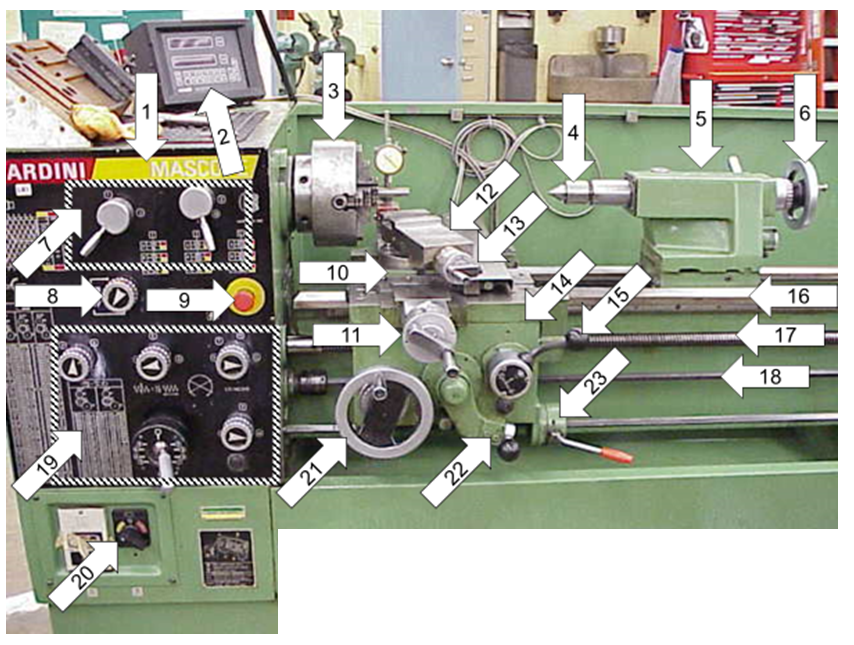
Where is the Headstock?
1

Where is the Digital Readout?
2
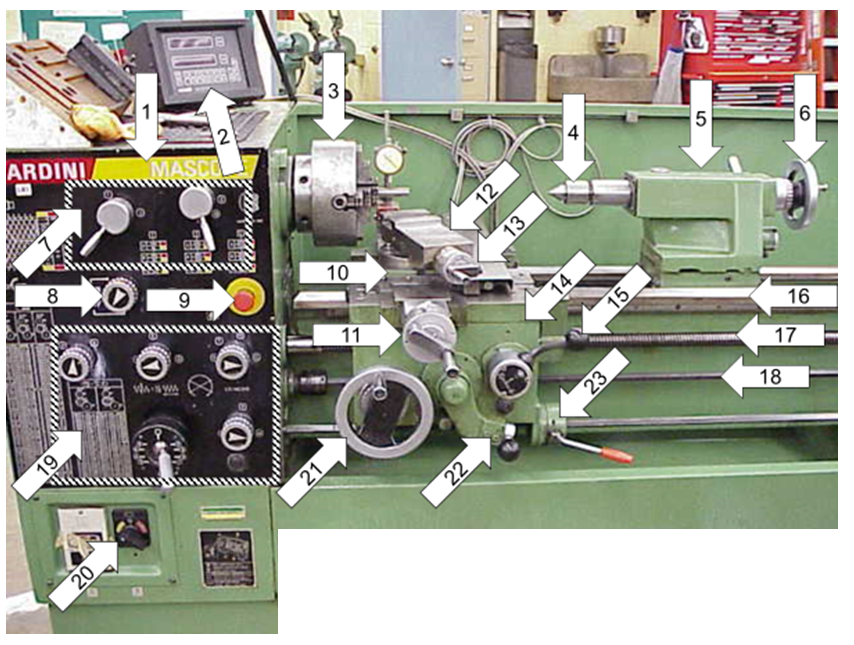
Where is the Chuck?
3

Where is the Live Center?
4
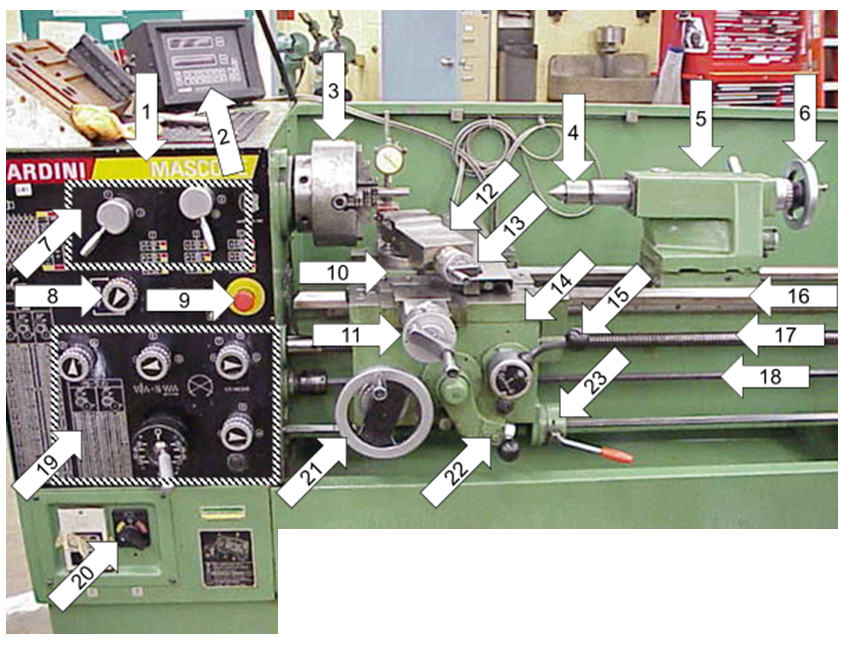
Where is the Tailstock?
5

Where is the Tailstock Handwheel?
6

Where is the Spindle RPM Setting Levers?
7

Where is the Leadscrew Reverse Lever?
8

Where is the Emergency Stop?
9
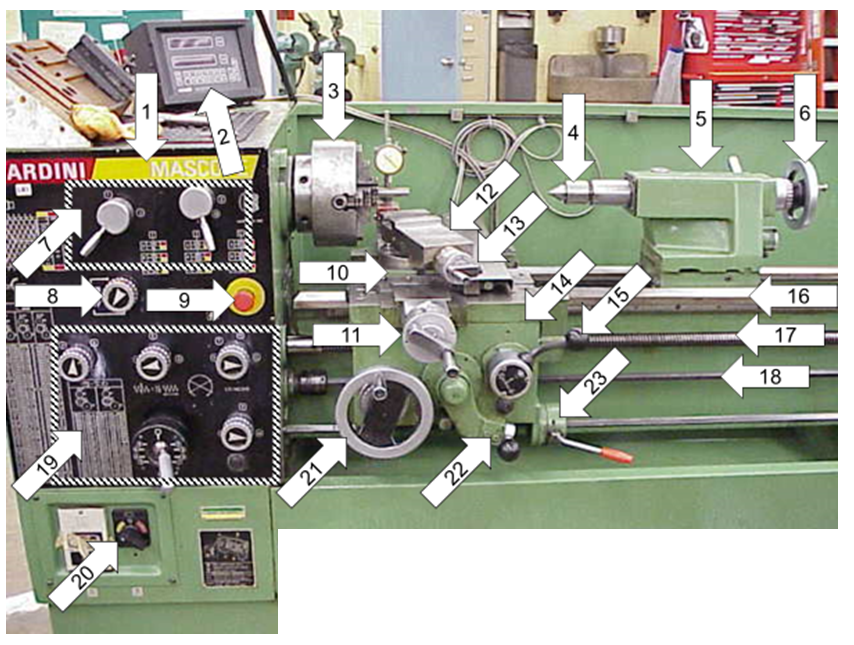
Where is the Cross Slide?
10

Where is the Cross Slide Handwheel?
11

Where is the Compound Rest?
12

Where is the Compound Rest Handwheel?
13

Where is the Carriage?
14

Where is the Feed Select & Half-Nut Engage Lever?
15

Where is the Lathe Bed?
16

Where is the Leadscrew?
17

Where is the Feedbar?
18

Where are the Threads & Feed Charts?
19

Where is the High-Low Motor Speed Setting?
20
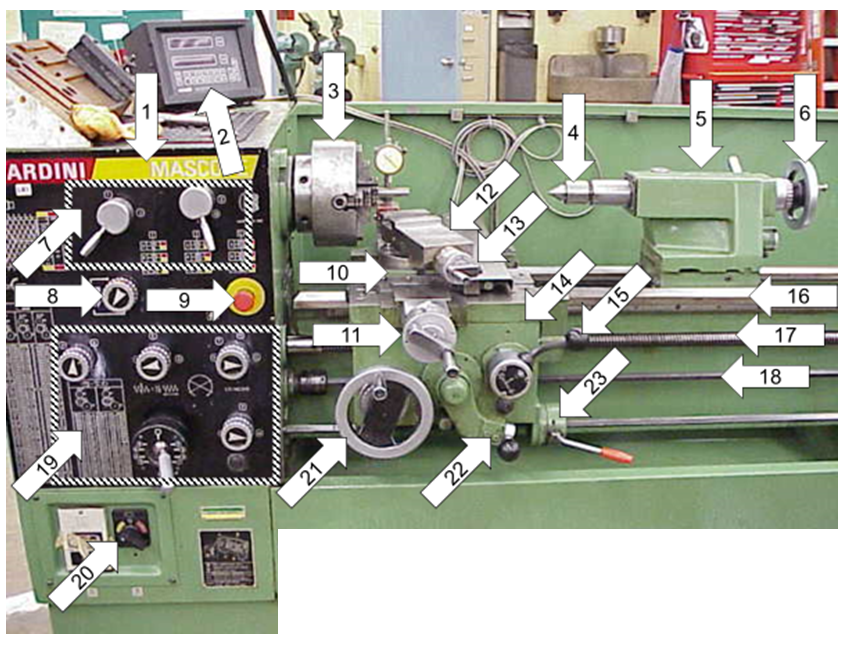
Where is the Carriage Handwheel?
21