Bio 3 - The Cell Cycle & Mitosis
 Call Kai
 Learn
 Practice Test
 Spaced Repetition
 Match
 Flashcards
 Knowt Play
1/84

There's no tags or description
Looks like no tags are added yet.
85 Terms
A key role of cell division is the ability of __ to produce more of their own kind best distinguishes __ things from __ matter.
organisms, living, nonliving
A key role of cell division is the continuity of life based on the __ of cells, or __.
reproduction, cell division
In __ organisms, division of __ cell reproduces the entire organism.
unicellular, one
Multicellular eukaryotes depend on cell division for...
-Development from a fertilized cell
-Growth
-Repair
__ is an integral part of the cell cycle, the life of a cell from __ to its own __.
cell division, formation, division
Copying cells- Most cell division results in __ cells with __ genetic information(DNA)
daughter, identical
Copying of cells with the exception of __, a special type of division that can produce __ and __ cells
meiosis, sperm, egg
All the DNA in a cell constitues the cell's __.
genome
A single DNA molecule is common in __ cells.
prokaryotic
A number of DNA molecules is common in __ cells.
eukaryotic
DNA molecules in a cell are packaged into __.
chromosomes
Chromatin
loose DNA + Proteins
Chromosomes
package of condensed DNA + Proteins
Somatic cells
-nonreproductive (body) cells
-2n
Gametes
-reproductive cells: sperm and eggs
-n
-humans, n=23
-chimps, n=24
In preparation for __, DNA is __, and the chromosomes __.
cell division, replicated, condense
Each duplicated chromosome has two __, attached along their lengths by __.
sister chromatids, cohesions
The centromere is the narrow "__" of the duplicated chromosome, where the two chromatids are most closely __.
waist, attached
Mitosis is the __ of the __ in the __.
division, genetic material, nucleus
Cytokinesis is the __ of the __.
division, cytoplasm
In animals, __ are produced by a __ of cell division called __.
gamets, variation, meiosis
Meiosis yields __ daughter cells that have __ as many __ as the __. (n)
non-identical, half, chromosomes, parent cell
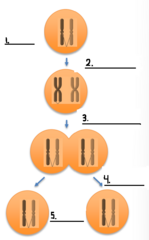
Eukaryotic Cell Division
1. parent cell
2. gene duplication
3. division of genetic material
4. division of cytoplasm
5. daughter cells
Phases of the cell cycle:
-mitotic (m) phase
-interphase
mitotic (m) phase
-mitosis
-cytokinesis
Interphase
-metabolic activity
-cell growth
-copying of chromosomes (s)
prep for cell division (G2)
Cell cycle: interphase (prep and synthesis)
- G1 prep for dna duplication
- S phase synthesize/duplicate dna (2n to 4n)
- G2 prepare for cell division
mitosis...
1. prophase
2. premetaphase
3. metaphase
4. anaphase
5. telophase
prophase: chromosomes __.
condense
in __ chromatin is __ into sister chromatids.
prophase, condensed
In prophase, __ form __ and __ to opposite sides.
centrioles, centrosomes, migrate
Prophase has __ mitotic __ formation (microtubules)
early, spindle
Prometaphase has __ envelope __.
nuclear, fragments
In prometaphase, __ attach to __ at the __.
microtubules, chromosomes, centromere
In prometaphase, a __ attaches a microtubule to each __, the __ chromatid will go to each __ cell.
kinetochore, chromatid, one, daughter
Chromosomes align along the __ plate in the middle of the __ cell.
metaphase, dividing
In anaphase, the __ divides, and __ microtubules shorten, pulling the __ apart __ the centrosome.
centromere, kinetochore, chromatids, toward
Anaphase ensures that one __ from each pair of sister chromatids goes to __ poles of the cell
chromatid, opposite
Finally, in telophase, a __ set of chromosomes is now at __ __ of the cell.
complete, each part
In telophase, the __ break down __ and the nuclear envelope __.
microtubules, completely, reforms
in telophase, chromosomes __, marking the end of __ and __.
decondense, telophase, mitosis
Cytokinesis: In __ cells, the parent cell __ into __ daughter cells.
animal, divides, two
Cytokinesis: In animal cells, a ring of __ filaments, called the __ ring, forms a __ and pinches the __ in two = cleavage.
actin, contractile, cleavage, cytoplasm
Once cytokinesis: in animal cells is complete:
2 cells, each 2n
Cytokinesis: In __ cells, a __ __ forms in the middle of the dividing cell.
plant, cell plate
Cytokinesis: In plant cells, once the cell plate is __ enough, it __ with the cell wall of the __ cell.
large, fuses, original
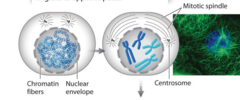
Prophase

Prometaphase
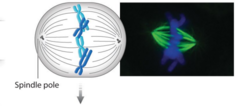
Metaphase

Anaphase
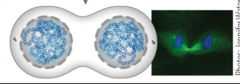
Telophase

Animal cell - cytokinesis
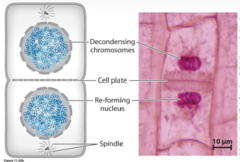
Plant cell - cytokinesis
Prokaryotic (bacteria and archaea) reproduce by a type of cell division called __ __.
binary fission
In binary fission, the chromosome __ (beginning at the origin of replication (ori)), and the two daughter chromosomes __ move apart.
replicate, actively
In binary fission, the __ membrane pinches __, dividing the cell into __.
plasma, inward, two
In binary fission, __ cells cannot undergo __.
prokaryotic, mitosis
The evolution of mitosis: since __ evolved before __, mitosis probably evolved from __ __.
prokaryotes, eukaryotes, binary fission
Certain __ exhibit types of cell division that seem __ between binary fission and mitosis.
protists, intermediate
The eukaryotic cell cycle is regulated by a __ __ system, and the __ of cell division varies with this type of cell.
molecular, control, frequency
In the eukaryotic cell cycle, the checkpoints __ the cell cycle until a __ signal is recieved, but __ cells manage to escape the usual controls on the cell cycle.
stops, go-ahead, cancer
Checkpoint: G1 to S
DNA Damage -> Is the DNA damaged? If so, stop and repair
Checkpoint: G2 to M
DNA Replication -> Is all the DNA replicated? If not, keep synthesizing
Checkpoint: M
Sindle assembly -> Are all the chromosomes attached to the spindle before anaphase? If not, wait and don't pull them apart.
In the cell cycle clock, the cell cycle appears to be __ by specific __ signals present in the __.
driven, chemical, cytoplasm
Two types of regulatory __ are involved in cell cycle contorl: __ and cylin-__ __ (CDKs).
proteins, cyclins, dependent, kinases
The activity of a CDK __ and __ with changes in __ of its cyclin __.
rises, falls, concentration, partner
G1 checkpoint: p53 regulation
When DNA is damaged by radiation, a specific protein kinase is activated that phosphorylates the p53 protein.
When __, p53 is prevented from being __, and its levels in the nucleus __. As p53 levels rise, p53 __ the __ of a gene that expresses a CDK __ protein.
phosphorylated, exported, rise, activates, transcription, inhibitor
This inhibitor __ to and __ the activity of the G1/S cyclin-CDK complex. This __ the cycle and gives it time to __ the DNA damage.
binds, blocks, attacks, repair
G2 checkpoint : MPF
- Maturation-promoting factor or M-phase promotion factor - is a cyclin-CDK complex
- MPF = a CDK + a cyclin protein
- MPF levels change with the cyclin protein
- Key role in the G2-M transition
Checkpoint M - spindle assembly goes inbetween which phases of mitosis?
Metaphase and Anaphase
Cells can receive signals to divide from within the cell: __
endogenous
Cells can also be signaled to divide by chemicals or physical factors outside the cell: __
exogenous
What are examples of endogenous signals
- cyclin
- CDKs
- MPF
What are examples of exogenous signals
- contact with other cells
- secreted factors
__ factors are released by certain cells and __ other cells to __ :(platelet-derived growth factor (PDGF) is made by __ __ __ called platelets.) Exogenous or Endogenous
Growth, stimulate, divide, blood, cell, fragments = Exogenous
In __-dependent __, crowded cells will __ dividing. Exogenous or Endogenous
density, inhibition, stop = Exogenous
Most cells also exhibit __ dependence -- to __, they must be attached to a __. Exogenous or Endogenous
anchorage, divide, substrate = Exogenous
Most cells exhibit anchorage dependence and density-dependent inhibition, but __ cells exhibit __ type of regulation of their division.
cancer, neither
Cancer cells may not need growth factors to grow and divide, so they...
- may make their own growth factor
- may convey a growth factor's signal without the presence of the growth factor
- may have an abnormal cell cycle control system
Tumor formation is...
a normal cell is converted to a cancerous cell by a process called transformation.
Cancer cells that are not __ by the immune system form __, masses of abnormal __ within otherwise normal tissue.
eliminates, tumors, cells
If __ cells remain only at the __ site and lack __ changes to move, the lump is called a __ tumor.
abnormal, original, cellular, benign
__ tumors may be treated with high-energy __, which damages the __ in the cancer cells.
localized, radiation, DNA