Astronomy #1 Exam Review
 Call Kai
 Learn
Learn Practice Test
 Spaced Repetition
 Match
Match Flashcards
 Knowt Play
1/75

There's no tags or description
Looks like no tags are added yet.
Name | Mastery | Learn | Test | Matching | Spaced | Call with Kai | Chat |
|---|
No analytics yet
Send a link to your students to track their progress
76 Terms
Scientific Notations
10^0= 1
10^1=10 (1 zero)
10²=100 (2 zeros)
5.3 × 10³= 5,300
8.9 × 10^4= 89,000
10^-1 = 0.1
10^-2= 0.01
2.1 × 10^-2= 0.021
Orders of magnitude
The numbers of powers of 10 that two things differ by (The orders of magnitude that separate them)
EX: two orders of magnitude = 10²
EX: The sun is 100 times larger than the earth, so it is 2 orders of magnitude larger than the earth
What are Quasars?
Extremely distant black holes shining brighter than MOST GALAXIES, but SMALLER than our solar system!
Looks like a star, but there’s a bunch of stars within it
brighter b/c it has a lot of gas supply
The easiest star to map out
What are superclusters?
A lot of galaxies near each other
Void
regions with very few galaxies
Naked eye planets
Planets you can see without a telescope
What is Orion
Roughly 3000 stars are visible at once
what made months a thing, 30 days long, 360 min in an hour, 360 sec in a minute, ect.
What are the outermost limits of the Universe?
More than 40 billion light years away
When does the first quarter moon rise and set
Rises at noon
Sets at midnight
when does the full moon rise/set
rises sunset
sets sunrise
Earth is…
light MINUTES away from the nearest PLANETS
light YEARS from the nearest STARS
MILLIONS OF LIGHT YEARS from the nearest large GALAXIES
when does the third quarter moon rise and set
rises at midnight
sets at noon
When we look at distant objects, how do we see them?
As they were when the light left them.
Traveling far in space means traveling back in time.
What are constellations?
The patterns of stars that stay the same
Stars being grouped because they are in about the same direction (NOT PHYSICAL)
88 regions of the sky
48 of them are defined by ancient greeks
Don’t really change relationships to each other
Zenith
The point directly overhead (so if you were to look straight up)
Horizon
The lowest part of the sky you can see; just above the earth’s surface
You can see anything above it, not below
So, we always see 50% of celestials, the other 50% is below the horizon
North/ South Celestial poles
The points on the celestial sphere where it intersects the Earth’s axis projected outward
The earth rotates on this line, and the sphere rotates in the opposite direction but around the same imaginary line
North pole, South pole
Celestial equator
The ring on the celestial sphere where it meets Earth’s equator, projected outward
Just like the Earth has an equator, we can project the equator of the earth till in meets our celestial equator.
Could be overhead at some point if you live on the Earth’s equator
How do stars move
East to West
They rise a 4 minutes earlier each night
Circumpolar stars
Stars near the North Celestial Pole (Polaris)
Travel in a circle around the pole
stay above the horizon
Ecliptic
the current path of the sun from EARTHS POV
It takes 1 year for the Earth to go around the sun
titled 23.5 degrees
the reason for the Earth’s changing seasons
The sun’s apparent path
Always RISES towards the EAST and SETS in the WEST
Due to Earth’s tilt, it gets HIGHER in the sky at noon in the SUMMER, lower in the sky at winter
Closest overhead at noon on the summer solstice
Polaris movement
The pole doesn’t move
So, The pole star BARELY moves
WHY?
Since earth rotates on an axis that runs through North and South poles, if you were to draw a straight line out it points at Polaris.
How stars near polaris move
circumpolar stars circle the pole
The stars move in an counterclockwise
They don’t rise or set because they are near the pole
Annual changes in constellations
Different constellations are on the RIGHT side of Earth at different times of the year
Stars rise 4 MINUTES earlier each night
FIGURES ARE NOT TO SCALE
Describe in what direction from us the Sun, Moon, planets and most stars rise and set, and why they do so
Rise in the east and set in the west BECAUSE the Earth spins from west to east on its axis (Counterclockwise)
One full turn takes 24 hours
What do the motions of Earth correspond to (day and year)
Rotates (spins) on its axis around the sun
Takes 24 hours to do one full spin; 365 days (1 year) to do one full trip around the sun
This is what creates day and night bc the side facing the sun experiences daytime, while the side turned away experiences night
The 23.5 degrees tilt of the Earth creates our CHANGING SEASONS b/c different parts of the planet receive more or less direct sunlight throughout the journey.
What are the two causes of seasons?
The Earths tilt, and directness of sunlight varies over the year
The Ecliptic (plane of earth’s orbit) is tilted at 23.5 degrees!
When it is tilted TOWARDS the sun, its SUMMER and when the tilt is AWAY from the sun, its WINTER
The sun is closest overhead at noon on the summer solstice, lower in the sky during the winter
we get less sun when the sun is lower in the sky
So, not only do we get less hours of daylight in the winter, but the light we get is also less intense.
When it is summer in the northern hemisphere, it is summer in the southern hemisphere
What would happen if Earth didn’t have a tilt?
Latitude alone would determine how much sun you get. So, the equator would get the most sunlight.
What causes the phases of the moon?
Due to us only seeing part of the sunlit moon
Depends on its position compared to the earth and sun
There is a daytime and nighttime for the moon
New moon, full moon, quarter moon
New Moon
Completely dark.
It’s not that its not getting sunlight, but the side that IS, is not facing us.
Rises and sets at the same time as the sun
Full moon
The side we see is entirely lit up
Opposite the sun and sky, so sets when the full moon rises
quarter moon
50% is lit up, 50% is dark
Rises at noon and sets at midnight.
When do eclipses occur?
When the Earth, Moon (Tilted 5 degrees), and Sun form a straight line
The moon’s shadow will cross the earth OR the Earth’s shadow will cross the moon
Both have to happen perfectly
RARE!!!
Lunar Eclipse
When the EARTH is between the Moon And Sun
The moon has to be BEHIND the earth
Full moon going in AND coming out
The moon becomes dark b/c its in earth’s shadow
Blood moon: even though it’s in the earth’s shadow, some light still comes through

Solar Eclipse
Moon is perfectly aligned between earth and sun
the moon has to be BETWEEN the earth and sun
The Sun goes dark
Can be Partial, TOTAL, or annual

Total Solar eclipse
denser shadow
The moon will look to be the same size in the sky as the sun (just close/big enough to block the sun barely)
Corona
the outer atmosphere of the sun
What phase of the moon must the solar eclipse happen during?
THE NEW MOON
What phase of the moon must the lunar eclipse happen during?
FULL MOON
What are 2 things light consists of?
Wave and Particle
Wave
moving pattern, carries energy
Particle
Fixed pieces, carries energy
light can be absorbed in fixed amounts (particles) so not half absorbed
Electric force
Attracts/repels ELECTRICALLY CHARGED objects
Two positive/negatives: pushes apart
One positive, one negative: it attracts
Responsible for static shocks/electricity
Can be both positive or negative, or you can have just a positive charge or just a negative charge
Magnetic Forces
Attracts/ repels MAGNETIC POLES (North pole & South pole)
what causes compasses to work
Two north/south poles: pushes each other apart
one north, one south: attracts
if you have a north pole you HAVE a south pole (they always coming together)
north pole always points to the south pole
What do electric & magnetic forces tell you?
The direction and strength
if it’s closer, its stronger
If you change the electric field what must you do?
Change the magnetic field
what actually makes up light?
Electromagnetic Waves
LIGHT IS ELECTROMAGNETIC RADIATION
Electromagnetic wave
A wave occuring in the electric and magnetic fields
always moves at the same speed
all of our technology relies on this
Electromagnetic waves in astronomy (stars)
Stars are made of protons, electrons, and neutrons
they’re really hot, so the electrons get stripped from the protons, and electric charges are flying around
This is what makes telescopes detect light traveling to earth
Radiation
when energy travels from one place to another without a direct contact between the two
What are basic properties of a wave?
wavelength
frequency
speed
amplitude

Wavelength
The DISTANCE between two peaks
Frequency
how long does it take to get from peak to peak
measured in Hertz (Hz)
hertz: number of peaks per second
speed of a wave
How fast the peak is moving.
speed = wavelength/period
speed = wavelength x frequency
light can cancel light
speed of light or light waves
C ∝ wavelength x frequency FOR ANY TYPE OF LIGHT
wavelength∝ c/frequency
wavelength ∝ 1/frequency
frequency ∝1/wavelength
if the wavelength is small/big, what does that say about the frequency?
small= frequency big
large= frequency small
What is visible light
the light our eyes can see
red, orange, yellow, green, blue purple
White light is NOT A THING!! its always made up of different colors
Red
Has the longest wavelength light
Although has a shorter frequency and enegry
Blue
Has the shortest wavelength light
BUT larger frequency and energy
Spectrum
when we split light into different components
so the range of all wavelengths of light is the ELECTROMAGNETiC SPECTRUM
Proportionality
MULTIPLYING & DIVIDING, no adding or subtracting
whatever you do to change the right hand side, you have to do to the right hand side
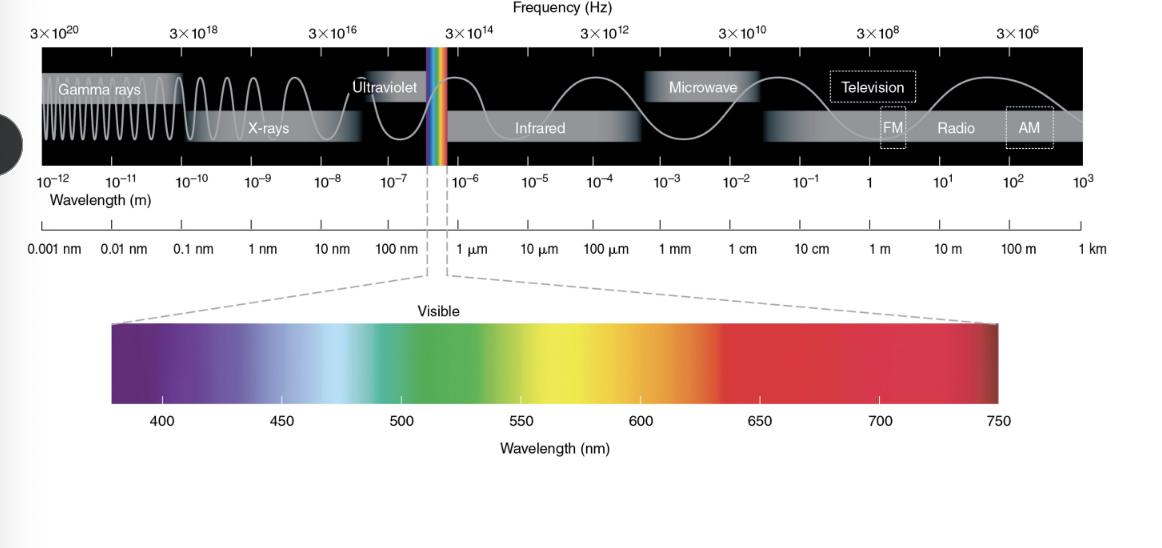
Which one has the highest frequnecy, which one has the lowest?
Highest: Gamma rays
Lowest: Radio waves
Longer wavelengths causes what to the frequency?
smaller frequency
E ∝ F (frequency)
HIGHER FREQUENCY = HIGHER ENERGY
one of the ways light acts as a particle
Everything in the Universe has what 2 things?
A wave and particle nature
The Inverse-Square Law
If we have a source of light giving light in every direction, then the amount of light that goes through a sphere per second HAS TO BE THE SAME no matter the size
the amount of light per sq meter determines how much bright light we see
EX: a street light is brighter if it’s closer
Intensity of light ∝ energy output per time / distance²
more distance = less intensity
closer distance = more intensity
INTENSITY DROPS FASTER THAN DISTANCE DOES.
Surface area of a sphere
4nr²
Thermal Radiation
ALL objects in the universe emit radiation (light)
Hotter outside: the particles in the air are moving faster and have more energy
The Kelvin temperature scale
0k means theres no random (thermal) motion
ABSOLUTE Zero
Ideal thermal emitter (BLACKBODY RADIATION
has to be TOTALLY OPAQUE (can’t see through it)
Absorbs all light hitting it determined ONLY by temperature
EX: the sun
Shorter wavelengths have more intensity
none of us are observing every wavelength of light or we would be black
peak wavelength
the wavelength where the intensity of light is the highest
so, where the curve is the highest
Wien’s law
Tells us that if an object is HOTTER, the peak wavelength will be SHORTER
λ peak (peak wavelength) ∝ 1/T
T is temperature in K
When T is bigger, wavelength is smaller
What color are hot objects that PEAK at SHORT wavelengths
blue
What color are cold objects that PEAK at Long wavelengths
Red
Stefan’s law
Adding up all the energy at every possible wavelength to get the total energy is PROPORTIONAL to the fourth power of temperature
So, intensity ∝ T^4 , if t is measured in k