Blood and Tissue Platyhelminthes
 Call Kai
 Learn
 Practice Test
 Spaced Repetition
 Match
 Flashcards
 Knowt Play
1/30

There's no tags or description
Looks like no tags are added yet.
31 Terms
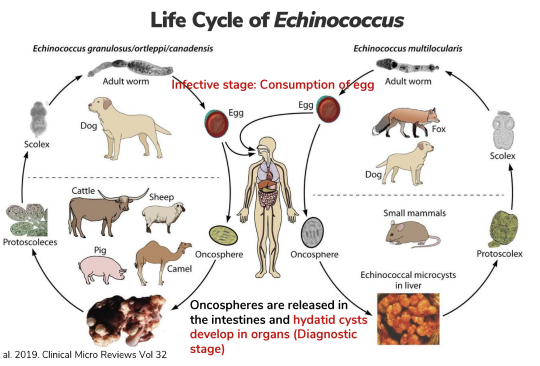
Echinococcus spp. - Epidemiology
parasite: cestode
worldwide distribution
animal reservoirs: carnivores
humans are accidental intermediate hosts
Life Cycle of Echinococcus
infective stage: consumption of egg
onocospheres are released in the intestines and hydatid cysts develop in organs (diagnostic stage)
Echinococcus spp. - Clinical Syndromes
latency can be up to 15 years (asymptomatic)
Cystic echinococcus (E. granulosus)
hydatid cysts (slow-growing, tumor-like lesion) form predominately in the liver (70%) and lungs (20%); cysts rupture can cause anaphylactic reactions, even death
Alveolar echinococcus (E. multilocularis)
lesions form predominately in the liver; can cause liver failure and death
Echinococcus spp. - Diagnosis
imagining techniques and ultrasound
antibody detection
molecular analysis
Echinococcus spp. Treatment and Prevention
albendazole only (small cysts) or albendazole and surgical resection of the cyst (larger cysts)
for alveolar (lung) lesions, surgery and albendazole for at least 2 years (recurrence is possible)
PAIR (percutaneous aspiration, injection of chemicals and reaspiration)
education and handwashing
Clonorchis sinensis - Epidemiology
parasite: liver trematode
distribution: mostly confined to Asia (85% China)
infecting an estimated 30 million people
human and animal reservoirs: dogs and cats are most common
Life Cycle of Clonorchis
infection occurs through ingestion of undercooked, salted, pickled, or smoked freshwater fish (second intermediate host) encysted with metacercariae (infective stage)
metacercariae excyst in duodenum and ascend to the bilary tract
develop into adults that release eggs in the stool (diagnostic stage)
eggs in the environment get ingested by snail (first intermediate host)
cercariae are released from the snail, invade the fish and encyst

Infective Stage of Clonorchis
freshwater fish encysted with metacercariae
Diagnostic Stage of Clonorchis
eggs
Intermediate hosts of Clonorchis
snail - first intermediate host
freshwater fish - second intermediate host
Clonorchis sinensis - Clinical Syndrome
normally asymptomatic in light infections
chronic infections have severe morbidity
abdominal pain with nausea and diarrhea due to the blockage of the biliary ducts
bile duct cancer
Clonorchis sinesis - Diagnosis
recovery of eggs from the stool or from duodenal aspirates
detection of parasite by imagining/ultrasound
Clonorchis sinensis - Treatment and Prevention
praziquantel/albendazole
do not eat raw or undercooked freshwater fish
freeze fish at -20 C or below for at least 7 days
Paragonimus - Epidemiology
parasite: lung trematode
distribution: most common in Far east Asia; also, in parts of Africa, North and South America
approx. 3 mil individuals infected (~1% of the Indochinese immigrants to the US are infected)
human and animal reservoirs: variety of shore-feeding animals (pigs, wild boar)
Life Cycle of Paragonimus
infection occurs through ingestion of undercooked, pickled, or salted crab/crayfish (second intermediate host) encysted with metacercariae (infective stage)
metacercariae excyst in duodenum, pentrate the intestinal wall into the peritoneal cavity, then through the abdominal wall and diaphragm into the lungs
develop into adults which release eggs in the sputum or are swallowed and passed in the stool (diagnostic stage)
eggs in the environment release miracida which invade the snail (first intermediate host)
cercariae are released from the snail and invade the crab where they encyst

Infective stage of Paragonimus
crab/crayfish encysted with metacercariae
Diagnostic stage of Paragonimus
eggs released in sputum or are swallowed and passed in the stool
Intermediate hosts of Paragonimus
snail - first
crab/crayfish - second
Paragonimus - Clinical Syndromes
first three weeks after ingestion (during migration): diarrhea, abdominal pain, cough, and fever
pulmonary form: often has no or mild symptoms
chronic cough and difficulty breathing
coughing fits with blood-tinged sputum (if large numbers); the sputum may be brown because of the Paragonimus eggs being coughed up
extrapulmonary form: affects the liver, spleen, abdomen, skin and brain
Paragonimus - Diagnosis
examination of sputum or stool for eggs
antibody detection for extrapulmonary cases
Paragonimus - Treatment and Prevention
praziquantel
education and proper sanitation
properly cook crabs/crayfish
Schistosomes
parasite: blood trematode
schistosomiasis is a major parasitic infection of tropical areas (~240 million infections worldwide)
trematode with both male and female adult worms (not hermaphroditic)
major pathogens: Schistosoma mansoni, Schistosoma japonicum, Shistosoma haematobium
collective cause schistosomiasis (bilarziasis or snail fever)
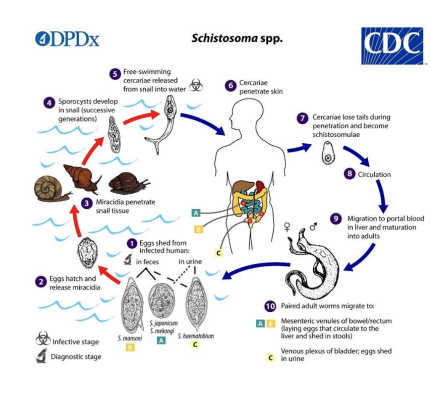
Life Cycle of Schistosoma
infection occurs through penetration of the cercariae into the skin (infective stage)
cercariae become schistosomulae that will migrate via venous circulation to the lungs, to the heart, and develop in the liver
upon maturation adults migrate to the mesenteric venules of the bowel/rectum (or veins that drain the bladder) where they lay eggs
eggs are passed in the stool or urine (species specific) (diagnostic stage)
eggs in the environment release miracida which invade the snail (intermediate host)
cercariae are released from the snail into the water
Infective Stage of Schistosoma
cercariae into the skin
Diagnostic stage of Schistosoma
eggs passed in the stool or urine
Intermediate host of Schistosoma
snail
Schistosoma mansoni
Epidemiology:
Distribution: Africa, South America, Caribbean
Humans and animal reservoirs
Clinical syndromes:
rash at penetration site followed by fever, chills, cough and muscle aches
chronic infection - hepatosplenomegaly
Diagnosis:
microscopic analysis of the stool for eggs
antibody detection
Schistosoma japonicum
Epidemiology:
Distribution: Far East Asia (China, Japan, Phiilippines)
mostly animal reservoirs
Clinical syndromes:
rash at penetration site followed by fever, chills, cough and muscle aches
chronic infection - hepatosplenomegaly
Diagnosis:
microscopic analysis of the stool for eggs
antibody detection
Schistosoma haematobium
Epidemiology:
Distribution: Africa, Middle East
human and animal reservoirs
Clinical syndromes:
rash at penetration site followed by fever, chills, cough and muscle aches
hematuria (blood in urine) and bladder cancer
Diagnosis:
Microscopic analysis of the urine for eggs
antibody detection
Swimmer’s Itch
nonhuman schistosomes have cercariae that penetrate human skin, producing severe dermatitis (cercarial dermatitis)
within mins to days, tingling, burining or ithcing of the skin
dead-end human host
natural hosts: birds and other shore-feeding animals from freshwater lakes throughout the world
Schistosome - Treatment and Prevention
praziquantel
corticosteriod cream or antihistamines for swimmer’s itch
Education and sanitation
avoid swimming in contaminated waters
reduce snail burden, if possible