11 - Bioenegetics Part 2 and ETC and OP Part 1
 Call Kai
 Learn
Learn Practice Test
 Spaced Repetition
 Match
Match Flashcards
 Knowt Play
1/22

There's no tags or description
Looks like no tags are added yet.
Name | Mastery | Learn | Test | Matching | Spaced | Call with Kai | Chat |
|---|
No analytics yet
Send a link to your students to track their progress
23 Terms
hydrolytic; phosphate
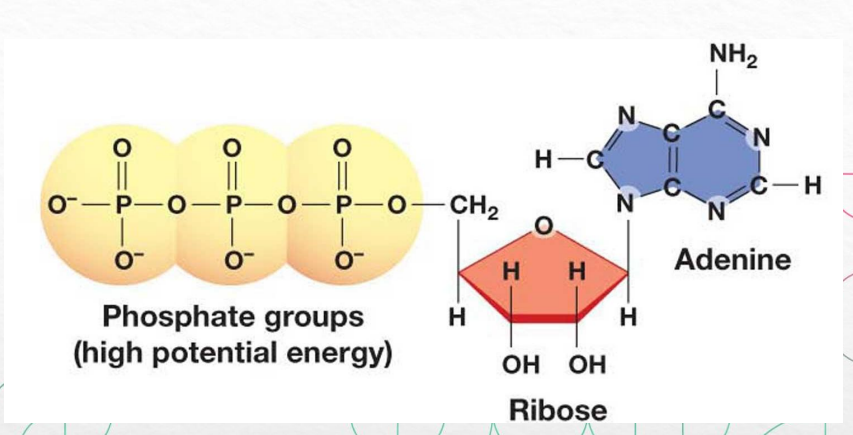

ADENOSINE TRIPHOSPHATE (ATP)
regarded as the energy currency of the cell
powers most cellular work. How?
__________ cleavage of the high energy ___________ bonds is coupled with an energy-requiring (non-spontaneous) reaction
negative (−); spontaneous

COUPLING OF REACTIONS
biochemical reactions that are thermodynamically unfavorable are coupled with those that are favorable
the aim of coupling is to attain a __________ (_) ΔG°’ thereby rendering the overall reaction ________________
an important thermodynamic fact:
the overall ΔG°’ for a chemically coupled series of reactions is equal to the sum of the ΔG°’ of the individual steps
AUTOTROPHIC
photophosphorylation
HETEROTROPHIC
substrate-level
oxidative


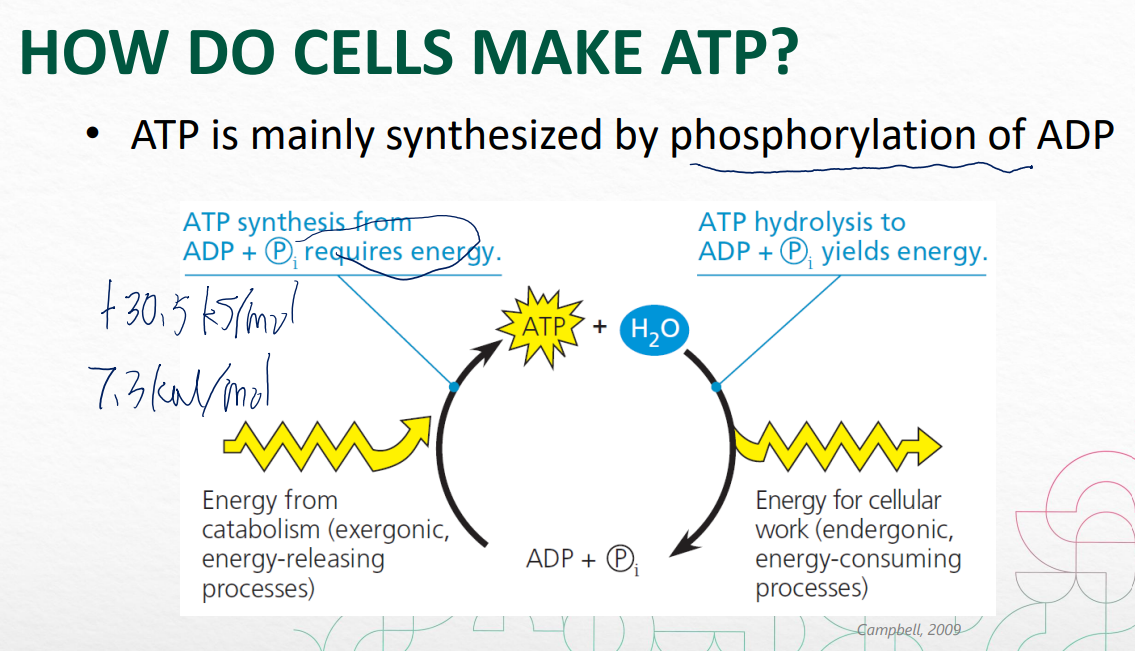
HOW DO CELLS MAKE ATP?
____________ METABOLISM
photosynthesis through ___________________
____________ METABOLISM
cellular respiration (aerobic and anaerobic)
____________ phosphorylation
_________ phosphorylation


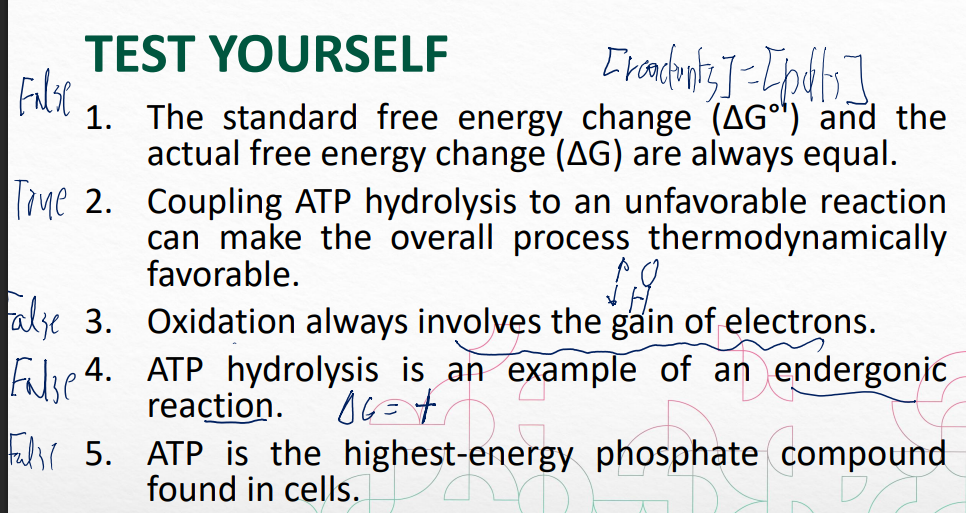
TEST YOURSELF
1. The standard free energy change (ΔG°') and the actual free energy change (ΔG) are always equal.
2. Coupling ATP hydrolysis to an unfavorable reaction can make the overall process thermodynamically favorable.
3. Oxidation always involves the gain of electrons.
4. ATP hydrolysis is an example of an endergonic reaction.
5. ATP is the highest-energy phosphate compound found in cells.
CELLULAR RESPIRATION

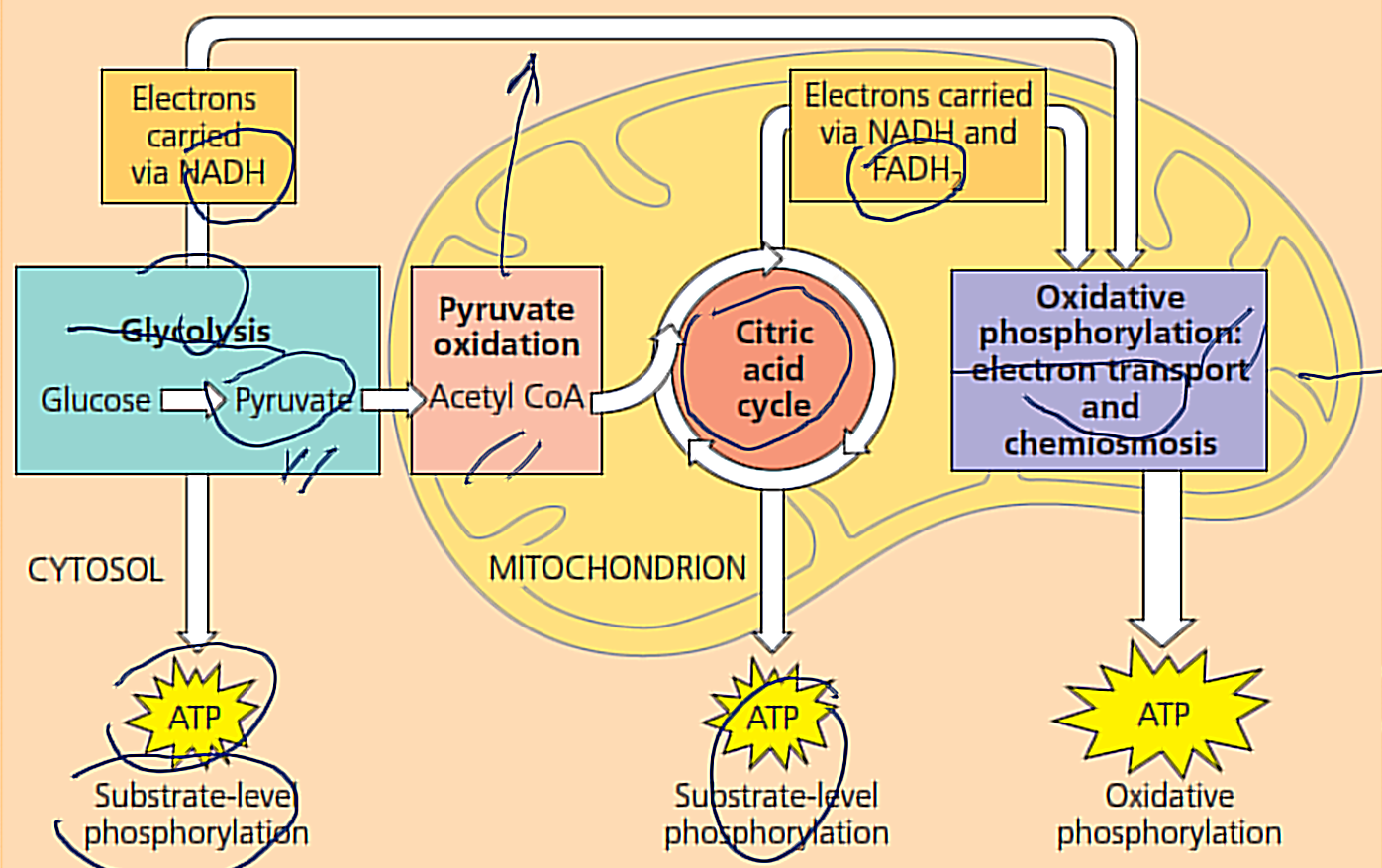

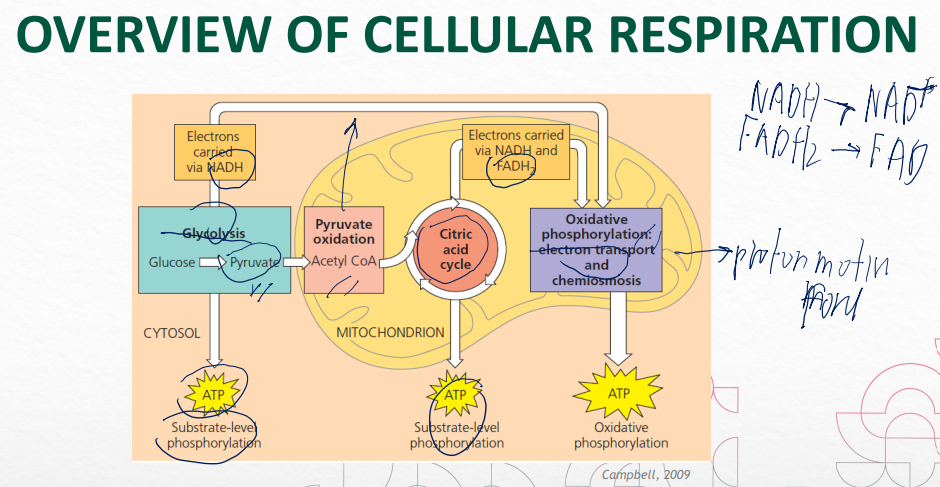
digestion
acetyl CoA
glycolysis; fatty acid oxidation
acetyle CoA
Krebs cycle; electron transport chain
STAGES OF CELLULAR RESPIRATION
_________ of food polymers
production of ______________
___________ and/or _____________
oxidation of ___________ to CO2 and H2O
____________ and ___________________

4 PATHWAYS OF RESPIRATION
GLYCOLYSIS
__________ → __________ + __________ + __________
__________ → __________
KREBS CYCLE
__________ → __________ + __________ + __________ + __________

4 PATHWAYS OF RESPIRATION
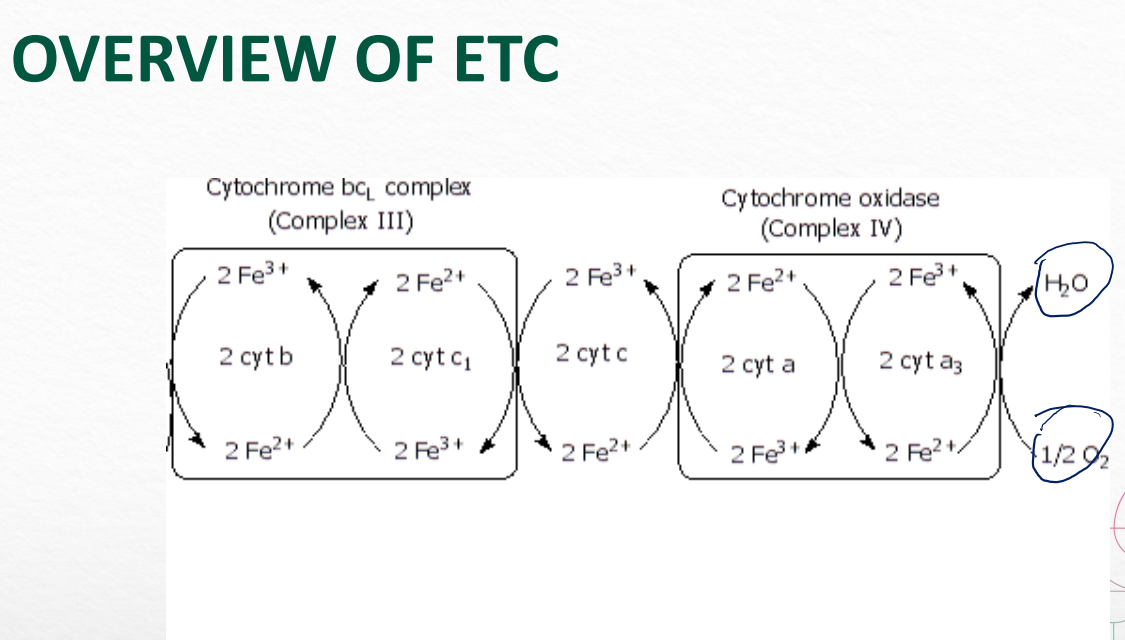
ELECTRON TRANSPORT CHAIN
passage of electrons from __________ and __________ to O2, H2O and __________
ATP SYNTHESIS
involves the enzyme __________ that synthesizes ATP
ELECTRON TRANSPORT CHAIN


a series of reaction wherein electrons and H+ from NADH and FADH2 are passed to intermediate carriers before being accepted ultimately by O2 to produce H2O
downhill

lowest; highest
ELECTRON TRANSPORT CHAIN
electrons flow “_________” creating energy (as ATP) from NADH and FADH2
_________ standard reduction potential to __________ standard reduction potential

PROTEIN COMPLEXES
NADH dehydrogenase
succinate CoQ oxidoreductase
bc1 complex
c oxidase

_________________ IN ETC
intermediate electron carriers embedded in the inner mitochondrial membrane
Complex I - ______________________
Complex II - _________________________
Complex III - cytochrome __________________
Complex IV - cytochrome ______________


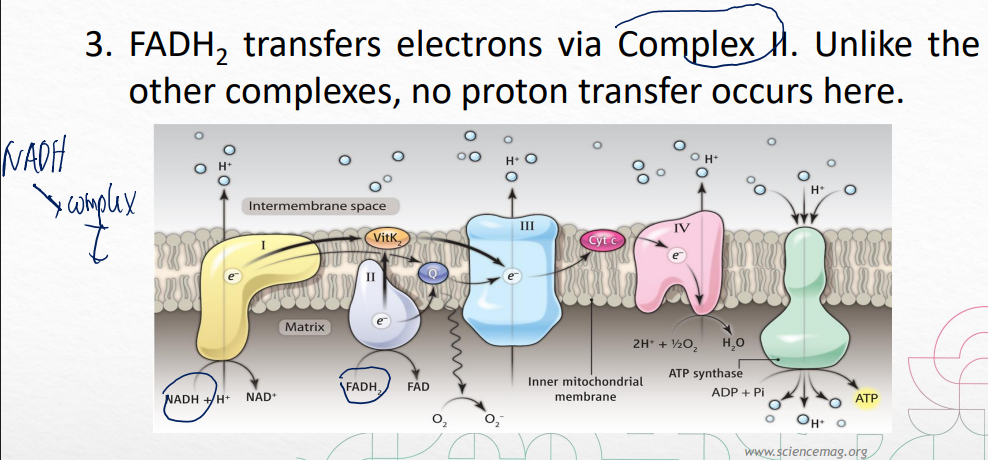


electron flow through complexes ___, ___ and ___ results to transfer of protons (H+) from the ___________ to the ___________ space.
_________ transfers electrons via Complex ___. Unlike the other complexes, no proton transfer occurs here.
Higher [H+] concentration in the intermembrane space generates the ___________________ (pH gradient + membrane potential).
___________ are ultimately accepted by O2 in Complex IV to generate H2O.


How many protons pumped during NADH oxidation and FADH2 oxidation, respectively?

________________________
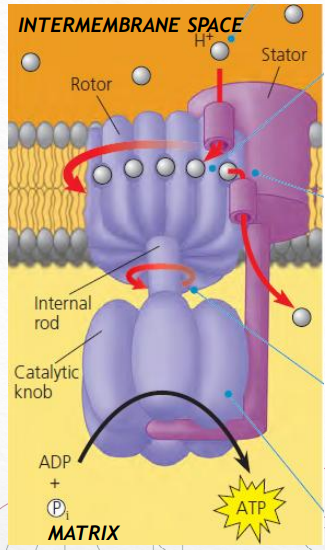
an enzyme complex containing the catalytic site for the synthesis of ATP
subunits:
Fo – ___________________ unit
F1 – where ____________ occurs

ATP SYNTHASE COMPLEX
reaction involved:
___ + ___ + ___ ⇌ ___ + ___
(ΔG°’ = +30.5 kJ/mol)
CHEMIOSMOTIC HYPOTHESIS

_________________________________
proposed by Peter Mitchell in 1961
electron transport and ATP synthesis are coupled by a proton gradient (pH gradient and membrane potential) across the inner mitochondrial membrane.
CHEMIOSMOTIC HYPOTHESIS
_______________________________
upon creation of a proton gradient, protons flow back to the matrix to equalize charge distribution and by doing so, drives synthesis of ATP by ATP synthase complex. How?
proton; shape; ATP synthase
ADP; Pi
proton-motive
ATP FORMATION
________ flow effects a change in the ________ of the ___________
change in shape enables binding of ___ and ___ to form ATP.
“_____________ force”
4
2
III and IV
ATP YIELD FROM OP
number of protons pumped per complex:
Complex I and III= _ protons each
Complex IV = _ protons
upon oxidation of NADH, 10 protons are pumped
for the oxidation of FADH2 , only 6 protons are pumped
FADH2 enters Complex II which does not pump protons. Thus, electrons from FADH2 pass through Complex ___ and ___ only.
4
10/4 = 2.5
6/4 = 1.5
ATP YIELD FROM OP
If _ protons are needed to synthesize one mole of ATP
For each NADH:
___________ ATPs are produced
For each FADH2 :
___________ ATPs are produced