Ecology: Chapter 8
 Call Kai
 Learn
 Practice Test
 Spaced Repetition
 Match
 Flashcards
 Knowt Play
1/59

There's no tags or description
Looks like no tags are added yet.
Name | Mastery | Learn | Test | Matching | Spaced | Call with Kai | Chat |
|---|
No analytics yet
Send a link to your students to track their progress
60 Terms
weather
variation in temperature, precipitation, and other factors over a period of hours to days
climate
the typical atmospheric conditions that occur throughout the year, average over many years
Greenhouse effect
the process of when solar radiation strikes the earth converting to infrared radiation and being re-emitted by atmospheric gases
what fraction of solar radiation is absorbed by earth and clouds, causing the warming of earth?
2/3
what are greenhouse gases?
gases that comprise of small fraction of the atmosphere, such as H2O, CO2, N2O, CH4, and ozone, that absorb and remit infrared radiation
Describe the 5 step process of the green house effect
1) 1/3 of incoming solar radiation is reflected back into space by the atmosphere
2) the remaining solar radiation fully penetrates, getting absorbed by clouds and earths surface
3) the earth gets warmer and emits heat in the form of infrared radiation
4) much of the infrared radiation emitted by earth is absorbed by greenhouse gases which heat up
5) these heated up greenhouse gases reradiate heat and while some go out into space, most stay in earth
How would the mean temperature of the earth look without greenhouse gases?
temperature would drastically decrease from 57.2 F to 0 F
How has the concentration in the earths atmosphere increased overtime?
fossil fuels and deforestation
what has increased CH4 and N2O in the atmopshere?
agriculture, landfills, and fossil fuels
how does the angle of the sun cause the unequal heating of the earth?
the distance traveled through the atmosphere is shorter at the equator than at the poles due to the spherical shape so less solar energy is removed by atmosphere and more strikes the ground
what angle does the sunlight strike the equator and how does that effect its spread?
perpendicular angle that delivers more direct and intense sunlight
what angle does the sunlight strike the poles and how does that effect its spread?
oblique angle that spreads radiation over a larger surface
albedo
the fraction of solar energy reflected by the surface
where is albedo low?
in dense forests, such as rainforests, with increased temp
where is albedo high?
at poles where the snow and ice contribute to lower temps
equinox
dircet moment when teh sun is over the equator
in regards to seasonal heating, during the months of march and September equinox where is the sun and how does it effect the temperature?
it is directly over the equator leading to hottest temps at places in the equator and mild temps in north and south
solstice
most extreme tilt of the earth toward or away from the sun
in regards to seasonal heating, during the month of June solstice where is the sun and how does it effect the temperature?
the northern hemisphere experiences warmest temperatures and the southern hemisphere experiences coldest temperatures
in regards to seasonal heating, during the month of december solstice where is the sun and how does it effect the temperature?
the northern hemisphere experiences coldest temperatures and the southern hemisphere experiences warmest temperatures
what does the unequal heating of earth drive?
air currents and global patterns of precipitation
what are 4 physical properties of the atmosphere in regards to air?
1) warm air is more buoyant than cold air
2) warm air can hold more water than cold air
3) air expansion causes atmosphere to cool
4) rotation of the earths surfaces deflects the movement of air masses
why is warm air more buoyant?
its less dense and thus rises
adiabatic cooling
the decline in air temp resulting from reduced pressure as air rises higher in the atmosphere and expands
*remember pressure decreases the higher you get and increases the lower you get
adiabatic heating
the increase in air temp from increased pressure as it sinks towards the ground and contracts
what concept is the reason why warm air can hold more water than cold air?
saturation point
saturation point
maximum amount of water vapor that air can hold at a given temperature
what happens if vapor exceeds the saturation point?
water condenses to liquid or ice and produces clouds and precipitation
Example: If cooled air is warmed from 10 C to 30 C, what will occur?
since the airs capacity to hold water increases as its warmed it now holds much less water than its actually capable of holding, this leads to enviornment becoming dry
how does air expansion cause cooling?
it uses up its own energy to spread out causing the temperature to drop
Hadley cells
2 circulation cells of air between the equator and 3o degrees N and 30 degrees S latitudes

Intertropical convergence zone (ITCZ)
the area where the 2 hadley cells converge and cause large amounts of precipitation

how is the ITCZ created?
by adiabtic cooling where hot air at teh equator rises, expands, cools down and dumps massive amounts of rain
*remeber as it moves up teh capacity to hold water decreases so when it surpasses its saturation point it rains
in equitorial regions what does the ITCZ do?
passes directly over the equator twice a year, once moving north in june and once moving south in december so it has two distinct rainy seasons in teh spring and fall
in northern subtropical regions what does the ITCZ do?
it only reaches its farthest northern point once a year during north’s summer so they get one rainy season in the summer months of june to august
in southern subtropical regions what does the ITCZ do?
reaches its farthest southern point during the south’s summer so they have one single rainy season in their summer from december to febuary
polar cells
atmospheric convection currents at the poles that has cold dense air that descends then flows away to warm and rise

ferrel cell
weak and driven by currents in the hadley and polar cells not by changes in air density

whats the rleationship between ferrel and hadley cells?
hadley cells go toward the equator while ferrel cells move away from the equator
coriolis effect
deflection of an objects path due to the rotation of earth

how does the coriolis effect act in the northern hemisphere?
it has a clockwise deflection of wind current

how does the coriolis effect act in the southern hemisphere?
counter-clockwise deflection of wind current

what winds move within the northern hadley cell and is deflected so that it moves from the northeast to the southwest
northeast trade winds

what winds within the southern hadley cell and is deflected so that it moves from the southeast to the northwest?
southeast trade winds

what winds in the mid latitude move from west to east
westerlies

what do ocean currents doo in regard to earth’s heat?
distribute unequal heating of earths water
what do ocean currents do in the west side of ocean basin?
warm water from the equator gets pushed up along the west side of the ocean creating warmer climates

what do ocean currents do in the east water basin?
cold water from the poles drops down along the east side of the ocean creating cooler enviornments

what factors contribute to ocean currents?
unequal heating, coriolis effect, wind direction, and salinity
whats the predominant factor of ocean currents?
wind
gyres
large scale water cicrculation in the ocean
which direction do gyres go in the north vs the south?
in the north clockwise and in the south counterclockwise

upwelling
an upward movement of ocean water where as water moves away cold water from ocean depths is drawn upward
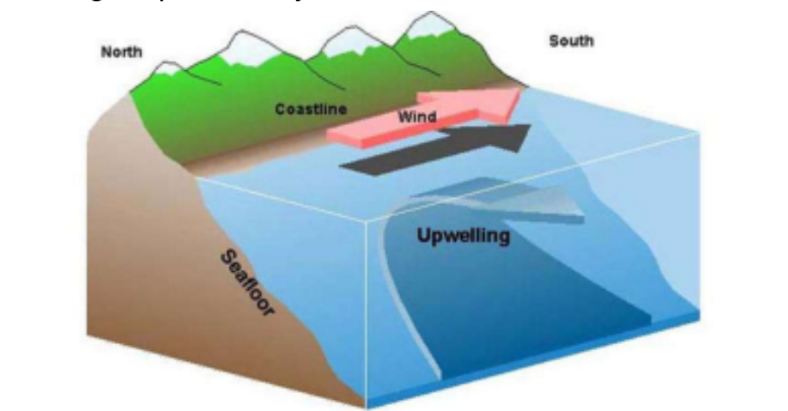
where does upwelling occur?
along continents where surface currents move away from coastline
what does upwelling do for biological activity?
since deep ocean water is close to bottom sediments, its high in nutrients so when it upwells it creates areas with high biological productivity and fish biomass
what temperature is the water on the east coasts of the continents and why?
warm because tropical water circulates up along the western reaches of the ocean basin
what temperature is the water on the west coast of continents and why?
cold because polar water is forced down toward the equator and upwelling pulls up deep, freezing water
what does the upwelling on the west coast do to the climate on nearby land?
make it dry

thinking about water coverage why does the southern hemisphere experience more precipitation?
water covers 81% of the southern hemisphere vs. 61% of the northern hemisphere

rain shadow
region with dry conditions found on the leeward side of the mountain range as a result of humid winds from the ocean causing precipitation on the windward side