Q6 Implant Midterm - Concepts
 Call Kai
 Learn
 Practice Test
 Spaced Repetition
 Match
 Flashcards
 Knowt Play
1/171

There's no tags or description
Looks like no tags are added yet.
172 Terms
What is osseointegration?
Direct structural and functional connection between living bone and the surface of a load bearing implant
Who pioneered osseointegration?
Per-Ingvar Branemark
In what year did Branemark place implants in the first human dental implant patient?
1965
Who was the 1st human dental implant patient?
Gosta Larsson
How does the connective tissue attachment differ between a tooth and an implant?
Tooth: Sharpey's fibers insert into cementum
Implant: no cementum or fiber insertion.
What type of epithelial attachment forms around implants?
Hemidesmosomes
What is the first step in peri implant bone healing?
Blood clot formation
What follows clot formation during peri implant healing?
Platelet activation, growth factor release, fibrin formation, osteogenic cell migration

What are the characteristics of woven bone?
Highly cellular, low mineral content, randomly oriented

When does woven bone reach the implant surface?
after 6 weeks
What are the characteristics of lamellar bone?
Highly organized and densely mineralized
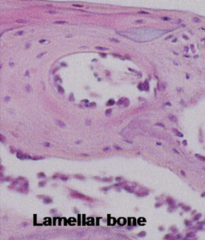
When does lamellar bone form?
18 weeks
What is the delayed loading interval for the mandible vs maxilla?
Mandible: 3 months
Maxilla: 6 months
What are the 2 domains in implant treatment planning?
Patient mediated factors and local factors
What are the 3 categories of local factors?
Field, foundation, and facial/dental esthetics
What does the ITI SAC stand for?
Straightforward, Advanced, Complex
What is the 'law of 7' for a standard 4mm implant?
7 mm interocclusal, 7 mm mesiodistal, and 7 mm buccolingual space

How is the 7mm mesiodistal space for a 4mm implant calculated?
1.5 mm tooth clearance + 4 mm implant + 1.5 mm tooth clearance

How is the 7mm buccolingual space for a 4mm implant calculated?
1.5 mm facial bone + 4 mm implant + 1.5 mm lingual bone
What contributes to the 7mm minimum interocclusal space?
5 mm abutment height + 2 mm zirconia thickness

Which soft tissue phenotype has a higher risk of recession?
Thin phenotype

How much more recession is associated with thin vs thick phenotype?
3x more recession
T/F: Implant treatment planning should begin with the final prosthetic goal.
True
What is the Osstell stability value for higher stability?
ISQ > 70
Green zone, high stability
What is the Osstell stability value for high-risk healing zone?
ISQ < 60
Red zone, low stability
Which ASA classes are considered for elective implant treatment?
ASA I-III, with individualized assessment
What defines ASA I?
Healthy patient
What defines ASA II?
Mild systemic disease
What defines ASA III?
Severe systemic disease that is not incapacitating
What defines ASA IV?
Incapacitating systemic disease, elective implant treatment generally avoided
What are 3 temporary contraindications to implants?
Incomplete growth, pregnancy, acute infection
What is the HbA1c cutoff for uncontrolled diabetes? *Dr. Wakeel
Greater than 7.5%
How does chronic hyperglycemia impair implant healing?
Reduces osteoblast activity and collagen formation, alters bone remodeling
What modifications are recommended for controlled diabetics undergoing implants?
Longer healing, prophylactic antibiotics, 0.12% chlorhexidine, larger implants where bone permits
Which antiresorptive route has the higher jaw osteonecrosis risk?
Intravenous bisphosphonates
BRONJ:
Bisphosphonate related osteonecrosis of the jaw
What is the duration of exposed jaw bone for BRONJ diagnosis?
at least 8 weeks
T/F: A CTX value or a bisphosphonate drug holiday reliably predicts or prevents osteonecrosis.
False
Name 3 relative implant risk factors:
Smoking, history of periodontitis, bruxism
What are smoking related implant failure rates?
6.35% in smokers vs 3.18% in nonsmokers
What smoking cessation interval is recommended for implant surgery?
4 weeks before + 8 weeks after surgery
How does previous periodontitis affect future implants?
Increases risk of peri implant disease, it requires strict maintenance
What is the approx peri-implant disease risk increase with a history of chronic periodontitis?
25x
What precautions are recommended for bruxism/parafunction?
Consider more/wider implants, avoid cantilevers, limit lateral contacts, use a night guard
T/F: A history of systemic corticosteroid use is always an absolute contraindication to implants.
False
What is the best way to approach immunocompromised implant candidates?
Assess disease control and medications, coordinate with the physician
Which patient expectations can contraindicate elective implant treatment?
Unrealistic expectations or inability to comply with treatment
What is the different between absolute and relative implant contraindications?
Absolute: generally precludes or defers treatment
Relative: needs risk modification and individualized assessment
What is the implant consultation code for a partially edentulous patient at UOP?
D0160I
What 2 planning records must be completed before an implant consult?
ODTP and occlusal assessment form
Where is the partially edentulous implant consultation booked?
Oral Surgery, chair 3D15
What casts do you bring to implant consultation?
Mounted study casts with wax-up and mounted casts showing the edentulous site
What imaging should be brought to an implant consultation?
Current Panorex, site periapicals, and CBCT
How recent should the pano be if there are no changes?
Within 1 year
How recent should a PA be for a single missing tooth?
within 1 month
What additional design is needed for an anterior implant consult?
Smile design
What must informed consent discuss before implant CBCT/treatment?
Alternatives (including no treatment)
What must be reviewed before ordering an implant CBCT?
Informed consent, finances, systemic history, 2D radiographs, mounted casts
What are the treatment options for a single missing tooth?
No treatment, removable prosthesis, tooth-supported fixed prosthesis, implant crown
What are the steps in the partially edentulous single-scan protocol?
Duplicate wax-up
Fabricate vacuum template
Fill with composite
CBCT with template
TRIOS scan
Plan guide
Obtain surgeon approval
What vacuum-forming sheet thickness is used for the radiographic template?
0.02 inch
What fills the single-scan radiographic template?
Flowable or packable composite
What is the code for a partially edentulous implant-planning CBCT?
D0367
What is the code for the printed surgical guide?
D6190
Which software is used to design the surgical guide at UOP?
Implant Studio
Who must approve the digital implant plan before guide printing?
the implant surgeon
When is bone grafting added to the treatment plan?
After reviewing the 3D scan and identifying a need for augmentation
What must be complete before implant surgery can be scheduled?
Treatment plan, relevant consents, financial approval, implant presentation
T/F: Implant surgery can be scheduled before the implant presentation.
False
What are the 3 digital file types used in implant planning?
DICOM, STL, JPEG
What is the DICOM for implant planning?
CBCT 3D bone/anatomic imaging
What does STL represent in implant planning?
Surface geometry of teeth and soft tissues from an optical scan
What does is the JPEG files for in implant planning?
Facial and intraoral photographs for esthetic evaluation
Voxel:
3D pixel in a CBCT dataset
How is a CBCT volume acquired?
Cone-shaped X-ray beam rotates and reconstructs a 3D dataset
How does medical CT differ from CBCT?
Medical CT uses a fan beam/multiple slices
CBCT uses a cone beam/one rotation.
What plane separates superior from inferior?
Axial

What plane separates anterior from posterior?
Coronal

What plane separates left from right?
Sagittal

What do PA xrays assess at a single implant site?
Mesiodistal space, interradicular distance, adjacent bone levels and root angulation
What anatomy do you have to trace on a panoramic implant workup?
Sinus/nasal floor, inferior alveolar canal, mental foramen/anterior loop, crestal bone

What anatomy must be checked in the posterior mandible on CBCT?
Inferior alveolar canal, mental foramen/anterior loop, lingual concavity

What imaging is needed to assess buccolingual bone width?
the cross sections of CBCT
T/F: A periapical radiograph reliably reveals buccolingual root position within the bone.
False
What are the two passes of systematic CBCT interpretation?
1) Diagnosis of anatomy/pathology
2) Implant dimensions and trajectory planning
What is the radiographic trough?
Arch curve traced on the axial view to generate panoramic and cross-sectional reconstructions
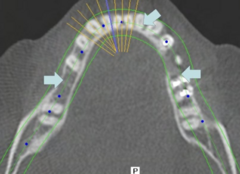
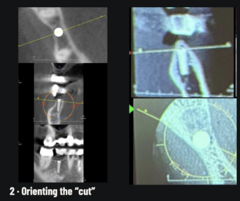
How should CBCT cross-sections be oriented to the ridge?
perpendicular to the ridge
What is a beam-hardening artifact?
Dark streaks or bands near dense objects such as metal

What is a cupping artifact?
Shadow where photons were blocked, distortion by metallic objects
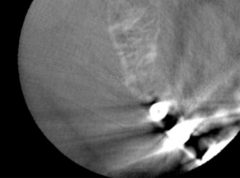
What causes a motion artifact in CBCT?
Patient movement causing blurred or doubled edges

What is the ALARA principle for CBCT?
Keep radiation as low as reasonably achievable, justify each scan and limit FOV
Which CBCT variable can be restricted to lower dose?
Field of view (FOV)
What should the planned implant axis pass through in posterior teeth?
Central fossa

What should the planned implant axis pass through in anterior teeth?
Cingulum

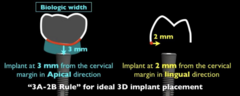
3A-2B rule:
Platform 3 mm apical to future cervical margin and 2 mm lingual to planned buccal contour
What two datasets are aligned in Implant Studio?
CBCT DICOM + optical-scan STL
Which planning method has the best accuracy?
Fully guided surgery
What support improves surgical guide accuracy?
Posterior tooth support
What are reasons a surgical guide might fail?
Limited mouth opening, bad scan, bad print, or guide fracture
What is the backup if a surgical guide cannot be used?
Freehand placement with independent anatomic assessment