EMAE260 Final Exam CWRU
0.0(0)
Studied by 3 people Call Kai
 Learn
 Practice Test
 Spaced Repetition
 Match
 Flashcards
 Knowt Play
Card Sorting
1/132

Earn XP
133 Terms
1
New cards
Embodiment Design: Three Basic Rules
Clarity, Simplicity, Safety
2
New cards
Embodiment Design: Product Drawings
Sketches, Detail Drawings, Assembly Drawings, Graphical Models produced in CAD systems
3
New cards
Embodiment Design: CAD v. Sketching-- when to use each?
Use sketching when wanting to develop a high number of ideas. Use CAD when we have details and components and assemblies planned out ahead of time.
4
New cards
Embodiment Design: BOM and what they include
- an index to the product
- the item number or letter
- the part number
- the quantity needed in the assembly
- name or description of the component
- material from which the component is made
-source of the component (purchased?)
- the item number or letter
- the part number
- the quantity needed in the assembly
- name or description of the component
- material from which the component is made
-source of the component (purchased?)
5
New cards
Embodiment Design: Difference between mockup, model, and prototype
mockup: to scale from plastics, wood, cardboard to give the designer a feel for their design
-least expensive technique, easy to produce, used as a tool in selling the idea to clients or management
model: the physical behavior of the real system
-proof of product prototype
prototype: most expensive technique that produces the most amount of useful info
-a constructed, full-scale working physical system
6
New cards
Embodiment Design: Design for X (NOT DONE --- GO BACK AND ADD SPECIFICIS?)
Design for manufacture (DFM): establishing the shape of components to allow for efficient, high-quality manufacture
Design for assembly (DFA): the best practice used to measure the ease with which a product can be assembled in terms of efficiency
Design for the environment (DFE): environmentally conscious design
Design for assembly (DFA): the best practice used to measure the ease with which a product can be assembled in terms of efficiency
Design for the environment (DFE): environmentally conscious design
7
New cards
Detail Design: what is and what happens during this phase?
happens:
-make/buy decision
-complete the selection and sizing of components
-complete engineering drawings
-complete the bill of materials
-revise the product design specifications
-complete verification prototype testing
-final cost estimate
-prepare design project report
-final design review
-release design to manufacturing
8
New cards
Detail Design: Product Development Team
Engineering Design
Industrial Engineering
Manufacturing Engineering
Purchasing
Production
Sales and Marketing
Industrial Design
Industrial Engineering
Manufacturing Engineering
Purchasing
Production
Sales and Marketing
Industrial Design
9
New cards
Design Engineering Responsibilities
-detail design performance analyses
-preproduction prototype performance tests
-manufacturing process specifications
-owner manuals
-layout drawings
-detail drawings
-assembly drawings
-bills of materials
-engineering change notices
-patents, trademarks, copyrights
-preproduction prototype performance tests
-manufacturing process specifications
-owner manuals
-layout drawings
-detail drawings
-assembly drawings
-bills of materials
-engineering change notices
-patents, trademarks, copyrights
10
New cards
Industrial Design Responsibilities
-product trim details
-finish details
-ergonomic refinements
-product packaging
-finish details
-ergonomic refinements
-product packaging
11
New cards
Sales and Marketing Responsibilities
-product warranty
-shipping
-warehousing
-advertising campaign
-product literature
-owner's manual
-product launch
-shipping
-warehousing
-advertising campaign
-product literature
-owner's manual
-product launch
12
New cards
Industrial Engineering Responsibilities
-materials and product flow
-facility layout/remodeling
-material handling equipment
-inventory warehousing
-assembly planning (machines and workers)
-facility layout/remodeling
-material handling equipment
-inventory warehousing
-assembly planning (machines and workers)
13
New cards
Manufacturing Engineering Responsibilities
-Fixture design/fabrication
-tool design/fabrication
-process equipment refurbishment/adaption
-process equipment acquisition/installation
-process planning
-tool design/fabrication
-process equipment refurbishment/adaption
-process equipment acquisition/installation
-process planning
14
New cards
Purchasing Responsibilities
-vendor qualification, selection, negotiation
-outsourcing parts or subassemblies
-raw materials
-materials planning
-quality control
-make or buy
-outsourcing parts or subassemblies
-raw materials
-materials planning
-quality control
-make or buy
15
New cards
Production Responsibilities
-tooling changeover
-acceptance testing
-worker training
-workforce scheduling
-acceptance testing
-worker training
-workforce scheduling
16
New cards
Materials: performance characteristics of metals
metals: strong, ductile, high thermal and electrical conductivity, opaque, reflective
17
New cards
Materials: performance characteristics of ceramics
ceramics: ionic bonding (refractory), brittle, glassy, elastic, non-conducting
18
New cards
Materials: performance characteristics of polymers/plastics
covalent bonding, sharing of electrons, soft ductile, low strength, low density, thermal and electrical insulators, translucent, transparent
19
New cards
Materials: Insensitiive (Instrinsic)
-melting point
-glass transition temp
-density
-porosity
-modulus of elasticity
-coefficient of linear thermal expansion
-thermal conductivity
-specific heat
-corrosion rate
-glass transition temp
-density
-porosity
-modulus of elasticity
-coefficient of linear thermal expansion
-thermal conductivity
-specific heat
-corrosion rate
20
New cards
Materials: Sensitive (Exstrinsic)
-strength
-ductility
-fracture toughness
-fatigue properties
-damping capacity
-creep
-impact or shock loading resistance
-hardness
-wear rate or corrosion rate
-ductility
-fracture toughness
-fatigue properties
-damping capacity
-creep
-impact or shock loading resistance
-hardness
-wear rate or corrosion rate
21
New cards
Durability Properties
Stress & Saltwater causes cracks
heat treatment slows crack speed in salt water
heat treatment slows crack speed in salt water
22
New cards
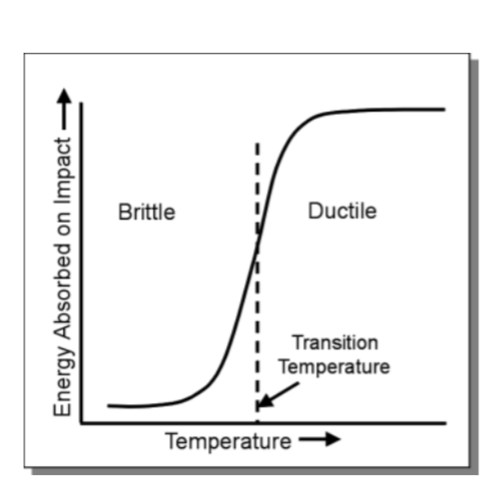
Ductile Brittle Transition Temperature
23
New cards
Mechanical Testing: Tension Mechanical Properties (NEEDS TO BE COMPLETED)
- Young's Modulus
- Yield Strength
- Ultimate Tensile Strength
- Percent Elongation
- Yield Strength
- Ultimate Tensile Strength
- Percent Elongation
24
New cards
Mechanical Testing: Hardness
25
New cards
Design for Durability- special cases of design for x
26
New cards
Design for Durability: Fatigue Failures
Fatigue Failures: failures occurring under conditions of dynamic loading.
three stages:
crack initiation
crack propagation
final fracture
three stages:
crack initiation
crack propagation
final fracture
27
New cards
Design for Durability: Basic Forms of Corrosion
uniform corrosion: entire surface is cracked
galvanic corrosion: dissimilar metals
crevice corrosion: design issue
pitting corrosion: non-uniform attack
selective launching: dezincification of brass
erosion/corrosion: high velocity fluid
stress corrosion cracking
galvanic corrosion: dissimilar metals
crevice corrosion: design issue
pitting corrosion: non-uniform attack
selective launching: dezincification of brass
erosion/corrosion: high velocity fluid
stress corrosion cracking
28
New cards
Design for Durability: Creep
the tendency of a solid material move slowly or deform permanently under the influence of stresses
- time and temperature dependent
- time and temperature dependent
29
New cards
Design for Durability: Wear
Match hardness of surfaces
reduce local contact stresses
surface treatments
lubrication
design for alignment
reduce local contact stresses
surface treatments
lubrication
design for alignment
30
New cards
Manufacturing Methods : manufacturing definition and three types of manufacturing industries
the key point is that manufacturing adds value to the material by changing its shape or properties, or by combining it with other materials that have been similarly altered.
Primary: industries cultivate and exploit natural resources
examples: agriculture, forestry, mining, livestock
Secondary: industries convert the output of primary to consumer and capital goods
examples: aerospace, computers, textiles, apparel, construction
Tertiary industries: provide services
examples: banking, communication, education, tourism, transportation
31
New cards
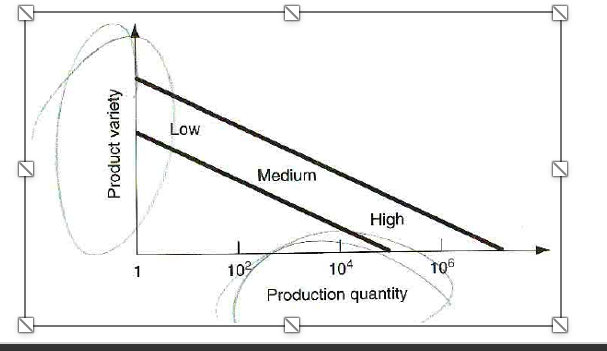
Manufacturing Methods: product quantity/variety tradeoff
key dimensions are: variety of products produced and quantity of each type of product. Is true for both manufactured items and finished goods.
finished goods: (final products) perform a function and are ready for service
manufactured items: (materials, components, and/or supplies) are used in the production of finished goods
finished goods: (final products) perform a function and are ready for service
manufactured items: (materials, components, and/or supplies) are used in the production of finished goods
32
New cards
Manufacturing Methods: manufacturing capability
technological processing capacity: the available set of manufacturing processes
physical product limitations: refer to size and weight restrictions that can be accommodated
product capacity: refers to quantity in a given period of time
physical product limitations: refer to size and weight restrictions that can be accommodated
product capacity: refers to quantity in a given period of time
33
New cards
Manufacturing Methods: design for manufacturing
-minimize total number of parts
-standardize components
-use common parts across product lines
-standardize design features
-keep design functional and simple
-design parts to be multifunctional
-design parts of ease of fabrication
-avoid excessively tight tolerances
-minimizing secondary/finishing operations
-use the special characteristics of processes
34
New cards
Manufacturing Methods: design for assembly
-minimize the total number of parts
-minimize the assembly surfaces
-use subassemblies
-mistake-proof the design and assembly
-avoid separate fasteners or minimize fastener costs
-minimize handling in assembly
-minimize assembly direction
-provide unobstructed access for parts and tools
-maximize compliance in assembly
-minimize the assembly surfaces
-use subassemblies
-mistake-proof the design and assembly
-avoid separate fasteners or minimize fastener costs
-minimize handling in assembly
-minimize assembly direction
-provide unobstructed access for parts and tools
-maximize compliance in assembly
35
New cards
Manufacturing Methods: forming and assembly operations (NEED TO FINISH )
36
New cards
Manufacturing Methods: metal casting methods and metal heating (NEED TO FINISH)
37
New cards
Additive Manufacturing: practical benefits
-negligible geometric constraints
-functionality graded materials
-speeds
-functionality graded materials
-speeds
38
New cards
Additive Manufacturing: financial benefits
-reduced material waste
-near constant costs (complexity does not drive up the cost of additi
-near constant costs (complexity does not drive up the cost of additi
39
New cards
Additive Manufacturing: metal and polymer drawbacks (NEEDS TO FINISH)
40
New cards
Additive Manufacturing: terminology
-build platform: surface which supports the part during production
-coordinate system: z-direction is always perpendicular to the build platform
-layer: the level set of a part created by a plane parallel to the xyz plane; also called a "slice"
-coordinate system: z-direction is always perpendicular to the build platform
-layer: the level set of a part created by a plane parallel to the xyz plane; also called a "slice"
41
New cards
Additive Manufacturing: used cases (NEED TO FINISH)
42
New cards
Additive Manufacturing: binder jetting
basic concept: deposit binder in shape of part slice, cover it in powder, repeat
-"binder" is liquid adhesive
-requires post processing
-build platform lowers to accommodate each powder layer
-"binder" is liquid adhesive
-requires post processing
-build platform lowers to accommodate each powder layer
43
New cards
Additive Manufacturing: drawbacks (metal and polymer) (NEED TO FINISH)
44
New cards
Additive Manufacturing: Good Cases
-rapid protyping
-small batch, infrequent production,
-geometrically tedious components
-components that need internal features, such as cooling channels
-in the field production
-small batch, infrequent production,
-geometrically tedious components
-components that need internal features, such as cooling channels
-in the field production
45
New cards
Additive Manufacturing: Bad Cases
-mass production
-geometrically simple components
-major load-bearing structural components
-components that cannot be tested before being used
-geometrically simple components
-major load-bearing structural components
-components that cannot be tested before being used
46
New cards
Additive Manufacturing: terminology
build platform: surface which supports the part during production
coordinate system: z-direction is always perpendicular to the build platform
layer: the level set of a part created by a plane parallel to the xy plane; also called a "slice"
coordinate system: z-direction is always perpendicular to the build platform
layer: the level set of a part created by a plane parallel to the xy plane; also called a "slice"
47
New cards
Additive Manufacturing: Binder Jetting
basic concept: deposit binder in shape of part slice, cover it in powder, repeat
-binder is liquid adhesive
-requires post-processing: sintering, to make the part solid
-build platform lowers to accommodate each powder layer
-binder is liquid adhesive
-requires post-processing: sintering, to make the part solid
-build platform lowers to accommodate each powder layer
48
New cards
Additive Manufacturing: Directed Energy Deposition (DED)
basic concept: deposit molten material where it is needed, when it is needed
-'directed energy' is high-power laser
-material propelled forward by stream of inert gas such as Argon
-propulsion gas must be inert, or else material will oxidize during solidification and won't adhere
-'directed energy' is high-power laser
-material propelled forward by stream of inert gas such as Argon
-propulsion gas must be inert, or else material will oxidize during solidification and won't adhere
49
New cards
Additive Manufacturing: Material Extrusion
basic concept: soften (but usually don't liquify) filament by heating it and deposit it where needed:
-most desktop printers are this type
-filament fed mechanically using gears
-normally uses open-air build platform
-most desktop printers are this type
-filament fed mechanically using gears
-normally uses open-air build platform
50
New cards
Additive Manufacturing: Material Jetting
basic concept: spray droplets of liquid material (usually polymer) and solidify them in place
-like binder jetting, but without powder
-needs dissolvable or otherwise removable support material
-like binder jetting, but without powder
-needs dissolvable or otherwise removable support material
51
New cards
Additive Manufacturing: Powder Bed Fusion (PBF)
basic concept: melt together regions of power bed in shape of part slice, recoat, repeat
-very similar to binder jetting but material is melted instead of glued together with an adhesive
-must be done in a vacuum chamber or inert gas chamber to prevent interstitial oxidation
-very similar to binder jetting but material is melted instead of glued together with an adhesive
-must be done in a vacuum chamber or inert gas chamber to prevent interstitial oxidation
52
New cards
Additive Manufacturing: Sheet Lamination
basic concept: apply glue only to part slice, apply next sheet, cut away unglued area, repeat
-usually done with paper
-can be done with metal or polymer films if ultrasonic welding is used to adhere them.
-usually done with paper
-can be done with metal or polymer films if ultrasonic welding is used to adhere them.
53
New cards
Additive Manufacturing: Vat Photopolymerization
basic concept: use a laser to solidify part slices on top of a liquid polymer vat, lower build platform, repeat
-mostly restricted to polymers, but can be done with an open-air build chamber
-usually regarded as the fastest polymer-based AM available today
-mostly restricted to polymers, but can be done with an open-air build chamber
-usually regarded as the fastest polymer-based AM available today
54
New cards
Additive Manufacturing: Hall-Petch Relationships
"grain boundary strengthening"
-essentially, more grain boundaries = more internal friction = more resistance to deformation
-related grain size (d) and yield stress (0y)
0y= 0o + [ (ky)/sqrt(d)]
as d increases, 0y decreases and vice-versa
-essentially, more grain boundaries = more internal friction = more resistance to deformation
-related grain size (d) and yield stress (0y)
0y= 0o + [ (ky)/sqrt(d)]
as d increases, 0y decreases and vice-versa
55
New cards
Sustainable Manufacturing: output emissions/products
output emissions: greenhouse gases, various pollutants, toxic chemicals, solid wastes
output products: products, by-products
output products: products, by-products
56
New cards
Sustainable Manufacturing: Embedded Energy (embodied)
the total amount of energy consumed in producing the material or products
57
New cards
Sustainable Manufacturing
the creation of manufactured products that use processes that are non-polluting, conserve energy and natural resources, and are economically sound and safe for employees, communities, and consumers
58
New cards
Sustainable Manufacturing: Benefits
direct benefits:
-reduce cost
-improve profit margin
-reduce environmental impacts (external costs to society)
indirect benefits:
-improve company's image
-aid in green marketing
-market value increase
-reduce cost
-improve profit margin
-reduce environmental impacts (external costs to society)
indirect benefits:
-improve company's image
-aid in green marketing
-market value increase
59
New cards
Sustainable Manufacturing: Drivers
1. economic incentives
-cost saving on energy
-cost saving on materials
-cost saving on manufacturing operations
2. regulatory pressure
-clean air act
-clean water act
-resource conservation and recovery act
3. competitive advantages
-customer preference
-revenues and market share
-positive correlation between environmental performance and commercial success
60
New cards
Sustainable Manufacturing: Obstacles
1. economic barrier
-largest capital cost requirement
-long pay-check period
2. technological barrier
-lack of technologies
-lack of materials
-lack of knowledge
-lack of skilled operators
3. managerial barrier
-lack of understanding from management
-lack of robust data
-lack of decision support tools
-largest capital cost requirement
-long pay-check period
2. technological barrier
-lack of technologies
-lack of materials
-lack of knowledge
-lack of skilled operators
3. managerial barrier
-lack of understanding from management
-lack of robust data
-lack of decision support tools
61
New cards
Sustainable Manufacturing: emission impacts (NEED TO FINISH)
62
New cards
Sustainable Manufacturing: Nano, Micro, Macro - scale (NEED TO FINISH)
63
New cards
Manufacturing Systems
a collection of integrated equipment and human resources, whose function is to perform one or more processing and/or assembly operations on a starting raw material, part, or set of parts
64
New cards
Manufacturing Systems: production machine types
manually operated machines: are controlled or supervised by a human worker
semi-automated machines: perform a portion of the work-cycle under some form of program control, and a worker tends the machine the rest of the cycle
fully automated machines: operate for extended periods of time with no human attention
semi-automated machines: perform a portion of the work-cycle under some form of program control, and a worker tends the machine the rest of the cycle
fully automated machines: operate for extended periods of time with no human attention
65
New cards
Manufacturing Systems: material handling system
-loading work units at each station
-positioning work units at each station
-unloading work units at each station
-transporting work units between stations in multi-station systems
-temporary storage of work units
(load, position, unload, transport, store)
-positioning work units at each station
-unloading work units at each station
-transporting work units between stations in multi-station systems
-temporary storage of work units
(load, position, unload, transport, store)
66
New cards
Manufacturing Systems: fixed routing
-work units always flow through the same sequence of workstations
-most production lines exemplify this category
-work stations are usually arranged linearly
-most production lines exemplify this category
-work stations are usually arranged linearly
67
New cards
Manufacturing Systems: variable routing
-work units are moved through a variety of different station sequences
-most job shops exemplify this category
-a variety of layouts are possible
-most job shops exemplify this category
-a variety of layouts are possible
68
New cards
Manufacturing Systems: Process Layout
-similar activities grouped together in work areas
-suitable for low volume or batch production
-flexible
-not very efficient
-storage space - large receiving, small shipping
-large aisles for movement of materials
-suitable for low volume or batch production
-flexible
-not very efficient
-storage space - large receiving, small shipping
-large aisles for movement of materials
69
New cards
Manufacturing Systems: product layout
-arrange activities in sequence of operation
-line set up for one product
-speciliased machines
-suitable for mass production
-more automated than process layouts
-efficient
-line flow
-not flexible
-line set up for one product
-speciliased machines
-suitable for mass production
-more automated than process layouts
-efficient
-line flow
-not flexible
70
New cards
Manufacturing Systems: fixed position layout
-large projects too big to move
-equipment and parts moved in and out of work area
-highly skilled workers-costly
-equipment and parts moved in and out of work area
-highly skilled workers-costly
71
New cards
Manufacturing Systems: manning levels
Mi= proportion of time worker is in attendance at station i
- Mi = 1 means that one worker must be at the station continously
- Mi >= 1 indicates manual operations
- Mi < 1 denotes some form of automation
- Mi = 1 means that one worker must be at the station continously
- Mi >= 1 indicates manual operations
- Mi < 1 denotes some form of automation
72
New cards
Manufacturing Systems: Capacity Planning - Lead Strategy
-capacity expanded in anticipation of demand
-expects to gain customers from competitors
-"push" strategy
-expects to gain customers from competitors
-"push" strategy
73
New cards
Manufacturing Systems: Capacity Planning - Lag Strategy
-capacity increased after increased in demand
-common where competition is weak
-"pull" strategy
-common where competition is weak
-"pull" strategy
74
New cards
Manufacturing Systems: Capacity Planning - Average Capacity Strategy
-capacity expanded to coincide with average expected demand
-"season goods"
-"season goods"
75
New cards
Smart Manufacturing
refers to intelligent automation and data-enhanced production
-artificial intelligence and machine learning
-from process control to factory management to supply chain logistics
-artificial intelligence and machine learning
-from process control to factory management to supply chain logistics
76
New cards
Smart Manufacturing: benefits
-know more about everything you produce
-better quality control
-more flexibility
-better quality control
-more flexibility
77
New cards
Smart Manufacturing: AI's definition of "intelligence"
intelligent agents should be rational actors
78
New cards
Smart Manufacturing: brute force
-finding all possible paths an agent can take
-works for small problems, completely implodes for large problems
-works for small problems, completely implodes for large problems
79
New cards
Smart Manufacturing: differences between AI and ML (NEED TO FINISH)
80
New cards
Smart Manufacturing: difference between classification and regression in ML (NEED TO FINISH)
81
New cards
Quality and Robust Design: Quality
-conformance to specifications
-fitness for use
-value for priced
-support services
-fitness for use
-value for priced
-support services
82
New cards
Quality and Robust Design: good manufacturing practices
-design controls: intrinsic quality established during design phase
-purchasing controls: manufacturer must adequately define and establish requirements
-maintenance and service controls: maintenance and repair data provide insight into performance
-quality system requirements: design, purchasing, and service controls
-clarify record keeping requirements for product failure and complaint investigations
-clarify requirements for qualifying, verifying, and validating processes and specification changes
-clarify requirements for evaluating quality data and correcting quality problems
83
New cards
Quality and Robust Design: control charts
a graphical technique in which statistics computed from measured values of a process characteristic are plotted over time to determine if the process remains in statistical control
indications out of control process:
-sample mean or range are outside UCL or LCL
-trends or cyclical patterns in data
-sudden changes in average values
-points consistently near UCL or LCL
-eight consecutive points that lie on one side of CL
-six consecutive points in which each point is higher (or lower than its predecessor)
84
New cards
Quality and Robust Design: process capability
PC = process mean +- (3 X standard deviation of the process)
assumptions: output is normally distributed
-steady state operation
-process is in statistical control
process capability and tolerances:
-natural tolerance limits - when tolerance is set = process capability
-process capability index
PCI = (UTL- LTL) / (6 X standard deviation of the process)
UTL and LTL are upper and lower tolerance limits
(6 X standard deviation of the process) is the range of natural tolerance limits
85
New cards
Quality and Robust Design: ISO 9000 and
ISO = international organization for standardization
ISO 9000 - standard for the systems and procedures used by a facility that affect the quality of the products and services provided by the facility
(generic: applied to any service/product)
ISO 14000 - focuses on a company's environmental responsibility
ISO 9000 - standard for the systems and procedures used by a facility that affect the quality of the products and services provided by the facility
(generic: applied to any service/product)
ISO 14000 - focuses on a company's environmental responsibility
86
New cards
Risk, Reliability, and Safety: hazard
the potential for human, property, or environmental damage; unsafe condition that can reasonably be expected to result in failure or injury
87
New cards
Risk, Reliability, and Safety: reliability
a measure of the capability of a part or system to operate without failure in the service environment; expressed as a probability
88
New cards
Risk, Reliability, and Safety: safety
relative protection from exposure to hazards
89
New cards
Risk, Reliability, and Safety: risk and characteristics
the likelihood of a specific effect within a specified period
uncertainty: the risk may or may not happen, there are no 100% risks
loss: the risk becomes a reality and unwanted consequences or losses occur
uncertainty: the risk may or may not happen, there are no 100% risks
loss: the risk becomes a reality and unwanted consequences or losses occur
90
New cards
Risk, Reliability, and Safety: FMEA
a structured approach to identify the ways in which a product or process can fail, estimate risk associated with specific causes, prioritize the actions that should be taken to reduce risk, and evaluate design validation plan
91
New cards
Risk, Reliability, and Safety: FMEA Procedure
1. for each process input determine the ways in which the input can go wrong
- select a severity level for each effect
2. for each failure mode, determine effects
- select a severity level for each effect
3. identify potential causes of each failure mode
- select an occurrence level for each cause
4. list current controls for each cause
-select a detection level for each cause
5. calculate the risk priority number
6. develop recommended actions, assign responsible persons, and take actions
-give priority to high RPNs
-must look at severities rated a 10
7. assign predicted severity, occurrence, and detection levels and compare RPN's
- select a severity level for each effect
2. for each failure mode, determine effects
- select a severity level for each effect
3. identify potential causes of each failure mode
- select an occurrence level for each cause
4. list current controls for each cause
-select a detection level for each cause
5. calculate the risk priority number
6. develop recommended actions, assign responsible persons, and take actions
-give priority to high RPNs
-must look at severities rated a 10
7. assign predicted severity, occurrence, and detection levels and compare RPN's
92
New cards
Risk, Reliability, and Safety: SOD
severity: importance of the effect on customer requirements
occurrence: frequency with which a given cause occurs and creates failure modes
detection: the ability of the current control scheme to detect or prevent a given cause
occurrence: frequency with which a given cause occurs and creates failure modes
detection: the ability of the current control scheme to detect or prevent a given cause
93
New cards
Risk, Reliability, and Safety: Rating Scales
-two types of scales (1-5) or (1-10)
- (1-5) makes it easier for teams to decide on scores
- (1-10) for better precision in estimates and a wide variation in scores
- (1-5) makes it easier for teams to decide on scores
- (1-10) for better precision in estimates and a wide variation in scores
94
New cards
Ethics: IDEK (need to finis)
95
New cards
Design and Manufacturing: Seven Phases of Design
1. Conceptual Design
2. Embodiment Design
3. Detail Design
4. Planning for Manufacture
5. Product Distribution
6. Product Use
7. Product Retirement/Decommissioning
2. Embodiment Design
3. Detail Design
4. Planning for Manufacture
5. Product Distribution
6. Product Use
7. Product Retirement/Decommissioning
96
New cards
Design and Manufacturing: Types of Design
original/innovative:
-invention
-disruptive
-top of design hierarchy
adaptive:
-known solutions to meet different needs
redesign:
-improve on existing design
-redesign a failing component
-reduce manufacture cost
selection:
industrial:
-improving appeal of a product
-invention
-disruptive
-top of design hierarchy
adaptive:
-known solutions to meet different needs
redesign:
-improve on existing design
-redesign a failing component
-reduce manufacture cost
selection:
industrial:
-improving appeal of a product
97
New cards
Design and Manufacturing: Design Process
step 1: identify the problem
step 2: research problem
step 3: develop solutions
step 4: select best possible solution
step 5: construct prototype
step 6: test and evaluate the solutions
step 7: communicate the solutions
step 2: research problem
step 3: develop solutions
step 4: select best possible solution
step 5: construct prototype
step 6: test and evaluate the solutions
step 7: communicate the solutions
98
New cards
Team Behavior Tools: characteristics of good team members
-take responsibility for success of the team
-deliver on commitments
-be a contributor to discussions
-give your full attention to speakers and ask questions
-develop techniques for getting your message across to the team
-learn to give and receive useful feedback
-deliver on commitments
-be a contributor to discussions
-give your full attention to speakers and ask questions
-develop techniques for getting your message across to the team
-learn to give and receive useful feedback
99
New cards
Team Behavior Tools: characteristics of effective teams
-team goals are as important as individual goals
-team understands goals are is committed to achieving them
-trust replaces fear, people feel comfortable taking risks
-respect, collaboration, open-mindedness
-communication
-decisions made by consensus and have acceptance support of members
-team understands goals are is committed to achieving them
-trust replaces fear, people feel comfortable taking risks
-respect, collaboration, open-mindedness
-communication
-decisions made by consensus and have acceptance support of members
100
New cards
Team Behavior Tools: Team Leadership Roles, Definitions, Responsibilities : Team sponsor
the manager who has the need for the output of the team
-provides any special resources needed by team and formally commissions the team
-provides any special resources needed by team and formally commissions the team