BCMB 401 Exam 3 Learning Objectives/Review
 Call Kai
 Learn
 Practice Test
 Spaced Repetition
 Match
 Flashcards
 Knowt Play
1/80

Earn XP
Description and Tags
https://utk.instructure.com/courses/261310/files/34245298?module_item_id=6953328
81 Terms
How is phosphorylation used to regulate protein activity
adds a phosphate group to amino acid residues, acting as a reversible on/off switch
Describe the mechanism used to activate protein Kinase A
signal (adrenaline, glucagon) binds to GPCR activates G-protein stimulating the enzyme adenylyl cyclase converting ATP into cAMP increasing concentration inside cell
PKA is inactive tetramer (two regulatory and two catalytic subunits) and active sites are blocked remaining off
Four cAMP molecules bind to regulatory subunits causing allosteric conformational change
Conformational change lowers the affinity between the regulatory and catalytic subunits, the complex dissociates releasing two catalytic subunits
Active catalytic subunits phosphorylate Ser, Thr residues on target proteins altering activity

Define signal transduction
Release of diffusible secondary messengers and activation of protein kinases
Describe the common elements of signal transduction pathways (The Signal Transduction Paradigm)
Signal: hormone or environmental signal that binds to a complementary target receptor
Receptor: membrane protein recognizing the signal, ligand bonding alters receptor shape
Transduction: release of diffusible secondary messengers and activation of protein kinases
Amplification: single component activates multiple downstream molecules, multiplying strength/output
Response: cellular changes in metabolism leading to response to original signal, regulatory mechanisms shut pathway down when signal is removed
Identify common second messengers
cAMP (targets PKA), DAG and PIP3 (targets PKC and Akt), Ca2+ (regulatory proteins, activate downstream protein kinases)
Describe B-AR signaling in the context of the Signal Transduction Paradigm
Reception: epinephrine binds to ß-ARs (7TM receptor), stimulates binding of ß-Arrestin blocking activation of additional G-proteins
Dissociation of epinephrine, phosphorylation on receptor kinase with recruits ß-Arrestin, blocking site from G-proteins
Describe the steps of GPCR signaling through protein kinase A
Signaling molecule to GPCR, conformational change interacting with heterotrimeric G-protein causing α subunit to release bound GDP and bind fresh GTP molecule.
Binding GTP activates α subunit, dissociates from ßgamma complex and receptor
Active α-GTP subunit diffuses along membrane and activates enzyme adenylyl cyclase which catalyzes conversion of ATP into cAMP
cAMP binds to regulatory subunits of PKA, detaching and releasing the active catalytic subunits of PKA - phosphorylating proteins/enzymes
Describe the steps of GPCR signaling through protein kinase C
extracellular ligand bvinds to GPCR, structural change to receptor. Heterotrimeric G protein α subunit releases GDP and binds GTP causing G-protein to split and moves along inner membrane
α subunit binds to and activates PLC enzyme cleaving PIP2 into IP3 and DAG
IP3 to ER releasing stored Ca2+ to cytoplasm
DAG recruits PKC and spike in calcium helps fully activate PKC
PKC phosphorylates target proteins and transcription factors
Explain how GPCR signaling is terminated
α subunit has intrinsic GTPase activity that hydrolyzes GTP back to GDP, reassociating with dimer and turn off downstream effectors
ß-arrestin recruitment to phosphorylated GPCR blocks receptors
Phosphatases remove phosphate groups with downstream PKC or PKA returning target proteins to inactive states
Identify second messengers and amplification steps in GPCR signaling
One GPCR can catalyze activation of multiple heterotrimeric G-protein
Each α subunit binds to and activates adenylyl cyclase/PLC which produces cAMP/IP3
cAMP or Ca2+ activate protein kinases, each phosphorylates and activate many downstream proteins/enzymes
Describe Insulin receptor signaling in the context of the Signal Transduction Paradigm
Insulin on α-subunit of insulin receptor, conformational shift causing cross phosphorylation of Tyr within activation loop “on” on ß-subunits
ß-subunits high affinity for IRS protein, phosphorylating IRS on multiple tyrosine residues, binding PI3K to membrane converting PIP2 into PIP3
PIP3 recruits PDK1 and Akt
Increase glucose transport on cell surface
Explain how insulin receptor signaling is terminated
Protein Tyrosine Phosphatases (PTPs) remove phosphate group from IRS resetting to inactive state
Lipid phosphatases dephosphorylate PIP3 back to PIP2
Identify commonly used activated carriers
ATP, NADH, FADH2, GTP, Acetyl-CoA, Biotin
Describe the use of activated carriers, what is meant by activated
store and transfer energy to couple energetically unfavorable reactions with favorable breakdown processes
Define gluconeogenesis
occurring in liver, gluconeogenesis synthesizes new glucose molecules to maintain blood glucose levels
Identify the enzymes used in gluconeogenesis
Pyruvate carboxylase, PEP carboxykinase, fructose 1,6-biphosphatase, and glucose-6-phostphatase
Identify the intermediates of glulconeogenesis
Pyruvate
Phosphoenolpyruvate
2-phosphoglycerate
1,3-Biphosphoglycerate
Glyceraldehyde 3-phosphate
Dihydroxyacetone phosphate
Fructose 1,6-biphosphate
Fructose 6-phosphate
Glucose 6-phosphate
Glucose
Explain the importance of biotin to gluconeogenesis
biotin is a required cofactor to pyruvate carboxylase
Explain how energy is supplied for gluconeogenesis
high concentrations of ATP and acetyl-CoA inhibit pyruvate kinase and activate gluconeogenesis
Compare/contrast regulation of glycolysis and gluconeogenesis in muscle and in the liver
High glucose -
Low glucose -
High AMP, High ADP, low ATP -
High ATP -
High Acetyl-CoA/Citrate
High glucose - glycolysis
Low glucose - gluconeogenesis
High AMP, High ADP, low ATP - Glycolysis
High ATP - Gluconeogenesis
High Acetyl-CoA/Citrate - Gluconeogenesis
Explain why it would be unfavorable for glycolysis and gluconeogenesis to be active at the same time. Define reciprocal regulation and explain its importance
If they were running at the same time it would waste energy as a futile cycle
Contrast the positive and negative regulators of glycolysis and gluconeogenesis
Glucagon
Insulin
F 2,6 BP
Glucagon - gluconeogensis
Insulin - glycolysis
F 2,6 BP - glycolysis
Explain how the activity of PFK-2/FBPase-2 is regulated
Glucagon activates PKA phosphorylates Ser 32 and inactivates PFK-2 domain, activating FBPase-2 turning on gluconeogenesis
Insulin dephosphorylates PKA, activating PFK-2 domain and inavtivates FBPAse-2 domain, stimulating glycolysis
Define fermentation
low energy yield, cytosol, 2 ATP per glucose, anaerobic
Describe the steps of lactic acid and ethanolic fermentation
Lactic Acid - NADH accumulates and NADH re-oxidized to sustain glycolysis with lactate dehydrogenase
Ethanolic - NADH recycled by dual action of pyruvate decarboxylase and alcohol dehydrogenase
Explain how pyruvate is activated to produce acetyl-CoA
Through PDH
TPP initiates decarboxylation in E1
Carboxyl group is removed from pyruvate releasing CO2
Hydroxyethyl group is oxidized to ecetyl group, used to reduce lipoamide group on E2
Acetyl group transferred from lipoamide to CoA-SH creating acetyl-CoA
E3 reoxidizes lipoamide by passing electrons to FAD (riboflavin) then to NAD+ (niacin)
Write the overall reaction for conversion of pyruvate to acetyl-CoA
Pyruvate + CoA-SH + NAD+ → NADH + Acetyl-CoA + CO2
Identify the cofactors required by the PDH complex
TPP, Lipoamide, Coenzyme A, FAD, NAD
Explain the energetics of the PDH reaction, what drives the formation of the thioester bond of Acetyl-CoA and what forms of “useful energy” are produced
energy is stored in reducing power as NADH and thioester Acetyl CoA.
Breaking of disulfide bonds drives energetics
Describe the general steps of the Citric Acid Cycle in terms of order of steps, reaction types, number, and type of energy-carrying molecule formed or used, number of carbons of intermediates, and cofactors used
Oxaloactate + Acetyl-CoA → Citrate
Condensation by Citrate synthase
Release CoA
Citrate → Isocitrate
Isomerization by Aconitase
Isocitrate → alpha-ketoglutarate
Oxidative decarboxylation by isocitrate dehydrogenase
Release CO2 and NADH
ATP and NADH inhibitors
alpha-ketoglutarate → succinyl-CoA
Oxdiative decarboxylation by alpha-ketoglutarate dehydrogenase
Release CO2 and NADH
ATP, NADH, and succinyl CoA inhibitors
Succinyl-CoA → Succinate
Thioester cleavage and Phosphorylation by Succinyl CoA synthetase
Release ATP
Succinate → Fumarate
Oxidation by Succinate dehydrogenase
Release FADH2
Fumarate → Malate
Hydration by Fumerase
Malate → oxaloacetate
Oxidation by Malate Dehydrogenase
Release NADH
Describe the regulation of the PDH complex
Activated by high NADH, Acetyl CoA, ATP concentrations, Ca2+
Inhibited by pyruvate and ADP
Describe the feedback loops that regulate citric acid cycle enzyme activity
Order the steps of the cell signaling paradigm
Signal (first messenger)
Reception
Transduction & Amplification(second messengers)
Response
Which of the following is not a component of a typical signaling cascade: receptor activation, secondary messengers, protein phosphorylation, orATP synthesis
ATP synthesis
What enzyme reverses phosphorylation by removing a phosphate group from a protein?
Protein phosphatase
Inactive protein kinase A (PKA) contains
two catalytic subunits and two regulatory subunits
What part of the signaling pathway do 7TM receptors contribute to
Transduction
What is the role of G-proteins in signal transduction
Transmit signals from the receptor to other intracellular molecules
In the epinephrine signaling pathway, which of the following is activated by the beta-adrenergic receptor
Adenylate cyclase
7TM/GPCR Signaling Cascade Example: Epinephrine Receptor with Adenylate Cyclase
Beta-AR is a 7TM receptor coupled to G-proteins. Ligand binding leads to G-protein activation wherein GDP switched for GTP. Dissociation of alpha subunit from the beta-gamma subunits. Galpha activates adenylate cyclase which converts ATP to cAMP
Alternative downstream signaling cascade: Epinepherine Receptor with Phospholipase C
Activated G protein activates PLC, which cleaves PIP2 to generate DAG and IP3. DAG activates PKC, and IP3 stimulates calcium release from ER. Signaling through PLC can occur downstream of GPCRs or RTKs
Receptor Tyrosine Kinase (RTK) Signaling Cascade Example: Insulin Receptor
IRS bridges insulin-activated receptor to PI3K, which synthesizes PIP3, which activates PDK1, which activates AKT. AKT stimulates glucose uptake by the cell
What is the primary role of catabolic pathways
to extract energy from fuels
Where does glycolysis occur in the cell?
Cytoplasm
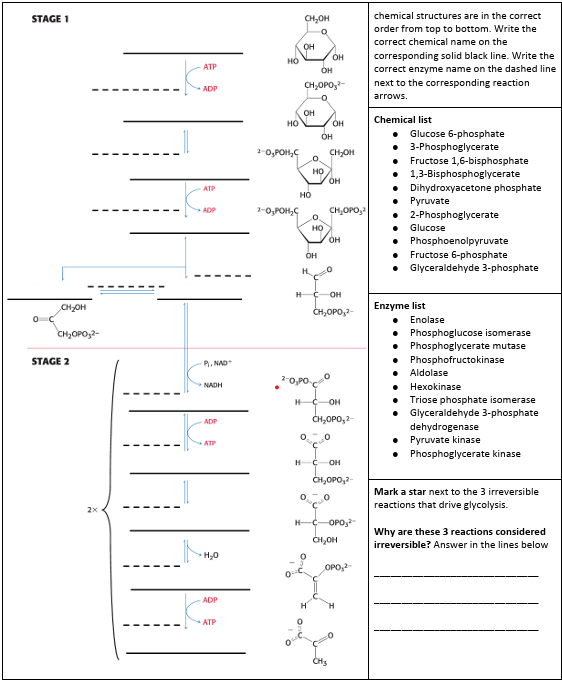
Glycolysis Stage 1 The Investment Stage Summary
During stage 1 of glycolysis, two molecules of ATP are invested to convert glucose into fructose 1,6-biphosphate in three steps: a phosphorylation, an isomerization, and a second phosphorylation reaction
Order of reactions from stage 1 of glycolysis
Hexokinase
Phosphoglucose isomerase
Phosphofructokinase
Aldolase
Triose phosphate isomerase
What enzyme catalyzes the first committed step of glycolysis
Phosphofructokinase
What net ATP per molecule of glucose is associated with stage 1 of glycolysis
use 2 ATP
What net ATP per molecule of glucose is associated with stage 2 of glycolysis
generate 4 ATP
Glycolysis Stage 2 The Payoff Stage Summary
Occurs twice for each molecule of glucose transformed in stage 1. Glyceraldehyde-3-P is converted to pyruvate and 2 ATP molecules are generated along with an NADH. Glycolysis nets 2 ATP and 2 NADH for every glucose unit
Order of reactions from stage 2 of glycolysis
Glyceraldehyde-3-phosphate dehydrogenase
Phosphoglycerate kinase
Phosphoglycerate mutase
Enolase
Pyruvate Kinase
Which enzyme performs substrate-level phosphorylation to form ATP
phosphoglycerate kinase
Which is the only redox enzyme in glycolysis
Glyceraldehyde-3-phosphate dehydrogenase
What electron carrier is generated by GAPDH
NADH
What molecule must be regenerated for glycolysis to continue
NAD+
Conversion of GAP to 1,3-BPG by GAPDH Summary
NAD+ is required as an electron acceptor in the active site of GAPDH to create a molecule with high phosphoryl-transfer potential (1,3-BPG) which can be used to generate ATP in a subsequent step
Which is not an irreversible reaction of glycolysis
Glyceraldehyde-3-phosphate dehydrogenase
What happens to pyruvate under aerobic conditions in humans
it forms acetyl-CoA
gluconeogenesis is the synthesis of
glucose from non-carbohydrate precursors
which non carbohydrate molecule can be used for gluconeogensis
Lactate, Alanine, Glycerol
What is the energy cost associated with gluconeogenesis for one glucose molecule
4 ATP + 2 GTP
Order of gluconeogenesis reaction
Pyruvate carboxylase
PEP carboxykinase
FBPase1
Glucose-6-phosphatase
Which of the following enzymes is found in both gluconeogenesis and glycolysis
phosphoglucoisomerase
What step of glycolysis is known as the committed step
fructose 6-phosphate to fructose 1,6-biphosphate
Why are glycolysis and gluconeogenesis reciprocally regulated
to prevent a futile cycle
Reciprocal Regulation of Glycolysis and Gluconeogenesis through allosteric effectors
Allosteric regulation of the above enzymes ensures when energy is needed or glycolytic intermediates are needed for biosynthesis, glycolysis will predominate. When there is a surplus of energy and glucose precursors, gluconeogenesis will take over
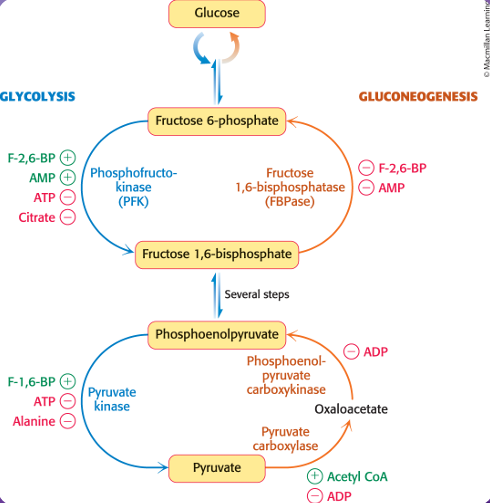
What is the main function of fructose 2,6-biphosphate
Activates glycolysis, inhibits gluconeogenesis
For phosphofructokinase-1 (PFK-1)
Low ATP stimulates, and fructose-2,6-biphosphate activates
Reciprocal Regulation of Glycolysis and Gluconeogenesis through hormone signaling
Insulin and glucagon signaling contribute to the pathways by regulating PFK2/FBPase2, which regulates [F-2,6-BP] in the cell

Which enzymes are stimulated by insulin signaling
PFK1 and PFK2
All of the enzymes of gluconeogenesis may be found in the cytosol EXCEPT ___, which is only found in the mitochondria
pyruvate carboxylase
Which enzyme complex links glycolysis to the citric acid cycle
Pyruvate dehydrogenase: pyruvate produced by glycolysis is converted into acetyl CoA, the fuel of the citric acid cycle
Pyruvate metabolism through the citric acid cycle and electron transport chain is an
aerobic process
What happens to pyruvate under anaerobic conditions in humans
It is converted to lactate, occurs to reoxidize NADH/regenerate NAD+ to sustain glycolysis in animal muscle cells
Niacin vitamin
Single six-membered ring with amide group branching

Pantothenate vitamin
Long, flexible chain containing amide bonds and central carbon with two methyl groups and a hydroxyl group

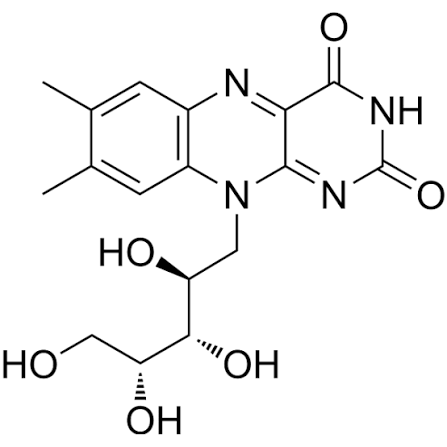
Riboflavin
Three-ring system with a straight-chain sugar alcohol extending downward from it
A reducer __ an electron __ an oxidizer, causing the reducer to become ___ while the oxidizer becomes ___
donates
to
oxidized
reduced
The coenzyme nicotinamide adenine dinucleotide (NAD+) is ___ to form ___ and goes on to interact ___ with its associated enzymes called
reduced
NADH
non-covalently
dehydrogenase
Coenzyme A becomes activated by ___ binding an ___ group via ___ bond, in which the fewest number of carbons it can carry is ___
covalently
acyl
thioester
2