Acellular Microbes and Agents
 Call Kai
 Learn
Learn Practice Test
 Spaced Repetition
 Match
Match Flashcards
 Knowt Play
1/55

There's no tags or description
Looks like no tags are added yet.
Name | Mastery | Learn | Test | Matching | Spaced | Call with Kai | Chat |
|---|
No analytics yet
Send a link to your students to track their progress
56 Terms
Prions
Pathogenic, misfolded versions of normal cell proteins
Major prion protein PrP
What prion is encoded by the gene PRNP also called CD230 on the p arm of chromosome 20
ZIP metal ion transporters
What class of proteins is it suspected that PrP came from
ZIP metal ion transporters
What class of proteins exhibits a pH dependent ability to bind metal cations with the strongest affinity for copper
3 alpha helices, 2 antiparallel beta sheets, globular domain
What is the secondary structure of a correctly folded PrP protein?
Cell-surface
Where is mature PrP found?
PrPc, or cellular isoform
What is the correctly folded form of PrP
PrPSc
Misfolded, disease-causing form of PrP; associated with scrapie; highly resistant to degradation by proteases
Amyloid Fibrils
Compact, insoluble aggregates in nervous tissue formed by PrPSc which resemble beta sheet rich aggregates and the molecular structure of starch
Amyloid Plaques
Extracellular deposits of amyloid fibrils that accumulate within the CNS and disrupt normal structure and function of the NS
Vacuolation
Neurons attempt to compartmentalize prions inside vacuoles, causing enlarged vacuoles that appear like holes when analyzing tissue, causing the spongiform histologic manifestation of prion diseases
Prion Diseases
Rapidly progressive and always fatal
Prion Diseases
May be acquired, familial, or sporadic
Acquired
arising from exposure to prions via medical procedure or via ingestion of prion-containing material including biofluids, animal tissue, or contaminated soil
Familial
Arising from a genetic mutation
Sporadic
Arising from spontaneous mutation
Transmissible spongiform encephalopathies
another name for prion diseases
Stanley B. Prusiner
First person to discover prions in 1982
Prion-like Proteins, prionoids
Misfolded proteins that form amyloid aggregates associated with degenerative diseases that do not complete a full infectious cycle
amyloid-beta
prion-like protein associated with alzheimers disease
tau
prion- like proteins that are associated with neurodegenerative diseases (specific type)
alpha-Synuclein amyloids
associated with parkinsons disease; accumulate inside neurons (substantia nigra, locus coeruleus) and form lewy bodies
Viroid
Small, single-stranded circular RNA molecules without a protein coat that infect flowering plants; the RNA often possesses a highly compact, intricate secondary structure
Rolling Circle Amplification
How viroids replicate using the host’s RNA polymerase II
Viroids
Accumulates and disrupts normal cellular processes and gene regulation
Viroids
What are these examples of: potato spindle tuber ____, coconut cadang-cadang ____; tomato apical stunt ___
Viruses
Obligate intracellular pathogens that posses DNA or RNA
Viruses
10s to 100s of nanometers in length
Virions
viral particles that consist of the genetic material encapsulated by the capsid
Prophage
Viral DNA incorporated into cellular DNA during lysogenic cycle
Capsid
protein coating on a virus
Viral envelope
lipid layer coating some viruses
Capsomeres
subunits that make up a capsid
Protomers
protein subunits that make up capsomeres
Bacteriophages
Viruses that infect bacteria; usually have genes composed of DNA
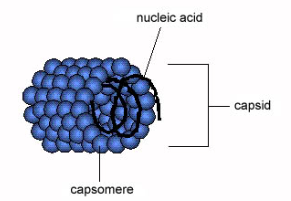
Helical
Capsid shape that appears to be rod-shaped or filamentous; includes tobacco mosaic virus and ebola
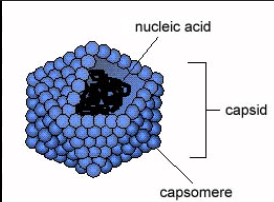
Polyhedral
Capsid shape that takes the shape of a regular, convex icosahedron (20-sided 3D shape composed of equilateral triangles); includes adenoviruses, picornaviruses, including Hep A and polio
Spherical
Type of virus; appear spherical under microscope due to viral envelope; HIV-1 and 2, herpes, influenza
Baltimore Classification
Divides viruses into seven different groups on the basis of their genetic material; created in 1971 by the virologist David Baltimore, this system is often used alongside and has now been partially incorporated into standard viral taxonomy.
Class I
Class of virus that has double-stranded DNA
Class II
Class of virus that have single-stranded DNA
Class III
Class of virus that have double-stranded RNA
Class IV
Class of virus that have positive-sense single-stranded RNA
Class V
Class of virus that have negative-sense single-stranded RNA
Class VI
Class of virus that are RNA retroviruses
Class VII
Class of virus that are DNA retroviruses
Lytic
Type of infection where the virus injects its genome into the host cell; cell begins making mRNA from viral DNA, which is made into viral proteins; cell shuts down and virus uses cell to replicate; enough viruses are made and cell bursts/lyses; 100s or 1000s are released
Lysogenic
Type of infection where a virus integrates its DNA into the host cell’s DNA; the prophage remains dormant in the cell’s DNA for several generations before becoming active, leaving the cell’s DNA, and directing synthesis of new viral proteins; allows virus to enter more cells; HIV
Satellites
Subviral particles that cannot complete the cycle of infection independently; dependent on both host machinery and presence of helper virus for proper replication; much shorter than viral genomes
Satellite Virus
Genome encodes a capsid
Satellite Nucleic Acids
Genome relies on helper viruses for encapsidation
Virophages
A type of subviral particle similar to satellite viruses; require help of co-infecting virus; remain in cytoplasm of infected host cells and hijack the cytoplasmic virus factories established by their co-infecting viruses, a parasitic; reduce the replication efficiency (and, therefore, also the infectivity) of co-infecting viruses, which may aid in host cell survival
Virophages
Always have circular or linear double-stranded DNA genomes; usually 16-18 kb in length; display parasitic relationship with co-infecting giant virus
giant virus
Have larger genomes and large capsids and belong to phylum Nucleocytoviricota
Nucleocytoplasmic large DNA viruses
can perform viral replication in either the nucleus or cytoplasm of host cells; encode enzymes involved in DNA repair, replication, and transcription, which allows them to establish cytoplasmic virus factories that facilitate genome replication in addition to protein synthesis and virion assembly
Virusoid
A type of satellite; viroid that has been enclosed in a protein capsid of another virus; depends on both the helper virus and the host cell RNA polymerase II for replication; have circular, single-stranded RNA genomes