Stereoselective synthesis
 Call Kai
 Learn
 Practice Test
 Spaced Repetition
 Match
 Flashcards
 Knowt Play
1/91

There's no tags or description
Looks like no tags are added yet.
92 Terms
How can enantiomers be separated? (4)
Covalent attachment of an enantiomerically pure functional group to create diastereomers
Form salts with an enantiomerically pure reagent to create diastereomers
Use chiral chromatography
Resolution with enzymes
Limitations of enzymatic resolution (4)
Limited solubility of enzymes in organic solvents
Enzymes only exist as one enantiomer
Can be too substrate specific
lose half of the product (applies to all separations)
Limitations of using a natural chiral pool (2)
Chiral pool molecules generally available as only one enantiomer.
Many steps may be required to convert it into the target.
Chemoselectivity
The selective transformation of one of several potentially reactive functional groups within a molecule.
Regioselectivity
The favored formation of one constitutional isomer in preference to another.
Stereoselectivity
one stereoisomer of product is formed predominantly
Optically inactive starting materials can give optically active products only if…(2)
they are treated with an optically active reagent
OR
the reaction is catalyzed by an optically active substance
enantiotopic faces of a carbonyl

What do a) enantiomeric and b) diastereomeric transition states lead to?
a) racemic product
b) diastereomeric excess
chiral auxiliary
a small chiral molecule which is covalently attached to a prochiral starting material to make diastereoselective reactions possible.
formula for calculating enantiomeric excess
Δ[S] & [R]/ [S]+[R]
reactions result from the interaction between…
Hint: orbitals
LUMO of electrophile and HOMO of nucleophile
Rationalization behind Bürgi-Dunitz angle
looking at the orientations of the LUMO of a carbonyl, the greatest overlap between the nucleophile and electrophile orbitals occurs when the Nu approaches at a >90o angle


From what direction(s) can nucleophiles attack the pictured molecule and why? (2)
LARGE Nu: equatorial to avoid steric hindrance
SMALL Nu: axial because the transition state is more favoured, and are too small to be limited by steric interactions
How to determine the most reactive conformation at a diastereotopic carbonyl?
Felkin-Anh model: In a Newman projection with the largest group perpendicular to the C=O bond and the smallest group close to R, nucleophile will attack from direction of smallest group

What causes changes in the Felkin-Anh model’s stipulated preferred conformation? (2)
electronegative atoms at α-chiral center; prefer to be perpendicular to C=O
chelation control: will coordinate eclipsed conformation between heteroatom, metal and C=O — 4-6 membered cyclic transition state
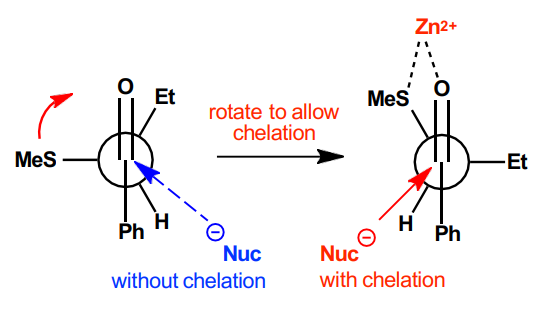
What is required for chelation control to occur? (2)
A heteroatom with lone pairs available for coordination to a metal.
A metal ion that prefers to coordinate to >1 heteroatom at once; typically M2+ or higher
TRUE OR FALSE: Chelation increases the rate of the addition reaction
TRUE
TRUE OR FALSE: Alkenes are nucleophilic
TRUE, BUT can also be electrophilic

Epoxidation reaction

What determines the stereospecificity of epoxidation? (2)
substituents will remain in same relative cis/trans configuration
mCPBA attacks less hindered face→ anti epoxide
hydroxyl (OH) groups can direct epoxidation to give syn epoxides

What is an exception to the general mechanism/stereoselectivity of epoxidation with mCBPA?
hydroxyl (OH) groups can direct epoxidation to give syn epoxides
What is the preferred/lowest energy conformation of an alkene?
with smallest group eclipsing/in the same plane as double bond

Epoxide ring opening gives what stereoselectivity of product?
OH from epoxide, retaining stereochemistry of epoxide, anti to nucleophile adding at less hindered position
Hydroboration
In unsymmetrical alkenes, the boron adds to the less-substituted carbon
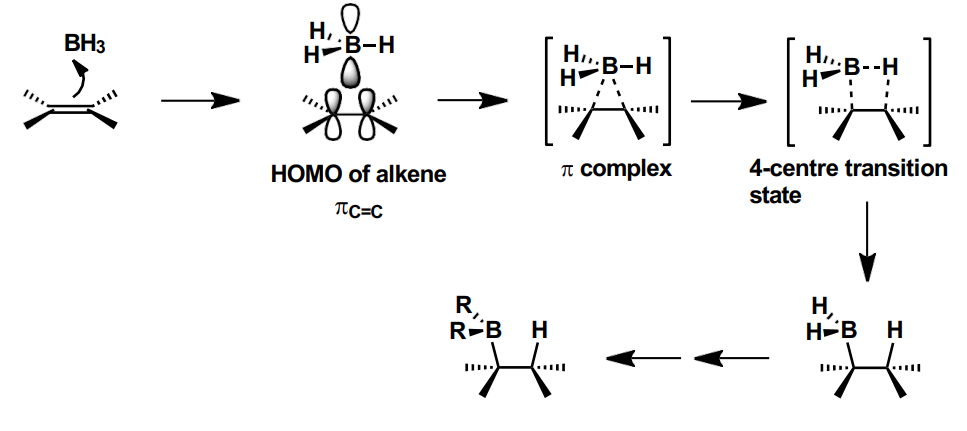
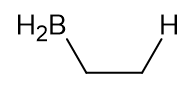
Oxidation of organoboranes: R2B-CR2-CHR2 —(a)→ (b)
a) H2O2, NaOH
b) HO-CR2-CHR2

Bromination of alkenes
anti addition of Br2 across the double bond

Iodolactonization
Syn addition of I+ followed by trans ring-opening generates the anti product

Simmons-Smith reaction
converting an alkene into a cyclopropane

What result does presence of an OH group have on Simmons-Smith reaction?
cyclopropanate over 100 times faster
new CH2 group also adds to the same face of the double bond as the hydroxyl group
R2CO + LDA → ?

Enolate stereochemistry assignment (E/Z, Re/Si)

Stereoelectronic effects controlling enolate formation
Hint: deprotonation
Deprotonation is favoured when the C-H bond is perpendicular to the C=O bond

Formation of which stereochemistry enolate is normally favoured for ketone in a) acyclic and b) cyclic systems?
a) Z-isomer
b) E-isomer; only one they can give

Reactive conformation of acyclic enolates (with stereocentre β to the carbonyl)
has C-H bond of the stereocenter co-planar with the plane of the enolate to minimise 1,3-allylic strain.

generic structure of Evans’ oxazolidinone chiral auxiliaries

synthesis of Evans’ oxazolidinone chiral auxiliaries from amino acids

Mechanism of Evans’ oxazolidinone chiral auxiliaries in synthesis (5 steps)
deprotonate auxiliary: H-NR2 —n-BuLi→ -NR2
attach carbonyl (acid chloride): -NR2 + RCOCl → RCO-NR2
deprotonate at α-C to form Z enolate
LDA/ alkali metal coordination; M+
Reaction with electrophile (activated alkyl halides) on opposite face to bulky group

Davis oxaziridine
electrophilic source of oxygen

Davis oxaziridine + Evans’ oxazolidinone system→ ?
asymmetric synthesis of C-O- bonds

Evans’ oxazolidinone chiral auxiliaries removal (4)
H- (NaBH4/ LiAlH4) → HOCH2R
H2O2, LiOH → HO2CR
LiSEt → RCOSEt
LiOBn → RCO2Bn

RCO-NR2 + NaBH4 or LiAlH4 → ?
RCH2OH


RCO-NR2 + M(:X)R →
where M= alkaline earth metal (M+)
and :X= group 16 element
RCO-:XR


RCO-NR2 + H2O2, LiOH →
RCOOH

TRUE OR FALSE: stoichiometric quantities of the Evans’ auxiliary are needed
TRUE, BUT can be recovered/ recycled after cleavage
Do the following conditions promote E1 or E2 elimination?: greater a) base concentration, b) base strength, c) carbocation stability
a) E2
b) E2
c) E1
acid catalysed aldol reaction
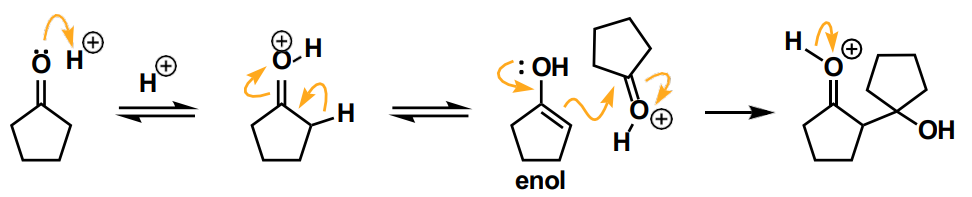
Elimination is easier under (acidic/basic) conditions and occurs via (E1/E2) mechanism
Elimination is easier under acidic conditions and occurs via E1 mechanism
What does an aldol (1,3- hydroxycarbonyl) turn into once it is subject to a) elimination, b) oxidation, c) reduction?
a) enone R(C=O)-C=C
b) dicarbonyl
c) diol

What requirements have to be satisfied for a chemoselective aldol reaction? (2)
Only one enolate possible/ specific enol equivalent used
The other partner is significantly more electrophilic
Lithium enolate formation

structure of LDA
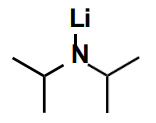
formation of aldol from lithium enolate intermediate
through Zimmerman-Traxler transition state

R2CO—(a; 2)→ (boron enolate; b)
R2CO—R2B-Cl, NEt3→ R2CO-BR2

formation of aldol from boron enolate intermediate

R2CO—(a; 2)→ (silyl enol ether; b)
R2CO—R3Si-Cl, NEt3→ R2CO-SiR3
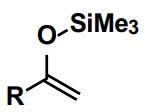
formation of aldol from silyl enolate intermediate

With substituted enolates, the aldol reaction forms (…) new stereocentres
2
What stereochemistry aldol products do a) cis and b) trans enolates give?

favoured Zimmerman-Traxler transition state for trans enolate

favoured Zimmerman-Traxler transition state for cis enolate


What will be the result of this reaction if R= a) sterically demanding, b) small substituent?
a) cis lithium enolate
b) trans lithium enolate

How can of Enolate/enol equivalent Geometry be made to favour cis or trans?
Boron enolates from BR2Cl
where R2 is sterically demanding to favour trans
and less so to favour cis
How can Evans’ auxiliary be exploited in aldol reactions?
serve as a large R group for [RCOC-R ] to favour cis enolate

Benefits of organocatalysts (6)
Simple to work with
No expensive metals or reagents
Catalytic in a cheap chiral source
High yields
High enantioselectivities
Green solvent
in acyclic systems hydroxyl groups need what characteristic to behave as a directing group?
allylic to C=C; RC=C-COH

The presence of OH groups will result in what product with the reagents:
VO(acac)2, t-BuOOH
epoxide added across double bond from same face as OH

Sharpless epoxidation reagents (4)
DET
Ti(OiPr)4
allylic alcohols (R2C=CR-COH)
tBuOOH
a) What is the structure of (+)-DET and b) what face of the alkene does it attack?
a) image
b) Re for trans, Si for cis (to OH)

a) What is the structure of (-)-DET and b) what face of the alkene does it attack?
a) image
b) Si for trans, Re for cis (to OH)

What side of the double bond do the enantiomers of DET add OH?
in the conformation with OH bottom right, (+)-DET adds below and (-)-DET adds above

Ring opening of an epoxide (acidic conditions) gives what stereochemical outcome?
anti diol
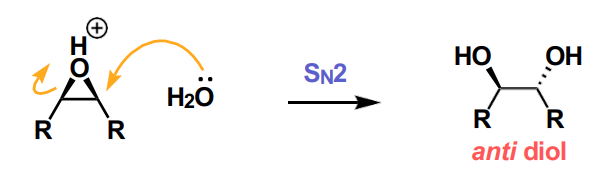
how are syn diols formed?
OsO4

In Sharpless dihydroxylation, what is the relationship between the two reagents?
pseudo-enantiomers; enantiomeric at all but one stereocenter as both enantiomers of quinine and quinidine are not readily available
AD-mix-α contains …
(DHQ)2PHAL
AD-mix-β contains …
(DHQD)2PHAL
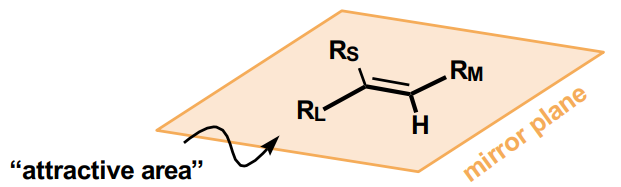
For Sharpless dihydroxlation, the largest group can be placed front right with alkene along y-axis, as for the OH group in Sharpless epoxidation; what faces will DHQ/DHQD add to?

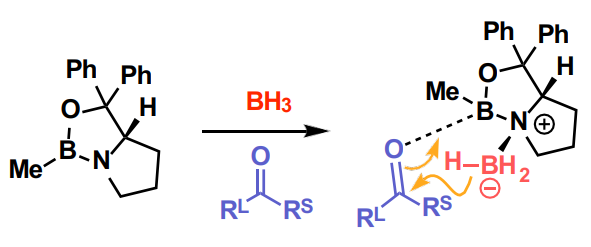
Corey-Bakshi-Shibata transition state rationalizing stereoselectivity

Corey–Bakshi–Shibata a) reaction b) reagents and c) product
a) enantioselective reduction of a ketone to an alcohol
b) CBS catalyst (image), BH3, R2CO
c) R2CHOH
RNH2 + R2CO—(a)→ (b)
a) needs acid catalyst
b) RHC=NR

HNR2 + R2CO→ ?

What is the electro/nucleophilicity of a) iminiums, b) enamines?
a) electrophilic
b) nucleophilic

enamine catalysis transition state/ enantioselectivity
least sterically clashing configuration made

What determines the preferred a) enamine and b) aldol formed in enamine catalysis?
a & b) occurs at the least hindered ketone (fewest R groups on α-Carbon)
Mannich reaction
imine (less hindered carbonyl) + enol (enolizable reagent)

If the Mannich reaction is conducted under enamine catalysis, the enamine will act as the (electrophile/nucleophile)
If the Mannich reaction is conducted under enamine catalysis, the enamine will act as the nucleophile; opposite reactivity to imine
What feature of imines allows them to react enantioselectively?
convert between trans/cis very fast and heavily favour trans

Key design considerations for iminium catalysis (2)
Enamine formation must be avoided
iminium geometry needs to be controlled
Kinetic resolution, for example, in Sharpless Epoxidation
if the rate of two reactions of a racemic mixture is significantly different, stopping the reaction at 50% completion can give just one stereoisomer of product ie. only pink product in image

imine formation

enamine formation
same as imine, but if there is a C–H protons next to the C=N the pictures conversion occurs
