AP World History Flashcards: Key Terms 5.1 & 5.2
 Call Kai
 Learn
 Practice Test
 Spaced Repetition
 Match
 Flashcards
1/47

There's no tags or description
Looks like no tags are added yet.
48 Terms
Enlightenment
A philosophical movement which started in Europe in the 1700's and spread to the colonies. It emphasized reason and the scientific method. Writers of the enlightenment tended to focus on government, ethics, and science, rather than on imagination, emotions, or religion. Many members of the Enlightenment rejected traditional religious beliefs in favor of Deism, which holds that the world is run by natural laws without the direct intervention of God.
Nationalism
Loyalty and devotion to others who share one's language and culture; the idea that people who share a culture should also live in independent nation-states threatened multiethnic empires in Europe
John Locke
English philosopher who advocated the idea of a "social contract" in which government powers are derived from the consent of the governed and in which the government serves the people; also said people have natural rights to life, liberty and property.

Social Contract
An agreement between the people and their government signifying their consent to be governed

philosophes
18th century writers who stressed reason and advocated freedom of expression, religious toleration, and a reformed legal system. Leading philosophes such as Voltaire fought irrational prejudice and believed that society should be open to people of talent.

Baron Montesquieu
French political philosopher who wrote "Spirt of the Laws"; advocated the separation of executive and legislative and judicial powers

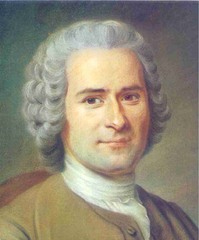
Jean-Jacques Rousseau
expanded on idea of social contract; wrote that government should exist to protect common good
Adam Smith
Scottish economist who wrote the "Wealth of Nations" calling for freer trade; a precursor to modern Capitalism.

Laissez-faire
Idea from Adam Smith; government should play as small a role as possible in economic affairs.
Capitalism
an economic and political system in which a country's trade and industry are controlled by private owners for profit, rather than by the state.
Deism
Enlightenment re-examination of the relationship between God and humans; put forth idea that God existed and had created the world, but that afterwards He left it to run by its own natural laws; metaphor of God as watchmaker who does not intervene in day-to-day workings
Thomas Paine
American Revolutionary leader and pamphleteer who supported the American colonist's fight for independence and supported the French Revolution (1737-1809)
Conservatism
a political philosophy based on tradition and social stability, favoring obedience to political authority and organized religion
Socialism
a political and economic theory of social organization that advocates that the means of production, distribution, and exchange should be owned or regulated by the community as a whole.
Utopian Socialism
Philosophy introduced by the Frenchman Charles Fourier in the early nineteenth century. Utopian socialists hoped to create humane alternatives to industrial capitalism by building self-sustaining communities whose inhabitants would work cooperatively
Fabian Society
Group of English socialists, including George Bernard Shaw, who advocated reform and electoral victories rather than violent revolution to bring about social change.
Robert Owen
British cotton manufacturer believed that humans would reveal their true natural goodness if they lived in a cooperative environment; tested his theories at New Lanark, Scotland and New Harmony, Indiana, but failed
Classical Liberalism
The political ideology of individual liberty, private property, a competitive market economy, free trade, and limited government; promoted the idea that the less government does, the better, particularly in reference to economic policies such as tariffs and incentives for industrial development; attacking corruption and defending private property, late-nineteenth-century liberals generally called for expanded male suffrage
Feminism
the belief that women should possess the same political and economic rights as men
Mary Wollstonecraft
English writer of "A Vindication of the Rights of Women"; early feminist who denied male supremacy and advocated equal education for women
abolitionism
the movement to end the Atlantic slave trade and free all enslaved people and an end to serfom; grew in strength in the 18th century
End of Serfdom in Russia
occurred in 1861 under Alexander II; emancipation of 23 million serfs was the largest single emancipation of people in bondage in human history
Zionism
A movement founded in the 1890s to promote the establishment of a Jewish homeland in Middle East; lead by Theodor Herzl
Anti-Semitism
hostility to or prejudice against Jews.
Dreyfus Affair
A divisive case in which Alfred Dreyfus, a Jewish captain in the French army, was falsely accused and convicted of treason. The Catholic Church sided with the anti-Semites against Dreyfus; after Dreyfus was declared innocent, the French government severed all ties between the state and the church.
Declaration of Independence
1776 statement explaining why the Americans colonies were declaring independence from Britain; written by Thomas Jefferson; relied on ideas from John Locke including "unalienable rights" and the idea of the social contract

New Zealand Wars
series of armed conflicts that took place in New Zealand from 1845 to 1872 between the British colonial New Zealand government and the Māori; won by the British

French Revolution
The revolution that began in 1789, overthrew the absolute monarchy of the Bourbons and the system of aristocratic privileges, and ended with Napoleon's seizure of power in 1799.
Estates General
An assembly of representatives from all three of the estates, or social classes, in pre-revolutionary France.
Bastille
fortress in Paris used as a prison; French Revolution began when Parisians stormed it in 1789
Declaration of the Rights of Man and Citizen
Statement of fundamental political rights adopted by the French National Assembly at the beginning of the French Revolution; Louis XVI refused to accept its calls for limited monarchy
Reign of Terror
period during the French Revolution led by Robespierre when thousands of opponents of the revolution were executed; resulted in the execution of King Louis XVI
Haitian Revolution
the only successful slave revolt in history; led by Toussaint L'Ouverture, who was inspired by Enlightenment ideals; modeled after American and French Revolutions
Maroons
Runaway African slaves who joined the Haitian revolution
Haiti
Name that revolutionaries gave to the former French colony of Saint Domingue; only country to become permanently independent as a result of a slave uprising; first black-led country in Western Hemisphere
Creoles
Descendants of Spanish-born but born in Latin America; resented their inferior social, political, economic status.
Mestizos
A person of mixed Native American and European ancestry; wanted more political power and share of economic wealth
Peninsulares
Spanish-born, came to Latin America; ruled, highest social class
Simon Bolivar
The most important military leader in the struggle for independence in South America. Born in Venezuela, he led military forces there and in Colombia, Ecuador, Peru, and Bolivia; wrote "Jamaica Letter" which outlined goals for an independent Latin America
Caudillos
Independent leaders who dominated local areas by force in defiance of national policies; sometimes seized national governments to impose their concept of rule; typical throughout newly independent countries of Latin America.
Lola Rodriguez de Tio
Puerto Rican poet who supported Puerto Rican and Cuban independence.
Propaganda Movement
Revolutionary group in the Philippines led by Jose Rizal; distributed magazines, pamphlets, and other publications that agitated for greater autonomy for the Filipino people from Spain
Italian Unification
led by Count Cavour, who worked to unify the North then helped Giuseppe Garibaldi unify the South staring with Sicily. Garibaldi eventually stepped aside and handed over all of Southern Italy to Victor Emmanuel II (King of Sardinia) rule all of the now unified Italy
Risorgimento
Italian nationalist movement led by Giuseppe Mazzini
Realpolitik
Political realism or practical politics, especially policy based on power rather than on ideals.
Otto von Bismarck
Conservative nationalist Chancellor of Prussia who led the unification of Germany; led Prussia to victory against Austria (1866) and France (1870) and was responsible for the creation of the German Empire.
Balkan nationalism
Movements to create independent nations within the Balkan possessions of the Ottoman Empire; provoked a series of crises within the European alliance system; eventually led to World War I.
Ottomanism
An ideology developed by the Ottoman state to create a modern, unified state; aimed to strengthen their subjects' loyalty and solidarity; focused on the idea the all subjects are equal (despite religious/ethnic/linguistic differences)