Arch History Flashcards Midterms
 Call Kai
 Learn
Learn Practice Test
 Spaced Repetition
 Match
Match Flashcards
 Knowt Play
1/131

Earn XP
Name | Mastery | Learn | Test | Matching | Spaced | Call with Kai | Chat |
|---|
No analytics yet
Send a link to your students to track their progress
132 Terms

Reconstruction drawing, of a prehistoric hut, Terra Amata, near Nice, France,
ca. 400,000 BC

Figure of a nude woman (Venus of Willendorf), from Willendorf, Austria, limestone, ca. 28000-25000 BC

Woman holding a bison horn, from Laussel, Dordogne, France, painted limestone, ca. 25000-20000 BC

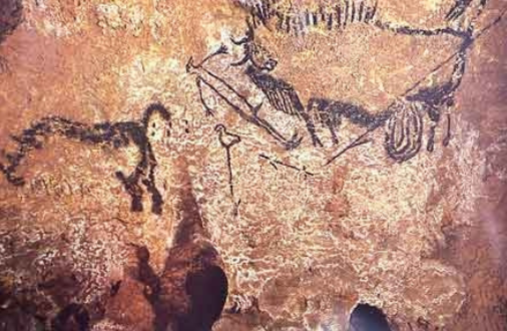
Painted caves at Lascaux, Dordogne, France, ca. 15000-13000 BC. Discovered 1940

Carnac alignments, Brittany, France, ca. 4250-3750 BC

Dolmen Menga, Antequera, Andalusia, Spain, ca. 2500 BC

Stonehenge, Wiltshire, England, ca. 2900-1400 BC


Avebury, Wiltshire, England, ca. 3250-2600 BC

Göbekli Tepe, Turkey, ca. 9600-8200 BC

Çatal Hüyük, Konya Plain, Anatolia, Turkey, ca. 6500-5700 BC
dolmen
a prehistoric tomb made of large upright stones, capped with a horizontal stone, and originally buried under an earth mound.
henge
a circle of upright stones or posts
megalith
a large stone
menhir
a prehistoric monument in the form of a large, upright stone.
palimpsest
a surface that is written or drawn upon, and then cleared and reused, often leaving trace remnants of the previous work.
trabeation
construction using upright posts and horizontal lintels, not arches or vaults; also known as “post-and-beam” or “post-and-lintel” construction.
wattle and daub
building materials used for making walls, consisting of “wattle” or thin branches
weaved between upright stakes and reinforced by applying “daub” or a plaster-like substance over the wattle structure.
in situ
Latin, “in place” (as in, still located in its original place)
lithos
Greek, "stone”
Stone Age
• Paleolithic Period – ca. 40000-10000 BC
• Mesolithic Period – ca. 10000-8000 BC
• Neolithic Period – ca. 8000-3500 BC
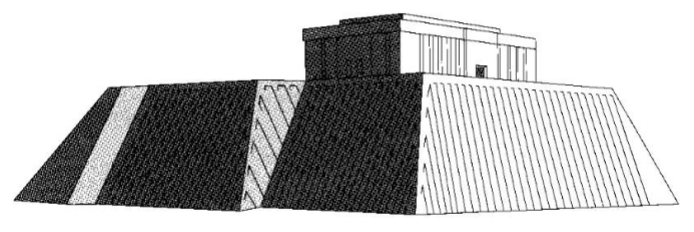
White Temple and Ziggurat, Uruk (Warka, Iraq), ca. 3500-3000 BC

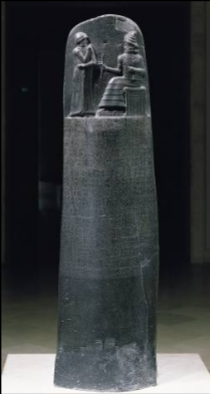
Stele with law code of Hammurabi, from Susa, Iran, basalt, ca. 1780 BC [Louvre]

Statues of Gudea, including one holding temple plan (on right), from Girsu, Iraq, diorite, ca. 2100 BC

Ziggurat of Ur-Nammu, Ur, Iraq, ca. 2100 BC

Citadel of Sargon II at Dur Sharrukin (Khorsabad, Iraq), ca. 720 BC

Citadel of Sargon II at Dur Sharrukin (Khorsabad, Iraq), ca. 720 BC
pair of lamassu figures at the British Museum, London

Citadel of Sargon II at Dur Sharrukin (Khorsabad, Iraq), ca. 720 BC
lamassu and tribute bearers in the Oriental Institute at the University of Chicago
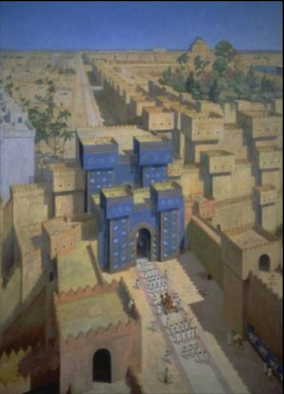
Ishtar Gate and Processional Way, Babylon, ca. 575 BC

bent-axis approach
in ancient Mesopotamia, an indirect approach into a temple or Cella; generally, gods entered a temple through the long axis, while humans entered on the short axis and turned 90-degrees to approach the cult statue.
bitumen
an asphalt of Asia Minor used in ancient times as a cement and mortar.
cella
the main room in a temple, housing the cult statue.
lamassu
an Assyrian guardian in the form of a human-headed winged bull.
ziggurat
in ancient Mesopotamia, a pyramidal mound or tower built of mud-brick forming the base of a temple, usually stepped or having a broad ascent winding around it.
Austen Henry Layard (1817-1894)
British archaeologist who excavated sites in Nineveh, Nimrud, and
Babylon for the British Museum mostly in the 1840s. He published the
results of his excavations in multiple illustrated volumes, including
Nineveh and its Remains
Leonard Woolley (1880-1960)
British archaeologist who excavated Ur for the University of
Pennsylvania and the British Museum in the 1920s and 1930s.
Protoliterate (ca. 3500-3000 BC)
• Political authority rests in an assembly of male citizens, who select short-term war leaders.
• Agricultural towns acquire ring-walls.
• The temple and ziggurat gain architectural definition
Early Dynastic (ca. 3000-2350 BC)
• Kingships develop (rulers in times of peace). First elected, then hereditary.
• Growth of monumental palaces.
• Growth of an administrative center and a large bureaucracy.
• Codification of a writing system: cuneiform.
Later Sumerian (ca. 2350-1600 BC)
• Rise of empire.
• Collective rule of several city-states by sovereign ruler
Assyrian (1350-862 BC)
• Marked by an imposing single state and its palaces, like at Dur Sharrukin (Khorsabad).

Rosetta Stone, granodiorite, Ptolemaic era, ca. 196 BC
Discovered by Napoleon’s troops in 1799 near el-Rashid (Rosetta), Egypt.;
Surrendered to British as part of terms of Treaty of Alexandria in 1801.
Diciphered in 1822. Now in the British Museum.

Mastaba Stone Diagrams

Imhotep, arch., Funerary complex of King Djoser, Saqqara, Egypt,
Dynasty III (Old Kingdom), ca. 2630 BC
First monumental construction in stone masonry
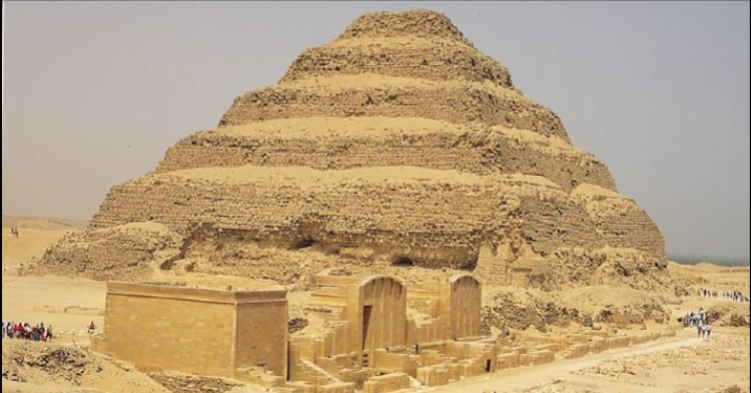

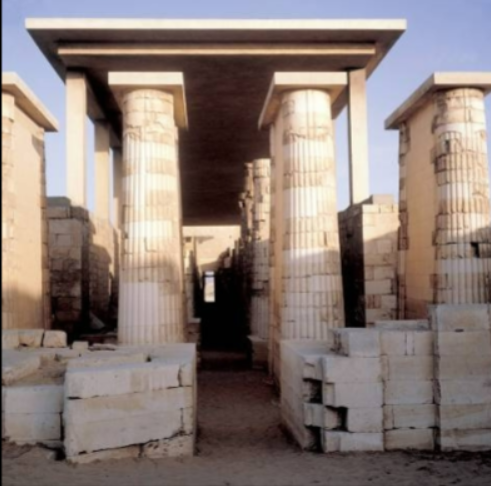
Imhotep, arch., Funerary complex of King Djoser, Saqqara, Egypt,
Dynasty III (Old Kingdom), ca. 2630 BC
Entrance hall and colonnade

Southern mastaba (at top middle)
Imhotep, arch., Funerary complex of King Djoser, Saqqara, Egypt,
Dynasty III (Old Kingdom), ca. 2630 BC

Jubilee Court; “dummy” buildings
Imhotep, arch., Funerary complex of King Djoser, Saqqara, Egypt,
Dynasty III (Old Kingdom), ca. 2630 BC
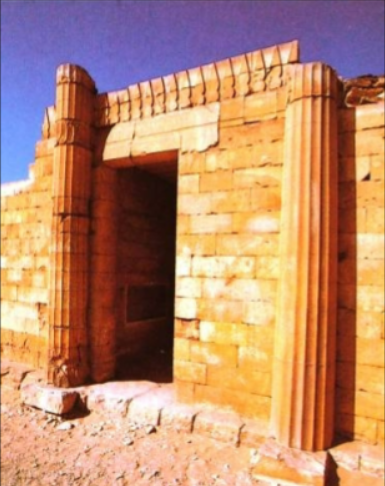
dummy South Palace
Imhotep, arch., Funerary complex of King Djoser, Saqqara, Egypt,
Dynasty III (Old Kingdom), ca. 2630 BC

dummy North Palace
Imhotep, arch., Funerary complex of King Djoser, Saqqara, Egypt,
Dynasty III (Old Kingdom), ca. 2630 BC

Step Pyramid
Imhotep, arch., Funerary complex of King Djoser, Saqqara, Egypt,
Dynasty III (Old Kingdom), ca. 2630 BC

Bent Pyramid of Sneferu, Dahshur, Egypt, Dynasty IV (Old Kingdom)

Great Sphinx, before the Pyramid of Khafre (Chefren), Giza, Egypt,
Dynasty IV (Old Kingdom), ca. 2530 BC

Plan of the Valley and Mortuary Temples for Khafre, Giza, Egypt,
Dynasty IV (Old Kingdom), ca. 2530 BC

Great Pyramid of Khufu (Cheops), Giza, Dynasty IV (Old Kingdom), ca. 2550 BC

Great Pyramid of Khufu (Cheops), Giza, Dynasty IV (Old Kingdom), ca. 2550 BC
Section

Great Pyramid of Khufu (Cheops), Giza, Dynasty IV (Old Kingdom), ca. 2550 BC
Grand Gallery


Great Pyramid of Khufu (Cheops), Giza, Dynasty IV (Old Kingdom), ca. 2550 BC
King’s Chamber

Great Pyramid of Khufu (Cheops), Giza, Dynasty IV (Old Kingdom), ca. 2550 BC
Section showing relieving-lintels over King’s Chamber

Rock-cut tombs at Beni Hasan, Egypt, Dynasty XII (Middle Kingdom), ca. 2000-1900 BC


Rock-cut tomb of Amenemhet, Beni Hasan, Dynasty XII (Middle Kingdom), ca. 2000-1900 BC
Plan and section

Rock-cut tomb of Amenemhet, Beni Hasan, Dynasty XII (Middle Kingdom), ca. 2000-1900 BC
Interior showing “columns” cut from rock

Rock-cut tomb of Amenemhet, Beni Hasan, Dynasty XII (Middle Kingdom), ca. 2000-1900 BC
Niche with broken effigy

Rock-cut tomb of Amenemhet, Beni Hasan, Dynasty XII (Middle Kingdom), ca. 2000-1900 BC
Wall painting showing Amenemhet collecting tribute from his estates

Rock-cut tomb of Kheti, Beni Hasan, Dynasty XII (Middle Kingdom), ca. 2000-1900 BC
Plan and section

Rock-cut tomb of Kheti, Beni Hasan, Dynasty XII (Middle Kingdom), ca. 2000-1900 BC
Interior showing papyrus-bud-capital “columns”

Corridor tomb of Seti I, Valley of the Kings, near Thebes,
Dynasty XIX (New Kingdom), ca. 1279 BC


Corridor tomb of Seti I, Valley of the Kings, near Thebes, Dynasty XIX (New Kingdom), ca. 1279 BC
upper pillared hall

Corridor tomb of Seti I, Valley of the Kings, near Thebes, Dynasty XIX (New Kingdom), ca. 1279 BC
burial chamber

Funerary Temple of Mentuhotep II, Deir el-Bahari, Thebes,
Dynasty XI (Middle Kingdom), ca. 2061-2010 BC
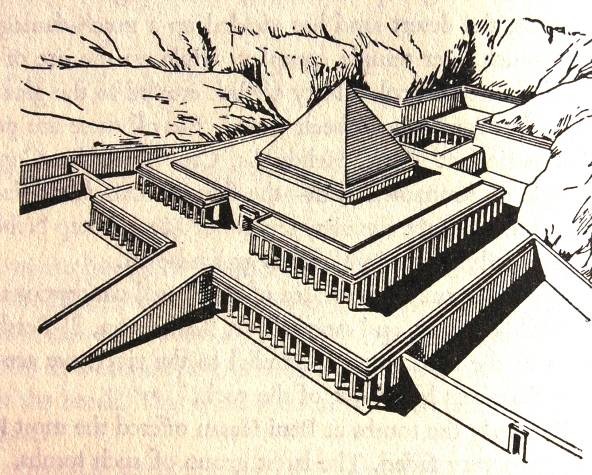

Funerary Temple of Mentuhotep, Deir el-Bahari, Thebes,
Dynasty XI (Middle Kingdom), ca. 2061-2010 BC


Senmut, arch., Funerary Temple of Queen Hatshepsut, Deir el-Bahari, Thebes,
Dynasty XVIII (New Kingdom), ca. 1473-1458 BC

Senmut, arch., Funerary Temple of Queen Hatshepsut, Deir el-Bahari, Thebes,
Dynasty XVIII (New Kingdom), ca. 1473-1458 BC
Portico of the Anubis Sanctuary

Senmut, arch., Funerary Temple of Queen Hatshepsut, Deir el-Bahari, Thebes,
Dynasty XVIII (New Kingdom), ca. 1473-1458 BC
Chapel to Hathor, with Hathor-headed capitals

Senmut, arch., Funerary Temple of Queen Hatshepsut, Deir el-Bahari, Thebes,
Dynasty XVIII (New Kingdom), ca. 1473-1458 BC
Punt Colonnade

Senmut, arch., Funerary Temple of Queen Hatshepsut, Deir el-Bahari, Thebes,
Dynasty XVIII (New Kingdom), ca. 1473-1458 BC
Restored colossal statues of Hatshepsut as Osiris
Periods in Ancient Egypt
Early Kingdom - Dynasties I to IV - ca. 2920 – 2134 BC
Middle Kingdom - Dynasties XI – XIII - ca. 2040 – 1640 BC
New Kingdom - Dynasties XVIII – XX - ca. 1550 – 1070 BC
Late Period Dynasties - XXI – XXXI - ca. 664 – 332 BC
Ptolemaic Period - ca. 310 – 30 BC
Reed construction
A traditional Egyptian form of building with dried river reeds that are bound together
Ben-ben
A cone shaped stone in Egypt, which was the most sacred relic of the sun god Re; the basis of the pyramidion form
ashlar
hewn blocks of masonry wrought to even faces and square edges and laid in horizontal courses with vertical joints, as opposed to rubble or unhewn stone straight from the quarry
axis
a main line of direction, motion, growth, or extension
atlantid
a male figure that functions as a supporting column
Book of the Dead
ancient Egyptian guidebook placed in tombs for a deceased person’s spirit to use to navigate successfully through the underworld and seek out judgment before Osiris
caryatid
a female figure that functions as a supporting column
clerestory
windows placed high in a wall, usually above lower roof elements
colonnade
a row of columns that carries an entablature
colossal
very large; as in, a colossal statue or colossal column (which rises several stories)
column
an upright structural member, circular in plan, and usually slightly tapering; in classical architecture it consists of a base, shaft, and capital
engaged column
a column attached to or appearing to be partly embedded in a wall
hypostyle hall
a large hall composed of many columns placed closely together to support the roof, which gives the appearance of a forest of columns
ka
in ancient Egypt, the immortal human life force (spirit)
mastaba
from Arabic, bench) an Egyptian tomb with flat top and sloping sides, built over a grave shaft
necropolis
(Greek, city of the dead) a large burial area or cemetery
Proto-Doric columns
column forms found in ancient Egypt which pre-date (come “before”) later Greek Doric columns, but which look very similar
relieving lintel
acts similarly to a relieving arch. A lintel (or rough construction) placed in a wall or above an opening to relieve it of superincumbent weight
serdab
a small, concealed chamber in an Egyptian mastaba for the statue of the deceased
sphinx
a mythical Egyptian beast with the body of a lion and the head of a human
Major gods/goddesses:
Osiris
Isis
Horus
Re
Amon-Re
Pyramids at Giza:
Khufu = Cheops (The Great Pyramid)
Khafre = Chefren
Minkaure = Mycerinus
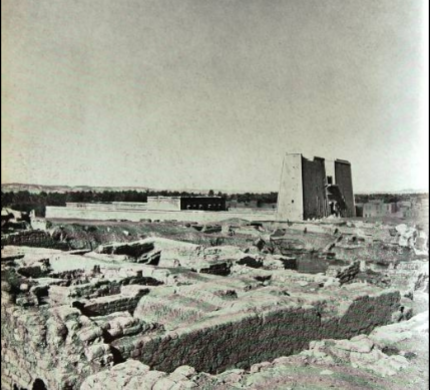
Temple of Horus, Edfu, Dynasty XXXI (Ptolemaic), 237-57 BC
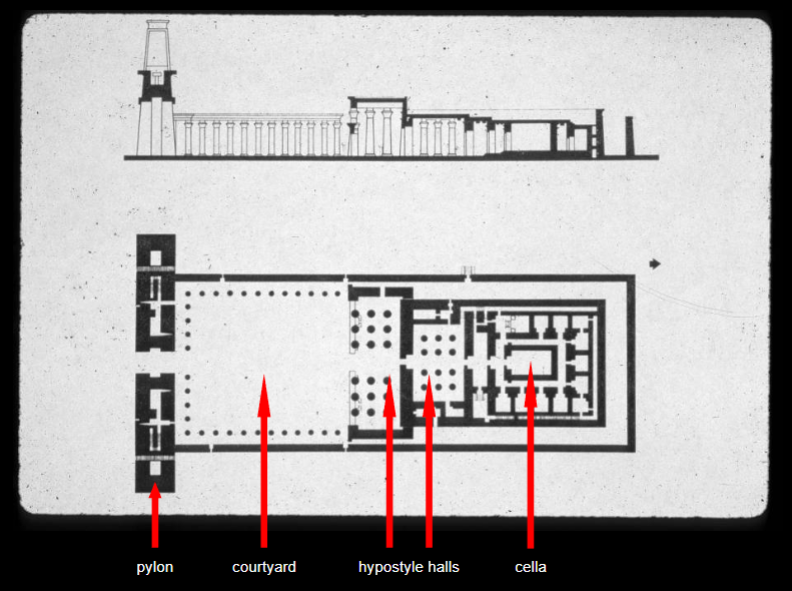
Temple of Horus, Edfu, Dynasty XXXI (Ptolemaic), 237-57 BC
Section and plan

Temple of Horus, Edfu, Dynasty XXXI (Ptolemaic), 237-57 BC
Pylon


Parts of a temple entrance
Temple of Horus, Edfu, Dynasty XXXI (Ptolemaic), 237-57 BC