Entomology LECTURE Test 3
 Call Kai
 Learn
Learn Practice Test
 Spaced Repetition
 Match
Match Flashcards
 Knowt Play
1/134

There's no tags or description
Looks like no tags are added yet.
Name | Mastery | Learn | Test | Matching | Spaced | Call with Kai | Chat |
|---|
No analytics yet
Send a link to your students to track their progress
135 Terms
What is true regarding how insects give birth?
Most insects lay eggs. Some give live birth but most do not
Why do insects need to hide their eggs? Give an example of an insect that hides their eggs
They need to hide their eggs because eggs are a very good meal for alot of predators.
An example of this is neuroptera. Silk is producedfrom abdomen with egg on the end of stalk. Insects and predators walk right past this without noticing
What is true about stinging insects and their ability to lay eggs?
Stinging hymenoptera cannot use their stinger as an ovipositor anymore. Egg is passed through a canal and some eggs are VERY slender. Use a special kind of egg called an Ootheca
What is the term for an egg case that protects egg from desiccation? Lots of hemiptera and cockroaches use this
Ootheca
Explain parthenogensis. Does it vary? How!
Parthenogenesis is when females produce offspring without being fertilized. Some produce males, some will onloy produce clones of self. Varies by species
Explain Pedogenesis.
Production of offspring from immature insects (nonadults). Parasitic or pest species commonly do this to have as many offspring as possible.
____ is when a non-terminal instar develops reproductive features of the adult. Adult has kept immature characteristicsand devleopms reproductive features. NOT Just seen in insects. Flightless birds and toy dogs are examples
Neoteny
Explain Hemaphroditism. Is it very common in insects?
Hemaphroditism is when you have both male and female reproductive organs. It is NOT very common in insects. very common in inverts in general though
Explain Polyembryony
Two or more embryos from a single egg by subdivision. Common in parasitic insects. Allows parasites to produce clones of self
Explain what molting essentially is for an insect
molting is ecdysis which is the changing of the cuticle
When is growth restricted to in insects
postmolt period before the cuticle hardens.
What are the two types of growth when it comes to molting? Explain who does each.
Determinate and Indeterminate Growth
Indeterminate growth: Entognatha, Zygentoma. (wingless hexopods/insects)
Keep molting throughout life.
determinate Growth: Everyone Else
Set amount of ecdysis events
How might one know if they have collected an immature? What is the one exception?
If you see wings, you have an adult. The one exception is the subimago mayflies undergo. They grow wings to fly upstream before fully maturing so eggs can flow downstream
What are the three types of development?
Ametabolous, Hemimetabolous, and holometabolous
What type of development:
-Emerge from egg resembling miniature adults
give example
Ametabolous
Zygentoma and Archeognatha
What type of development>
Process of going through the pupa stage (coccoon)
Evolved ONCE. Everyone that evolved from this ancestor is _____.
So many individuals exist because of the usefulness of the pupa stage.
holometabolous
What type of development?
-Nymph looks diff from adult
-Growth by molting. No pupa stage.
Hemimetabolous
Explain the difference between Exoptergote and Endopterygote
Endopterygote is another word for holometabolous. Wings develop from cells that we know of as imaginal disks, which strore memoreis from insects from larvae to adult
Exopterygote is another word for hemimetabolous. Wings develop on outside of the body from wingpads (hemiptera)
Define larvae and explain the growth process it undergoes
Larvae is the immature form of holometabola, the stage following egg and before pupa. Many instars exist.
Egg-first instar larvae- (ecdysis)-second onstar)-ecdysis-third instar (ecdysis) pupa (ecdysis) adult.
Define an instar
Different iterations of larvae and nympths as they grow
Explain what a nymph is
A nymph is an immature of hemimetabola. This is the stage following egg and before adult. Also has instars, but no pupa stage exists. Ecdysis events happen through every change similarly though
What are the three functional forms of larvae?
Apod Larvae
Oligopod Larvae
Polypod Larvae
Abbaccio owns publix
What type of larvae:
-legless larvae
-typically fly larvae, beetle on rare occasions
Apod larvae
What type of larvae:
-3 pairs of legs
-most orders have this form of larvae
oligopod larvae
What type of larvae:
-have more than 3 legs
-6 ‘legs’ coming out of abdomen
-pseudopods from the abdomen
-always will be caterpillars, moths, and on RARE occasions hymenoptera
Polypod larvae
What is the word used to describe the change between immatures and adults
metamorphasis
What is the term for the process of forming a pupa
pupation
When are adults fully formed inside the coccoon before they cut the cocoon to come out
Pharate adults
Define molting
the periodic formation of a new cuticle and shedding of the old cuticle. All muscles must be cut from the exoskseleton during molting and between instars
What occurs following an ecdysis event?
-Outside will slowly grow into new size after ecdysis event
-once they reach full size, new ecdysis event will occur
State the 4 steps of ecdysis
A) Growth Stops
B) Apolysis
C) Most of the endocuticle is digested. New exocuticle forms
D) Old exosuticle ready to be shed
Get A Morioh Orthopteran
Explain the Growth Stops stage of ecdysis
Cells in the body stop multiplying, Ecdysis triggering hormone starts.
Explain the Apolysis stage of ecdysis
Separate → Digest → Rebuild.
Separate: Epidermis pulls away from the old cuticle.
Digest: Molting fluid breaks down the old endocuticle.
Rebuild: The epidermis starts making the new cuticle, beginning with the epicuticle.
What are the layers of an insect (probably not on test, but good to know for reference for previous Q)
-Epicuticle layer is on top
-Exocuticle
-Endocuticle
-Epidermis (organic part)
You find a molt outside of a cicada! What cuticles are contained?
Epicuticle and a bit of the exocuticle
What is the name for the very stoft adult that is present right after molting occurs
Teneral adult
What is the differnence between aquatic teneral adults and terrestrial teneral adults?
Aquatic teneral adults fill up their body with water until it can be replaced with cells
Terrestrial teneral adults fill up their body with air until it can be replaced iwth cells
What are some things that occur to coordinate process of molting
Hormone and behevioral changes
What are the 3 types of hormones involved in molting?
1) Neuropeptides
2) Ecdysteroids
3) Juvenile Hormones
Not Everybody (can be) Jotaro
What are the three types of Neuropeptide Hormones that are invovled in molting
PTTH
ETH
EH
PTTH- stimulates the secretion of ecdysteroids
ETH- ecdysis triggering hormone (initiates the preecdysis behevior)
EH- eclosiou hormone (tells insect to escapte the old cuticle)
What is the term for how many generations there will be in a year? Can be uni, bi, multi, semi
Voltinism
Do insects develop continuously throughout the year?
No. Pupa, Ecdysis, and adult phases are all stops in development
Do all insects go from egg→ larvae/nymph→ adult?
Most do but not all. For example, the Micromathus beelte or telophone pole beetle.
These beetles only become adults in cases of extreme heat, and only become male in random situtions. Their normal life is spent in larvae form.
Define unioviparity
1 male egg is laid at a time
Define polyviviparity
several female larvae are produced at a time
Define matiphagy
consumption of mother by offspring.
What is the key organism used to study development
Drosophila
Explain Maternal MRNA? What is it produced by?
Maternal MRNA is MRNA specifically passed down from mother to child. It is is transcribed by the maternal effect gene/ egg polarity gene, as it provides polarity to the develping embryo. Without this embryo would not make it.
What type of genes produce the various sections of the body?
Gap Genes/segmentation genes
Explain the existance of a homeotic leg
Development of leg instead of antenna. tricks body into browing a leg where it doesn’t belong. not typically seen in surviving individuals .
What is the term for halted or slowed development? What are some examples?
Quiescence
ex: hybernation (winter) and aestiuation (summer)
What is the term for the further development of Quiecence invovlign slowed development combined with adaptive physiological response?
What is an example
Diapause
ex: mosquitos during dry periods. they will lay eggs and the eggs will wait until it rains before reactivating in puddles.
What impact does extreme cold have on insects?
low temperatures resemble dehydration because during low temperature, water freezes and befomes undrinkable.
Name the ways that insects may protect themselves from extreme cold
1) Cryoprotection
2)Freeze Avoidance
3)Chill Tolerance
Can Freeza chill
Explain Cryoprotection
most intense protection to cold. found only in individuals that live in areas where it is nearly always below freezing.
Insects produce several chemicals in their bodies that work as antifreeze known as ice-nucleating agents (INA) They raise the temperature at which body fluids begin to freeze, allowing ice to form in controlled locations and reducing the risk of supercooling and sudden, uncontrolled freezing.
Explain Freeze Avoidance
insects use this tha only sometimes live in an area with cold weather (chicago)
insects empty their digestive systems and synthesize glycol that serves as antifreeze. Winterize their bodies.
Explain chill tolerance
Bevioral adaptation to surviving freezing for a few days such as in late october or early november. cold snaps lead to death
Explain the impacts of extreme heat on insects
Extreme heat denatures proteins, leads to dehydration, and eventaully alters membrane structures
What is the one way that insects can deal with heat?
Behavioral adaptations such as coming out at night when it is cooler
What is the term for lack of water?
Aridity
What are the two major ways that insects can dealwith aridity? Explain each.
1)Carabidae
2)Tenebrionidae
-Carabidae invovles eating juice from prey for water
-Tenebrionidae is also called ‘fog basking’. Insects are active during morning when there is lots of dew. Insects catch this on body and take it in.
Define migration
persistant movement away from home to deal with harsh environmental conditions. normally a 2 way trip, but doesn’t have to be the same generation that left returning.
Explain the main difference between migration and dispersal
migration is a 2 way trip, dispersal is a 1 way trip.
What is a major exaple of migration in insects? Explain how this takes place.
Eastern Monarch Butterflies.
-Butterflies sense decreased temps and shortened day length (normally in combiantion)
-magnetic fields help them to navigate
-9 month journy in total
-adults born after august will migrate south to Mexico and arrive in mid November
-In early march, butterflies will begin journey north. Will not make it all the way and lay eggs and die
-SECOND generation will continue journey north and arrive in south USA by April/May, where they will again breed and lay eggs. 3rd generation wil do simialrly
-FOURTH generation will be the one that comes back to the same spot of canada/north usa where they started from
What is polymorphism? What are the two forms we discussed?
Different forms based on different conditions
1) Genetic Polymorphism
2) Sexual Dimorphism
3)Environmental Polymorphism
What type of polymorphism is differences seen between male and female individuals such as the large size of the female hissing cockroach and small size of the male hissing cockroach
sexual dimorphism/ genetic polymorphism
What type of polymorphism is differences caused by the environment? What are the two ways it can be?
Environmental Polymorphism.
It can be either seasonal or can be due to different foods recieved.
How can one estimate the growth stage of an immature?
body size
How can someone estimate the growth stage of an adult?
there are not many good ways to tell BUT body wear and tear, changes in body color, and age related physiological changes can sometimes be used.
What are the five environemntal effects on development?
A)Temperature
B) Photoperiod
C) Humidity
D)Mutagens and Toxins
E)Biotic effects
Tell polnareff he might turn bisexual
Which environemntal effect on insect development is described by
-insects will grow faster when it warms
-Physiological time is the amt of heat needed for an insect to complete their development
Temperature
Which environemntal effect on insect development is described by:
-most insects are ‘long-day’ insects that develop during the summer
photoperiod
Which environemntal effect on insects development is described as:
-insects enjoy 40-80% relative humidity
-ssues occur when humidity is too hight or too low.
-When humidity is too low you have no insects
-when humidity it too high, insects have fungus
Humidity
Which environemntal effect on insects development is described as:
-Fluctuating assymetry
-Very clearly seen in aquatic insects
mutagens and toxins
____ is when presence of lots of mutagens and toxins cause variations in symmetry or overall asymmetry
Fluctuating assympetry
Which environemntal effect on insects development is described as:
-amount and quality of food as well as crowding
biotic effects
What is the index that can be made to account for the 5 environemntal impacts to growth to allow predictiopons to be made? What type of modeling is this
Ecoclimatic index
Predictive Modeling
What does it mean to classify?
To document, order, and rank organisms into groups.
What is systematics?
The study of biological diversity that includes describing new species
What are some basic reasons we care about phylogenetics
-relationships of organisms
-used to figure out the evolution of structures
-used to study coevolutionary interactions
What are some applied reasons we care about phylogenetics
-used to track diseases (epidemiology)
-diversity of pathogens
-trace genes

Label the parts of the phylogentic tree
A- Tips
B- Branches
C-Root
D-Nodes
Where should you start when you read a phylogenetic tree?
the very top
_____ is the term used for the closest relative of a group
sister group
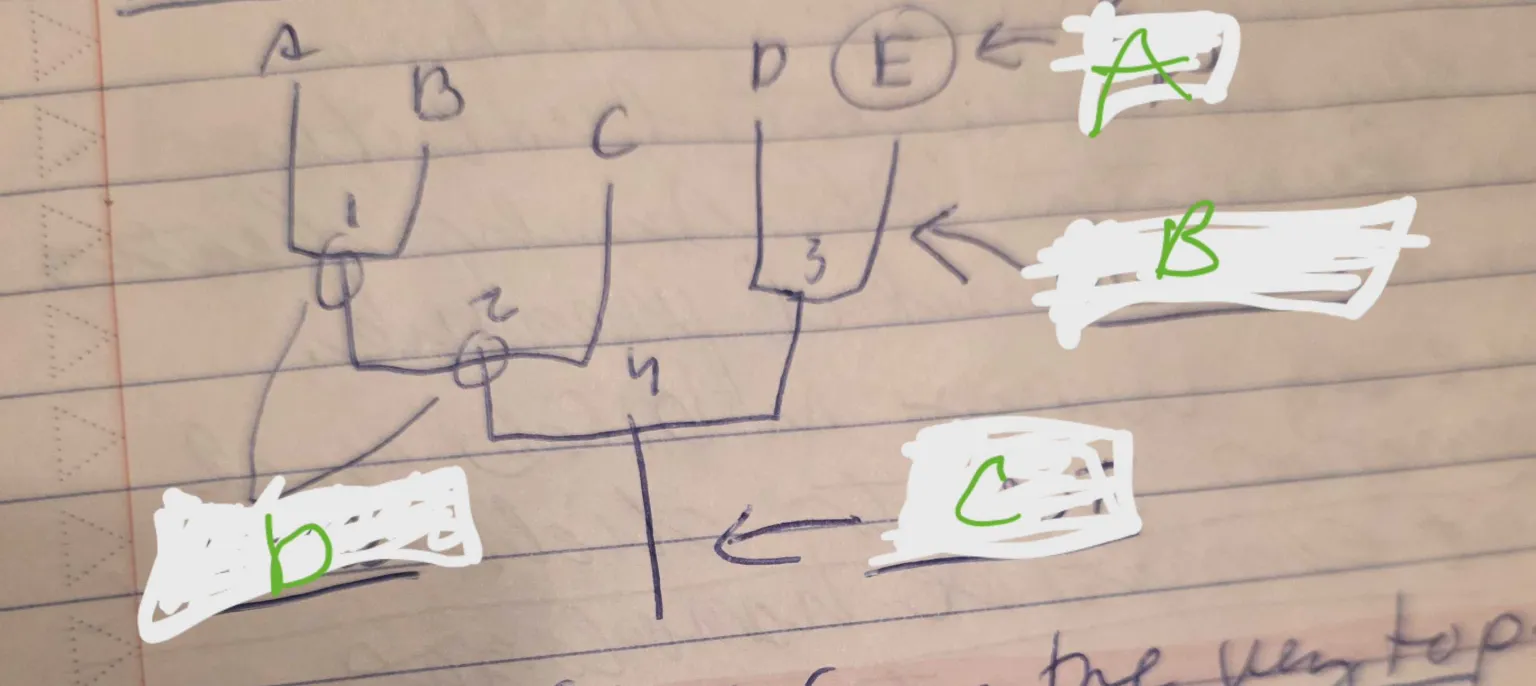
What is the sister group of the nonelectronically drawn group C here
A and B TOGETHER
can the tips be swapped on a branch? will this cause issues?
yes they can be its no big deal
What does a dashed line refer to in a phylogenetic tree
uncertain relationship

If you see this, what is this and what does it tell you
It is a polytomy. It shows uncertain relationships
What is a similarity that is due to common ancestry? What is an example?
Homology.
ex: Elytra. All beetles have elytra. this is a homologous structure.
What is a structure that is similar due to convergent evolution or parallelism? Evolution of similar features due to similar environmental pressures.
What is an example?
Homoplasy.
Ex: presence of wings in birds and insects. common ancestor did NOT have wings so it cannot be homologous
Homologous traits have _____ evolutionary event(s)
one
What are the two types of Homology? Explain both.
Apomorphy and Plesiomorphy.
Apomorphy is a unique feature used to define a group. Elytra is an example of this for beetles.
Plesiomorphy is an ancestral trait that is NOT used to define a group such as the presence of six legs or an exoskeleton.
What is the apomorphy of insects (WARNED THIS WILL VERY LIKELY BE ON THE TEST)
-Three distinct body tagmata
-hexapody
-loss of abdominal appendages
(?)
True or false: plesiomorphies can become apomorohies if you go far enough down a phylogenetic tree
true
What is the term for a taxon that is based on apomorphy? Includes ancestor of group and all of decendents? Most insect groups are this
Monophyletic
What is the term for a group that includes the ancestor and some but not all of the decendants? Naturalo but incomplete group. What is an example?
Paraphyletic group.
Ex: reptiles. doesn’t include birds.
What is a group that is based on homoplasy?
‘unnatural group’
What is an example?
Polyphyletic group.
ex: group of all marine vertebrates
What is the field of biology that studies the distribution of organisms and why they occur where they occur?
Biogeography
Explain how drosophila were used in a biogeographical study as a model organism.
Drosophila were used to study speciation rates and evolutionaryhistory of islands in the Hawai’ian archipelago.
Drosophila lineages were found to be older than the lineages themselves. Likely due to the existance of other islands that are now submerged.
List the anthropogenic effects on insect distribution
1)Human loving insects that feed off of trash
2)Disturbed habitats caused by humans (giure ants more likely to be found in disturbed habitats than undisturbed
3)Insects as external parasites (fleas, lice, and mosquitos)
4)Agricultural byproducts (crops guarenteed food for insects)
5) Anthropogenic introductions (Humans accidnetly bring insects around when we move place to place