Protein structure Facilitates Enzyme Mechanism
 Call Kai
 Learn
 Practice Test
 Spaced Repetition
 Match
 Flashcards
 Knowt Play
1/14

There's no tags or description
Looks like no tags are added yet.
15 Terms
What is Chymotrypsin?
A serine protease that cleaves peptide bonds. Made in the pancreas and activates in the small intestine
What is a scissile bond
It is the peptide bond between the carbonyl carbon (C1) and amino group (NH) in the peptide backbone

What secondary structure are the two domains in the active site of Chymotrypsin?
Three chains form two domains with a Beta barrel in each
Which residues does chymotrypsin prefer to cut after?
Phe (F), Tyr (Y), Trp (W).
What are the four parts of the chymotrypsin active site
Catalytic triad
Oxyanion hole
Specificity pocket
Substrate-biding pocket
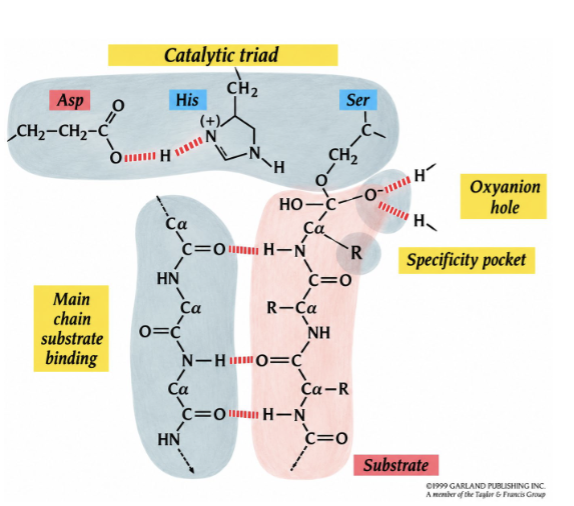
Catalytic triad residues
D-H-S
Seri195 (Nu:) - attacks C1, forming a covalent bond and a tetrahedral intermediate
His57 (base then acid) - takes a proton from Ser making Ser a strong Nu: & gives proton to leaving peptide. Takes proton from water during deacylation
Asp102 - negatatively charged & stabilizes (+) His 58
Role of oxyanion
Backbone NH groups form H-bonds with the negatively charged oxygen of tetrahedral intermediate
Role of specificity pocket
Hydrophobic pocket that recognizes the side chain right before the scissile bond. Recognizes F Y W
Role of substrate binding pocket
H-bonds to the peptide backbone, forming a short antiparallel beta sheet; helps position substrate but does not determine sequence specificity
What is the overall chymotrypsin mechanism pattern?
Attack→tetrahedral intermediate→collapse and happens twice
First and Second Nu: in chymotrypsin
First: Ser195 alkoxide, activated by His57 first
Second: Hydroixde from water
What happens in step 1/acylation
Ser195 attacks C1 and C1 forms tetrahedral intermediate
Intermediate is unstable →collapses → breaks scissile bond
His donates the proton, it got from Ser195, to N bonded to C1 to complete NH2 & C terminal peptide leaves while Ser185 is covalently bonded to the C1
What happens in step 2/ deacylation?
water gets activated by His, H2O→OH
OH attacks C1 which is still attached to Ser, forming tetrahedral intermediate
Intermediate collapses, breaking C1-Ser bond. His donates H to Ser. N terminal peptide can leave
Trypsin Specificity
Positively charged: Arg (R), Lys (K)
Elastase Specificity
Small hydrophobic: Ala (A), Val (V), Gly (G)