Ch 6: Carbohydrates: Mono and Disaccharides, Glycolysis, Gluconeogenesis, and the Fates of Pyruvate
 Call Kai
 Learn
 Practice Test
 Spaced Repetition
 Match
 Flashcards
 Knowt Play
1/71

There's no tags or description
Looks like no tags are added yet.
72 Terms
What are polysaccharides?
Polysaccharides are large carbohydrates made up of many monosaccharides (simple sugars) connected by glycosidic bonds. Their major functions include:
Energy storage: Storing glucose for later use.
Structural support: Providing strength and structure to cells and organisms.
Different organisms use different polysaccharides.
(Glucose is a simple sugar (monosaccharide) and the primary energy source for your body's cells. It is often referred to as "blood sugar" because it circulates in the bloodstream to deliver fuel to your organs, muscles, and brain).

Glycogen: Glucose storage in animals
Glycogen is the storage form of glucose in humans and other animals. It is a polymer made entirely of glucose molecules.
Structure of glycogen
Glycogen contains two types of glycosidic linkages:
Alpha-1,4 linkages: Connect glucose molecules in the main chains.
Alpha-1,6 linkages: Create branches off the main chains.
Important characteristics:
Glycogen can contain tens of thousands of glucose molecules.
The main chains are connected through alpha-1,4 linkages.
Branches occur through alpha-1,6 linkages.
Branches occur approximately every 6–12 glucose residues.
Glycogen has a protein called glycogenin at its center.
Reducing ends vs. non-reducing ends
This is an important concept for understanding how glycogen releases glucose.
Reducing end:
The end of a sugar chain that has a free anomeric carbon.
Can open from its ring form into its straight-chain form.
Non-reducing end:
- The end that cannot open into the straight-chain form because its anomeric carbon is involved in a glycosidic bond.
In glycogen:
There is one reducing end associated with the glycogenin core.
There are many non-reducing ends at the ends of the branches.
Why does glycogen have so many branches?
The enzymes responsible for removing glucose from glycogen work at the non-reducing ends.
Because glycogen has many non-reducing ends:
Multiple enzymes can work simultaneously.
Glucose can be removed from several branches at once.
Stored glucose can be released rapidly when the body needs energy.
Main takeaway: More branches = more non-reducing ends = faster glucose mobilization.

What is glycogenin?
Glycogenin is a protein located at the center of a glycogen molecule.
It acts as the starting point for glycogen formation.
Glucose chains begin attaching to glycogenin.
There are two locations on glycogenin where glucose chains can begin.
Remember: Glycogenin is the protein core, not a glucose molecule.

Amylopectin: Glucose storage in plants
Amylopectin is the plant equivalent of glycogen in terms of glucose storage.
Similarities to glycogen:
Both are made of glucose.
Both have alpha-1,4 linkages in their main chains.
Both have alpha-1,6 linkages at branch points.
Both release glucose from non-reducing ends.
(Differences: see image)

Amylose: Straight-chain glucose storage in plants
Amylose is another glucose-storage molecule found in plants. Characteristics:
Made entirely of glucose.
Contains alpha-1,4 glycosidic linkages.
Does not have branches.
Forms a relatively straight chain.
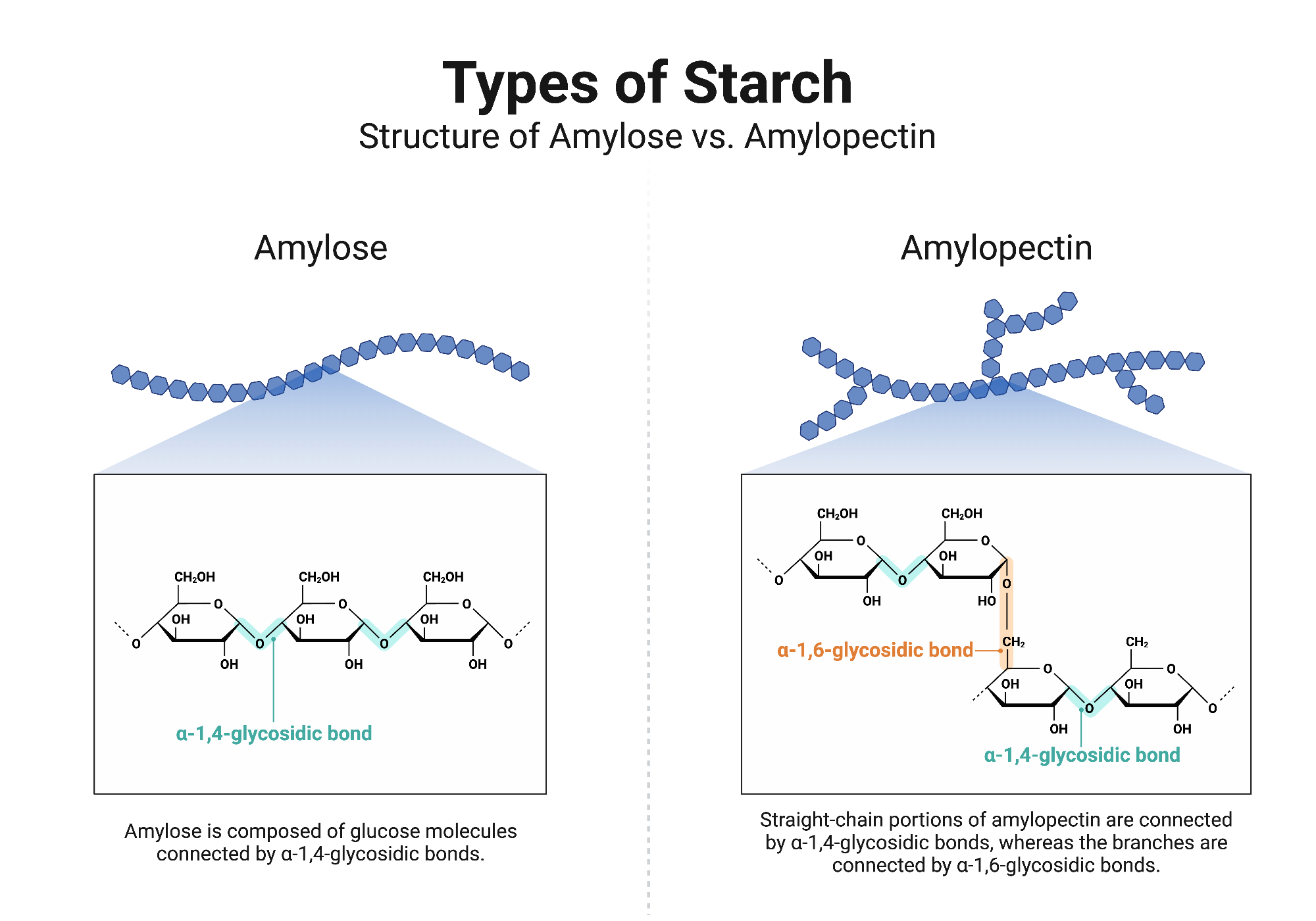
What is starch?
Starch is the plant storage carbohydrate consisting of:
Amylose (unbranched).
Amylopectin (branched).
Remember: Plants store glucose as starch, while animals store glucose as glycogen.

Cellulose: Structural carbohydrate in plants
Cellulose is another glucose polymer, but it has a different type of linkage.
Characteristics:
Found in plant cell walls.
Made of glucose molecules.
Contains beta-1,4 glycosidic linkages.
Provides structural strength and support.
Why can't humans digest cellulose?
Humans do not have the enzymes needed to hydrolyze beta-1,4 glycosidic linkages in cellulose.
Therefore:
We cannot digest cellulose.
It passes through our digestive system as dietary fiber.
Some other organisms can digest cellulose because they possess the necessary enzymes, often with the help of microorganisms.
Exam tip: The difference between starch and cellulose is not the glucose itself, but the type of glycosidic linkage.
Starch: Alpha-1,4 linkages.
Cellulose: Beta-1,4 linkages.

Other glucose-related polymers: Chitin & Alginate
Chitin is a structural polysaccharide found in:
Shells and exoskeletons of animals such as insects and crustaceans.
Fungal cell walls.
Characteristics:
Made of modified glucose molecules called N-acetylglucosamine.
Contains beta-1,4 linkages.
Humans cannot digest it effectively because we lack the necessary enzymes.
Alginate is a polysaccharide found in brown seaweed and algae.
Contains modified sugar components.
Its chains can cross-link with one another.
These cross-links help form structural networks.
Comparison of major polysaccharides
(See image) Memorize these distinctions.

What are metabolic pathways?
A metabolic pathway is a series of chemical reactions that convert an initial molecule into a final product. Each reaction is catalyzed by a specific enzyme. For example: (see image). Each step depends on an enzyme to make the reaction happen.
Three types of metabolic pathways
1. Linear pathways
Start with one molecule.
Progress through a series of reactions.
End with a final product.
Example: Glycolysis.
2. Branched pathways
A molecule in one pathway can be used in another pathway.
One intermediate can lead to multiple products.
3. Cyclic pathways
The pathway eventually regenerates an earlier molecule.
The reactions form a cycle.
Example: Citric acid cycle (Krebs cycle).

Metabolic pathway
Series of chemical reactions
Intermediate
Molecule formed during a pathway
Metabolite
Molecule involved in metabolism
Intermediary metabolism
Metabolic reactions involving intermediates
Enzyme
Protein that catalyzes a reaction
Catabolism
Metabolism consists of two major processes: catabolism and anabolism.
Catabolism breaks down large molecules into smaller molecules.
Examples:
Breaking glucose down during glycolysis.
Breaking down fatty acids.
Breaking down nutrients to extract energy.
Characteristics:
Breaks molecules apart.
Usually releases energy.
Typically involves oxidation.
Often produces ATP or reduced electron carriers such as NADH.
Anabolism
Anabolism builds larger molecules from smaller molecules.
Examples:
Making proteins from amino acids.
Making fatty acids.
Making larger carbohydrates.
Characteristics:
Builds molecules.
Requires energy.
Typically involves reduction.
Often uses ATP and NADPH.
Catabolism vs. Anabolism
(see image). Remember:
Catabolism = Breakdown.
Anabolism = Building.
Metabolism = Both processes combined.

Oxidation and Reduction
What is oxidation? Oxidation means loss of electrons.
What is reduction? Reduction means gain of electrons.
A useful memory trick:
OIL = Oxidation Is Loss.
RIG = Reduction Is Gain.
Oxidation and reduction always occur together in a redox reaction. If one molecule loses electrons, another molecule must gain those electrons.
Oxidation states of Carbon
You should recognize how oxidized or reduced a carbon atom is by looking at its functional group. Carbon can exist in several different oxidation states. The general order from most reduced to most oxidized is (see image).
Example: Alcohol → Aldehyde
If an alcohol becomes an aldehyde, the carbon has become more oxidized.
Therefore:
The alcohol loses electrons.
Another molecule must gain those electrons.
The other molecule becomes reduced.
Why is this important? In catabolic pathways, carbon atoms generally become progressively more oxidized. This allows cells to extract energy from molecules. In anabolic pathways, carbon atoms generally become more reduced as larger molecules are built.
To determine which functional group is more oxidized, look at the bonds connected to the central carbon atom:
• More Oxidized: More bonds to oxygen (or other electronegative atoms like nitrogen or halogens) and fewer bonds to hydrogen. A double bond to oxygen (like C=O) counts as two bonds to oxygen.
• More Reduced: More bonds to hydrogen and fewer bonds to oxygen or electronegative atoms

Regulation of Metabolic Pathways
Metabolic pathways must be regulated so that cells do not waste energy or produce unnecessary products. Remember: Each step of a pathway is controlled by an enzyme. Therefore, regulating enzymes also regulates metabolic pathways.
Ways enzymes can be regulated
Allosteric regulation: A molecule binds somewhere other than the active site and changes enzyme activity.
Post-translational modification: The enzyme is chemically modified after it is produced, such as through phosphorylation.
Gene regulation: The cell turns a gene on or off, controlling how much enzyme is produced.
Not every enzyme uses every regulatory mechanism. Main idea: Regulating enzyme activity controls the speed and direction of metabolic pathways.
What is glycolysis?
Glycolysis is a metabolic pathway that breaks down one glucose molecule into two pyruvate molecules. It consists of 10 enzyme-catalyzed reactions.
Important characteristics
Occurs in the cytosol.
Occurs in nearly all living organisms.
Does not require oxygen.
Contains 10 reactions.
Breaks one 6-carbon glucose into two 3-carbon pyruvate molecules.
Produces ATP and NADH.
Why is glycolysis considered an ancient pathway?
Glycolysis occurs in nearly all organisms, including bacteria, plants, and animals.
Oxygen is not required for any of its reactions.
Early life evolved before oxygen became abundant in Earth's atmosphere. Therefore, glycolysis is thought to have developed very early in evolution as a way to produce ATP without oxygen.

What happens to glucose after glycolysis?
The final product of glycolysis is pyruvate. Pyruvate can be used in different metabolic pathways. Major pathways:
Gluconeogenesis
Acetyl-CoA production

1. Gluconeogenesis
The pathway that produces glucose.
Uses pyruvate and other precursors to make glucose.
Some reactions are the reverse of glycolysis.
Other reactions require different enzymes.

2. Acetyl-CoA production
Pyruvate can be converted into acetyl-CoA. Acetyl-CoA is extremely important because it can be used for:
ATP production through further oxidation.
Fatty acid synthesis.
Cholesterol synthesis.
Other lipid synthesis pathways.
Why is acetyl-CoA important?
Acetyl-CoA contains two carbon atoms. These carbons can be used to build larger molecules.
For example:
Fatty acids are built by adding two-carbon units.
Fatty acids can be stored in triglycerides (triacylglycerols).
Fatty acids are components of membrane phospholipids.
Acetyl-CoA also supplies the carbon atoms used in cholesterol synthesis.
Important connection: Glycolysis does not just produce energy. It also provides molecules that can be used to build other important biological molecules.
The 10 Reactions of Glycolysis
Your professor made it very clear that simply memorizing the structures is not enough. For every reaction, you should understand:
The starting molecule (substrate/reactant).
The final molecule (product).
The enzyme.
What chemical change occurs.
Why the reaction happens.
Whether ATP is used or produced.
Whether NADH is produced.
How the enzyme is regulated, when relevant.

Phase 1: Energy investment phase (Steps 1–5)
The first five steps prepare glucose for breakdown. During this phase, the cell uses 2 ATP molecules.
Step 1: Glucose → Glucose-6-phosphate
Enzyme: Hexokinase
Uses 1 ATP
Reaction: Glucose + ATP —> G6P + ADP
What happens?
A phosphate group is transferred from ATP to glucose.
The phosphate attaches to carbon 6.
The product is glucose-6-phosphate (G6P).
What type of enzyme?- Kinase.
A kinase transfers phosphate groups.
Why does this reaction happen?
The phosphate group gives glucose-6-phosphate a negative charge.
This prevents it from easily leaving the cell through glucose transporters.
Main purpose: Traps glucose inside the cell.

Hexokinase vs. Glucokinase
Both enzymes can phosphorylate glucose. (see image)

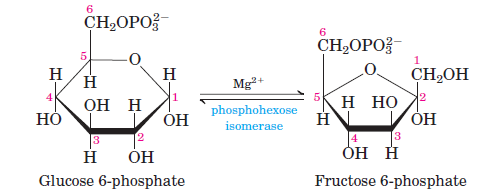
Step 2: Glucose-6-phosphate → Fructose-6-phosphate
Enzyme: Phosphoglucose isomerase
Reaction: Glucose-6-phosphate→Fructose-6-phosphate
What happens?
The molecule is rearranged.
Glucose changes from an aldose to a ketose.
The six-membered ring becomes a five-membered ring in the representation shown in lecture.
Why does this happen?
This rearrangement prepares the molecule for the next phosphorylation reaction. The next step requires a suitable hydroxyl group at carbon 1.
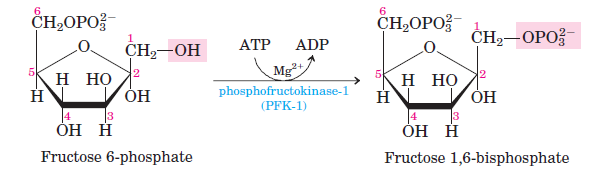
Step 3: Fructose-6-phosphate → Fructose-1,6-bisphosphate
Enzyme: Phosphofructokinase-1 (PFK-1)
Uses 1 ATP
Reaction: F6P+ATP→F1,6BP+ADP
What happens?
Another phosphate is added.
It attaches to carbon 1.
The product is fructose-1,6-bisphosphate.
Important: The committed step
This is called the committed step of glycolysis. Why?
Before this reaction:
- Glucose-6-phosphate and fructose-6-phosphate can enter other metabolic pathways.
After this reaction:
- The molecule is committed to continuing through glycolysis toward pyruvate.
This is also one of the major regulated steps of glycolysis. Remember: PFK-1 is a major regulatory enzyme.
What does bisphosphate mean?
Bis means two phosphate groups attached at separate locations on a molecule.
Di typically describes two groups connected together, as in ADP.
Tri describes three connected phosphate groups, as in ATP.
In fructose-1,6-bisphosphate, the two phosphates are attached at carbons 1 and 6.
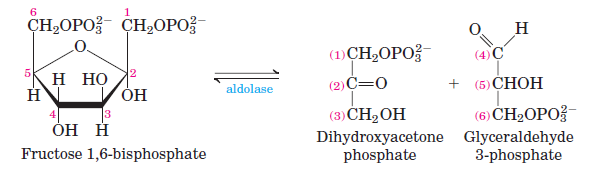
Step 4: Fructose-1,6-bisphosphate → G3P + DHAP
Enzyme: Aldolase
Uses 0 ATP.
Reaction: Fructose-1,6-bisphosphate ⇌ Glyceraldehyde-3-phosphate + Dihydroxyacetone phosphate
What happens?
The six-carbon sugar is split into two three-carbon molecules.
The carbon-carbon bond between carbons 3 and 4 is broken.
Two products are formed:
Glyceraldehyde-3-phosphate (G3P).
Dihydroxyacetone phosphate (DHAP).
Important: Tracking the carbons: The original glucose contains six carbons.
After splitting:
Glyceraldehyde-3-phosphate (G3P)
- Contains the original carbons 1, 2, and 3.
Dihydroxyacetone phosphate (DHAP)
- Contains the original carbons 4, 5, and 6.
Why does this reaction happen?
The purpose is to split the original six-carbon glucose into two three-carbon molecules. Both three-carbon portions can eventually be used to produce energy.
Step 5: DHAP → Glyceraldehyde-3-phosphate
Enzyme: Triose phosphate isomerase
Uses 0 ATP.
Reaction: DHAP ⇌ Glyceraldehyde-3-phosphate
What happens?
DHAP is converted into G3P.
Both molecules are three-carbon sugars.
They are isomers of each other.
Why does this reaction happen?
Only G3P continues directly through the remaining reactions of glycolysis. If DHAP were not converted, half of the original glucose would be wasted. This reaction allows all six carbons from glucose to continue through glycolysis. Important: Why do we now have a 2 next to G3P?
After step 5:
There are 2 G3P molecules for every 1 glucose molecule.
All remaining reactions happen twice per original glucose.
Remember: From this point forward, you must account for two three-carbon molecules.

Step 6: G3P → 1,3-bisphosphoglycerate
Enzyme: Glyceraldehyde-3-phosphate dehydrogenase (GAPDH)
Uses 0 ATP.
Reaction: G3P + Pi + NAD⁺ ⇌ 1,3-bisphosphoglycerate + NADH + H⁺
What happens?
Two important things occur:
1. An inorganic phosphate is added.
Pi stands for inorganic phosphate.
The phosphate does NOT come from ATP.
It comes from the surrounding cellular environment.
2. G3P is oxidized.
The aldehyde carbon becomes a carboxylate carbon.
The carbon loses electrons.
NAD⁺ accepts those electrons and becomes NADH.
Why does this reaction happen?
This reaction captures energy from the oxidation of G3P. That energy is stored in:
NADH.
The high-energy phosphate-containing product 1,3-bisphosphoglycerate.
NADH will later help with energy production. Important: NAD⁺ vs. NADH
NAD⁺ = Oxidized form.
NADH = Reduced form.
Remember: When something gets oxidized, something else must get reduced.

Step 7: 1,3-bisphosphoglycerate → 3-phosphoglycerate
Enzyme: Phosphoglycerate kinase
Produces 1 ATP per molecule.
Reaction: 1,3-bisphosphoglycerate + ADP ⇌ 3-phosphoglycerate + ATP
What happens?
A phosphate is transferred from 1,3-bisphosphoglycerate to ADP.
ADP becomes ATP.
The remaining molecule becomes 3-phosphoglycerate.
Why does this reaction happen?
This reaction produces ATP. The phosphate added during step 6 is transferred to ADP to make ATP. Important: ATP calculation
Remember that there are two 1,3-bisphosphoglycerate molecules per glucose.
Therefore:
1 ATP is produced from each molecule.
2 ATP are produced per glucose.
At this point:
2 ATP were used in steps 1 and 3.
2 ATP were produced in step 7.
We have broken even.

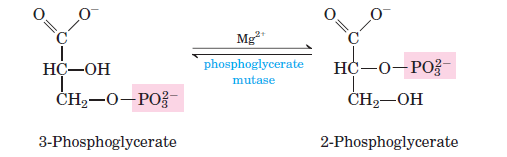
Step 8: 3-phosphoglycerate → 2-phosphoglycerate
Enzyme: Phosphoglycerate mutase
Uses 0 ATP.
Reaction: 3-phosphoglycerate ⇌ 2-phosphoglycerate
What happens?
The phosphate group moves from carbon 3 to carbon 2.
The molecule is rearranged.
No ATP is used or produced.
Why does this reaction happen?
The phosphate is moved to prepare the molecule for the next reaction. Remember: A mutase moves a functional group from one position to another within the same molecule.
Step 9: 2-phosphoglycerate → Phosphoenolpyruvate (PEP)
Enzyme: Enolase
Uses 0 ATP.
Reaction: 2-phosphoglycerate ⇌ Phosphoenolpyruvate + H₂O
What happens?
Water is removed from 2-phosphoglycerate.
An OH and an H are removed.
A double bond forms between two carbon atoms.
The product is phosphoenolpyruvate (PEP).
Why does this reaction happen?
It creates PEP, a molecule with high phosphoryl-transfer potential. This prepares the molecule for ATP production in the next step. Remember from organic chemistry: Removing water from a molecule can create a double bond. This is called a dehydration reaction.

Step 10: PEP → Pyruvate
Enzyme: Pyruvate kinase
Produces 1 ATP per molecule.
Reaction: PEP + ADP + H⁺ → Pyruvate + ATP
What happens?
PEP transfers its phosphate group to ADP.
ADP becomes ATP.
The final product is pyruvate.
Why does this reaction happen?
This is the second ATP-producing reaction in glycolysis. Because there are two PEP molecules per glucose:
1 ATP is produced from each PEP.
2 ATP are produced per glucose.
Important: Why is it called a kinase?
Your professor discussed why this enzyme is called a kinase rather than a phosphatase. If you look at the reverse reaction:
ATP transfers a phosphate to pyruvate.
This is a kinase-type reaction.
The enzyme is named based on the type of reaction it catalyzes, not simply whether a phosphate leaves the molecule in the direction shown.

How much ATP does glycolysis produce?
ATP investment
Step 1: Hexokinase
- Uses 1 ATP.
Step 3: Phosphofructokinase-1
- Uses 1 ATP.
Total ATP used = 2 ATP.
ATP production
Step 7: Phosphoglycerate kinase
- Produces 2 ATP per glucose.
Step 10: Pyruvate kinase
- Produces 2 ATP per glucose.
Total ATP produced = 4 ATP.
Net ATP production
Gross ATP production = 4 ATP.
ATP used = 2 ATP.
Net ATP production = 2 ATP.
Final products per 1 glucose
2 pyruvate.
4 ATP produced (gross).
2 ATP used.
2 ATP net.
2 NADH.
Remember: Net ATP is the amount left over after subtracting the ATP used.
Where does glycolysis occur?
Glycolysis occurs in the cytosol.
This applies to:
Human cells.
Animal cells.
Plant cells.
Bacterial cells.
The enzymes involved are soluble cytosolic proteins. They are individual proteins rather than one large enzyme complex.
What should you know about enzyme mechanisms?
Your professor said you do NOT need to memorize every detailed enzyme mechanism. However, you should recognize how important amino acid residues behave during catalysis. You should be able to identify three types of catalysis:
General acid catalysis
General base catalysis
Covalent catalysis
1. General acid catalysis
An amino acid donates a proton (H⁺).
It acts as an acid.
2. General base catalysis
An amino acid accepts a proton (H⁺).
It acts as a base.
3. Covalent catalysis
An amino acid forms a temporary covalent bond with the substrate.
This helps the reaction occur.
Amino acids involved in catalysis
Aspartate: Can donate or accept protons.
Glutamate: Can donate or accept protons.
Lysine: Can participate in acid-base catalysis.
Cysteine:
Contains an –SH (thiol) group.
Can participate in enzyme catalysis.
Understanding NAD⁺ and NADH
NAD stands for nicotinamide adenine dinucleotide.
It contains two nucleotide components:
A nicotinamide-containing nucleotide.
An adenine-containing nucleotide.
NAD⁺ vs. NADH
NAD⁺
Oxidized form.
Accepts electrons.
Becomes NADH.
NADH
Reduced form.
Carries electrons.
Can donate electrons in other reactions.
How does NAD⁺ become NADH?
Another molecule gets oxidized.
NAD⁺ accepts electrons.
NAD⁺ becomes NADH.
The nicotinamide ring accepts a hydride ion (H⁻).
Important hydrogen terminology
H⁺:
A proton.
Has no electrons.
H:
A hydrogen atom.
Has one electron.
H⁻:
A hydride ion.
Has two electrons.
Why does NAD contain an entire adenine nucleotide?
Your professor compared NAD to a tool with a handle. The nicotinamide ring is the part that directly participates in the redox reaction. The rest of the molecule helps the enzyme:
Bind NAD.
Hold onto it.
Position the nicotinamide ring correctly in the active site.
This is why many enzymes have nucleotide-binding sites.

Understanding ΔG
ΔG°: Standard free energy change
Standard conditions generally assume:
Reactant and product concentrations of 1 M.
Temperature of 25°C.
Hydrogen ion concentration of 1 M (pH 0).
ΔG°′: Biochemical standard free energy change
The main difference:
Hydrogen ion concentration is assumed to be 10−710−7 M.
This corresponds to pH 7.
ΔG: Actual free energy change
Takes into account the actual concentrations of reactants and products inside the cell.
Helps determine which direction a reaction will proceed.
The equation: ΔG=ΔG∘′+RTlnQ
Where:
ΔG = Actual free energy change.
ΔG°′ = Standard biochemical free energy change.
R = Gas constant.
T = Temperature in Kelvin.
Q = Reaction quotient, which depends on reactant and product concentrations.
Remember: Cellular concentrations can change the direction and favorability of a reaction.
Reversible reactions
Have an actual ΔG close to zero.
Can proceed in either direction.
Their direction depends on the concentrations of reactants and products.
This follows Le Chatelier's principle. For example:
More reactants → Reaction tends toward products.
More products → Reaction tends toward reactants.
Essentially irreversible reactions
Have a large negative ΔG in the direction written.
Strongly favor the forward reaction.
Do not easily reverse under normal cellular conditions.
Why does this matter?
The cell uses essentially irreversible reactions as important control points in metabolic pathways. These reactions need regulation because otherwise they would continue moving forward even when the cell does not need their products.
The three major regulated steps of glycolysis
Step 1: Hexokinase
Enzyme: Hexokinase
Reaction: Glucose → Glucose-6-phosphate
Uses ATP.
Traps glucose inside the cell.
Major regulated step.
Step 3: Phosphofructokinase-1
Enzyme: PFK-1
Reaction: Fructose-6-phosphate → Fructose-1,6-bisphosphate
Uses ATP.
Committed step of glycolysis.
Major regulatory enzyme.
Step 10: Pyruvate kinase
Enzyme: Pyruvate kinase
Reaction: PEP → Pyruvate
Produces ATP.
Final reaction of glycolysis.
Major regulated step.
Why are these three reactions regulated?
They have large negative ΔG values under normal cellular conditions. This means they strongly favor moving forward. The cell must regulate these enzymes so glycolysis can slow down or stop when appropriate.
How are they regulated?
Examples include:
Allosteric regulation.
Phosphorylation.
Dephosphorylation.
Other changes in enzyme activity.
Remember: Not every enzyme uses every regulatory mechanism.
Glycolysis exam checklist
For every reaction, make sure you know:
Starting substrate (reactant).
Product.
Enzyme name.
Chemical change that occurs.
Why the reaction happens.
Whether ATP is used or produced.
Whether NADH is produced.
Whether oxidation or reduction occurs.
Whether the reaction is regulated.
Whether the reaction is reversible.
Glycogen
Animal glucose storage
Amylopectin
Branched plant glucose storage
Amylose
Unbranched plant glucose storage
Starch
Amylose + amylopectin
Cellulose
β-1,4 glucose polymer; dietary fiber
Glycogen branching
Every 6–12 glucose residues
Amylopectin branching
Every 20–30 glucose residues
Catabolism
Breakdown; usually oxidation
Anabolism
Building; usually reduction
Glycolysis
10 reactions
Glycolysis location
Cytosol
Starting molecule
Glucose
Final product
2 pyruvate
ATP investment
2 ATP
Gross ATP production
4 ATP
Net ATP production
2 ATP
NADH production
2 NADH
Committed step
Step 3, PFK-1
Regulated steps
1, 3, and 10
Oxygen requirement?
Not Required
For every glycolysis reaction, practice answering these five questions:
What molecule am I starting with?
What molecule am I producing?
Which enzyme catalyzes the reaction?
What chemical change is happening, and why?
Does the reaction use or produce ATP, NADH, or another important molecule?