instrumentation exam 1
 Call Kai
 Learn
Learn Practice Test
 Spaced Repetition
 Match
Match Flashcards
 Knowt Play
1/125

There's no tags or description
Looks like no tags are added yet.
Name | Mastery | Learn | Test | Matching | Spaced | Call with Kai | Chat |
|---|
No analytics yet
Send a link to your students to track their progress
126 Terms
transducer
a device that translates energy from one form to another (ex: light bulb, motor)
biotransducer
a device that converts energy from a physiological process into a voltage (or current) with an amplitude proportional to the input energy
biotransducers establish the _____ or ______ of a particular system
risk or invasivness
encoding
process of representing information in the form of a signal(s) (ex: human speech vs morse code)
continuous signal
signal encoded via amplitude (intensity)
discrete signal
signal transmitted as pulses at specific intervals, encoded via pulse length
(stair steps)
analog
continuous signal that is encoded linearly
ex: temp=2*voltage amplitude
digital
analog signals represented by a series of discrete samples
analog signals must be _______ in both time and amplitude to digitize
sliced
time slicing
discretization
amplitude slicing
quantization
quantization
the process of changing a continuous set of values to a discrete set, usually refers to binning signal magnitude
discretization
the process to transform a continuous time signal to discrete time process
nyquist frequency
=2*highest frequency of signal
maximum signal
=2n-1
resolution of the ADC / system voltage =
ADC reading / analog voltage measured
two major types of systems concerning bioinstruments
linear vs nonlinear
linear systems
feature a proportional relationship between input and output y=f(x)
nonlinear systems
do not hold to a proportional relationship
electric charge (Q)
physical property of matter, positive or negative, units coulombs [C]
Current (I)
flow of charge, measured through an element with respect to time, units of Amperes [A]
Voltage (V)
potential energy per charge, measured across an element, units volts [V]
resistivity (ρ)
a material dependent constant
R=
ρ*l/A
resistors in parallel
R1*R2/R1+R2
resistors in series
R1+R2
kirchoffs voltage law
sum of voltages around a loop is equal to 0
kitchoffs current law
sum of currents at any node is equal to 0
resistive sensors
use the fact that an element can have a resistance change due to an external stimulus

wheatstone bridge circuit
two voltage dividers in parallel, used to measure resistances of unknowns
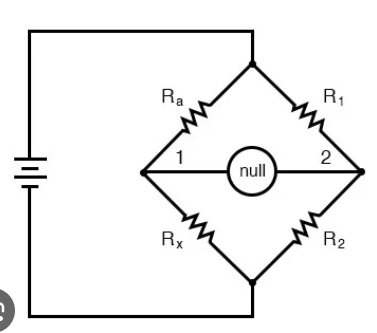
a wheatstone bridge circuit is balanced when
Ra/Rx=R1/R2
strain gauge
resistor based sensor, resistance changes with strain, use a bridge circuit to measure resistance
measuring temperature
thermocouple, thermistor
voltage division formula
V0=Vin *(R2/R1+R2)

wheatstone bridge circuit formula
V1,2=Vin(Rx/Rv+Rx - R2/R1+R2)
linear system
feature a proportional relationship between input and output
nonlinear system
do not hold a proportional relationship
capacitor
stores energy
-CV=Q → I=C(dV/dT)
capacitors are useful in
local energy storage, voltage spike supression, signal filtering, resist sudden changes in voltage
parallel plate capacitors are composed of
conductive plates, insulating dielectric, nonconductive material

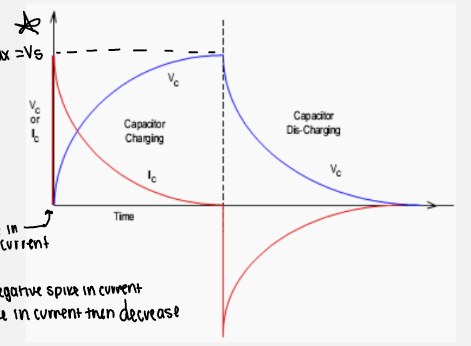
charging capacitor

fully charged capacitor

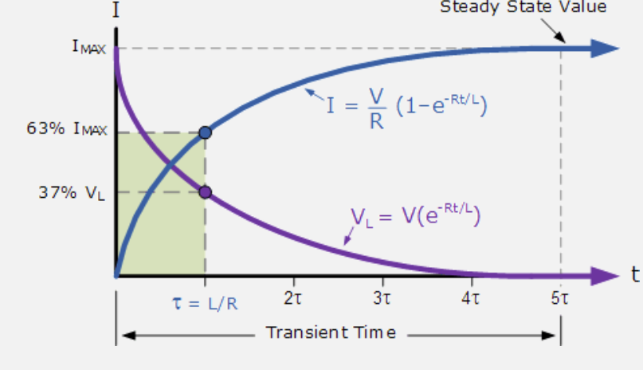
inductor
results from magnetic fields around the conductor
-V=L(dI/dT)
inductors are used for
control spikes in current, create oscillators, proximity sensing applications
analog circuit relationships
Z=R+jX where Z is total impedence, R is resistance, X is capacitance/ inductance
network reduction is a process of ________ the number of elements in a complex circuit to simplify its analysis
reducing
-90 degree
fully charged reactance
+90 degrees
fully inductance
inductor XL=
jωL
capacitor Xc=
1/jωC
resistor and inductor in series ZL=
RL+jωL
resistor and capacitor in series Zc=
Rc-j/ωC
voltage current method
applies a known voltage across two nodes of interest and measures the current
Zeq= Vknown/Imeasured
used when circuit is unknown
RC circuit
1st order linear differential equation with constant coefficient
t=0 capacitors
capacitor acts as a short circuit, current flowing but enough time has not passed
t→ ∞ capacitor
acts as an open circuit, charge is now saturated, so current effectively becomes 0
discharging
decreasing voltage, negative spike in current
charging
increasing voltage, spike in current then decreases
t=0 inductors
acts as an open circuit, no current flowing
t→∞ inductor
acts as a short circuit, current flows freely through the element because field is maximized
RLC circuit
a 2nd order differential equation with constant coefficient
laplace transform
in cases where signals change suddenly
examples of when to use laplace transforms
stepwise, transient
sinusoidal signals
offer unique properties for many useful signal analysis
many complex signals can be broken down into…
sinusoids or a series of sinusoids (fourier), signals must be periodic
sinusoids have energy at…
only one frequency (pure tones)
a sinusoidal input into a linear system will…
yield a similar sinusoidal output (same frequency and shape, different magnitude and phase)
given that two sinusoids are harmonically related…
they are orthogonal to each other, this means that they can be independently decomposed without interference
when can fourier analysis be used
in cases where signal is not changing in stepwise (transient) fashion
Fourier transforms
used to shift from the time domain to the frequency domain

transfer functions
describes the behavior in the frequency or s- domain
H(s)=
H(jω)=Vout/Vin
low pass filter

nonlinear circuit elements _______ use superposition
cannot
diode
only lets current go one way
LED
light emitting diode
photodiode
used for measuring light
rectfier circuit

half recitifier
negative component becomes 0

full wave rectifier
negative component becomes positive

transistor
semiconductor devices used to amplify or switch electronic signals
Bipolar Junction Transistor (BJT)
composed of two diodes, sandwhich an n-type or p-type semiconductor material generating 2 n-p junctions
three terminals of BJTs
base, emitter, collector

BJTs are useful in amplifiers due to…
controllable by small base current, low input impedence device
two types of Field-Effect Transistor (FETs)
junction FET (JFET), metal-oxide FET (MOSFET)
JFETs feature a
p-n junction
MOSFETs feature a
insulating material
three terminals of FETs
drain, source, gate
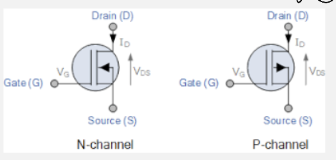
both types of FETs have
a high input impedence, control a drain-source current via an applies gate-source voltage
FETs are useful…
in amplifiers (most of market share in commercial devices) and in power switching applications
op amp
critical for amplification or active filtering, powered element, two inputs, 1 output, 2 DC power inputs
2 inputs for an op amp
inverting and noninverting
2 DC power inputs op amps
positive and negative power supply (ceiling and floor)
basic op amp
amplifies difference in inputs

OP Amp saturation

comparator
use the fact that omp amps saturate very easily
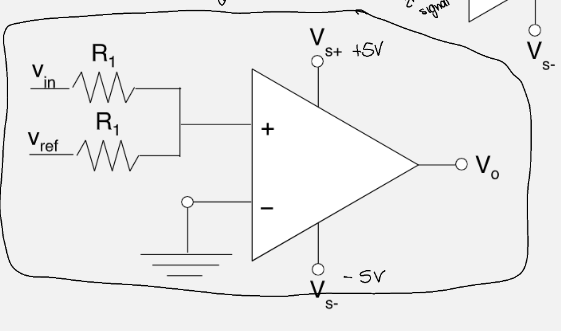
ideal op amp
infinite gain and no offset voltage, infinite input impedence, zero output impedence, no noise, infinite bandwidth, no change with temperature

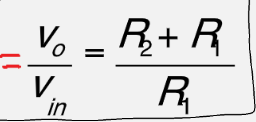
noninverting amplifier

gain= (noninverting)
why use op amps
two inputs are isolated from each other